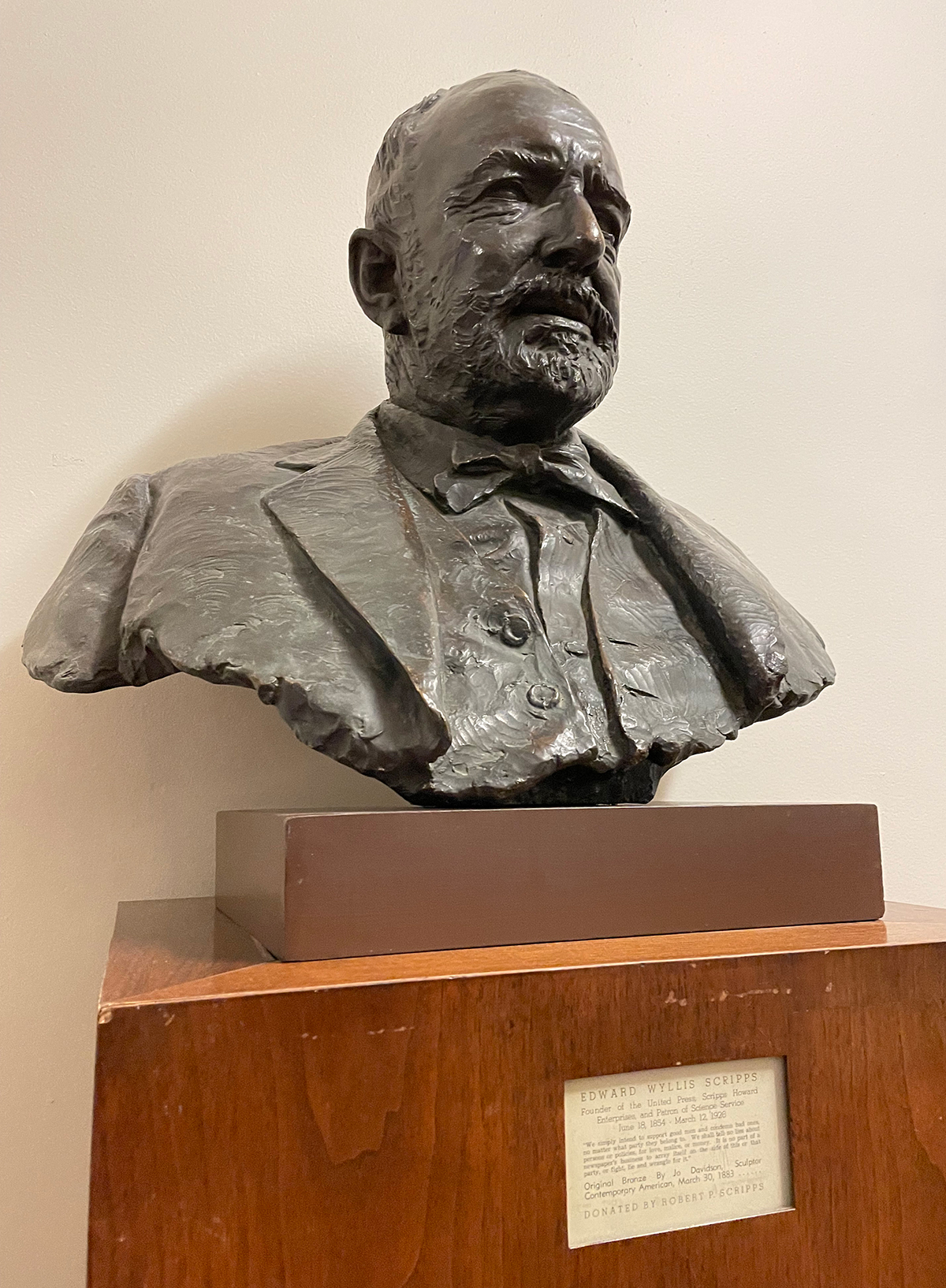
There are lessons to learn from the news ghosts of journalism’s past


As a female journalist of color with 22 years in the industry and now a professor of journalism, I believe that obliviousness to journalism’s trailblazers—both their errors and biases and their accomplishments and innovations—leaves the media professional in a state of historical amnesia.

Melita Garza, associate professor and Tom and June Netzel Sleeman Scholar in Business Journalism, wrote an op-ed piece for the Chicago Tribune Opinion titled, “There are lessons to learn from the news ghosts of journalism’s past.”

In the article—inspired by the Editors’ Hall of Fame in Gregory Hall—Garza urges today’s journalists to “revere the past, learn from mistakes, and work to build legacies of truth.”

Scripps bust

Blue tongues and an exposed brain: How ‘Beetlejuice Beetlejuice’ visual effects went back to basics


They were, to the industry, a kind of proof of concept that both aesthetically they can be successful, and also they could be marketed as an attraction, ‘Come see what the movies do now.’

Beetlejuice

Digital effects in films have existed for decades. Their true watershed moments came in 1991 with James Cameron’s Terminator 2: Judgment Day and 1993’s Steven Spielberg blockbuster Jurassic Park. Though the films had a limited number of CGI shots, the effects—a liquid morphing into a robot and dinosaurs roaming the planet—showed the industry that such technology could appeal to audiences, even though the execution was still expensive and difficult to pull off, says Illinois professor of media and cinema studies Julie Turnock.

A One-Man Telemundo on TikTok


You’re seeing some of the same trends that we see in the English-speaking community, but they’re much more pronounced in the Latino community, especially the immigrant community.

Melita M. Garza

Melita Garza, associate professor and Tom and June Netzel Sleeman Scholar in Business Journalism, was quoted in a New York Times article about Carlos Espina’s social media influence in the Latino community regarding political and immigrant issues in the United States. 

Garza said Latinos are tuning in less to legacy Spanish-language television networks like Telemundo and Univision and turning more to social media for news.

“You’re seeing some of the same trends that we see in the English-speaking community, but they’re much more pronounced in the Latino community, especially the immigrant community,” she said.

CU-Citizen Access News Outlet Gets Students Their Clips, and the Community Their News


Brant Houston

If you pick up the 2023 book Changing Models for Journalism by Brant Houston, Knight Chair Professor in Investigative and Enterprise Reporting in the Department of Journalism, you would read about the collapse of traditional media and the changes in the news landscape over the past decade, written by an award-winning journalist who has spent years researching journalism models.

You would learn about the digital age, blogging, nonprofits, investigative centers and the rise in university-led student reporting programs—which is fitting because Houston founded his own such program in 2009 at the University of Illinois Urbana-Champaign. The watchdog community reporting outlet, CU-CitizenAccess, is run entirely by him and his managing editor, Dylan Tiger, as well as a cadre of student journalists.

How the power of Minions and Gen Z propelled the ‘Despicable Me’ franchise


You note your popularity specifically when you get internalized into meme culture.

Carrie Wilson-Brown

Carrie Wilson-Brown, a lecturer of media and cinema studies and of advertising, was quoted in a Los Angeles Times article about the cross-cultural and cross-generational appeal of the Despicable Me movie franchise, and its fame beyond the film.

“You note your popularity specifically when you get internalized into meme culture,” Wilson-Brown said. “In terms of Despicable Me and the Minions specifically, all of a sudden, they kind of transcended out of the film and into internet culture.”

Dr. Mike Yao explains how AI bias reflects back human beliefs


There are biases in AI in how it works, biases in the data that we feed to the AI to train them, there are biases in the way in which AI is being used and implemented, and then there are also biases and psychological processes at the psychological level that we bring naturally when we interact with AI technology.

headshot of Mike Yao

Mike Yao, professor of digital media in the Charles H. Sandage Department of Advertising and director of the Institute of Communications Research, explained to NPR’s Community Voices how AI bias is generated by humans and reflects back what it learns from inputs humans provide it. He also discussed how AI can be helpful when designed with human needs in mind.

College of Media
119 Gregory Hall
810 S. Wright St.
Urbana, IL 61801
217-333-2350