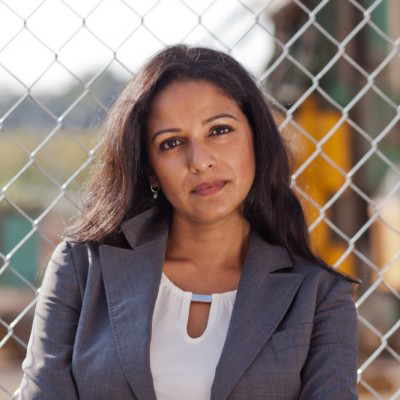
Take 5 with Media Alumni: Kavitha Cardoza


Kavitha Cardoza (MS ’02, journalism) is an assistant professor of journalism at the University of Richmond, and an award-winning reporter, recently being awarded the prestigious American Mosaic Journalism Prize for exemplifying excellence in reporting on underrepresented communities in the United States.

Kavitha Cardoza

About Kavitha Cardoza

Her work has been seen, heard, and read by millions on outlets like NPR, BBC World News, The Washington Post, The Guardian, and The Atlantic. She was also the host of Breaking Ground with Kavitha Cardoza, a documentary series on education that aired on more than 150 public radio stations.

Originally from India, Cardoza earned bachelor’s degrees in English literature, economics, and psychology, as well as a master’s degree in communication, before coming to the United States. Cardoza says her decision to get a master’s degree in journalism at the University of Illinois College of Media completely changed her life. Read more about this Media alum who has been passionately elevating stories on “the last, the least, and the littlest,” for the past 20 years.

*Q&A transcribed from Zoom interview and edited for length and clarity.

1. Most of your reporting focuses on underrepresented communities and giving voices to vulnerable populations. Why are you drawn to these stories?

When I came to the U.S., I was very surprised because you don’t see poverty the way you see it in India. Over here, sometimes we pretend it isn’t happening, or it’s not around us, when, in fact, there’s deep, deep poverty. I worked for many years for the local NPR affiliate in Washington, D.C., and my beat was education and poverty, and I would see children who didn’t have food, [living] in terrible poverty in our nation’s capital.

There’s this American [sentiment] of pulling yourself up by your bootstraps and the belief that if you haven’t gotten out of poverty, you haven’t tried hard enough. That’s just not the case. There are all kinds of systemic issues that can impact poverty and so, I really felt strongly about bringing these stories to light and showing these struggles, and how people internalize them—thinking it’s their fault or they’re not good enough—when really there are much bigger forces at play.

There are people really, really hurting, and we need to tell their stories. Journalists can elevate those voices because of the platform we have. I cannot imagine doing anything else. I cannot imagine anything else giving me more meaning. I really do wake up every morning feeling like I’m doing something that matters, and I feel so lucky.

2. You’ve covered education, health, and poverty for decades, but you’ve said a story you wrote as a College of Media student about a roadkill collector stands out. Why?

My very first story for audio was to do a profile of someone, and at that time, I was driving from Springfield to Urbana-Champaign and noticed these marks on the road that I later learned were from roadkill. As an international student, I had never heard of roadkill so when I found out, I thought, ‘Oh my gosh, wouldn’t it be cool and interesting to profile the roadkill man? Like, who does this for a job?’

I think this guy thought I was totally crazy when I first called and asked to do a ride along. He was this 6’4 African-American guy from the South and I’m this 5-foot-nothing brown girl from India—you couldn’t get further apart in terms of our backgrounds, and there we were, spending the whole day in the truck and talking and trying to learn about each other, because for every question I had, he had questions for me as well. They dig a kind of grave, usually at the side of the road, and bury the roadkill there, so he had got out to do that, and I had gone with him. We were at the side of the highway, waiting to cross to get back into this big orange truck and when you’re outside your car on the highway, the noises are so loud, the cars are just whizzing by, and it’s totally overwhelming and feels so much more dangerous than when you’re inside your car.

Both of us had to cross the road, and without thinking, we instinctively just held hands and ran across the road together. I thought to myself, that is such a metaphor for what we’re doing in life, right? It’s like we’re so different, and all we’re trying to do is get support from each other and understand each other and try and cross the road and not have something hit you. It just became this beautiful lesson to me that taught me to never say or think to myself that a person and I have nothing in common. I always believe we have common ground—I can understand someone, and they can understand me. All it takes is the willingness to start a conversation.

It’s also how I got my first job. Another professor had us ask a news director anywhere in Illinois to critique our work. So, I took my roadkill story to the news director of the public radio station in Springfield, Illinois, and I said, ‘This is a class assignment, do you mind critiquing it for me?’ He said he was born and raised in central Illinois and never thought of doing a story like this. Then he offered me a job. I really owe my career to that little story.

3. What led you to pursue a graduate degree in journalism at Illinois, and what was your experience like?

I came to the U.S. and I thought I’d get a degree and work for one year as a reporter and then start on my PhD. I did my master’s at Illinois, and the journalism bug just bit me and never left!

Illinois changed my life. I would not trade it for anything. When I was a student, I felt like people went out of their way to help. I feel like my professors poured into me, and they have been my educators for life. When I had to negotiate my first salary, I called a professor. When I moved to a bigger market in D.C., I called a professor. When I got married, I invited my professors. They are such a part of my life, and I’m so, so grateful to them.

4. How does your experience as a working journalist shape your teaching?

Most of my students are getting their news from social media. They’re not consuming and creating news the way I did, and so I wanted to keep up. I felt if I’m going to be someone’s teacher, I want them to have the most up-to-date kind of way of doing things. And when we talk about ethics, which I talk about in almost every class, I wanted up-to-date examples. I never want to stop practicing journalism so I can feel like I can bring my experience back to the classroom and my students and keep discussions relevant.

5. With journalism constantly evolving, what remains constant for you?

When I was at the U of I, we were still using something called carts—they’re like bulky cassettes you don’t even use anymore for broadcast journalism—and the format has changed several times over since then. I’ve already seen so many changes, and with AI, there are going to be many more. But I always tell my students, you can write with your finger in the sand, or you can write on the latest Mac computer. It doesn’t matter what you’re writing on, if you don’t have something to say. And that is my job—to help students figure out what they have to say. To me, that is most important, and so I’m sure by the time these students graduate, or by the time they are mid-career, AI will probably be old, and they will be wrestling with technology we haven’t even heard of or thought of yet. But really, learning how to think is why they’re in my classroom and that is what I focus on.

Share on social
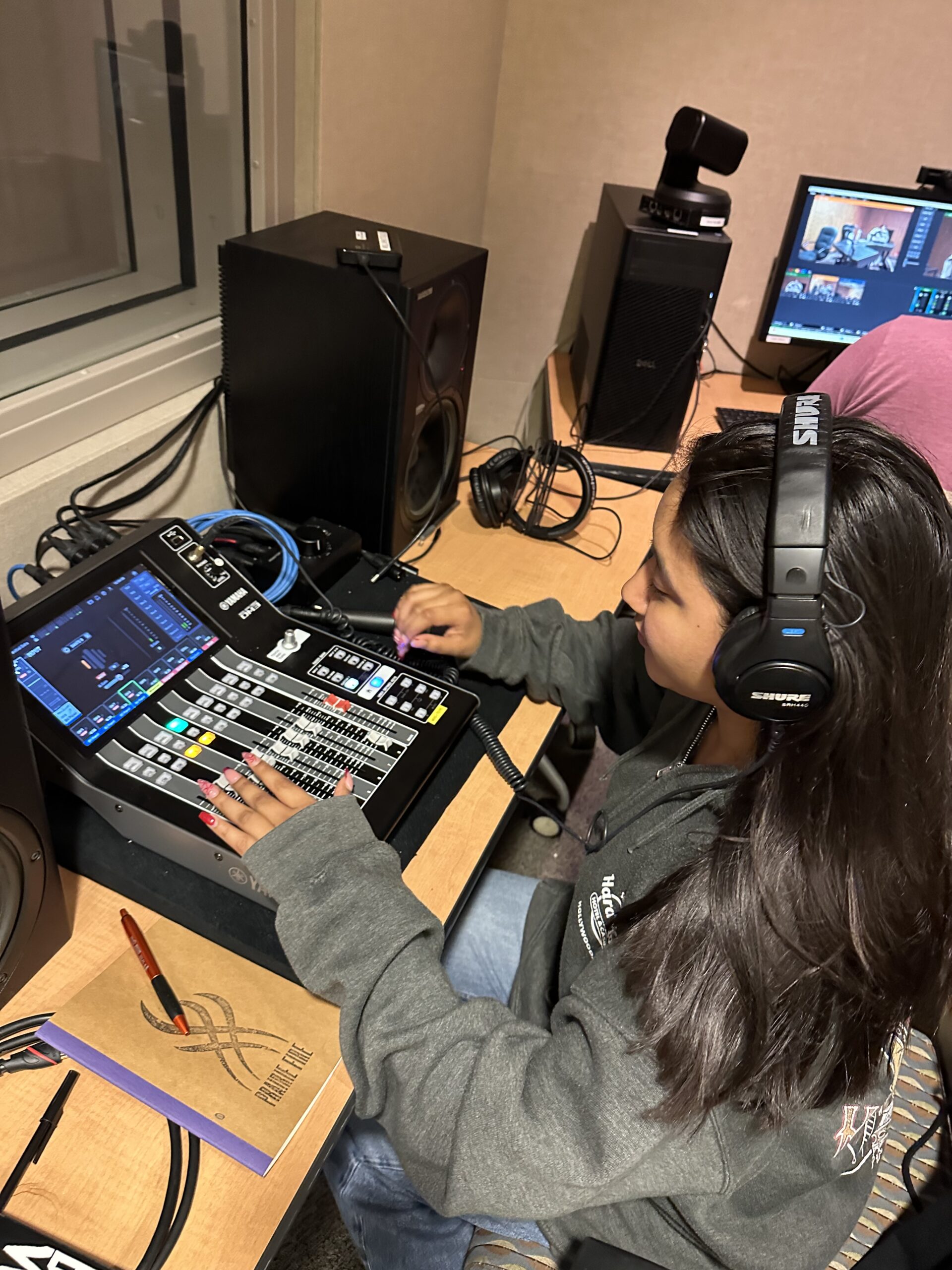
Content Creation Lab to help local high school students acquire media production skills


An open, hands-on media studio for local high school students will launch this spring that encourages critical thinking, media literacy, and community engagement.

audio workshop at IPM

Angela Aguayo, associate professor of media and cinema studies, created the Content Creation Lab to help young teens acquire media production skills. The pilot program, which will be held in new podcasting studios at Illinois Public Media, was awarded a grant from the College of Media and is supported by the Illinois Community Media Project.

The first Content Creation Lab workshop will kick off this spring on Saturdays, 10 a.m. to 12:30 p.m., on April 4, 11, and 25. There is no fee for students to participate.

Aguayo said the program will offer a space for teens to try out new ideas, collaborate, self-direct, and articulate their own perspective on the world through media production.

“My biggest hope is that local youth can see the College of Media and the Content Creation Lab as a resource hub and a space for exploration, that we are a location where students can come decide if they’re interested in developing lives as media makers, creators, and thinkers,” said Aguayo.

This spring, the Lab will focus on media literacy, audio production, storytelling, and podcasting. In Fall 2026, instruction in video production and short-form storytelling will also be taught.

Aguayo has been training a team of undergraduate and graduate students who will help facilitate the open studio lab, guiding participants to develop their own projects through a practice of media literacy and encouraging them to direct their curiosity toward the local community as a place of discovery. The student-led team includes journalism major Leonor Carrillo; Earth, society, and environmental sustainability major Angela Conde; and Institute of Communications Research doctoral students Tom Farrenkopf and Gillian Paxton. Carrie Wilson-Brown, senior lecturer of media and cinema studies and of advertising, will also help oversee the project.

There’s a barrier to students trying media production, and the idea of the Lab is to lower that barrier so that students who might want to pursue media—either as a hobby or as a profession or as a pathway of study—can do so without having it cost anything.

Angela Aguayo

Associate Professor of Media and Cinema Studies, Creator of Content Creation Lab

“We’re going to lead students through the process of thinking about the things that concern them the most, the questions that they have about their world and their local community, and where those stories show up,” Aguayo said.

High schoolers will also be able to experiment with audio and video tools to learn more about recording and editing, an invaluable opportunity for local teens who may not have access to production equipment or facilities. The Lab’s partnership with Illinois Public Media will provide an opportunity for young people to work in a professional media facility and acquire mentorship from experts there.

“There’s a barrier to students trying media production, and the idea of the Lab is to lower that barrier so that students who might want to pursue media—either as a hobby or as a profession or as a pathway of study—can do so without having it cost anything,” Aguayo said.

In addition to providing instruction and hands on experience with media tools, Aguayo would like to see the Content Creation Lab function as a space for continued research on the evolving pedagogical approaches to youth media production.

While some students may end up with a finished product, Aguayo envisions the Content Creation Lab as a creative space for development.

“The Lab is not outcome-focused, it’s process-focused. What we’re really doing is [determining] how we can help students understand that media production is a productive way to contribute to their community.”

Share on social

2026 News Layout Updates


Lede left border:Either university presses will embrace new technology and offer scholarly content in new forms to researchers and under new business models, or they will follow the music industry and spend all of their resources on trying to protect their territory — unsuccessfully.

Creative team doing whiteboard excercise.
Diverse team of designers smiling while brainstorming together with sticky notes.

A new paper co-written by a University of Illinois Urbana-Champaign scholar who studies how authenticity and aesthetics intersect with branding found that interracial couples featured in advertisements enhanced brand outcomes relative to white couples, but also decreased brand outcomes relative to Black, Hispanic and Asian couples.

The findings point to such effects being driven by the perception of the couple’s “warmth,” which is either strengthened or weakened by the presence of other dominant or nondominant racial group members, said Rosanna K. Smith, a professor of business administration at the Gies College of Business at Illinois and a co-author of the research.

“We found that the perceived warmth of the couple in the ad drove brand outcomes,” said Smith, who is also a John. M. Jones Faculty Fellow and the co-coordinator of the Gies Business Research Lab. “Interracial couples increased brand evaluations and the desire to purchase from the brand relative to white couples, but interracial couples decreased brand outcomes relative to minority couples.”

The paper was co-written by Nicole Davis of the University of Kentucky and Julio Sevilla of the University of Georgia and published in the Journal of Consumer Research.

Lede no border: Either university presses will embrace new technology and offer scholarly content in new forms to researchers and under new business models, or they will follow the music industry and spend all of their resources on trying to protect their territory — unsuccessfully.

Either university presses will embrace new technology and offer scholarly content in new forms to researchers and under new business models, or they will follow the music industry and spend all of their resources on trying to protect their territory — unsuccessfully.

Liz Shallenberger

UX Liaison

Share on social

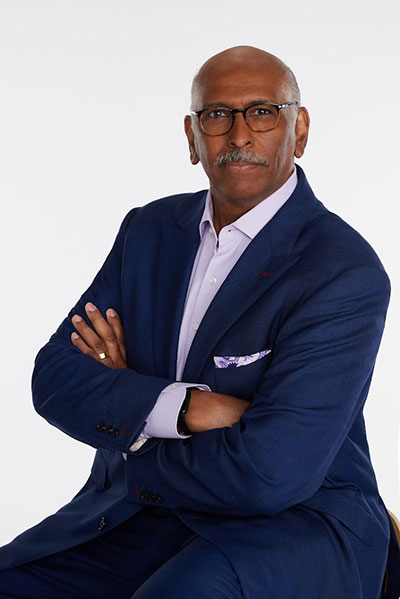
Q&A with Former RNC Chairman Michael Steele

Join the College of Media and the Frank Center via Zoom for a conversation with Michael Steele, former Republican National Committee Chairman and current co-host of The Weekend on MSNBC, discussing Donald Trump’s campaign and trials, the future of the GOP, Speaker of the House of Representatives Mike Johnson’s future, and more.

The Q&A will be led by Colleen King, director of the Frank Center and clinical assistant professor of journalism.

Presented by the Richard and Leslie Frank Center for Leadership and Innovation in Media.

About Michael Steele

Michael Steele

When he was elected Lt. Governor of Maryland in 2003, Michael Steele made history as the first African American elected to statewide office; and again with his subsequent chairmanship of the Republican National Committee in 2009.

As chairman of the RNC, Michael Steele was charged with revitalizing the Republican Party. A self-described “Lincoln Republican,” under Steele’s leadership the RNC broke fundraising records (over $192 million raised during the 2010 cycle) and Republicans won 63 House seats, the biggest pickup since 1938.

As Lt. Governor of Maryland, Steele’s priorities included reforming the state’s Minority Business Enterprise program, improving the quality of Maryland’s public education system, expanding economic development in the state, and fostering cooperation between government and faith-based organizations to help those in need.

Steele’s ability as a communicator and commentator has been showcased as a political analyst for MSNBC and recently in his role as co-host of MSNBC’s The Weekend. He has appeared on Meet the Press, Face the Nation, HBO’s Real Time with Bill Maher, and Comedy Central’s The Daily Show. In addition to his work in television, Steele co-hosted the daily radio program Steele & Ungar on the POTUS Channel on SiriusXM and is the host of The Michael Steele Podcast.

Steele is a graduate of Georgetown Law Center (’91), an Aspen Institute Rodel Fellow in Public Leadership, and a University of Chicago Institute of Politics Fellow. He currently serves as Chairman of the U.S. Vote Foundation and Holder of the Chair for The Gwendolyn S. & Colbert L. King Endowed Chair in Public Policy Lecture Series at Howard University. He has served as a Senior Fellow in International and Public Affairs at Brown University Watson Institute.

Roger Ebert Lecture: Iranian Cinema

Kaveh Askari

The Roger Ebert Lecture, “Provenance, Fakes, and Feuds: Building Expertise around Transnational Genre in 1960s Iran,” will be presented by Kaveh Askari, an associate professor and director of film studies at Michigan State University. 

Kaveh Askari’s research and teaching focus on cinema and media history in a global context. Special areas of interest include art cinema, media circulation, film and the other arts, and cinemas of the Middle East.

Askari is the author of Relaying Cinema in Midcentury Iran: Material Cultures in Transit, which won the 2023 Katherine Singer Kovács Book Award from the Society for Cinema and Media Studies. He also wrote Making Movies into Art: Picture Craft from the Magic Lantern to Early Hollywood (2014) and is the co-editor of several volumes including a special issue of Film History titled “South by South/West Asia: Transregional Histories of Middle East–South Asia Cinemas” (2021) and “Performing New Media, 1890-1915” (2014).

View screening details on Thursday, October 26.

Presented by the Roger Ebert Center for Film Studies.

College of Media
119 Gregory Hall
810 S. Wright St.
Urbana, IL 61801
217-333-2350