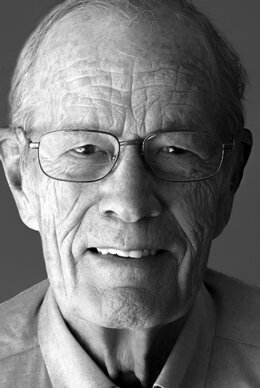
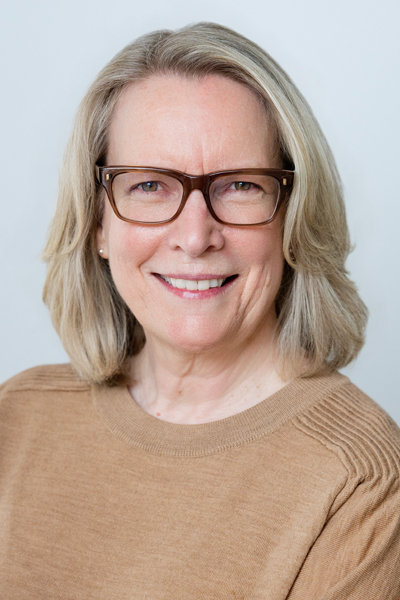
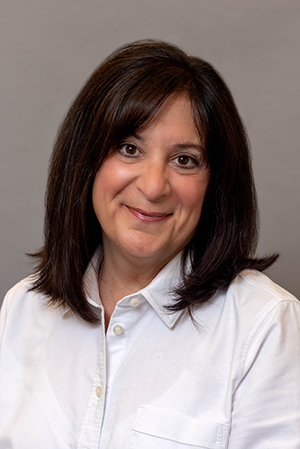
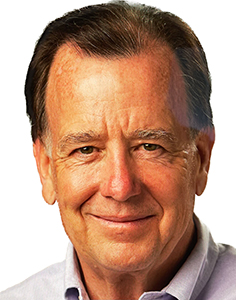
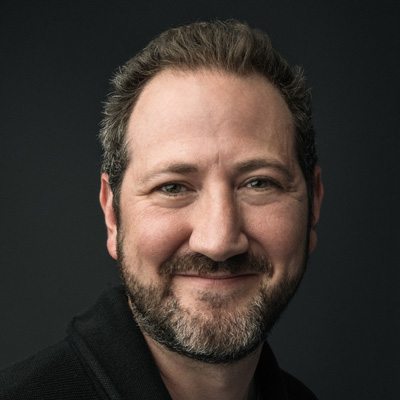
Loren Tate (BS ’53, journalism) was named the recipient of the University of Illinois Alumni Association’s 2026 Lou Liay Spirit Award. Established in 1997, the Lou Liay Spirit Award is presented to those who have consistently demonstrated extraordinary spirit and pride in support of the university, the Alumni Association, and related organizations, exemplifying a positive image of their Alma Mater while inspiring loyalty and pride in their fellow alumni.
Tate has covered Fighting Illini athletics since 1966, when he became a sportswriter, sports editor, and columnist for the The News-Gazette in Champaign. Although he’s been technically retired for nearly three decades, Tate continues to work for the paper as a contract writer.
Tate also has a considerable radio broadcast career related to Illini sports. He provided color commentary for men’s basketball from 1968 to 2001, called football games for several years, and appears regularly on the local station WDWS to discuss the highs and lows of Illinois athletics.
Tate, who authored A Century of Orange and Blue (2004) and Tatelines (2008), was inducted into the Illinois Basketball Coaches Association Hall of Fame in 1974 and the U.S. Basketball Writers Association Hall of Fame in 2021. He also has a street named after him—the street adjacent to the former News-Gazette building was named Loren Tate Way by the City of Champaign.
The Lou Liay Spirit Award, which is bestowed upon alumni by the University of Illinois Alumni Association on behalf of the University of Illinois, was named in honor of Lou Liay, EDM ’62, executive director of the UI Alumni Association from 1983 to 1998.
Tate, along with nine other alumni awardees, will be honored at the UIAA’s 2026 Alumni Awards Gala on October 1 at Pear Tree Estate in Champaign, in conjunction with Homecoming Week, September 27-October 3.
The Institute of Communications Research is excited to announce their newest cohort! Please learn more about the students’ research interests below and join us in welcoming them to the University of Illinois College of Media community this fall. For more information, see full student profiles.
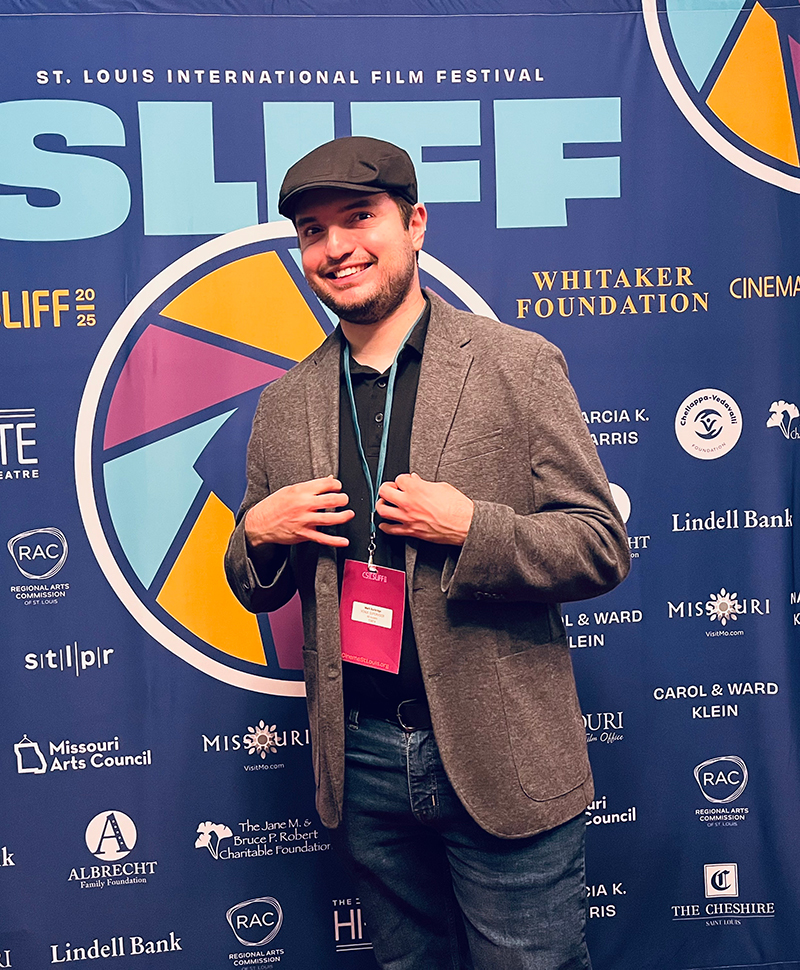
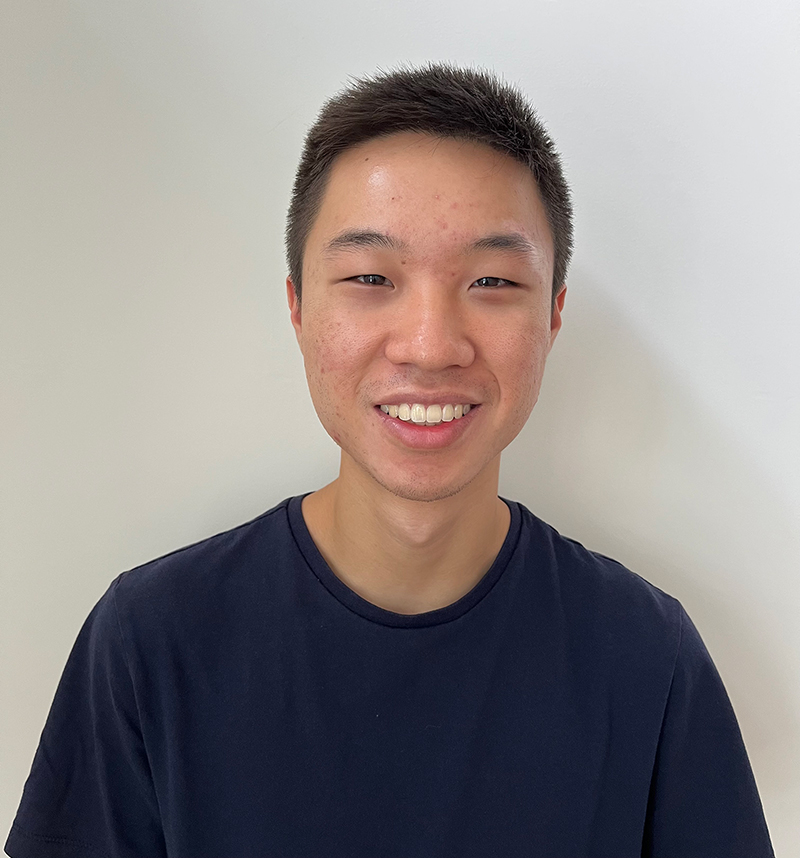
Mark Burbridge’s primary research areas center around film criticism, media studies, and digital media studies, with specific research focus on the evolution of film criticism, histories of film industry and media markets, and how emerging technologies affect popular film discourse.
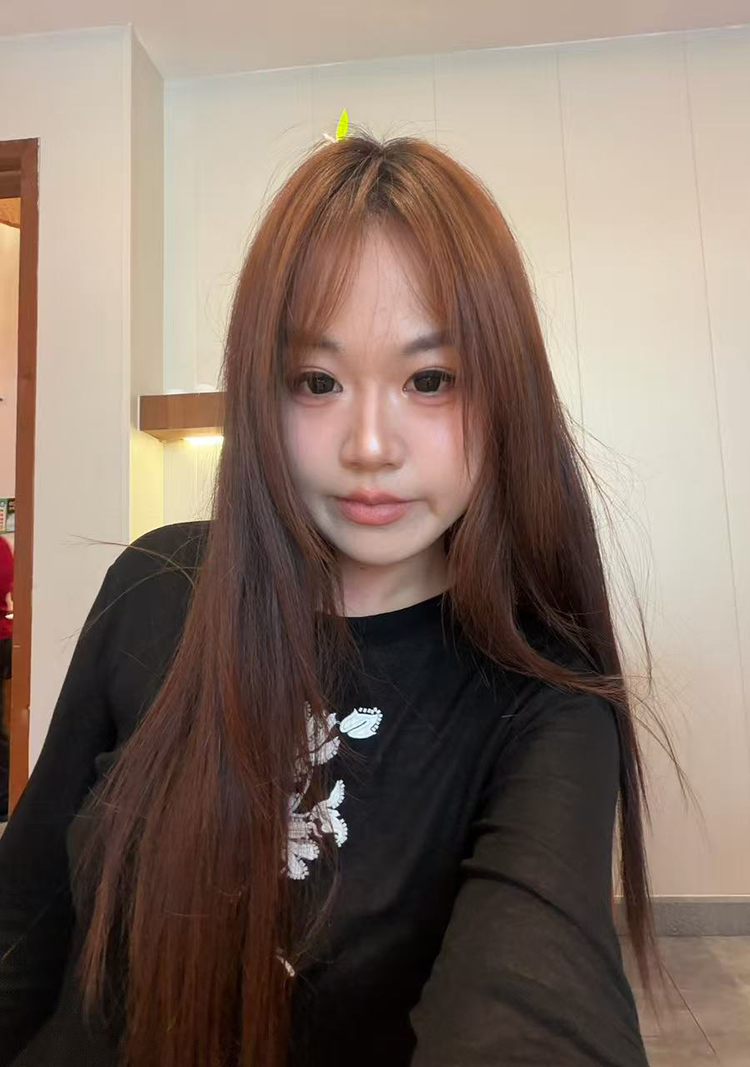
Boram Cho’sresearch interests include AI creativity, human-AI interaction and collaboration, persuasion knowledge, emerging technologies and media in children and older adults, and ethical AI use.
Matthew Huh’sresearch focuses on cultural and audience shifts found in contemporary pop culture, animation, and nostalgia, along with the impact of blockbuster media in film culture.
Jiayi (Joy) Wang’s research focuses on artificial intelligence in advertising and consumer behavior, with particular interest in how AI-generated advertising and persuasion knowledge shape consumer responses across digital platforms.
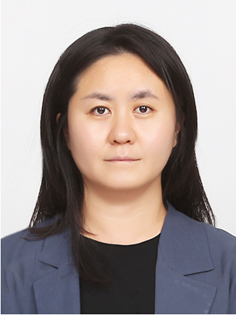
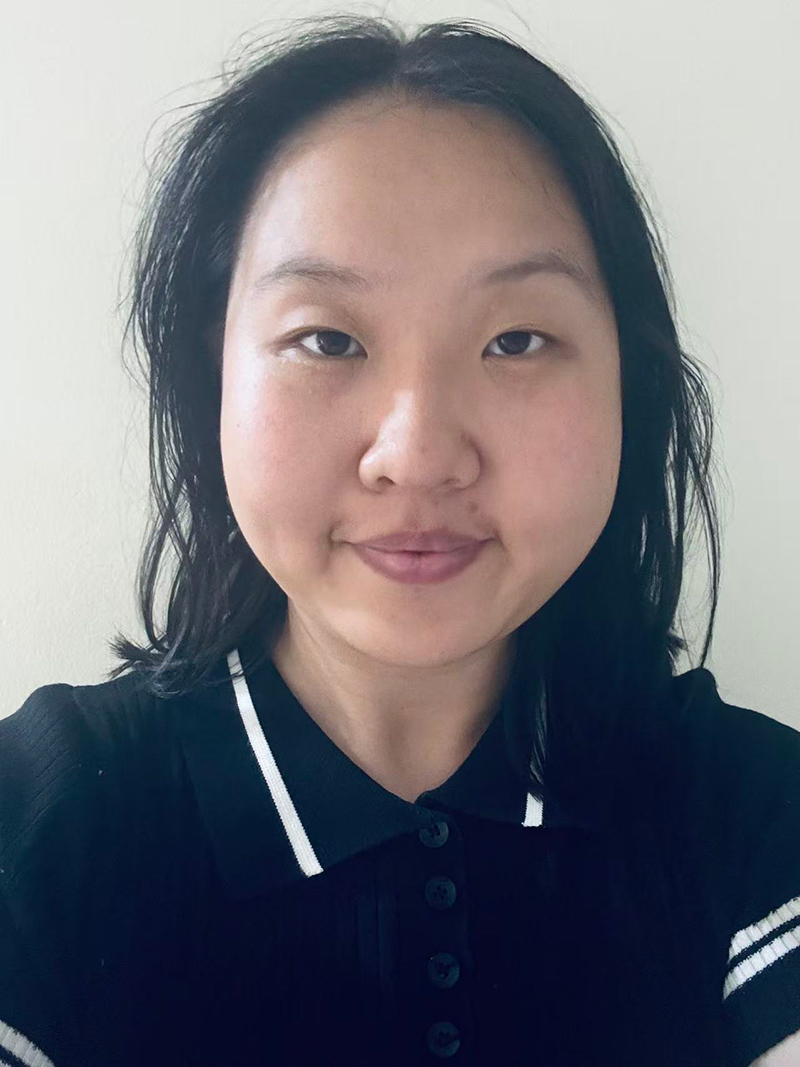
Chenqi Zhu’sresearch interests lie in the intersection of media and communication study, history of science, and science technology studies. She is interested in how communicative, scientific, and technological practices condition and transform each other across historical trajectories, and to their constitutive role in structuring human nature and broader social formations.
This fall, the College of Media announces a faculty investiture, two Dean’s Fellows, two faculty promotions, and three leadership appointments.
Craft appointed as the Karin and Folke Dovring Professor in Journalism and Democratic Society
Stephanie Craft, a professor in the Department of Journalism with an appointment in the Institute of Communications Research, and associate dean for academic and faculty affairs, was named the Karin and Folke Dovring Professor in Journalism and Democratic Society. The professorship supports a distinguished faculty member whose research advances our understanding of journalism and democratic society.
The Dovring Professorship was initially established by Karin and Folke Dovring in 2001. Karin was a foreign correspondent, an internationally recognized communication analyst, and the author of English as Lingua Franca: Double Talk in Global Persuasion (1997) and The Road of Propaganda (1959). Her husband, Folke, was a distinguished professor of land economics who taught at the University of Illinois from 1960 to 1987.
Craft, whose research focuses on news literacy, misinformation, and journalism ethics—particularly how people evaluate and understand news—joined the University of Illinois in 2013. She is best known for her efforts to build news literacy theory by uniting scholars around shared definitions and measures of important concepts (such as “Defining and Conceptualizing News Literacy” and “Developing and Validating a 15-Item True/False Measure of News Literacy Knowledge”) and for her research on the ethical obligations of journalism that arise from its democratic functions and the resulting tension between independence and accountability (such as a special edition of Mass Communication and Society addressing “Media and the Future of Democracy”).
She is the co-author of a widely used introductory textbook, Principles of American Journalism: An Introduction (2025), now in its 4th edition, and serves on the editorial boards of the Journal of Media Ethics, Journalism Practice, and Journalism & Communication Monographs. Craft is also a former head of the Journalism Studies Division of the International Communication Association and of the Media Ethics Division of the Association for Education in Journalism and Mass Communication.
King and Maslowska appointed as Dean’s Fellows focusing on AI
Colleen King, clinical associate professor in the Department of Journalism and director of the Richard and Leslie Frank Center for Leadership and Innovation in Media, and Ewa Maslowska, associate professor in the Chales H. Sandage Department of Advertising with an appointment in the Institute of Communications Research, will serve as Dean’s Fellows for the 2026–27 academic year, with a focus on artificial intelligence.
King will concentrate primarily on AI in curriculum and instruction, while Maslowska will focus on AI in media research and innovation. Both will work to convene discussions across departments and units as the College of Media collectively navigates the perils and possibilities of the AI era.
The Dean’s Fellows Program provides faculty in the College of Media with academic leadership experience through mentoring opportunities, collaboration with colleagues within and beyond the College, and leadership roles on key strategic initiatives and projects.
Faculty Promotions
In the Department of Journalism, Christopher Ball, who has an appointment in the Institute of Communications Research, has been promoted to associate professor with indefinite tenure, and Colleen King has been promoted to clinical associate professor.
Leadership Appointments
Jenny Oyallon-Koloski, associate professor in the Department of Media & Cinema Studies with an appointment in the Institute of Communications Research, will serve as the new director of the Roger Ebert Center for Film Studies.
Leona Yi-Fan Su, associate professor in the Charles H. Sandage Department of Advertising with an appointment in the Institute of Communications Research, will serve as the new director of the Institute of Communications Research.
Kevin Wise, professor in the Charles H. Sandage Department of Advertising with an appointment in the Institute of Communications Research, will serve as Advertising’s associate head of graduate studies.
Several College of Media students, including a recent graduate, expanded their skills, learned more about the industries, and gained valuable professional experience through various internship opportunities this summer. Read about a few of our students’ experiences below in these Q&As.
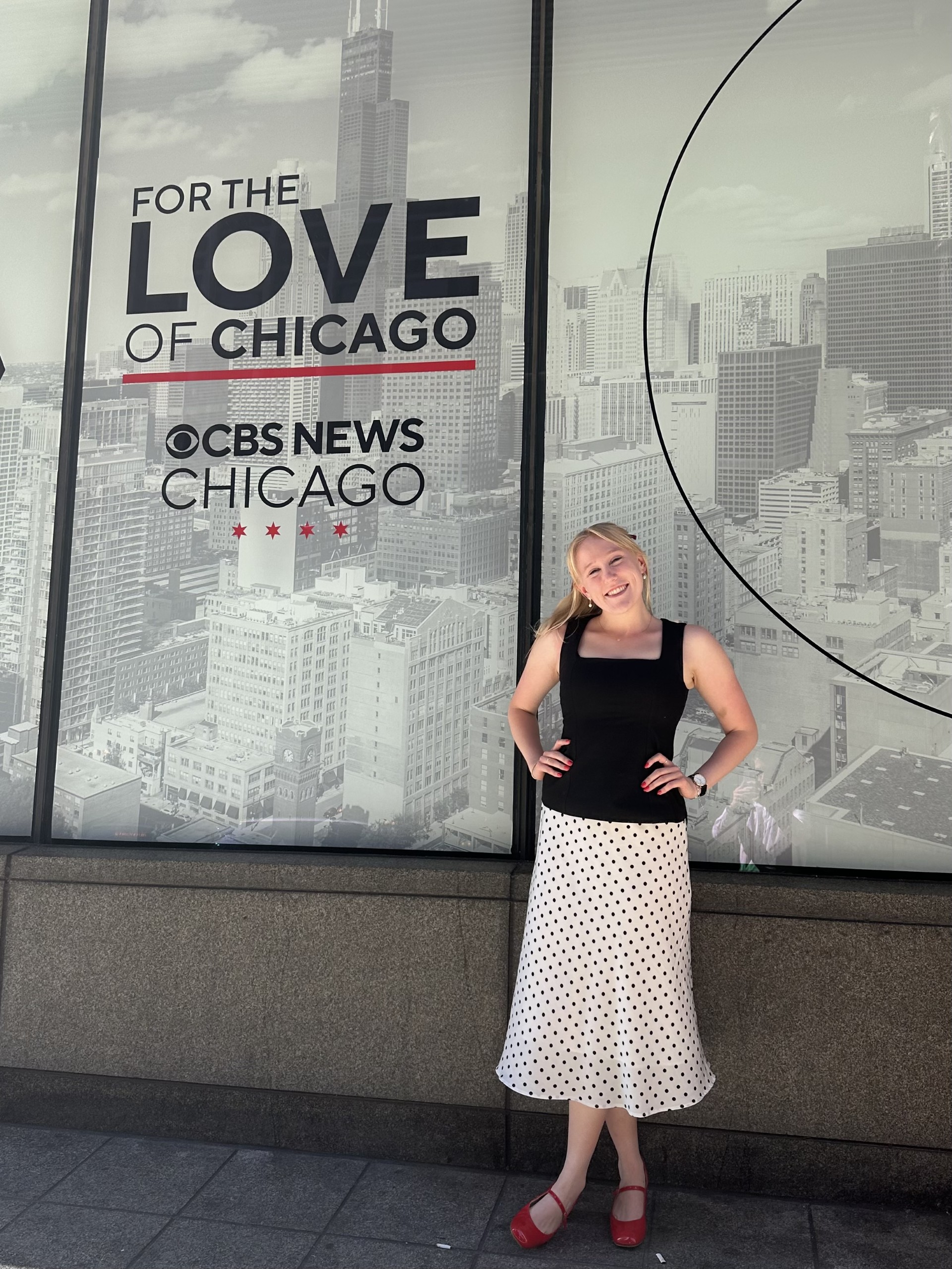
Felicity Abbott, senior in journalism
CBS Chicago | News Intern | Chicago, Illinois
“I’ve had the opportunity to meet so many Illinois alumni working at CBS Chicago and they have welcomed me with open arms. This experience was a great demonstration of how strong the Illini family is and reinforced my decision to study at the University of Illinois.”
What she did: As the newsroom intern, I spent 10 weeks rotating through a variety of positions and roles, expanding a plethora of my journalistic skills. I served as a field producer several times, including for CBS Chicago’s annual “Party at the Pier,” where I coordinated live talent, interviews, a camera crew, and transportation. I also had the opportunity to help with social media coverage of the Obama Presidential Center. I spent several weeks working alongside the CBS Chicago Investigative team, completing research, tagging along on interviews, and practicing script writing. With the producers, I wrote copy for the daily newscasts, sourced VO (voice-over) stories, edited videos, and created graphics. Alongside the digital team, I worked to clip stories, publish them to the CBS Chicago website and wrote digital stories to accompany clips. With reporters, I attended press conferences with city and state officials, practiced standups, and learned how to be efficient with quick deadlines.
What she enjoyed: I really enjoyed the flexibility I was given to move through the different roles in a newsroom. I developed many skills I wouldn’t have if I had only stuck with what I knew. Plus, this allowed me to meet and get to know lots of people, both inside and outside of the newsroom.
What she learned: I learned about how many roles there are in a newsroom of this size and how to effectively communicate between them all. Additionally, I got a lot of good insight into the type of role I can see myself going into post-grad.
What helped her prepare: My extracurricular activities like UI7 Newsroom really helped prepare me for this internship. I had a lot of experience I was able to reference during my interview and had a really solid understanding of TV news right off the bat, which gave me a lot of confidence as I started.
Abbottreceived funding from the College of MediaNancy Ronald and Ronald L. Hartshorn Internship Fund to support this internship.
Said Bravo, (BS ’26, journalism)
The Commercial Appeal | Sports Intern | Memphis, Tennessee
What he did: I interned at The Commercial Appeal, a legacy newspaper in Memphis. I was the sports intern through the Sports Journalism Institute.
What he enjoyed: I enjoyed the little moments in between assignments where I got to hang out with the sports staff and pick their brains. The best part about it was doing original reporting and working on enterprise stories. Over the summer, I had over 50 bylines and some vertical videos.
What he learned: I learned you must take initiative to succeed in print. You must seek out stories; oftentimes the best stories won’t fall on your lap. I also learned details matter a lot. The more granular you can go with a story, the better.
What helped him prepare: The Sports Journalism Institute prepared my cohort and me with a five-day sports journalism bootcamp at Arizona State University. They put me in a unique position to succeed in starting my career. I have been hired as a full-time sports reporter at Shaw Local in Kankakee, Illinois, where I will be covering high school sports.
Ruiyao Chao, graduate student in advertising
TikTok | Talent Acquisition Partner | San Jose, California
“Overall, this internship was a great learning experience. It helped me connect what I learned in class with real work. I also learned more about the career path I want to pursue. I am very grateful to my mentors and teammates for their support.”
What she did: We supported several technical teams, including AI Research, Search & Recommendation, E-commerce Algorithm, and Intelligent Creation. My work included sourcing candidates, talent mapping, conference recruiting, and supporting hiring managers.
What she enjoyed: I really enjoyed talking with candidates and talent mapping, which helped me understand how different companies and teams are structured. I also learned what skills companies are looking for.
What she learned: I learned that recruiting is not just about filling open roles. Recruiters also need to understand the business and the talent market. They need to know what the team needs and where to find the right people. Building strong relationships with candidates is also very important.
What helped her prepare: My classes at the University of Illinois helped me improve my communication and research skills, understand workplace communication, teamwork, and how technology affects the way people work. These skills were useful when I worked with recruiters, hiring managers, and candidates.
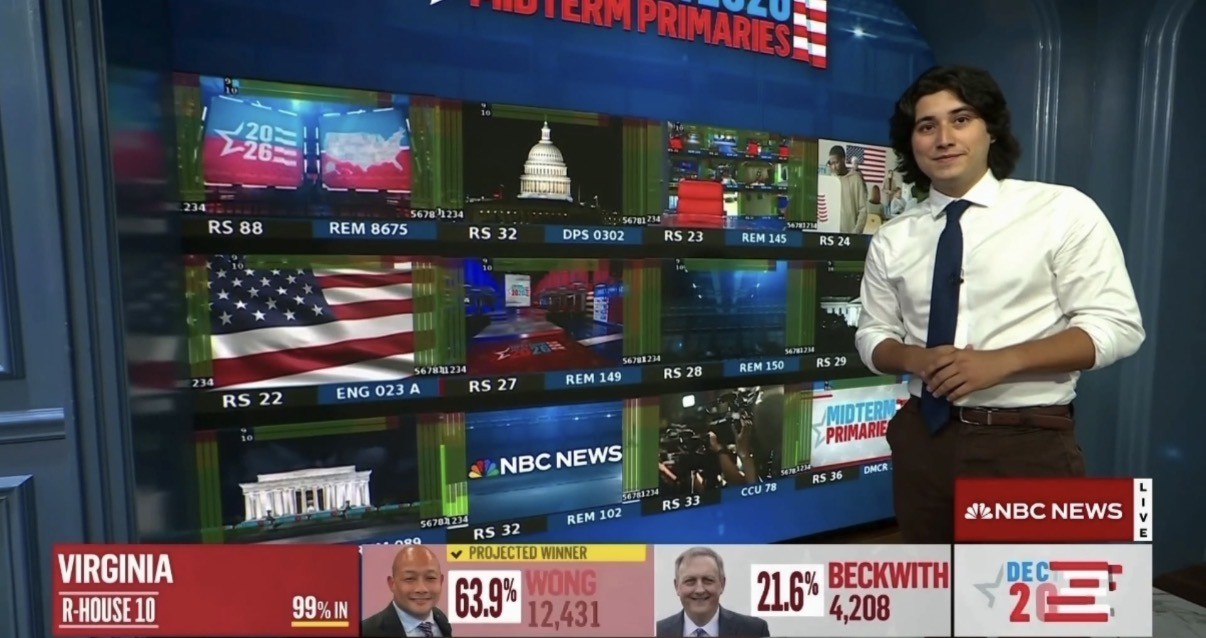
Nathan Gonzalez, senior in journalism
NBC News | Intern at Justice and National Security Unit | Washington, D.C.
I’m eternally grateful for the lecturers, professors, and staff at the College of Media. Because of them, I’ve landed an internship every summer, two of them in Washington, D.C., and been accepted into some of the most prestigious programs in political journalism. Thanks to the College of Media, I’m a multiskilled journalist who’s prepared for graduation and ready to start my professional career.
What he did: During my internship, I focused on national security reporting, learning how to navigate procedures, understand documents, conduct research, and investigate the operations of the Department of Justice, Department of Homeland Security, Department of Defense, CIA, FBI, ICE, and Customs and Border Protection. I also learned how to properly report on U.S. federal courts. I was frequently sent to cover rulings and hearings at the U.S. District Courts in Alexandria, Virginia, and Washington, D.C., as well as a week of Supreme Court opinions, where I sat in the courtroom and reported quotes from the justices back to the bureau. I booked and conducted interviews with immigration advocates and legal counsel on deportation cases. I was published multiple times as a reporter and researcher on the NBC News website and have my own author page. I learned how to conduct background checks, geographic tracking, and conflict-of-interest research using open-source intelligence.
I also led data processing and analysis for the unit on defense contracts, ICE deportation statistics, and FEC filings. I also led national security research for the July 4th celebrations in Washington, where I broke the news of an evacuation order to the bureau which ended up airing on our network.
What he enjoyed: I enjoyed being back in Washington, learning more about political reporting, and getting to work at my dream network, NBC News.
What helped him prepare: JOUR 400: Newsroom Experience and my work at UI7 Newsroom in general prepared me a great deal, helping me build my politics show Illinois in Session.
Gonzalezreceived funding from the College of MediaNancy Ronald and Ronald L. Hartshorn Internship Fund to support this internship.
Zijie Wang, senior in media and cinema studies
OpenQQuantify | Media Intern | Remote Work Opportunity
“This internship made me sure of my interest in media production, documentary development, and research-based content creation. It not only helped me accumulate portfolio-building and professional development experience but also made me more aware that I want to continue to explore technology storytelling and educational media direction in the future.”
What he did: As part of OpenQQuantify’s technology documentary initiative, which focused on areas such as artificial intelligence, robotics, cybersecurity, fintech, and other emerging technologies, I assisted in documentary research, organizing and editing digital media assets, content publishing, and social media outreach. I also helped with interviews, media coordination, creative brainstorming, and online community engagement. My goal was to transform technical information into content that is clearer and more suitable for public understanding.
What he enjoyed: My favorite thing is that this internship combined research and creative media production. This internship made me see that a professional documentary project requires a lot of preliminary research and fact-checking. I especially liked the process of documentary theme research and content conception, because I was able to help the audience understand complex scientific and technological topics.
What he learned: Through this experience, I learned that media production is not just about shooting, editing, or publishing content. A good media project requires accurate information, clear narrative structure, and cooperation between teams; especially technology-focused media production, which requires both creative and analytical skills. Through the internship, I also learned a lot about documentary research, digital storytelling, social media communication, video editing, technology journalism, and innovation reporting.
What helped him prepare: My courses related to digital media, content creation, and media writing helped me prepare for this internship. These courses taught me how to organize information, analyze the audience, tell a good story, and express the content clearly.
Seo-Jeong (Rachel) Heo is a PhD candidate in the Institute of Communications Research, which houses the world’s oldest doctoral program in communications and media. Heo’s research interest focuses on what happens as AI takes on a bigger role in consumers’ lives.
Describe your areas of research interest.
I’m especially interested in three questions. First, how do people make sense of AI in the first place—what do they believe a machine can genuinely experience, claim, do, or create? Second, what changes when AI moves from simply providing information to recommending, interpreting, and eventually acting on a consumer’s behalf? And third, what happens when AI becomes emotional—when it recognizes how we feel, expresses emotions of its own, or begins to function more like a companion than a tool?
How do you approach your research?
I study these questions in advertising and consumer decision-making across contexts such as virtual influencers, generative AI advertising, conversational AI, social robots, AI shopping agents, and emotionally responsive AI. I also try to study these technologies in settings that resemble how people actually encounter them. Rather than relying only on written scenarios, many of my studies use live AI conversations, interactive advertising interfaces, and simulated shopping environments where participants actually interact with or delegate tasks to an AI. That allows me to study not just what people say they would do with AI, but how they respond when the technology is actively participating in the decision.
As AI moves from communicating with consumers to influencing their decisions, to acting for them, and even relating to them, it keeps entering roles that were once occupied by people. I want to understand how consumers decide what role a machine is allowed to play in each of those roles—and what happens when it crosses the line.
Seo-Jeong (Rachel) Heo
ICR Doctoral Student
Why does your research matter?
Even if you never think of yourself as an “AI person,” AI is increasingly involved in ordinary decisions around you. It can influence which products you see, explain why an advertised option supposedly fits you, recommend what to buy, create the advertising itself, or even complete parts of a purchase on your behalf. At the same time, companies are designing AI to sound warmer, more understanding, and more human.
Each of those changes raises a different question that matters beyond AI itself. When AI creates or endorses something, we have to decide what kinds of claims we consider credible coming from a machine. When AI recommends something, we have to decide how much weight to give its judgment. When it acts for us, we have to decide how much control we are willing to hand over. And when it becomes emotionally responsive, we have to decide whether we are still interacting with a tool or beginning to treat it as a social partner.
Those are ultimately questions about persuasion, autonomy, responsibility, and relationships. They matter because AI is increasingly being inserted into moments where consumers are vulnerable to influence—when they are uncertain about what to choose, when they are delegating a consequential decision, or even when they are looking for emotional support. Understanding when these systems help people and when they become uncomfortable, misleading, or overly influential can inform not only advertising practice, but also how companies design AI and how consumers are protected as these technologies become more deeply embedded in everyday life.
How did ICR help you develop and hone in on your research area?
ICR gave me the freedom to follow a research question across disciplinary boundaries. My work is grounded in advertising and consumer psychology, but it also draws from communication, social psychology, human–computer interaction, and research on emotion and emerging technology. Having faculty with expertise spanning AI, computational approaches, and emotional and physiological processes made it possible for me to think about consumer–AI interaction from more than one perspective.
ICR also broadened my methodological training. In addition to experimental and survey methods, coursework in analytics and computational research introduced me to R-based data analysis (a free, open-source software environment designed for statistical computing and graphics) and encouraged me to think more broadly about the kinds of data and methods I can use. That combination of theoretical breadth and methodological flexibility helped me move from studying individual AI phenomena to developing a more connected research program.
Just as importantly, ICR taught me to keep asking, “What is the theoretical question underneath the new technology?” AI changes incredibly quickly. A platform or feature that feels novel today may look completely different a few years from now, so I learned not to build my research around a particular technology. Instead, I focus on the more enduring human questions underneath it—how people infer minds and intentions, respond to persuasion, give up control, assign responsibility, and form relationships.
What led you to be interested in your research area?
I became interested in AI because I kept noticing that the most interesting part was not whether the technology worked—it was how quickly people began treating it as something more than technology.
A conversational AI can produce a technically correct answer, but people still ask whether it really understands them. A virtual influencer can present a product perfectly, but consumers may still wonder whether it could actually have experienced what it is describing. And an AI can make a very good recommendation, yet that recommendation feels different once the system moves from saying, “Here is what I think you should buy,” to saying, “I can buy it for you.” That shift toward agentic AI, which can search, choose, and execute decisions on the consumer’s behalf, made me especially interested in what happens when people stop simply taking advice from AI and begin giving it authority.
What other aspects of your research do you find interesting?
AI systems are increasingly designed not only to be capable, but to be emotionally responsive—to recognize distress, offer reassurance, express emotion, and maintain ongoing conversations. That creates a very different set of questions. What does it mean when a machine says, “I understand,” or even, “I feel the same way”? When does that make the interaction feel supportive, and when does it feel artificial or manipulative? And what happens when repeated emotional interaction develops into something that consumers experience as a relationship?
Those moments are what continue to draw me to this area. As AI moves from communicating with consumers to influencing their decisions, to acting for them, and even relating to them, it keeps entering roles that were once occupied by people. I want to understand how consumers decide what role a machine is allowed to play in each of those roles—and what happens when it crosses the line.
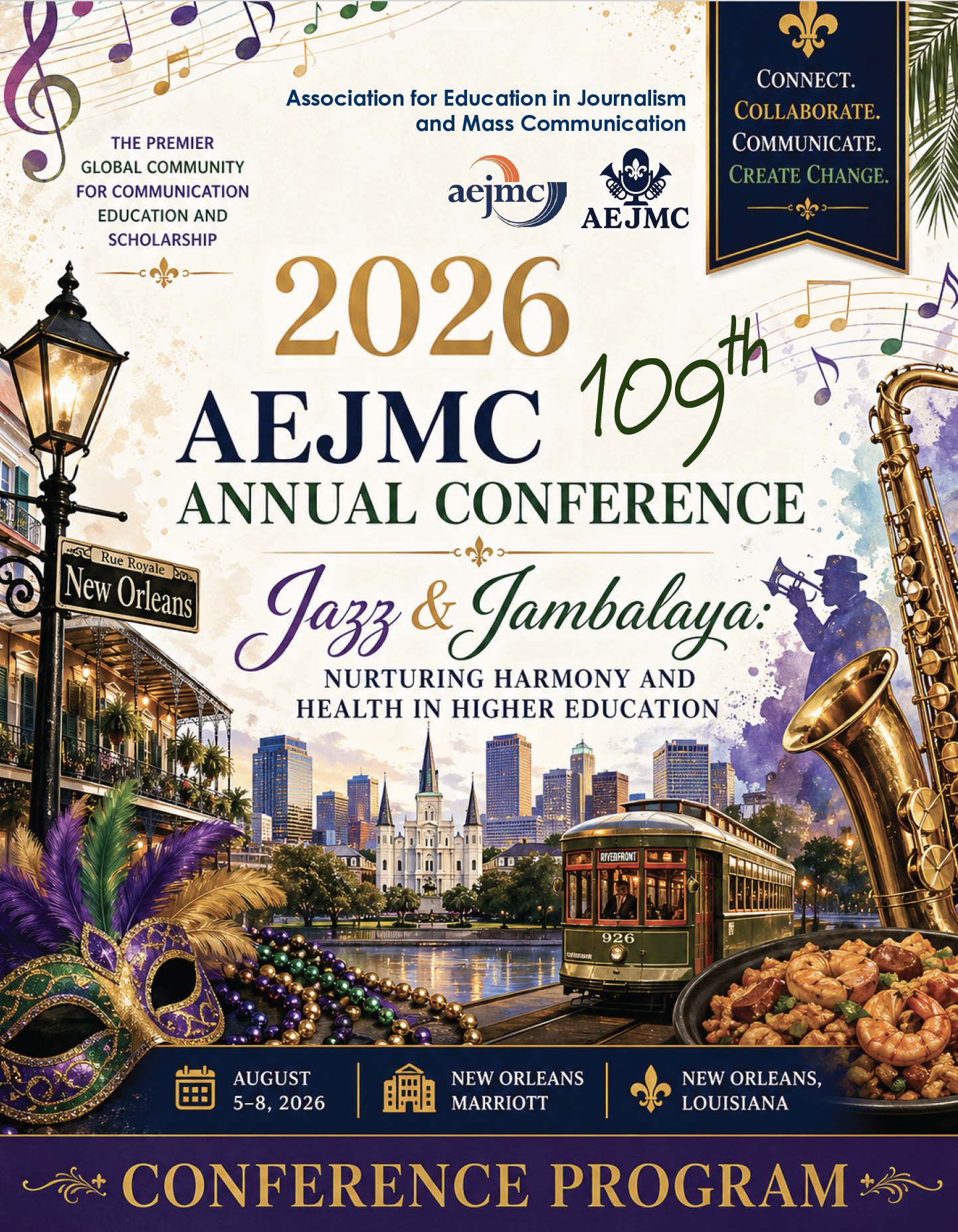
This year’s conference theme was “Jazz & Jambalaya: Nurturing Harmony and Health in Higher Education.” Presenters included faculty in the Institute of Communications Research, the Charles H. Sandage Department of Advertising, and the Department of Journalism; and graduate students in ICR’s PhD program and the MS advertising program.
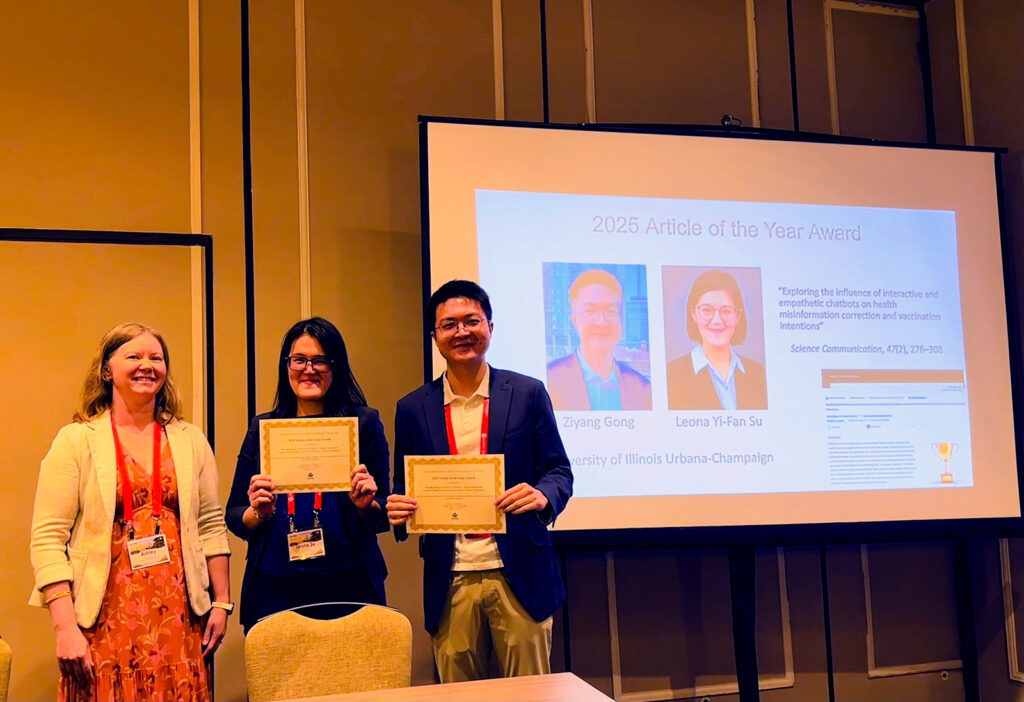
A Science Communication paper, “Exploring the Influence of Interactive and Empathetic Chatbots on Health Misinformation Correction and Vaccination Intentions,” co-authored by ICR Director Leona Yi-Fan Su and iSchool doctoral student Mobius Ziyang Gong (MS ’22, advertising) received the 2025 Article of the Year Award from AEJMC’s Communicating Science, Health, Environment and Risk Division.
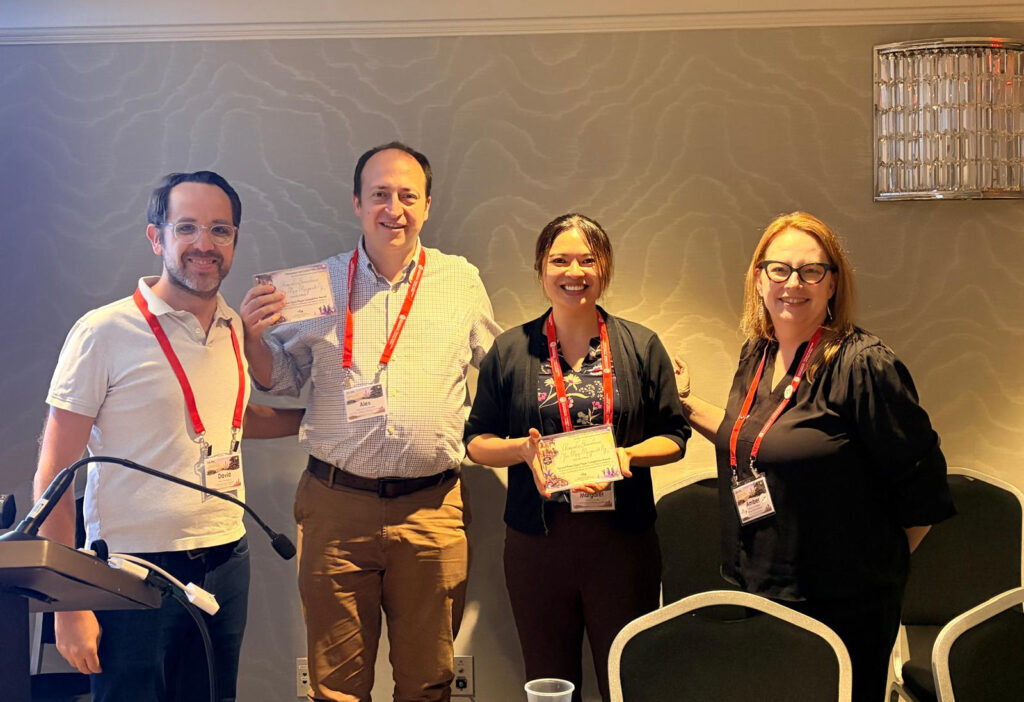
Journalism Professors Alexandre Gonçalvesand Margaret Yee Man Ng received Second Place Open Competition Award for their paper “Analyzing News Outlet Social Media Use: Platform Adoption, Usage, and Migration Across Two Decades (2005–2025),” in the Newspaper and Online News Division.
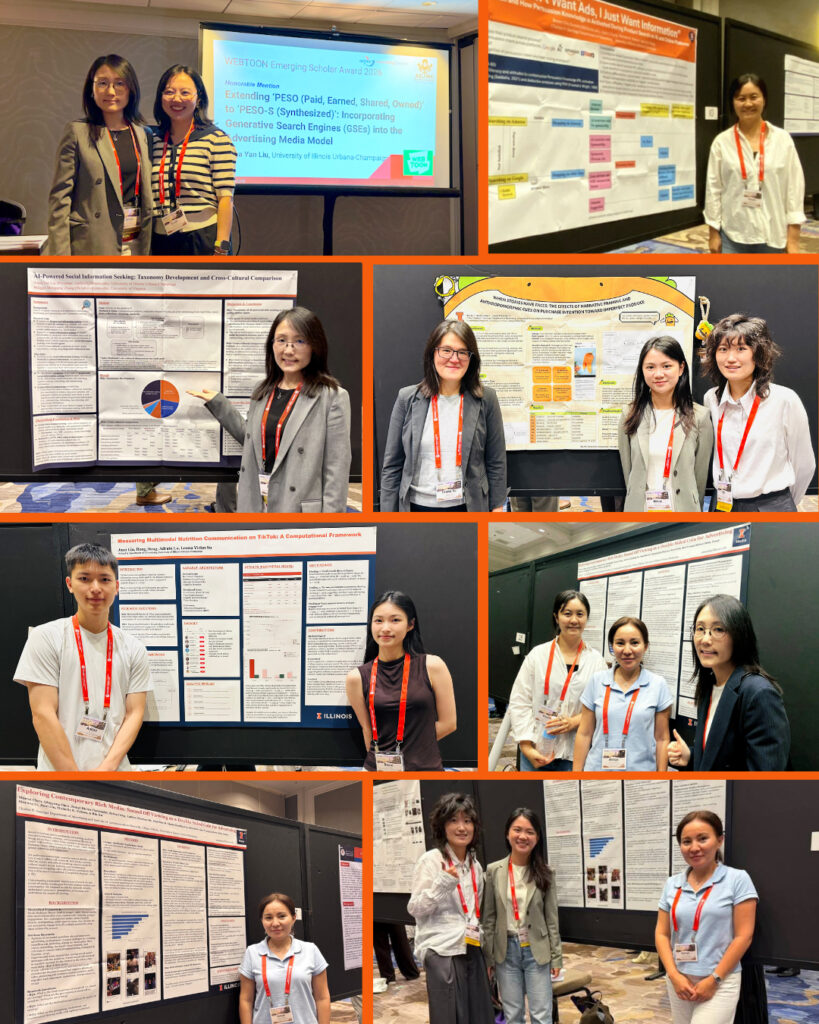
In addition, two ICR doctoral students received awards at the conference including Anthea Xiaohua He, who received second place in the Washington Media Scholar Fund Graduate Research Scholarship competition, and Anna Liu, who received an honorable mention for the Webtoon Emerging Scholar Award.
The AEJMC aims to promote the highest possible standards for journalism and mass communication education, to cultivate the widest possible range of communication research, to encourage the implementation of a multi-cultural society in the classroom and curriculum, and to defend and maintain freedom of communication to achieve better professional practice and a better-informed public.
College of Media research presenters and presentations are listed below. (Please see the AEJMC conference program for complete listings and participants.)
Su and Gong received Article of the Year Award in the Communicating Science, Health, Environment and Risk Division.Gonçalves and Ng received the Second Place Open Competition Award for their paper in the Newspaper and Online News Division.
Scholar-to-Scholar (Poster) RefereedResearch Paper Session
Visual Communication Across Digital Contexts
“Visual Metaphor Complexity: Structural, Semantic, and Cognitive Dimensions”
The 2026 Sandage Symposium: Advancing Advertising Together, presented by the Charles H. Sandage Department of Advertising, will be held on Friday, Sept. 18, from 9:30 a.m. to 5:30 p.m., at the Illini Union, 2nd Floor Ballroom, 1401 W. Green St., Urbana.
“Advertising as the Invited Guest Who Took Over the Party”
Keynote Speaker: Judy Ungar Franks, Former Agency Executive, Professor at Northwestern University, and Author of Media from Chaos to Clarity and Back Again
10:45 a.m.-12 p.m.
“Where Advertising Goes Next”
Panelists from left to right: Jessica Jorsch (BS ’07, ADV), Global Digital Performance Media Lead, Mars; Helen Katz (MS ’86, ADV; PhD ’88, ICR), Executive Vice President, Research, Publicis Media; Mike Kelly (BA ’79, LAS), CEO and Co-founder of Kelly/Newman Advisors; Ashley McGowan (BS ’07, ADV), Head of Marketing, Audience & Growth, Meta; Greg Morrison (BS ’07, ADV), Co-founder, MXML Creative
“From Classroom to Industry: Exploring the Possibilities of Advertising”
Panelists from left to right: Lacey Gilbert (MS ’11, ADV), Senior Vice President, Strategy Director, Leo Burnett; Adam Hamilton (BS ’11, ADV; MBA ’19) Director, Brand Communications, McDonald’s; Amy Restko (BA ’13, LAS; MS ’14, ADV), Vice President, Engagement Strategy, AbelsonTaylor Group; Bill Rouse (BA ’96, LAS), Senior Vice President, Advertising Sales, Sony Pictures Entertainment; Rachelle Pierre-Lott (BA ’03, LAS), Director II, Enterprise Digital Advancement & Innovation at AbbVie
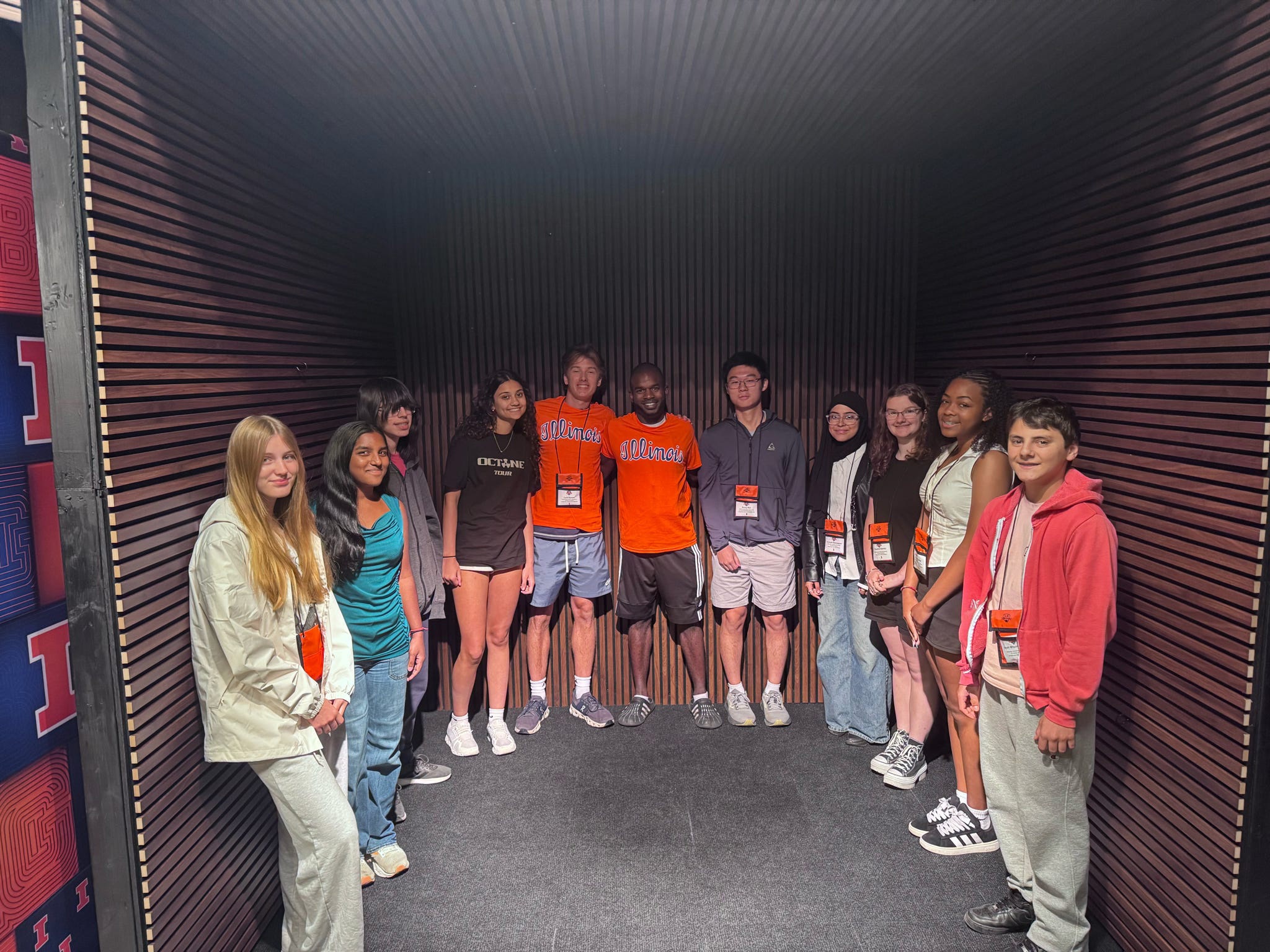
Several faculty and staff members from the College of Media led workshops for high-school-aged youth in Illinois during Illini Summer Academies, held June 21-25, at the University of Illinois Urbana-Champaign.
(Photo of Media attendees by Lark Runkle, youth photographer)
Illini Summer Academies, which is presented by Illinois 4-H, the youth development program of University of Illinois Extension, partners with various departments and colleges across campus every summer to give high school students an opportunity to experience college life and explore a career of their choice.
Twelve students from across Illinois registered for the College of Media program, which marked the college’s first year of participation in the 4-H Summer Academies.
“As the coordinator for the program as well as one of its instructors, I think it went great,” said Jason P. Chambers, professor in the Charles H. Sandage Department of Advertising and associate dean for access and engagement.
“I think that the program helped build student awareness about the majors available in the college and the types of jobs they can get with an education in the College of Media.”
Chambers led the workshop “Exploring Public Service Advertising,” which gave students an overview of the ad industry, including discussions about the different types of advertising, tools, and approaches used to attract an audience.
(Photo of broadcast workshop by Disha Rai, youth photographer)
Students developed a public service advertising campaign on a topic of their choice, such as excess phone usage among teens, distracted driving, and voting.
“I think the big things that students get from these workshops are [learning] that there is an entire industry that works to produce all the advertising that they see [and] that it takes a lot of time and work to create an average advertisement, let alone one that really engages an audience and gets them to pay attention,” Chambers said.
Marisa Peacock, senior lecturer in the Sandage Department of Advertising, led “Create, Connect, and Think: Discovering Your Voice on Social Media,” where students explored how social media shapes identity, creativity, and communication.
Peacock said the workshop was designed to connect participants with college life and future careers, encourage collaboration and peer learning, and build students’ confidence and agency as creators, innovators, and problem-solvers—not just consumers of information.
“It was really fun, and I was impressed by the thoughtful responses from students and admired their understanding of how technology, creativity, and problem-solving can be applied to real-world challenges and future opportunities,” Peacock said.
Other Media faculty and staff who participated in Illini Summer Academies were Angela Aguayo, associate professor in the Department of Media & Cinema Studies; Daniel Almanza, assistant director of Media Career Services; Ken Erdey, instructor and technical coordinator for broadcast operations in the Department of Journalism; and Mike Yao, professor in the Sandage Department of Advertising and director of the Institute of Communications Research. Cassie Arner, executive senior associate director of athletics, sport administration at Illinois Athletics, helped organize a workshop that focused on sports media.
Faculty and graduate students from the College of Media co-presented various topics of research at the 76th annual International Communication Association Conference—the largest academic conference for communication scholars—on June 4-8, 2026, in Cape Town, South Africa. The ICA aims to advance the scholarly study of human communication by encouraging and facilitating excellence in academic research worldwide.
This year’s conference theme addressed “Communication and Inequalities in Context.” College of Media presenters included faculty in the Institute of Communications Research and the Charles H. Sandage Department of Advertising; graduate students in the MS advertising program; and doctoral students in the Institute of Communications Research PhD program.
College of Media research presenters and presentations are listed below in bold.
Pre-Conference: A Causal Inference Institute in Communication Studies Organizers
Shuning Lu, U of Maryland, College Park, USA
Ewa Maslowska, Associate Professor, Advertising
Harsh Taneja, Associate Professor, Advertising
When Communication Makes the Difference: From Signals to Relational Dynamics Human-Machine Communication “Reconsidering Gender: A Computational Examination of Conversational Dynamics between Human and Gendered AI”
Weizi Liu, Texas Christian U, USA
Haocan Sun, Beijing Normal U, CHINA
Mike Yao, Professor, Advertising
Human-Machine Care: Well-Being and Vulnerability Human-Machine Communication “Emotionally Vulnerable Subtype of Internet Gaming Disorder: Measuring and Exploring the Pathology of Problematic Generative AI Use”
Di Wu, Beijing Normal U, CHINA
Haocan Sun, Beijing Normal U, CHINA
Weizi Liu, Texas Christian U, USA
Guoming Yu, Beijing Normal U, CHINA
Mike Yao, Professor, Advertising
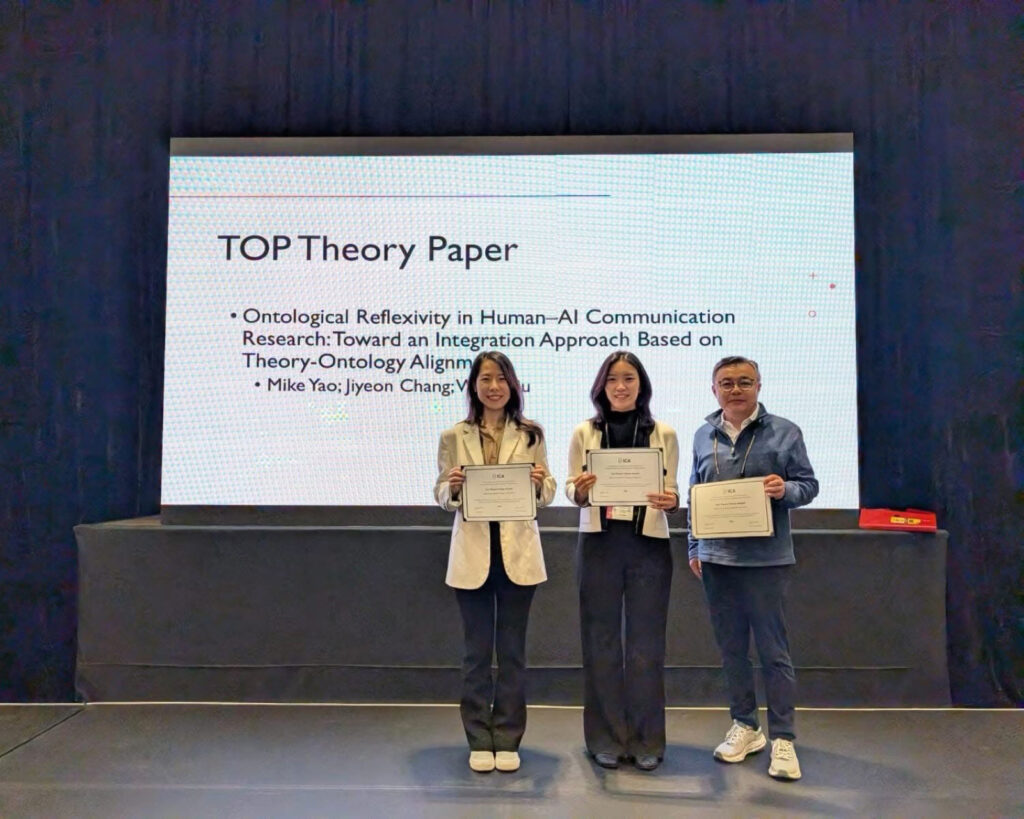
Top Papers in Human-Machine Communication Human-Machine Communication “Ontological Reflexivity in Human–AI Communication Research: Toward an Integration Approach Based on Theory-Ontology Alignment”
Mike Yao, Professor, Advertising
Jiyeon Chang, Student, ICR
Weizi Liu, Texas Christian U, USA
Persuasion and Consumer Behavior Information Systems “The Brand Transparency Paradox: Consumer Reactions to Explicit Mentions of Artificial Intelligence”
Viviana Zambrano Rodriguez, U of South Carolina, USA
Louvins Pierre, Assistant Professor, Advertising
“Exploring How Attitudes toward AI and Disclosure Influence Purchase Intention of AI-Integrated Products through Hedonic, Social, and Epistemic Value”
Louvins Pierre, Assistant Professor, Advertising
Viviana C. Zambrano Rodriguez, U of South Carolina, USA
Yanbo Li, Student, ICR
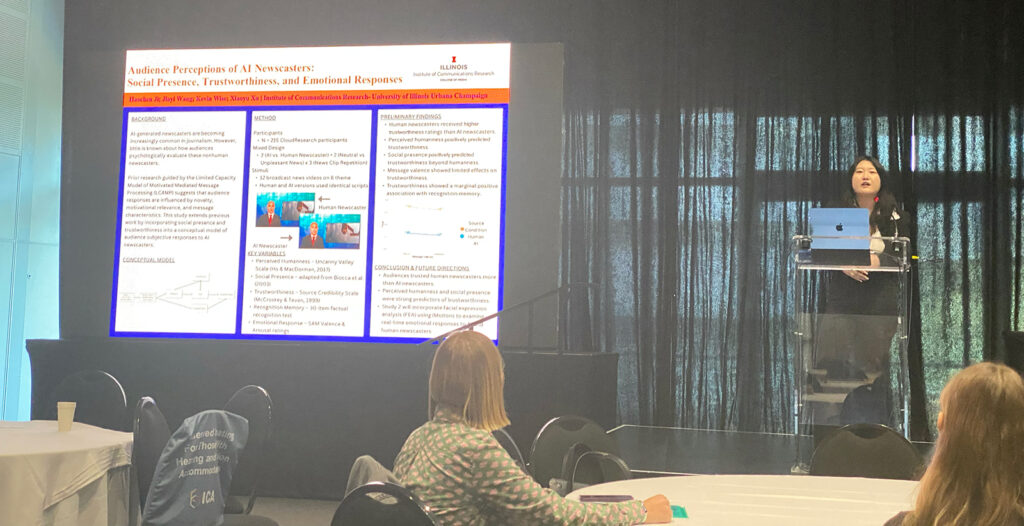
AI in News Production and Consumption Information Systems “Audience Perceptions of AI Newscasters: Social Presence, Trust, and Emotional Responses”
Haochen Ji, Student, ICR
Jiayi Wang, Student, MS Advertising
Kevin Wise, Professor, Advertising
Xiaoyu Xu, State U of New York at Cortland, USA
AI Taking Over: Promises and Pitfalls of AI Use in Research, Journalism, and Society Computational Methods “When Machines Start Writing: Assessing the Impact of Generative AI on Journalism Labor Markets”
Sakshi Bhalla, Student, ICR
Jennifer Henrichsen, Washington State U, USA
Benjamin Toff, U of Minnesota, USA
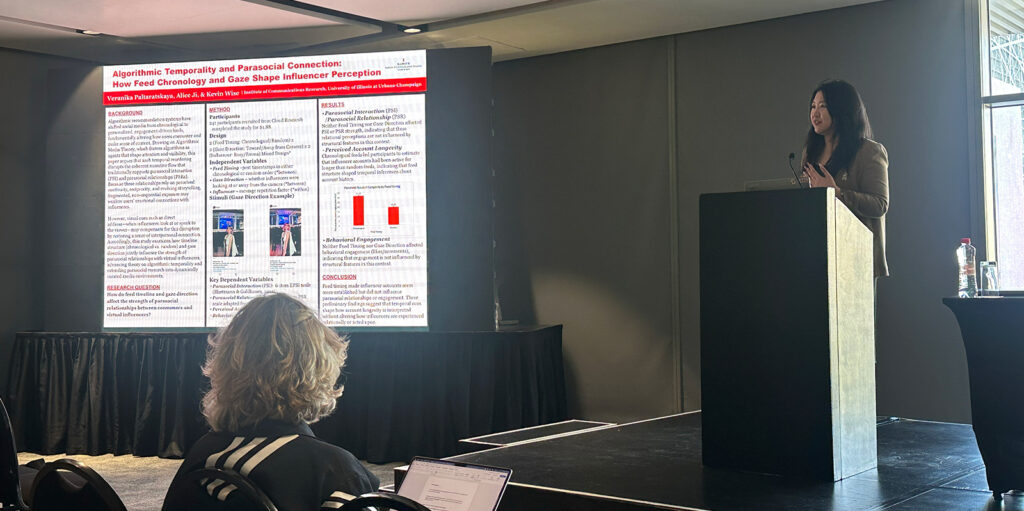
Cognitive and Emotional Processing Information Systems “Algorithmic Temporality and Parasocial Connection: How Feed Chronology and Gaze Shape Influencer Perception”
Veranika Paltaratskaya, Student, ICR
Alice Ji, Student, ICR
Kevin Wise, Professor, Advertising
Editorial Board Meeting: Journal of Computer-Mediated Communication (JCMC)
Chair: Mike Yao, Professor, Advertising
MIAU-steerable AI: Trust, Adoption, Dependency, and Behavioral Regulation in Generative Tech Ecosystems Communication and Technology “Social Media Exit and Platform Loyalty: Generational Differences in Platform Abandonment”
Margaret Yee Man Ng, Associate Professor, Journalism
Ewa Maslowska, Associate Professor, Advertising
Computational Methods Research Escalator Computational Methods “When AI Imagines Consumers: A Computational Analysis of Representational Bias in Generative AI Brand Imagery”
Haochen Ji, Student, ICR
Co-Constructing Trust in HMC Human-Machine Communication “Revisiting Trust in the Era of Generative AI: Factorial Structure and Latent Profiles”
Haocan Sun, Beijing Normal U, CHINA
Weizi Liu, Texas Christian U, USA
Di Wu, Beijing Normal U, CHINA
Guoming Yu, Beijing Normal U, CHINA
Mike Yao, Professor, Advertising
Growing up with AI: Children’s and Adolescents’ Understanding, Trust, and Risk Children, Adolescents, and Media “Children and AI Mind Attribution: Reasoning and Learning with ChatGPT through Social Learning Theory”
Boram Cho, Student, MS Advertising
Jiyeon Chang, Student, ICR
Michelle Nelson, Professor, Advertising
Top Papers Session Information Systems “Following the News: Polarization and the Networked Structure of Attention”
Sakshi Bhalla, Student, ICR
Perception, Trust, and Bias of Artificial Intelligence Information Systems “Emotional and Social Drivers of Artificial Intelligence Pessimism Aversion: Extending the Appraisal Tendency Framework to AI Environments”
Heng Zhang, Chongqing U, CHINA
Nansong Zhou, Student, ICR
Jer Shyuan Ng, Royal Melbourne Institute of Technology, AUSTRALIA
Shiyi Zhang, Chongqing U, CHINA
Masculinities, Femininities in Digital Communication Feminist Scholarship “Masculine Anxiety and the Making of Racialized Nationalism in China: A Qualitative Investigation Into Sunxiaochuan Bar”
Nini Zhou, Student, ICR
JungHwan Yang, U of Illinois Urbana-Champaign, USA
Veteran producer and executive Stephen Feder’s (BS ’02, media studies) career ranges from working alongside both independent and major studios spanning television, film, and global franchises, with a recent move up to senior vice president of production at Disney Live Action.
Feder’s impressive career achievements, along with his continued engagement with the college, have earned him the 2026 College of Media Distinguished Alumni Award.
“Stephen Feder has had an illustrative career and has been closely connected to the College of Media, from sharing advice with students at Media Career Night panels to inspiring graduates at our Media Convocation ceremony to participating as a film guest at Roger Ebert’s Film Festival,” said Dean Tracy Sulkin. “He is most deserving of this year’s Distinguished Alumni Award.”
In his new role, Feder will bring his breadth of experience to Disney’s live action film slate.
“I really feel very lucky and very happy to be here. The mentality of Disney is to create experiences for audiences and ultimately to make them feel good when they go into a theater. Just knowing that I get to be a part of that culture is such a blessing, especially at this time in my life,” said Feder, who has a young son.
Feder has always appreciated film, theater, and the arts, even participating in the Illini Union Board musicals when he attended Illinois. But he realized early on his greatest contribution to the field was in supporting and understanding how the creative process works.
“I really have dedicated much of my life, whether it’s being a producer on a particular project or an executive who oversees a slate of projects, to really championing and creating an environment for the artist to succeed in,” he said.
Feder began his career in Chicago, after earning his master’s degree at the London School of Economics. His first job was working as a producer on the Jerry Springer Show, a popular 1990s tabloid-style, daytime talk show known for its altercations between guests. Despite the raucous environment, Feder said he learned about the power of telling a story.
I really have dedicated much of my life, whether it’s being a producer on a particular project or an executive who oversees a slate of projects, to really championing and creating an environment for the artist to succeed in.
Stephen Feder
Senior Vice President of Production at Disney Live Action
After a year, he moved on to Towers Productions in Chicago as a series producer on the NBC docu-comedy series Sports Action Team, which was a comedy show shot like a documentary, before he decided to try his luck in Los Angeles.
He got his break after connecting with actor and comedian Sacha Baron Cohen on the making of Brüno, which became a pivotal moment in Feder’s career trajectory. The experience introduced him to people who became his network as he built his career.
“A lot of other opportunities led from that particular one, which is kind of how it works. Once you get going you start to build this network of people and advocates,” Feder said.
Feder has managed to excel on a variety of film projects with success across independent and large-scale motion picture companies.
Feder was a founding member of Annapurna Pictures, overseeing development and production on acclaimed projects like Richard Linklater’s Everybody Wants Some!!, Wong Kar-Wai’s The Grandmaster, and Harmony Korine’s Spring Breakers.
From 2016 to 2019, he served as vice president of film development at Lucasfilm, managing production for films like Solo: A Star Wars Story. Following his post at Lucasfilm, Feder joined Rian Johnson’s T-Street Productions team, along with producer Kiri Hart, known for her work on the Star Wars franchise. Feder and Hart also launched a new production label Counterculture, producing projects like Rock Springs, which debuted at the Sundance Film Festival in 2026.
Feder was executive producer on Kumaré, which received the Audience Award for Best Documentary Feature at the South by Southwest Film Festival in 2011. Two years later, the film was shown at Ebertfest, which was a great honor for Feder who always admired Roger Ebert and recognized the impact Ebert had on his career.
“His love of movies permeated society, and his spirited way that he would talk about [movies], and the conviction of his opinions around movies is really what drove me to [realize] that a single story could spark such a debate. That alone opened my mind to how important that medium is,” he said.
Feder, who served as the alumni speaker at the college’s 2022 convocation, believes his education at the College of Media laid a foundation for him to understand the power of a story, whether that’s in the form of an ad, an article, or a film.
“I think there’s elements of ethics that you learn, like how you need to understand that the words that you’re putting out into the world matter, how they’re going to be interpreted. It’s not only understanding your audience but understanding the power behind the story that you’re telling,” he said.
“Film is a very powerful medium because it can reach so many people, if you’re so lucky.”