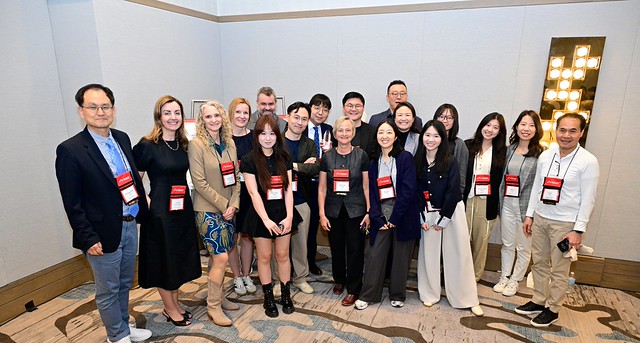
The Institute of Communications Research is excited to announce their newest cohort! Please learn more about the students’ research interests below and join us in welcoming them to the University of Illinois College of Media community this fall. For more information, see full student profiles.
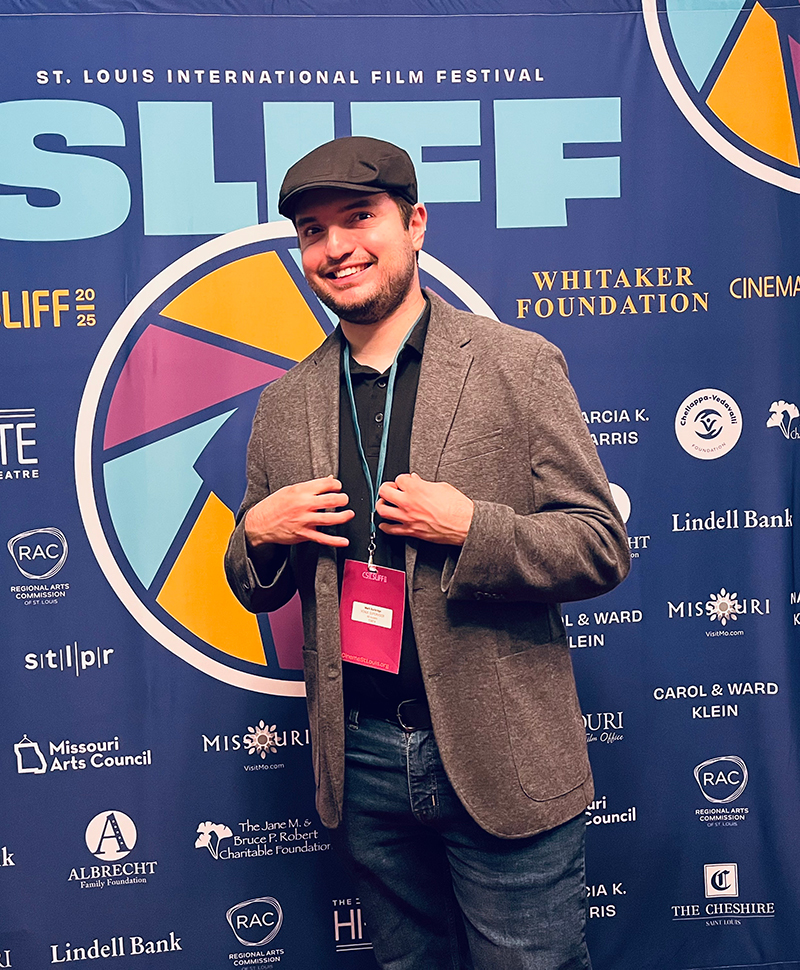
Mark Burbridge’s primary research areas center around film criticism, media studies, and digital media studies, with specific research focus on the evolution of film criticism, histories of film industry and media markets, and how emerging technologies affect popular film discourse.
Boram Cho’sresearch interests include AI creativity, human-AI interaction and collaboration, persuasion knowledge, emerging technologies and media in children and older adults, and ethical AI use.
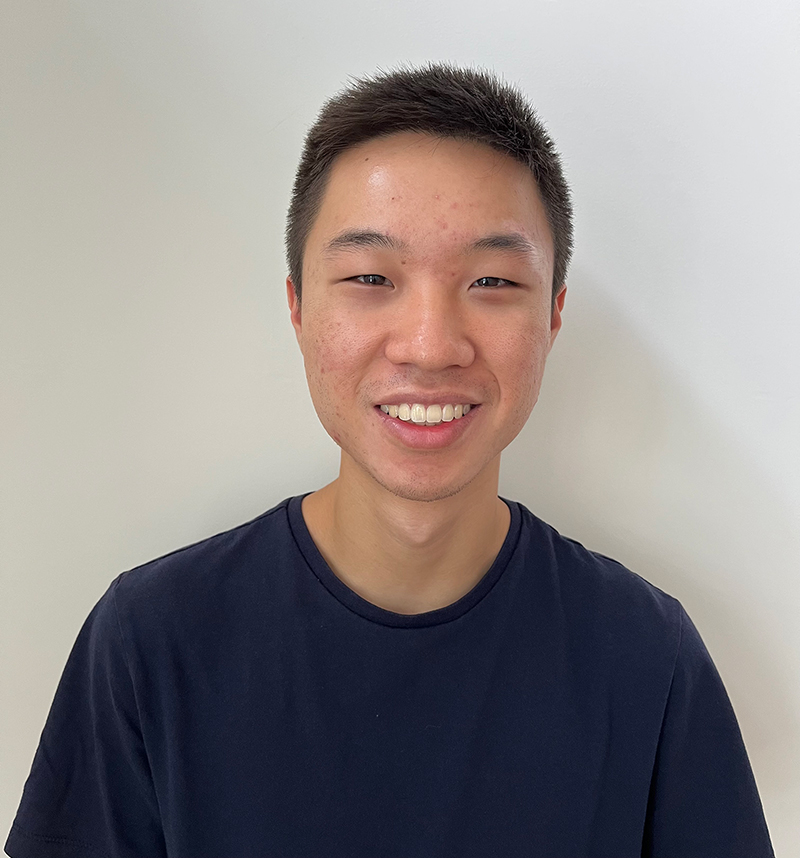
Matthew Huh’sresearch focuses on cultural and audience shifts found in contemporary pop culture, animation, and nostalgia, along with the impact of blockbuster media in film culture.
Jiayi (Joy) Wang’s research focuses on artificial intelligence in advertising and consumer behavior, with particular interest in how AI-generated advertising and persuasion knowledge shape consumer responses across digital platforms.
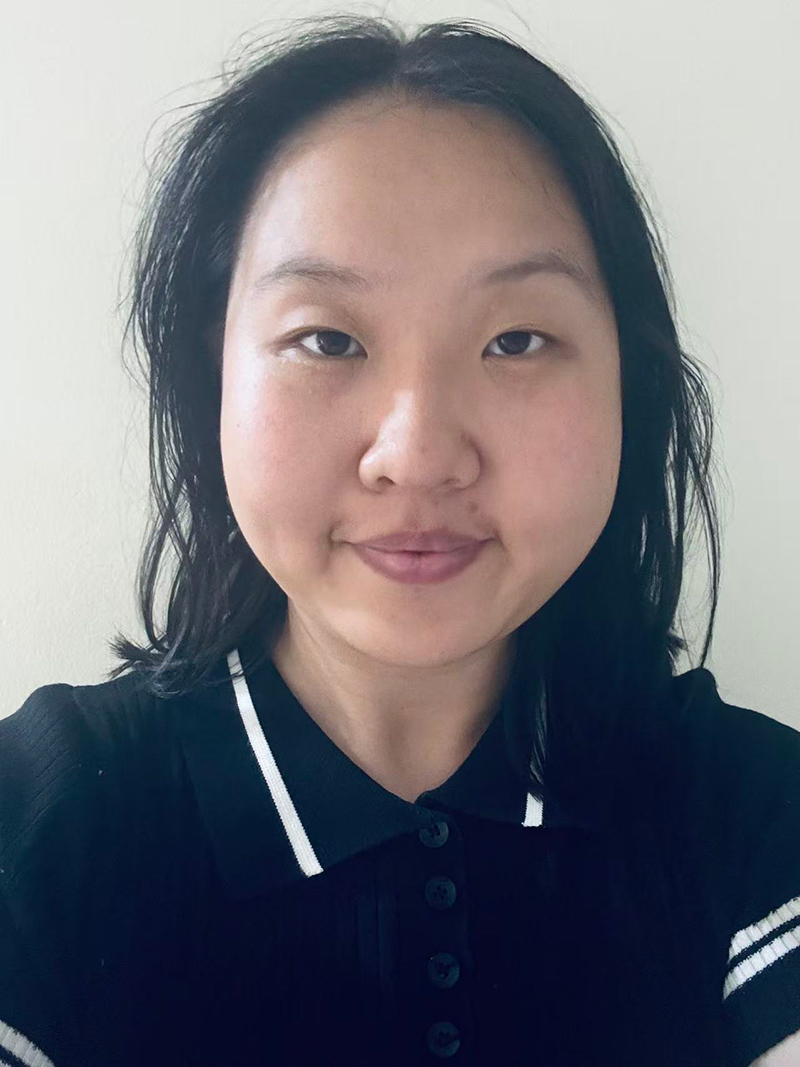
Chenqi Zhu’sresearch interests lie in the intersection of media and communication study, history of science, and science technology studies. She is interested in how communicative, scientific, and technological practices condition and transform each other across historical trajectories, and to their constitutive role in structuring human nature and broader social formations.
Seo-Jeong (Rachel) Heo is a PhD candidate in the Institute of Communications Research, which houses the world’s oldest doctoral program in communications and media. Heo’s research interest focuses on what happens as AI takes on a bigger role in consumers’ lives.
Describe your areas of research interest.
I’m especially interested in three questions. First, how do people make sense of AI in the first place—what do they believe a machine can genuinely experience, claim, do, or create? Second, what changes when AI moves from simply providing information to recommending, interpreting, and eventually acting on a consumer’s behalf? And third, what happens when AI becomes emotional—when it recognizes how we feel, expresses emotions of its own, or begins to function more like a companion than a tool?
How do you approach your research?
I study these questions in advertising and consumer decision-making across contexts such as virtual influencers, generative AI advertising, conversational AI, social robots, AI shopping agents, and emotionally responsive AI. I also try to study these technologies in settings that resemble how people actually encounter them. Rather than relying only on written scenarios, many of my studies use live AI conversations, interactive advertising interfaces, and simulated shopping environments where participants actually interact with or delegate tasks to an AI. That allows me to study not just what people say they would do with AI, but how they respond when the technology is actively participating in the decision.
As AI moves from communicating with consumers to influencing their decisions, to acting for them, and even relating to them, it keeps entering roles that were once occupied by people. I want to understand how consumers decide what role a machine is allowed to play in each of those roles—and what happens when it crosses the line.
Seo-Jeong (Rachel) Heo
ICR Doctoral Student
Why does your research matter?
Even if you never think of yourself as an “AI person,” AI is increasingly involved in ordinary decisions around you. It can influence which products you see, explain why an advertised option supposedly fits you, recommend what to buy, create the advertising itself, or even complete parts of a purchase on your behalf. At the same time, companies are designing AI to sound warmer, more understanding, and more human.
Each of those changes raises a different question that matters beyond AI itself. When AI creates or endorses something, we have to decide what kinds of claims we consider credible coming from a machine. When AI recommends something, we have to decide how much weight to give its judgment. When it acts for us, we have to decide how much control we are willing to hand over. And when it becomes emotionally responsive, we have to decide whether we are still interacting with a tool or beginning to treat it as a social partner.
Those are ultimately questions about persuasion, autonomy, responsibility, and relationships. They matter because AI is increasingly being inserted into moments where consumers are vulnerable to influence—when they are uncertain about what to choose, when they are delegating a consequential decision, or even when they are looking for emotional support. Understanding when these systems help people and when they become uncomfortable, misleading, or overly influential can inform not only advertising practice, but also how companies design AI and how consumers are protected as these technologies become more deeply embedded in everyday life.
How did ICR help you develop and hone in on your research area?
ICR gave me the freedom to follow a research question across disciplinary boundaries. My work is grounded in advertising and consumer psychology, but it also draws from communication, social psychology, human–computer interaction, and research on emotion and emerging technology. Having faculty with expertise spanning AI, computational approaches, and emotional and physiological processes made it possible for me to think about consumer–AI interaction from more than one perspective.
ICR also broadened my methodological training. In addition to experimental and survey methods, coursework in analytics and computational research introduced me to R-based data analysis (a free, open-source software environment designed for statistical computing and graphics) and encouraged me to think more broadly about the kinds of data and methods I can use. That combination of theoretical breadth and methodological flexibility helped me move from studying individual AI phenomena to developing a more connected research program.
Just as importantly, ICR taught me to keep asking, “What is the theoretical question underneath the new technology?” AI changes incredibly quickly. A platform or feature that feels novel today may look completely different a few years from now, so I learned not to build my research around a particular technology. Instead, I focus on the more enduring human questions underneath it—how people infer minds and intentions, respond to persuasion, give up control, assign responsibility, and form relationships.
What led you to be interested in your research area?
I became interested in AI because I kept noticing that the most interesting part was not whether the technology worked—it was how quickly people began treating it as something more than technology.
A conversational AI can produce a technically correct answer, but people still ask whether it really understands them. A virtual influencer can present a product perfectly, but consumers may still wonder whether it could actually have experienced what it is describing. And an AI can make a very good recommendation, yet that recommendation feels different once the system moves from saying, “Here is what I think you should buy,” to saying, “I can buy it for you.” That shift toward agentic AI, which can search, choose, and execute decisions on the consumer’s behalf, made me especially interested in what happens when people stop simply taking advice from AI and begin giving it authority.
What other aspects of your research do you find interesting?
AI systems are increasingly designed not only to be capable, but to be emotionally responsive—to recognize distress, offer reassurance, express emotion, and maintain ongoing conversations. That creates a very different set of questions. What does it mean when a machine says, “I understand,” or even, “I feel the same way”? When does that make the interaction feel supportive, and when does it feel artificial or manipulative? And what happens when repeated emotional interaction develops into something that consumers experience as a relationship?
Those moments are what continue to draw me to this area. As AI moves from communicating with consumers to influencing their decisions, to acting for them, and even relating to them, it keeps entering roles that were once occupied by people. I want to understand how consumers decide what role a machine is allowed to play in each of those roles—and what happens when it crosses the line.
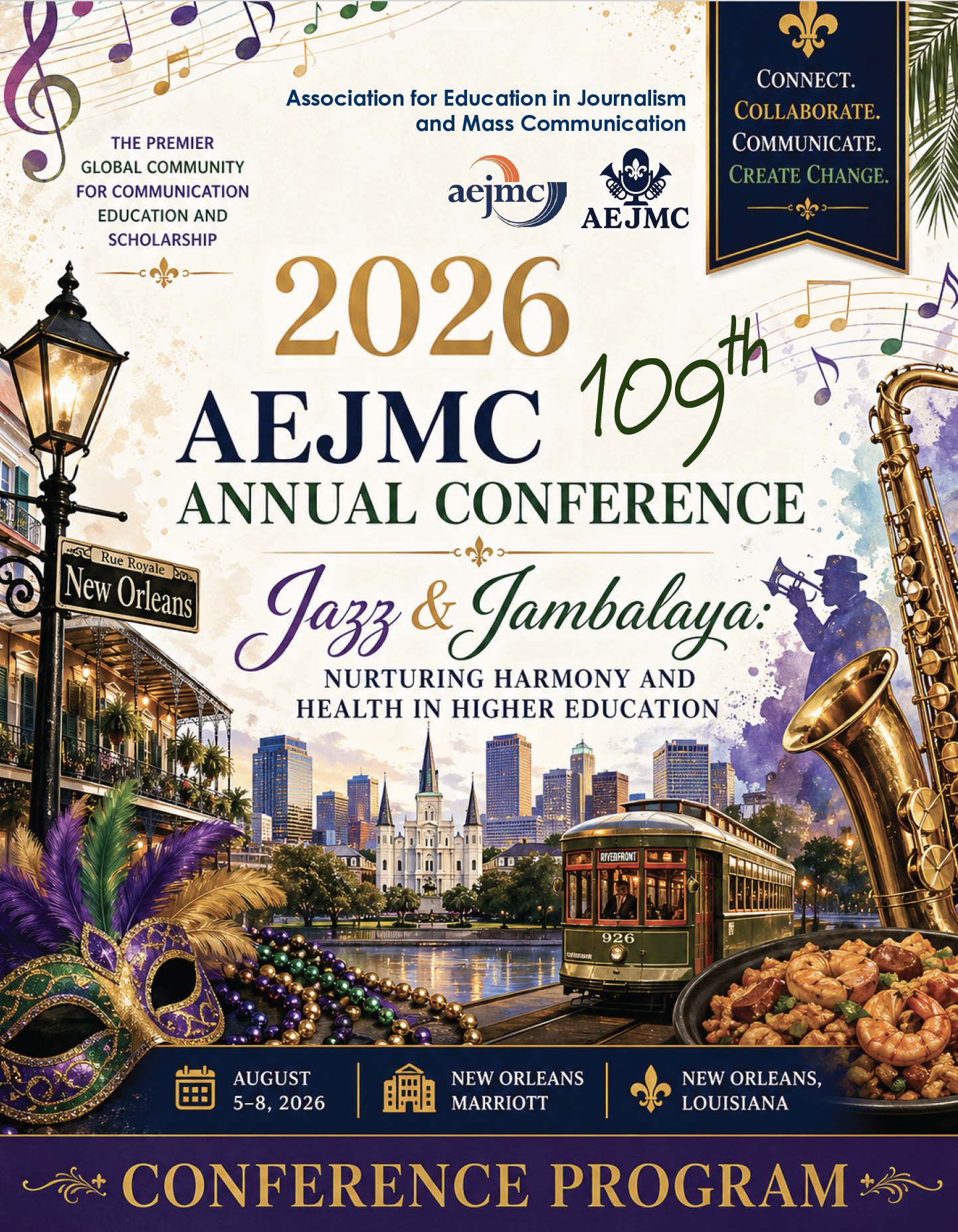
This year’s conference theme was “Jazz & Jambalaya: Nurturing Harmony and Health in Higher Education.” Presenters included faculty in the Institute of Communications Research, the Charles H. Sandage Department of Advertising, and the Department of Journalism; and graduate students in ICR’s PhD program and the MS advertising program.
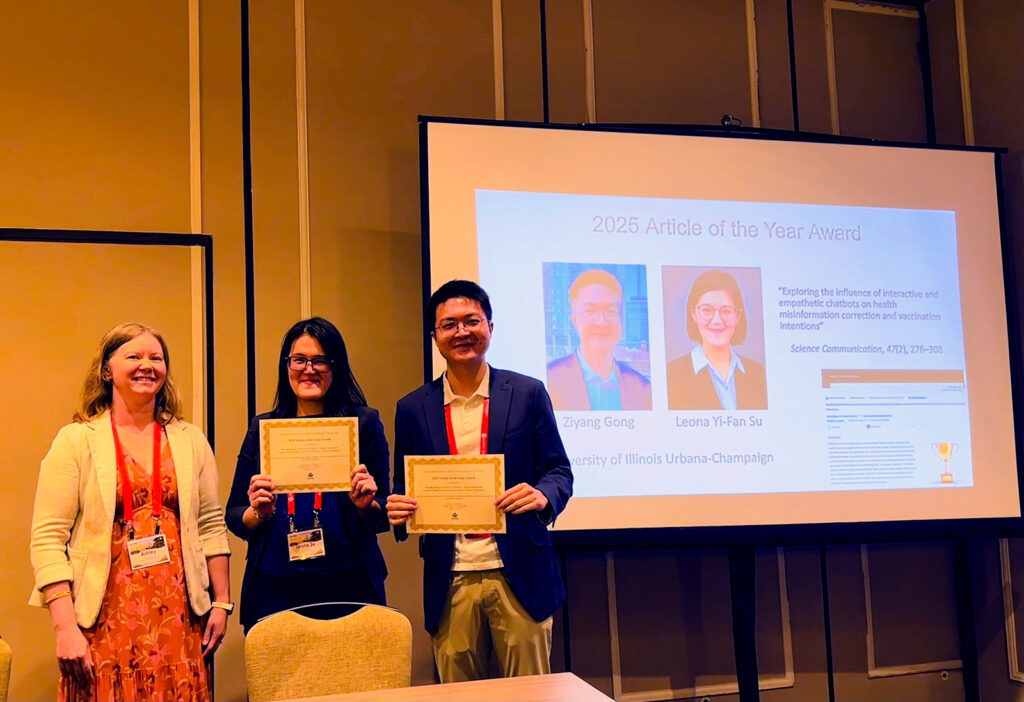
A Science Communication paper, “Exploring the Influence of Interactive and Empathetic Chatbots on Health Misinformation Correction and Vaccination Intentions,” co-authored by ICR Director Leona Yi-Fan Su and iSchool doctoral student Mobius Ziyang Gong (MS ’22, advertising) received the 2025 Article of the Year Award from AEJMC’s Communicating Science, Health, Environment and Risk Division.
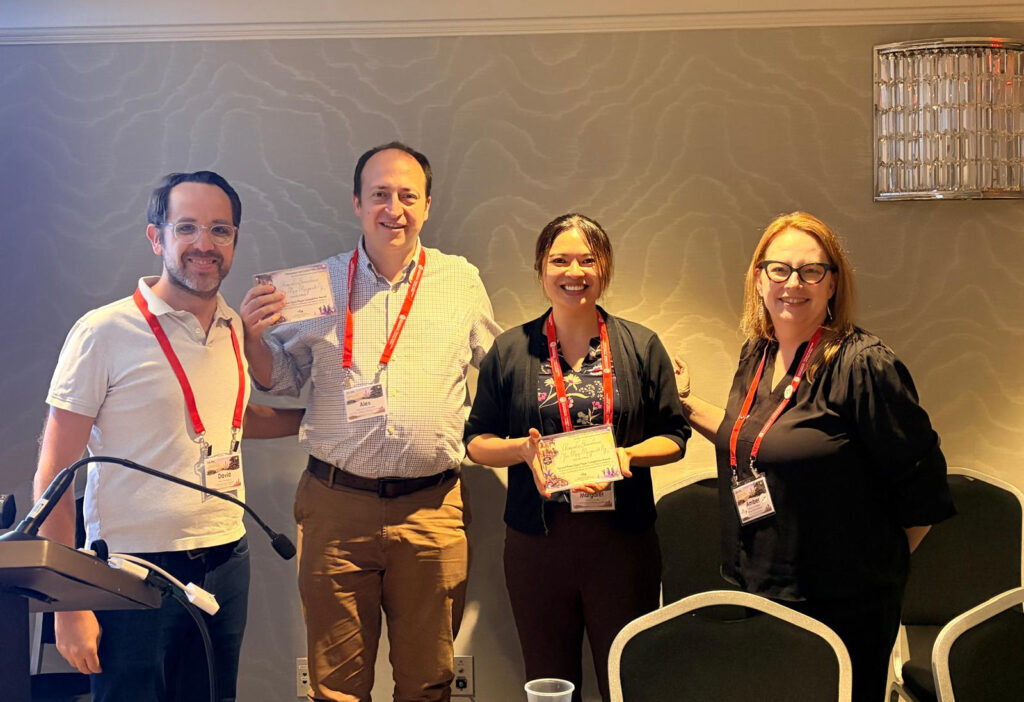
Journalism Professors Alexandre Gonçalvesand Margaret Yee Man Ng received Second Place Open Competition Award for their paper “Analyzing News Outlet Social Media Use: Platform Adoption, Usage, and Migration Across Two Decades (2005–2025),” in the Newspaper and Online News Division.
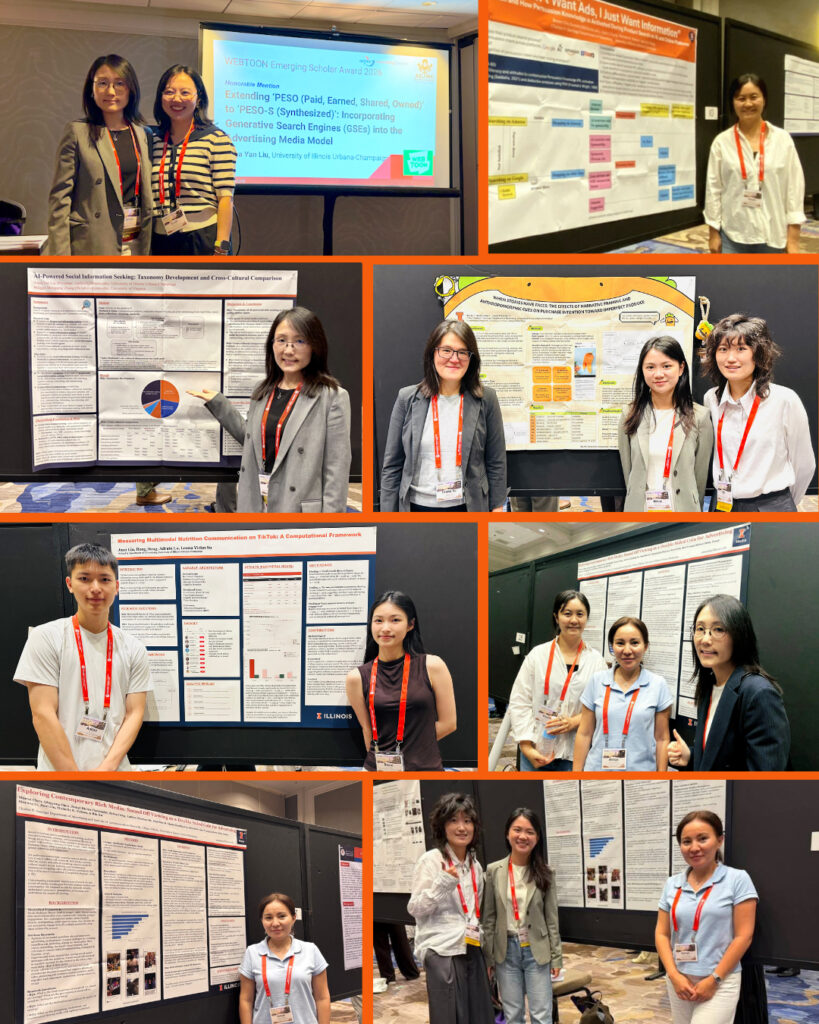
In addition, two ICR doctoral students received awards at the conference including Anthea Xiaohua He, who received second place in the Washington Media Scholar Fund Graduate Research Scholarship competition, and Anna Liu, who received an honorable mention for the Webtoon Emerging Scholar Award.
The AEJMC aims to promote the highest possible standards for journalism and mass communication education, to cultivate the widest possible range of communication research, to encourage the implementation of a multi-cultural society in the classroom and curriculum, and to defend and maintain freedom of communication to achieve better professional practice and a better-informed public.
College of Media research presenters and presentations are listed below. (Please see the AEJMC conference program for complete listings and participants.)
Su and Gong received Article of the Year Award in the Communicating Science, Health, Environment and Risk Division.Gonçalves and Ng received the Second Place Open Competition Award for their paper in the Newspaper and Online News Division.
Scholar-to-Scholar (Poster) RefereedResearch Paper Session
Visual Communication Across Digital Contexts
“Visual Metaphor Complexity: Structural, Semantic, and Cognitive Dimensions”
Faculty and graduate students from the College of Media co-presented various topics of research at the 76th annual International Communication Association Conference—the largest academic conference for communication scholars—on June 4-8, 2026, in Cape Town, South Africa. The ICA aims to advance the scholarly study of human communication by encouraging and facilitating excellence in academic research worldwide.
This year’s conference theme addressed “Communication and Inequalities in Context.” College of Media presenters included faculty in the Institute of Communications Research and the Charles H. Sandage Department of Advertising; graduate students in the MS advertising program; and doctoral students in the Institute of Communications Research PhD program.
College of Media research presenters and presentations are listed below in bold.
Pre-Conference: A Causal Inference Institute in Communication Studies Organizers
Shuning Lu, U of Maryland, College Park, USA
Ewa Maslowska, Associate Professor, Advertising
Harsh Taneja, Associate Professor, Advertising
When Communication Makes the Difference: From Signals to Relational Dynamics Human-Machine Communication “Reconsidering Gender: A Computational Examination of Conversational Dynamics between Human and Gendered AI”
Weizi Liu, Texas Christian U, USA
Haocan Sun, Beijing Normal U, CHINA
Mike Yao, Professor, Advertising
Human-Machine Care: Well-Being and Vulnerability Human-Machine Communication “Emotionally Vulnerable Subtype of Internet Gaming Disorder: Measuring and Exploring the Pathology of Problematic Generative AI Use”
Di Wu, Beijing Normal U, CHINA
Haocan Sun, Beijing Normal U, CHINA
Weizi Liu, Texas Christian U, USA
Guoming Yu, Beijing Normal U, CHINA
Mike Yao, Professor, Advertising
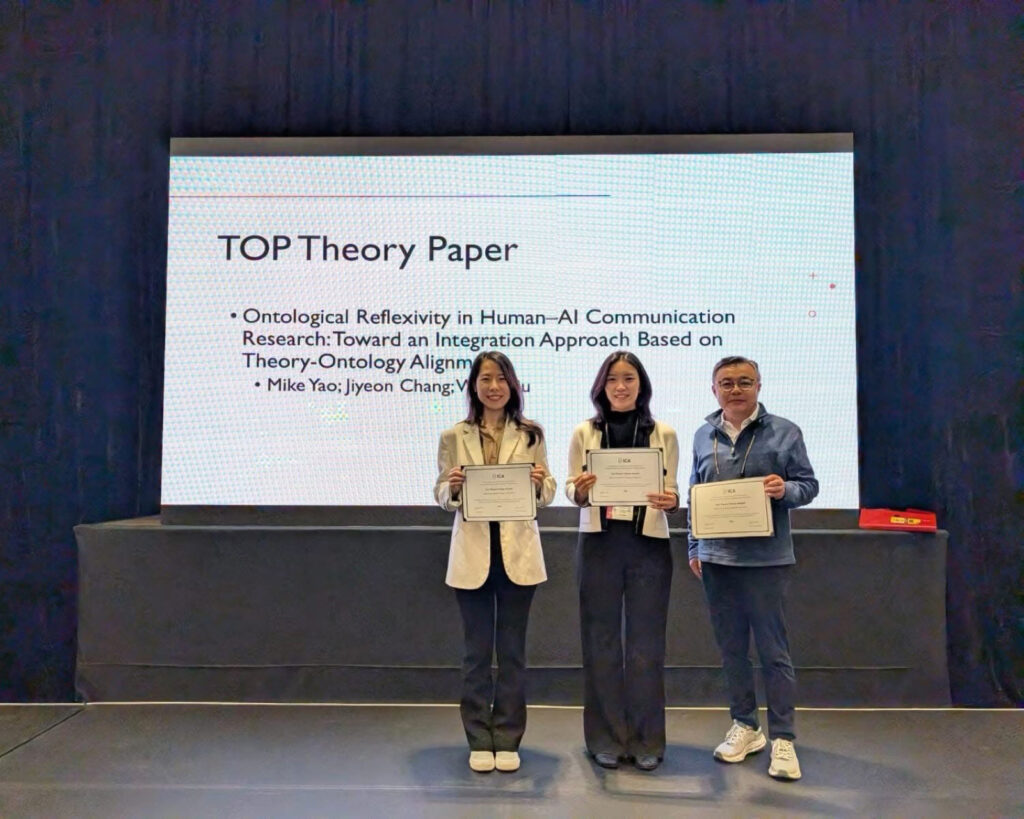
Top Papers in Human-Machine Communication Human-Machine Communication “Ontological Reflexivity in Human–AI Communication Research: Toward an Integration Approach Based on Theory-Ontology Alignment”
Mike Yao, Professor, Advertising
Jiyeon Chang, Student, ICR
Weizi Liu, Texas Christian U, USA
Persuasion and Consumer Behavior Information Systems “The Brand Transparency Paradox: Consumer Reactions to Explicit Mentions of Artificial Intelligence”
Viviana Zambrano Rodriguez, U of South Carolina, USA
Louvins Pierre, Assistant Professor, Advertising
“Exploring How Attitudes toward AI and Disclosure Influence Purchase Intention of AI-Integrated Products through Hedonic, Social, and Epistemic Value”
Louvins Pierre, Assistant Professor, Advertising
Viviana C. Zambrano Rodriguez, U of South Carolina, USA
Yanbo Li, Student, ICR
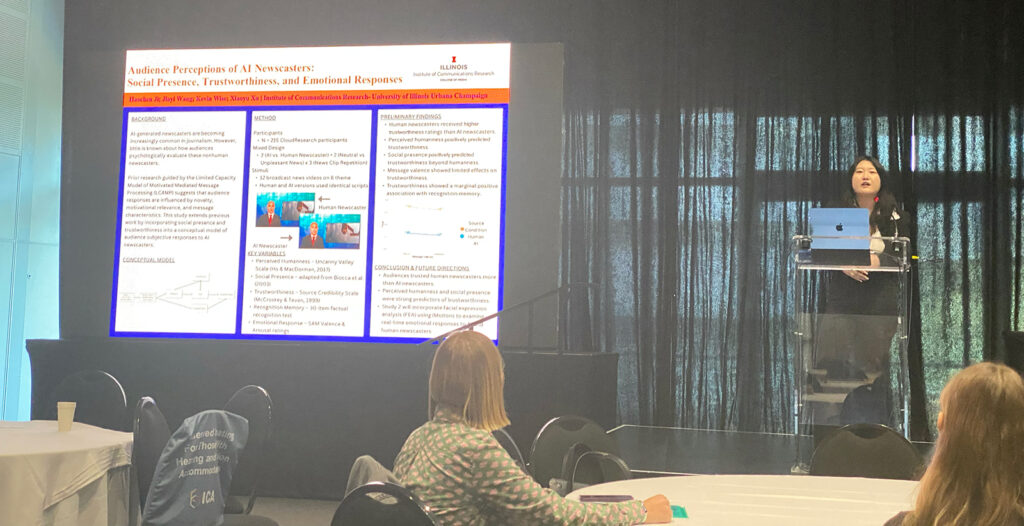
AI in News Production and Consumption Information Systems “Audience Perceptions of AI Newscasters: Social Presence, Trust, and Emotional Responses”
Haochen Ji, Student, ICR
Jiayi Wang, Student, MS Advertising
Kevin Wise, Professor, Advertising
Xiaoyu Xu, State U of New York at Cortland, USA
AI Taking Over: Promises and Pitfalls of AI Use in Research, Journalism, and Society Computational Methods “When Machines Start Writing: Assessing the Impact of Generative AI on Journalism Labor Markets”
Sakshi Bhalla, Student, ICR
Jennifer Henrichsen, Washington State U, USA
Benjamin Toff, U of Minnesota, USA
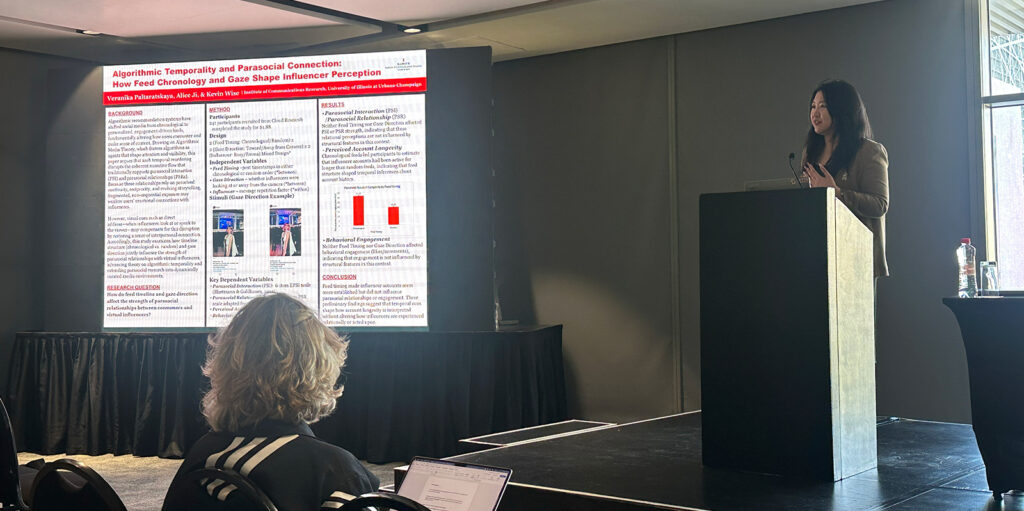
Cognitive and Emotional Processing Information Systems “Algorithmic Temporality and Parasocial Connection: How Feed Chronology and Gaze Shape Influencer Perception”
Veranika Paltaratskaya, Student, ICR
Alice Ji, Student, ICR
Kevin Wise, Professor, Advertising
Editorial Board Meeting: Journal of Computer-Mediated Communication (JCMC)
Chair: Mike Yao, Professor, Advertising
MIAU-steerable AI: Trust, Adoption, Dependency, and Behavioral Regulation in Generative Tech Ecosystems Communication and Technology “Social Media Exit and Platform Loyalty: Generational Differences in Platform Abandonment”
Margaret Yee Man Ng, Associate Professor, Journalism
Ewa Maslowska, Associate Professor, Advertising
Computational Methods Research Escalator Computational Methods “When AI Imagines Consumers: A Computational Analysis of Representational Bias in Generative AI Brand Imagery”
Haochen Ji, Student, ICR
Co-Constructing Trust in HMC Human-Machine Communication “Revisiting Trust in the Era of Generative AI: Factorial Structure and Latent Profiles”
Haocan Sun, Beijing Normal U, CHINA
Weizi Liu, Texas Christian U, USA
Di Wu, Beijing Normal U, CHINA
Guoming Yu, Beijing Normal U, CHINA
Mike Yao, Professor, Advertising
Growing up with AI: Children’s and Adolescents’ Understanding, Trust, and Risk Children, Adolescents, and Media “Children and AI Mind Attribution: Reasoning and Learning with ChatGPT through Social Learning Theory”
Boram Cho, Student, MS Advertising
Jiyeon Chang, Student, ICR
Michelle Nelson, Professor, Advertising
Top Papers Session Information Systems “Following the News: Polarization and the Networked Structure of Attention”
Sakshi Bhalla, Student, ICR
Perception, Trust, and Bias of Artificial Intelligence Information Systems “Emotional and Social Drivers of Artificial Intelligence Pessimism Aversion: Extending the Appraisal Tendency Framework to AI Environments”
Heng Zhang, Chongqing U, CHINA
Nansong Zhou, Student, ICR
Jer Shyuan Ng, Royal Melbourne Institute of Technology, AUSTRALIA
Shiyi Zhang, Chongqing U, CHINA
Masculinities, Femininities in Digital Communication Feminist Scholarship “Masculine Anxiety and the Making of Racialized Nationalism in China: A Qualitative Investigation Into Sunxiaochuan Bar”
Nini Zhou, Student, ICR
JungHwan Yang, U of Illinois Urbana-Champaign, USA
Advertising faculty with appointments in the Institute of Communications Research, doctoral students in ICR, graduate students in advertising, and ICR alumni participated in the 2026 annual conference of the American Academy of Advertising, held March 26-29 in Austin, Texas.
Through presentations and panels, they discussed research and ideas related to teaching AI and advertising, ethics, and more. Advertising Professor Chang-Dae Ham serves as the 2026-27 president-elect of AAA and will become AAA’s president next year.
Below is a list of the Illinois participants and their research.
Special Topic Sessions
“Navigating Advertising Academic Leadership During a Time of Change: An Inside Look at Administration Roles in the Age of A.I., Program Changes, and Industry Upheaval”
Speakers: Huan Chen (University of Florida), Joe Phua (Southern Methodist University), Shu-Chuan (Kelly) Chu (DePaul University), Matthew S Eastin (University of Texas at Austin Professor and Head Michelle Nelson, Soojung Kim (University of North Dakota), Fuyuan Shen (Pennsylvania State University), Tom Reichert (University of South Carolina), Heidi Hennick-Kaminski (Michigan State University), Harsha Gangadharbatia (University of North Carolina at Chapel Hill)
“Teaching Privacy in the Age of AI: Preparing Ethical Advertising Professionals”
Speakers: Kristen Sussman (Texas State University), Faren Karimkhan (Syracuse University), Daniela Molta (Syracuse University), Associate Professor Ewa Maslowska, Carina Alderete (Accenture)
Panels
“Foundational Framework in Virtual Influencer Marketing: Bridging Operational Control and Narrative Archetypes in Virtual Influencer Design”
“Peripheral Cues in a Democracy? Using the Elaboration Likelihood Model to Examine Information Cues and Negativity in Millions of Political TV Advertisements”
“Measuring AI-Advertising Aversion: An Initial Scale Development and Empirical Assessment of Its Relationship with AI Anxiety”
Speakers: Assistant Professor Louvins Pierre, Viviana Carolina Zambrano Rodriguez (University of South Carolina), MS advertising student Jiayi (Joy) Wang
“From Black Box to Glass Box: The Moderating Role of AI Literacy on the Political Matching Effect”
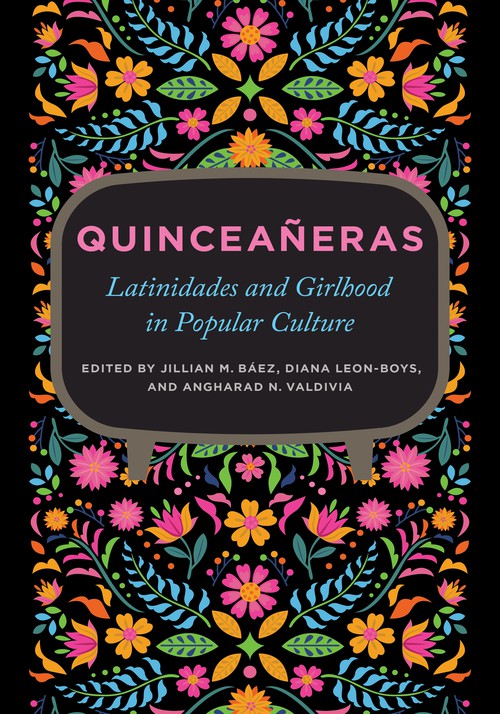
Jillian M. Báez (PhD ’09, communications and media, ICR), Diana Leon-Boys (PhD ’20, communications and media, ICR), and Institute of Communications Research Professor Emerita Angharad N. Valdivia (PhD ’91, communications and media, ICR) edited a collection that draws on the expanding field of girlhood studies to examine the increasing visibility of the event and the figure of the quinceañera herself in pop culture.
The contributors focus on quinceañeras as a trope for English-language media’s treatment of Latina girlhoods and Latinx cultures but also examine how use of the quinceañera charts openness and inclusivity within Latinx culture.
Mukhopadhyaym will join six other graduate students and seven faculty members who will meet at the Humanities Research Institute throughout the year to address how they are rethinking research paradigms.
The theme for this year’s Fellowship is “Up Against Erasure,” which invites researchers to persuade others of the stakes of identifying processes of erasure, of being up against it, and of working in opposition to it. Mukhopadhyay’s research narrative is “Governing the AIR: Radio, Polity, and Nationalism in Postcolonial India, 1950–2023.”
As an HRI Graduate Student Fellow, Mukhopadhyay will receive a $25,000 stipend and a tuition and partial fee waiver.
HRI grants fellowships to Illinois faculty and graduate students, who spend the year engaged in research and writing. All HRI Fellows participate in HRI activities, including the yearlong Fellows Seminar.
The Super Bowl, the Milano Cortina Winter Olympics, and the FIFA World Cup this summer have set the stage for a sports season defined not just by competition but by community.
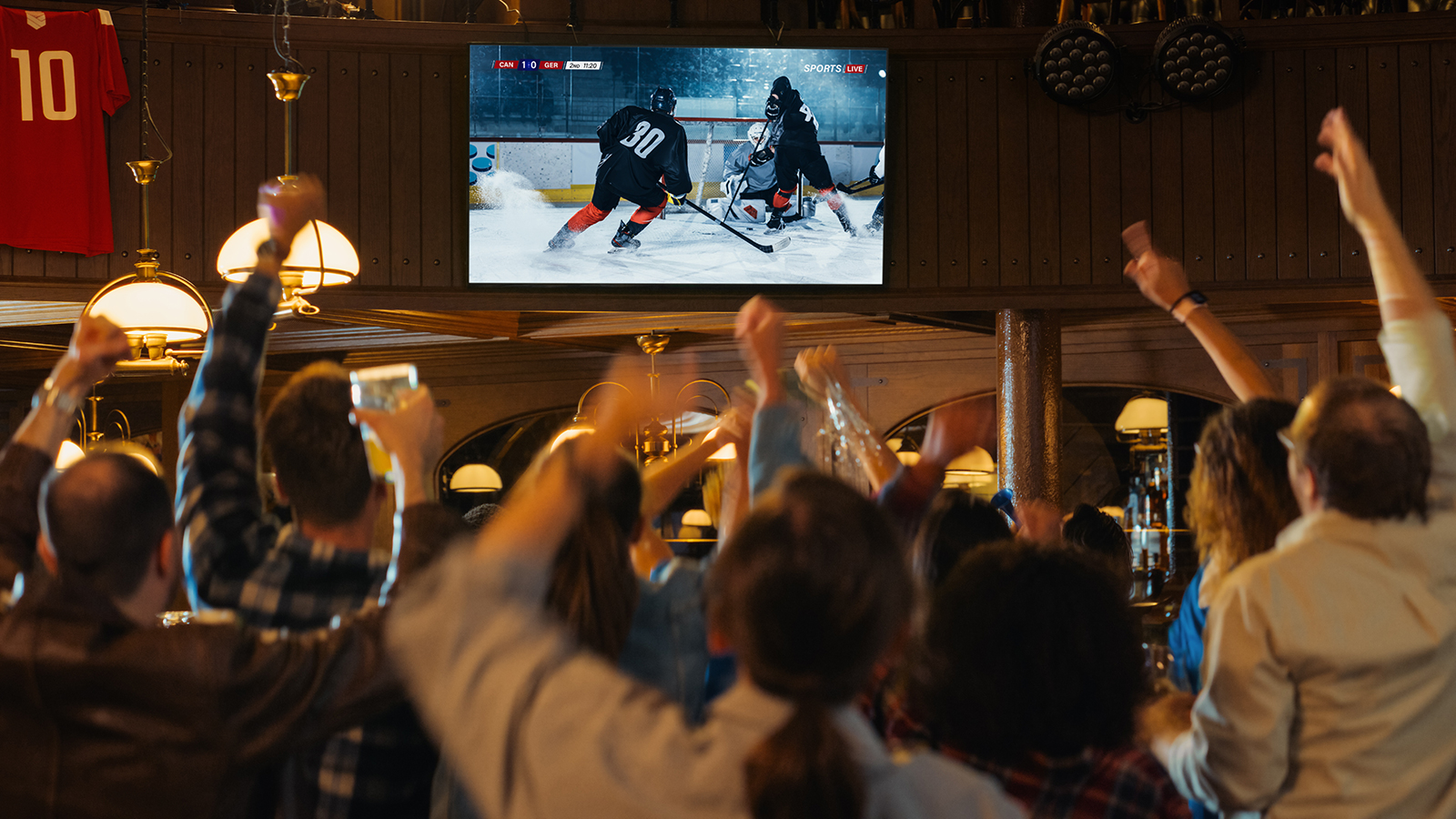
These sporting events create shared viewing rituals that bring millions of people together to experience the games in real time. And while audiences continue to reach historic highs, even as media habits fragment, it’s worth examining how these events shape identity, fandom, community, and the way people connect with one another.
To help understand why sports carry such cultural influence and how brands try to engage with fans in these moments of collective attention, we spoke with Steve Hall,senior lecturer of advertising, who is teaching a brand new course this semester on “Sports Advertising and Branding” and serves as chair of the University of Illinois Urbana-Champaign Athletic Board.
With the rise of “communal viewing”—from watch parties to bars to fan zones—how does the social nature of watching sports amplify the impact of an ad compared to watching alone?
Viewing sports together as a shared social experience can be extremely powerful and create incredible opportunities for advertisers. It can also pose serious challenges.
The impact of advertising in communal contexts is complicated and depends on a dizzying array of variables. There are a lot of questions that need to be asked. For starters, how does an advertiser define and measure impact? From a media perspective, there’s a ton of data analytics being generated to measure what and when people are watching when it comes to sports on linear and streaming platforms. But that’s just scratching the surface.
Questions remain: What kind of fan zone, bar, or watch party is it? Organized or spontaneous? Is the game, match, or race interesting or boring? What stake or emotional connection do each of the audience members have with the sport, teams, players, and the group of people or type of fans who are there watching? Favorite or rival team winning or losing? Are people intensely engaged, having side conversations, focused on eating a pastrami on rye, checking fantasy stats, or posting videos of themselves at the party on social media?
Then you have the ad itself. Is the storytelling mediocre or amazing? Does it connect with the audience on an emotional, human level from a creative perspective? Do people discuss, share, or comment on the ad with others in a positive or negative way? Is there a strategy to amplify the advertising message across omnichannel touchpoints?
Understanding the impact of advertising in communal viewing environments is complicated. Stay curious. Keep asking questions. Because you’ll never have all the answers.
With the United States co‑hosting the 2026 FIFA World Cup, how significant is this moment for American brands looking to reach a global audience—especially given soccer’s growing popularity in the U.S.?
Whether you call it soccer or football doesn’t matter—the 2026 FIFA World Cup is a huge moment for all brands looking to reach global audiences. As the most popular sport on the planet, fandom is massive and culturally diverse. That opens a very big door for advertisers to tell their stories, create experiences, and connect with people everywhere on the world stage. To be successful, culture should be at the epicenter of advertising, fan engagement activities, and marketing programs. Branding is about what people think, feel, and believe. It’s reputation.
The FIFA World Cup will present incredible opportunities for advertisers to leverage culture, meet new audiences, create trust, and build relationships with everything from in-stadium brand activations to prime-time TV commercials. This global event will allow brands to align fans, teams, and athletes with relevant, authentic storytelling, sponsorships, partnerships, and innovative experiences that will not only reach global audiences, but connect with them in entirely new ways. After all, the world will be watching. Game on.
What are students currently analyzing and discovering in your brand new “Sports Advertising and Branding” course?
Currently, we’re looking at the relationship between culture, trends, and sports. Overall, the class allows students to explore, discover, and examine sports advertising and branding in a broad array of contexts that connect advertising, marketing, media, sports, teams, athletes, fans, events, experiences, and partnerships at amateur, collegiate, and professional levels.
The course introduces industry practices and processes to help students understand and apply concepts related to research, data, consumer behavior, strategic planning, creative content, production, media, and branded integration into the incredibly immense and fascinating world of sports.
Specific topics include sports information, public relations, event management, fan engagement, merchandising, brand activation, technology, e-sports, NIL, gambling, ethics, personal branding, sports celebrities, and collaborations. The class also incorporates experiential learning opportunities with alumni, sports industry professionals, and coaches, as well as attending NCAA athletic events on campus.
As a CAS Associate, Ng will take time off from teaching in Fall 2026 to advance her research on “platform migration,” focusing on how regulatory bans, algorithmic shifts, and geopolitical tensions drive user migration between social media platforms. She argues that these shifts are fueling digital nationalism and reshaping digital sovereignty in an increasingly fragmented society.
Ng said recent events highlight the urgency of this topic, including the restructuring of TikTok in the U.S. and regulatory restrictions in Taiwan, the decline of Twitter/X use among journalists and academics, and the rise of Truth Social as the de facto official channel for the U.S. Presidency. These events reveal how global tensions and local politics are transforming the platforms people choose and the public spheres they build.
“We live in an era of rapid digital migration. We are seeing a wave of “digital migration” where users are trading in the dominant platforms for new communities that match who they are and what they care about.” Ng said.
“This project examines the forces behind this shift—from algorithmic decay and privacy concerns to political polarization and digital fatigue—and how these movements are reshaping the social, political, and cultural dimensions of online life.”
Ng said her study will particularly investigate digital migration across the United States, Hong Kong, and Taiwan by integrating large-scale computational analysis, surveys of thousands of users, and in-depth interviews with college students, journalists, tech workers, and elderly users. Drawing from those insights, the project will develop a framework that explains how political systems, institutional pressures, and everyday user practices intersect to shape modern migration patterns.
Ng said the findings promise to advance both theory and policy by documenting how these digital migrations create new forms of labor precarity, fragment public discourse, and erode the shared information environment essential for democracy. As users segregate into platforms that reflect their personal identities, the project explores how this new “digital mobility” challenges Big Tech dominance, redefines national sovereignty online, and ultimately reshapes the future of media, regulation, and public life.
Ng was appointed a CAS Associate for the Fall 2026 semester upon the recommendation of CAS professors and with concurrence of campus and university administrations.
CAS Associates are tenured Illinois faculty members whose project proposals are selected in an annual competition. They are granted one semester of teaching release time to pursue an individual scholarly or creative project.
The Center for Advanced Study works with every department on campus to identify and support the most productive, high-achieving, and innovative faculty at Illinois, providing them with connections and funding to pursue their work. Members of this accomplished community are invited to participate in CAS activities throughout the year and given opportunities to present their work to the CAS community. See CAS’s upcoming events.
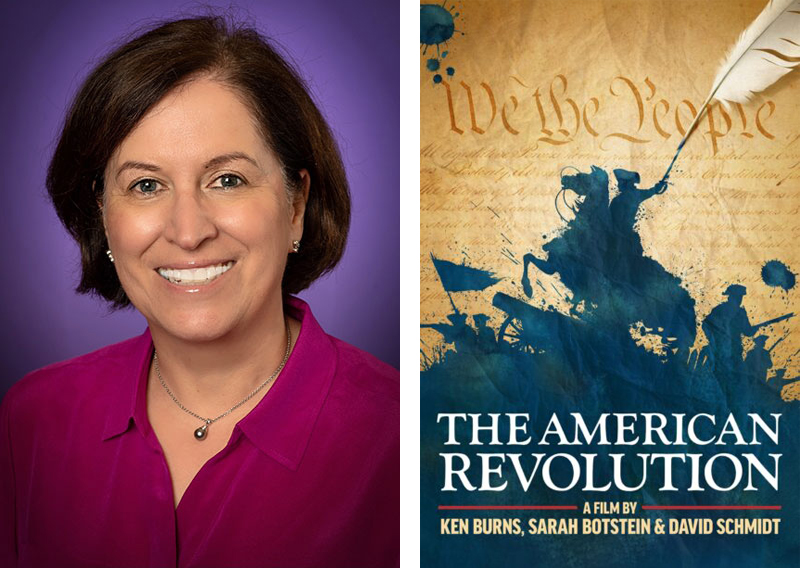
Ken Burns’s new PBS series The American Revolution is more than a sweeping historical documentary—it illustrates the ways in which journalism helped ignite and sustain the fight for independence. Melita Garza, associate professor and Tom and June Netzel Sleeman Scholar in Business Journalism, and winner of Journalism History’s 2024 essay contest, shares her insights on journalism’s pivotal role in shaping America’s founding era.
About the Media Expert
Melita M. Garza, associate professor in the Department of Journalism and a faculty member of the Institute of Communications Research, is an American journalism historian who studies news as an agent of democracy, specializing in English- and Spanish-language news, the immigrant press, and coverage of underrepresented groups. She is the lead editor of The Routledge Companion to American Journalism History (2024). Her research has won awards from the American Journalism Historians Association, and the Association for Education in Journalism and Mass Communication divisions of: History, Minorities and Communication, and International Communication.
How does this series place journalism at the heart of the American Revolution?
The most obvious example is the documentary’s treatment of colonial reaction to the Stamp Act, showing that the two dozen weekly newspapers, along with pamphleteers, stoked support for colonial tax protests. Significant though this is, the imprint of journalism on the Revolution is much bigger than that.
Bostonians reading the Stamp Act in 1765, public domain, via Wikimedia Commons
Consider that Burns starts his six-part history with a quote from Thomas Paine, America’s first political journalist. The documentary opens with a black screen that slowly transforms into the pink, purple, and yellow colors of dawn. The audience then hears a voice intoning:
From a small spark, kindled in America, a flame has arisen not to be extinguished. Without consuming, it winds its progress from nation to nation, and conquers by a silent operation. Man finds himself changed and discovers that the strength and powers of despotism consist wholly in the fear of resisting it, and that in order to be free, it is sufficient that he wills it.”
Although these words of agency come from Paine’s The Rights of Man, written in 1791 during the French Revolution, they capture the spirt of Paine’s earlier writings, such as Common Sense, which helped catalyze the colonists to pursue and persist in the American Revolution. Writing for Wired in 1995, Jon Katz explained why this pioneer of free expression should be remembered in the Internet age. “Because we owe Paine. He is our dead and silenced ancestor. He made us possible.” The documentary covers the eight years of the American Revolution, making it impossible to push too deeply into any single historical actor’s role with the depth they deserve. Ideally, however, the series will inspire viewers to take another look at Thomas Paine and other figures from our past whose impact isn’t fully understood today.
Political cartoon (1754) attributed to Benjamin Franklin, public domain, via Wikimedia Commons
And there’s more. Still within the first two-and-a-half minutes of the documentary, viewers are introduced to Benjamin Franklin. Although described simply as a noted scientist and writer in The American Revolution, Franklin was a pivotal figure in the development of American journalism and is credited with publishing one of the earliest pieces of colonial visual journalism: the political cartoon. The documentary showcases the famous “Join, or Die” snake woodcut drawing, published in Franklin’s Pennsylvania Gazette on May 9, 1754. Originally designed to rouse the colonists to unite during the French and Indian War, the documentary notes that it was republished to urge colonial unity against the British during the American Revolution.
The documentary is replete with such examples of what I call “hidden” journalism, in which their groundbreaking significance to the journalism profession as a whole remains obscured.
Apart from serving as a sparkplug for rebellion, what are some other ways the documentary depicts the role of journalism in colonial life?
There are a few things, again, just in the first installment, that the documentary flicks at, which underscore the primacy of journalism and print culture more generally in the lives of the colonists. For instance, in a segment discussing the impact of British culture on colonial life, historian Jane Kamensky references the London Book Shop and the Crown Coffee House in Boston. Bookstores offered colonial citizens exposure to Enlightenment ideas, among other things, and served as centers of cultural exchange for the community. Book sellers were often also in the newspaper business. One such newspaper owner was Benjamin Franklin, who is also credited with being first to open a book shop in colonial America. Likewise, coffeehouses were central places for the exchange of news and newspapers. These are two more examples of the “hidden” journalism in the documentary.
Another aspect of journalism that might be easy to overlook in the documentary involves the episode of the Saturday, December 27, 1760, arrival of the British frigate that “brought with it big news”—the death of King George II and the ascendancy of King George III to the British throne. In early colonial America, it was often faster to get news from England by ship than it was to get news from southern colonies, considering the state of the roads at the time. Even so, having to wait two months to find out that you were being ruled by a new monarch illuminates the pace of colonial communication compared to that of today’s high speed Wi-Fi society.
What can TheAmerican Revolution teach us about telling historical stories in ways that connect with today’s audiences?
Ken Burns is well known as a gifted storyteller and the documentary’s striking visuals, sound effects and music, and well-edited commentary from experts, are staples of his work. In The American Revolution, letters and journals from young men, women, and officials and pundits on both sides are the stars. These primary sources allow individuals to speak as though they are reporting to us from the homefront and the battlefront, and that brings the Revolution right into our living rooms centuries after it ended. Simply employing solid storytelling techniques is only partly why the story resonates with today’s audiences. The other reason is that we can see parallels with our own experience. Some of these parallels are obvious. Others are a matter of perspective.
Thomas Paine (1792) by Laurent Dabos, public domain, via Wikimedia Commons
For instance, one scene shows colonists on the street reading newspapers together, with some looking like they are commenting to each other. Thinking critically about media and information, the colonists were practicing true social media. In person, face-to-face, they exchanged ideas in a way today’s often anonymous, digital exchanges can’t compare. And as the documentary also notes, word of mouth was also a prime source of news. While it is true that stories and ideas didn’t have a World Wide Web to buzz through, these mechanisms still allowed journalism, starting with Thomas Paine’s Common Sense, to go viral through the colonies. In fact, the documentary points out a prime reason for print culture’s popularity in the Thirteen Colonies: At the time, only Scandinavia was more literate than the American colonial population.
Other relatable issues that we still grapple with today, such as women’s rights, the limits of free speech, taxation, and immigration, to name a few, are also highlighted. Take immigration. In the documentary, historian Christopher Brown discusses “the sheer diversity…living in the heart of the Thirteen Colonies”: Africans, Scots, Scots-Irish, Huguenots, Germans, and Native Americans, along with the English. The outcome of American Revolution, both the reel one and the real one, proves it was not culture, national origin, or language that brought the colonists success. In historian Christopher Brown’s words, the colonists cohered “around a set of purposes and ideals for one common cause.” In my view, the American Revolution shows how colonial journalism played a prime role in establishing coherence for that single cause: freedom.