2024-25 Ebert Fellows announced


Each fall, the Roger Ebert Fellows program selects three College of Media undergraduate students to complete a yearlong fellowship that immerses students into the film industry and provides them with opportunities to sharpen their critical writing skills and engage with the film community.

Ebert in theatre- orange

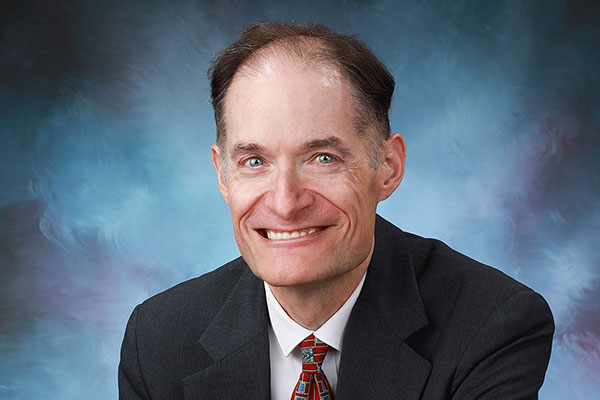
The Roger Ebert Fellows for the 2024-25 academic year are Aaron Anastos, Kennedy Caldwell, and Diamond Steward-Hutton. 

The program, named after the late Pulitzer Prize-winning film critic and University of Illinois journalism alumnus Roger Ebert, allows fellows to work with Chicago Tribune film critic Michael Phillips to hone their skills in writing, critical analysis, and media studies, as well as meeting with various film and media workers in “immersion excursion” days in Chicago.

Phillips, who has been an advisor and mentor for the program since it began in 2015, hopes to teach the Ebert Fellows the principles of becoming effective critics. 

“My job, as I see it, is to kind of take the entire school year to figure out different ways to show them what might help them become more persuasive, more interesting writers,” Phillips said. 

The Ebert Fellows will also attend the True/False Film Festival in Columbia, Missouri, and produce written work for RogerEbert.com. They will also help host and curate screenings for the Roger Ebert Center for Film Studies.

“With all the people we meet over the course of the Ebert Fellowship, I hope each of the fellows finds at least one person, somewhere in the world outside U of I, who speaks directly to their own interests and passions,” Phillips said. “I’m here to help them make connections because we all need them.”

Meet the 2024-25 Ebert Fellows

Aaron Anastos

Aaron Anastos is a junior in journalism. Anastos is excited to sharpen his writing skills, work with the other fellows, and give more to the film community on campus. 

“To be able to have this opportunity to meet people with the same passions and get involved, and be able to improve our skills in writing, public discourse, criticism, all that interesting stuff, it meant a lot,” Anastos said. 

He believes that the fellowship will help him marry his passions for journalism, film, and writing. 

On campus, Anastos is involved in the UI7 Newsroom as a host and reporter for Good Morning Illini, an opinion columnist for The Daily Illini, and a residential advisor at Newman Hall. 

Anastos is a fan of the Lord of the Rings trilogy because of the film’s powerful themes.

“I think it’s a story that truly has something for everybody,” Anastos said. “It has themes that everyone can relate to that are powerful, no matter what phase you are in life.”


Kennedy Caldwell

Kennedy Caldwell is a junior in journalism. Caldwell became interested in media and production at a young age after being featured in several advertisements as a model. As an Ebert Fellow, she wants to improve her writing skills and learn how to create good stories. 

“I’m really excited to get to know my other fellows. I’m really excited to get to know Michael [Phillips]. And I’m really excited to get to know more about what it means to be a film critic and how to tell people about movies in a vivid, detailed way that makes them want to watch it or makes them not want to watch it,” Caldwell said. 

Caldwell is looking forward to traveling to different film festivals to watch movies and meet new people. 

One of Caldwell’s favorite films is Its About Time because of the way it mixes drama, comedy, and romance.


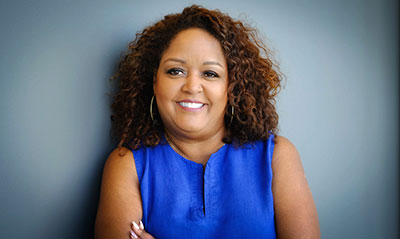
Diamond Steward-Hutton

Diamond Steward-Hutton is a senior in journalism and developed a passion for news while growing up watching ABC7 Chicago and learning the importance of staying informed on certain topics. 

“I always wanted to be able to know how to improve my storytelling as an anchor, as an artist, and just a person who writes on the daily…. [This opportunity] means the world to me,” Steward-Hutton said. 

She is interested in becoming a news anchor and is involved with UI7 Newsroom and the National Association of Black Journalists. 

“[It’s important] to learn how to write, to learn how to connect with people, and also to build that credibility and that trust with people, so that could be carried on throughout my career,” Steward-Hutton said. 

Steward-Hutton’s favorite film is Love Jones because of the realistic storyline and the performances from actors Nia Long and Larenz Tate. 

Share on social
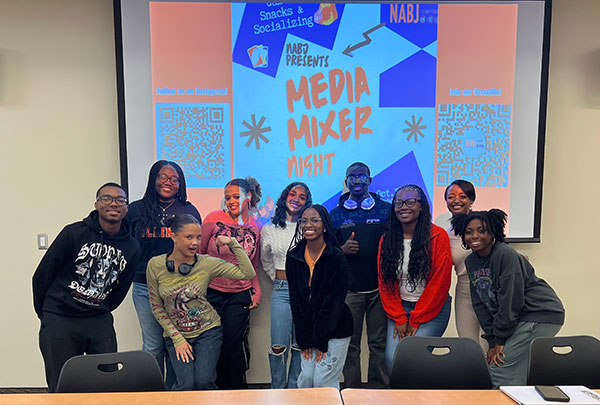
Illinois chapter of National Association of Black Journalists promotes unity among Black Media students


At its first event of the 2024-25 school year, the Illinois chapter of the National Association of Black Journalists hosted “Black on Black Commentary,” where students discussed popular topics involving the Black community in the media, such as election coverage of Vice President Kamala Harris and the failure of cosmetic brands to include Black customers. 

NABJ Media Mixer

It’s an event NABJ, a registered student organization, has held in the past and one that inspires back-and-forth conversations around current events.  

“We talk about different topics on social media that kind of go viral and we discuss the implications that they have on the African American community,” said Faith Lee, president of the NABJ Illinois chapter and senior in journalism. 

The event, which is one of many the NABJ holds on campus throughout the year, is designed to help meet the mission of the local chapter—to promote unity among Black Media students across the University of Illinois. 

“Sometimes it can be hard to meet people in your classes that look like you and that feeling can definitely be isolating,” Lee said. “I know I’ve felt it before, just being in class and on campus, sometimes just in general, being the only person of color.”

That’s why Lee says organizations like NABJ are so important. They not only bring Black students together, but also help to provide professional development and networking opportunities. 

“I’ve learned that while it’s important to network upwards, it’s also important to network across with your peers because they’re going to be the ones who are sitting in those rooms with you in the future,” Lee said. “You never know where we all might end up, so it’s important to make connections now so that in the future we can have each other in mind for jobs.”

We hope to be there to give advice on something as small as what class to take, to recommending internships to each other, to just being that community that I feel like we need.

Recently, the Illinois chapter hosted Leona Towner, author of 23 and on TV, who spoke about the day-to-day life of a multimedia journalist. She shared vital information on overcoming barriers, standing out in the industry, and the importance of telling compelling yet authentic stories. 

They also held a media mixer where all College of Media students were invited to get together and play games, such as a creative advertising competition, Uno, Jenga, and speed networking.

NABJ at Quad Day

Lee said the events are specifically designed for students, intended to provide an environment where everyone feels comfortable being themselves, sharing their passions, and learning from each other.

“We hope to be there to give advice on something as small as what class to take, to recommending internships to each other, to just being that community that I feel like we need,” she said.

The National Association of Black Journalists was founded nearly 50 years ago to advocate for Black journalists and media professionals in the U.S. and worldwide. Leon Dash, Pulitzer Prize winner and Swanlund Chair Professor of Journalism at the College of Media, was one of 44 Black journalists who founded the organization in 1975.

Today, NABJ’s national membership is more than 4,000 strong and includes emerging journalists, professional journalists, student journalists, journalism educators, and media professionals of all kinds.

For Lee, who is a Mark L. Brandt Public Engagement Fellow with the Richard and Leslie Frank Center for Leadership and Innovation in Media, business manager of the Illio yearbook, a College of Media communications intern, and educational chair of the National Association of Colored Women’s Clubs, Inc., serving as president of the Illinois chapter of the NABJ has provided her an opportunity to cultivate her leadership style. 

“One of my personal goals this year was not just to be president for the sake of being president, but also to help those who are coming up behind me to find their footing in the College of Media and be successful, and not feel alone, and find that community that they might be seeking out,” Lee said.

For more information about the Illinois chapter of NABJ or upcoming events, email uofinabj@gmail.com or check out their Instagram account, @nabjuofi.

NABJ meeting
Photos provided by Faith Lee, pictured at center in the “Illinois” T-shirt.

Share on social

NBC News’ chief political analyst Chuck Todd to visit the University of Illinois for a conversation on presidential election results


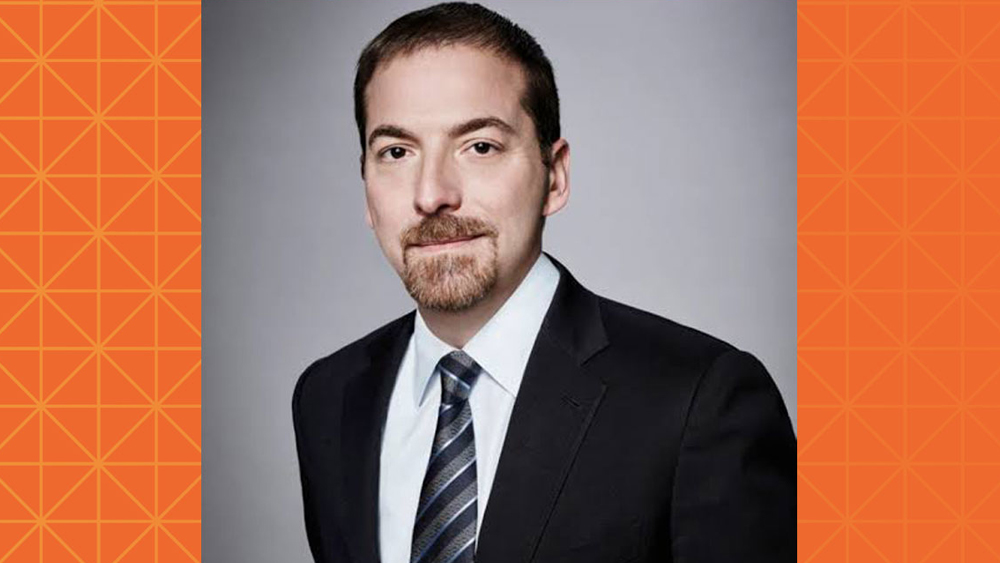
Chuck Todd, NBC News’ chief political analyst and former moderator of the network’s flagship Sunday public affairs program Meet the Press, will be on the University of Illinois Urbana-Champaign campus for a conversation about the presidential election results on Tuesday, Dec. 3, from 5-6 p.m.

Chuck Todd

Todd will discuss what we can learn about voters and the country following the election results, what kind of messaging we can expect in the president’s first 100 days, the importance of local news, as well as some of his career highlights.

This event is free and open to the public and is presented by the Richard and Leslie Frank Center for Leadership and Innovation in Media at the University of Illinois College of Media. 

Attendees may join the event in the Gregory Hall auditorium (Room 112), 810 S. Wright, Urbana, or register to join via Zoom. The conversation will be led by Colleen King, director of the Frank Center and clinical assistant professor of journalism. 

“There is no one better qualified to help us understand the state of American politics than Chuck Todd,” King said. “For three decades, he has had a front-row seat to American politics and held the country’s top lawmakers accountable week after week. The Frank Center is honored to welcome him to Illinois at such a critical time.” 

Todd, a three-time Emmy Award-winner for his contributions to NBC News’ election night and breaking news coverage, was moderator of Meet the Press from 2014 through 2023. Building on the success of MTP Daily, which Todd anchored for eight seasons on MSNBC, Todd launched Meet the Press NOW in 2022—a daily show on the streaming platform NBC News NOW—that brings the insight and analysis made famous by the Sunday show to a wider audience than ever before. Todd also hosts the seasonal deep-dive show Meet the Press Reports and the weekly podcast Chuck ToddCast.

For more information, please contact Colleen King at cck@illinois.edu

Share on social

Have newspaper political endorsements outlived their purpose?


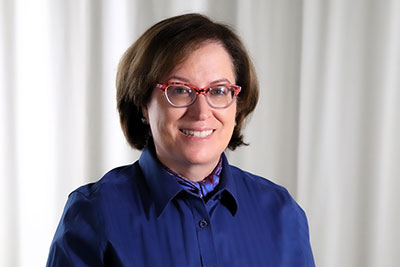
Melita Garza, associate professor and Tom and June Netzel Sleeman Scholar in Business Journalism, is a journalism historian who studies news as an agent of democracy. University of Illinois News Bureau editor Lois Yoksoulian discussed the history and future of presidential endorsements with Garza in light of recent nonendorsement decisions within some news organizations.

Melita Garza

Melita Garza, associate professor and Tom and June Netzel Sleeman Scholar in Business Journalism, is a journalism historian who studies news as an agent of democracy. University of Illinois News Bureau editor Lois Yoksoulian discussed the history and future of presidential endorsements with Garza in light of recent nonendorsement decisions within some news organizations. 

Why do some newspapers endorse presidential candidates?

In the early days of the republic, newspapers were partisan tools, often funded by politicians. In the early 1800s, it was fairly common to see publishers and editors as leaders of local political parties. Local and national party tickets were printed in newspapers, and the role of editors and publishers in state conventions was announced in the paper, too. 

Such open political involvement today would be seen as unethical and would clearly compromise the news product. As the 19th century progressed, the press became free of party control. By the early 20th century, traditional newspapers pursued the widest audiences possible, emphasizing news that would appeal across the political spectrum. 

Advertising subsidized the news pages—the larger the circulation, the more newspapers could charge advertisers. Journalists bolstered their credibility and high standards through the Society of Professional Journalists Code of Ethics. 

The divide between the owner, the publisher and the newsroom became sacrosanct, so much so that when Chicago’s Tribune Tower was completed in 1925, only the two center elevators in the four-elevator bank serving the Nathan Hale lobby of the newspaper stopped on the 4th and 5th floors—the floors where the editorial department was housed. It wasn’t until decades later that those elevators finally began serving all 24 floors, including the Chicago Tribune’s advertising and circulation departments.

At a completely independent newspaper, even the editorial board would have its say without interference from the owner. More often, the publisher controls the editorial board, including having a final say on political endorsements. Ultimately, however, the owner reserves the right to call the shots. After all, it is their money that backs the newspaper. 

Not all newspapers endorsed presidential candidates in the past, but those that did typically reflected the publisher’s public policy preferences for the country and the world. Embedded in this point of view are the publisher’s values and ideals. While an editorial board typically has crafted the political endorsements, the final word has always been the publisher’s prerogative. The New York Times, the nation’s newspaper of record, first endorsed a presidential candidate in 1860 when it supported Abraham Lincoln. It has endorsed presidential candidates every four years since, including this year.

Why isn’t a newspaper’s endorsement of a candidate seen as a conflict of interest?

Some newspaper readers historically have been well aware of the sharp divide between news and opinion. In an ideal world, opinion and editorial pages would be clearly labeled and set apart, either on the back pages of the main section or, in larger newspapers, in a stand-alone Sunday section. Some news and editorial departments function like church and state, rigidly separated. For instance, at The Wall Street Journal, one side doesn’t talk to the other. But not all newspapers are church and state. Some allow opinion to creep into the news columns by selecting stories they print or by allowing political opinion to surface. 

In the digital era, the distinction between opinion and news has become even more blurred, largely because digital articles tend to come across smartphones, tablets and computers independent of the news “pages.” Content flashes across the screen, and to a scrolling news consumer, it’s not always obvious whether it’s presented as fact or opinion. Even readers who understand this may be skeptical that individual journalists can remain independent of their bosses’ ideas.

What has changed in the newspaper business and political climate that has led papers like The Washington Post and The Los Angeles Times to ditch their endorsements?

The Age of the Internet, the creation of Craigslist, and the concomitant migration of advertisements online broke the newspaper revenue model. While there have always been multimillionaire newspaper owners, like William Randolph Hearst who owned the biggest pile of newspapers in the world in the 1930s, today’s newspaper-owning moguls often have other businesses, creating the potential for additional conflicts. 

That said, what’s changed the most is neither the newspaper business nor “the political climate.” The big change is the casual acceptance and even applause for an ex-president and current presidential candidate who promises retribution against those who exercise the right of the free press to oppose his policies.

What is the value of candidate endorsements? 

Some have said that newspapers as a whole have outlived their purpose. Candidate endorsements offer readers insight into the newspaper’s thinking about the direction and needs of the country and what should be expected from the leader of the world’s oldest constitutional democracy. Readers have always been free to take it or leave it. There is little empirical evidence that these presidential endorsements swayed readers to vote one way or another. 

Will subscription cancellations in the wake of non-endorsements impact the bottom line for papers like The Washington Post and The Los Angeles Times? 

Understandably, neither the business nor newsroom sides benefit when circulation drops. A lower number of subscribers still leads to lost advertising revenue. Meanwhile, journalists find a smaller audience for their work, lessening its reach and impact. Most devastatingly, it holds the journalists responsible for the publisher’s decision and punishes them for it. It also harms news consumers, leaving them less informed. 

You have to ask, however, whether those 250,000 or so people who canceled their Jeff Bezos-owned Washington Post subscription also canceled their Bezos-owned Amazon Prime, Amazon Music and Amazon Cloud accounts—I think not. The only people hurt by the cancellation were the journalists, who probably will face another round of layoffs.

Editor’s note:      

To reach Melita Garza, email melitamg@illinois.edu

View original press release.

Share on social

Illinois Public Media programs and staff garner awards


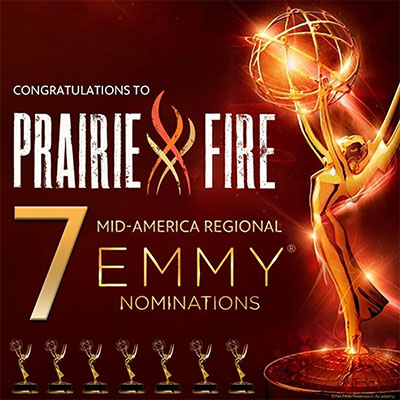
Prairie Fire Emmy image

Illinois Public Media’s Prairie Fire nominated for seven Emmys

UPDATE 10/29/2024: 

WILL-TV’s Prairie Fire won four Mid-America Emmy Awards, including Best Magazine Program, for its first season. The show also won in the following categories:

  • Arts/Entertainment, Short Form: Preston Jackson.” A profile of renowned artist and musician Preston Jackson from Peoria, whose works document the Black experience.
  • Diversity/Equity/Inclusion, Short Form: Operation Wild Horse.” A visit to Operation Wild Horse, a nonprofit organization that partners wild mustangs and burros with U.S. military veterans.
  • Human Interest, Short Form: Susannah Scaroni.” The remarkable journey of Paralympian Susannah Scaroni—from her days growing up to adapting to life in a wheelchair to the winner’s circle of the 2023 Boston Marathon.

* * *

Prairie Firea WILL-TV program featuring cinematic documentaries, profiles, and performances from downstate Illinois, has been nominated for seven Mid-America regional Emmy awards, including Best Magazine Program, in the first season of its reboot. The show, which first debuted in 1992 and ran until 2009, was rebooted last year by Illinois Public Media.

Other nominations Prairie Fire received from the Mid-America chapter of the National Academy of Television Arts and Sciences include Arts/Entertainment-Short Form; Informational/Instruction- Short Form; Entertainment – Short or Long Form; Diversity/Equity/Inclusion – Short Form; Human Interest – Short Form; and Musical Composition/Arrangement for its theme song.

The winners will be announced on October 26 at a ceremony in Kansas City, Missouri. 

The second season of Prairie Fire returned September 19 and airs the third Thursday of every month. It can be watched on WILL-TV, or on demand on YouTube or with the PBS App.

Read more.

IPM staff Jill Clements and Reginald Hardwick honored with local NAACP awards 

Jill Clements and Reginald Hardwick
(Photo by Dominique Gill)

Illinois Soul station manager Jill Clements and IPM news and public affairs director Reginald Hardwick were honored with local NAACP awards for their efforts to launch Illinois Soul 101.1 FM, a new radio station from IPM amplifying Black voices.   

The two were among six community members that were recognized at the NAACP’s Champaign County branch’s annual Freedom Fund celebration, held September 28.

Clements was honored with the Media Trailblazer Award for leading the development of the groundbreaking venture of Illinois Soul. The station was lauded for amplifying Black voices and culture, along with R&B music throughout central Illinois and online, with the power of public media. 

Hardwick, Illinois Public Media’s director of news and public affairs, was honored with the Media Expansion Award. 

He was also a driving force behind the launch of Illinois Soul, which Hardwick says is “reaching and representing Black communities over the air in Champaign County in a way that was long overdue.” He also manages The 21st Show, a live weekday public radio talk show that brings news, culture, and stories that matter to Illinois.

Hardwick has won seven regional Emmy awards, and says he is intent on building a news team that is “smart, diverse, and empathetic.”

IPM receives two INBA awards

Kennedy Vincent

The Illinois News Broadcasters Association has honored two Illinois Public Media programs with 2024 Crystal Mic Awards. The awards were presented September 21 during the organization’s fall convention in East Peoria.

An episode of Dialogue, a new community affairs program airing on Illinois Soul and hosted by Kennedy Vincent, was honored with second place in Podcasting (small market radio). The episode focused on the Congolese community in Champaign-Urbana.

“There are thousands of people in our region who have immigrated from the Democratic Republic of the Congo,” said Reginald Hardwick, IPM news and public affairs director. “We don’t often know about them because they’re quietly operating businesses, churches, and enriching schools in Champaign-Urbana. And they speak French. Kennedy Vincent took time to produce a quality podcast that explored what brought them to the U.S., how their lives have changed in central Illinois, and she was in the kitchen for preparation of a Congolese meal. This is exactly why we created the Dialogue show.”

Listen to the episode called “A Dialogue with Congolese Community of Champaign County.”

Farrah Anderson

The INBA award for Investigative Reporting (small market radio) was awarded to a piece for IPM News by former intern Farrah Anderson (BS ’24, journalism) about inconsistencies in following protocol during domestic violence cases by the Champaign Police. She was a senior at the University of Illinois College of Media when she produced the story in a partnership with the Invisible Institute. The story also was recognized with a regional award from the Society of Professional Journalists and Collaborative Effort from the Public Media Journalists Association. Anderson is now a full-time reporter at WFYI in Indianapolis.

Listen to or read the piece called “Champaign Police investigate ‘agency culture’ of not following domestic violence reporting laws.”

Illinois Public Media is a not-for-profit public media service of the College of Media at the University of Illinois.

Share on social
Students create first all-Spanish news broadcast ‘UI7 En Vivo Contigo,’ present at NAHJ conference


As the son of first-generation immigrant parents from Mexico, Emilio Reyes sometimes found it difficult fitting in while growing up in rural Indiana.

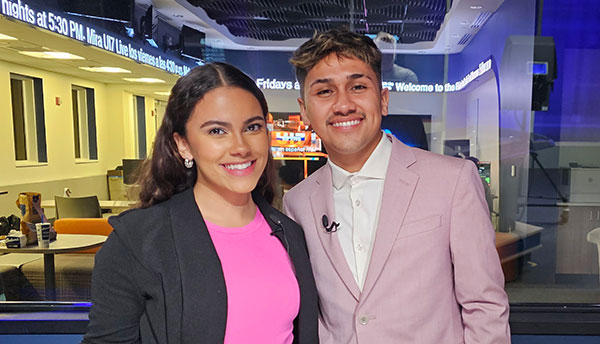
Emilio Reyes and Anneliese Cornejo Garcia of En Vivo Contigo

It wasn’t until he came to the University of Illinois to study journalism that he says he began to really embrace his Hispanic heritage. 

“I [was able] to find my community and really flourish so much here. I really think the U of I has definitely helped me develop and accept and love my identity so much that I am at my utmost [best],” Reyes said. 

Reyes, a senior and president of the Latino fraternity Sigma Lambda Beta International Fraternity Inc., says his time at Illinois has not only allowed him to gain a new sense of self-confidence, but also empowered him to help others on campus and beyond connect with their Latina/Latino roots. 

Last fall, Reyes and two other journalism students created, anchored, and produced En Vivo Contigo (“Live with You”), an all-Spanish-speaking television newscast on UI7, the University of Illinois cable channel. 

“I’ve always believed that media representation is so important,” Reyes said. “If I would have seen someone that looks like me on TV, I would have definitely learned about what a journalist is way before I was 18 years old and applying to colleges.”

It’s an endeavor that earned him and recent graduate Anneliese Cornejo Garcia (BS ’24, journalism; BA ’24, Spanish) an opportunity to speak at the National Association of Hispanic Journalists convention held July 9-13, 2024, in Los Angeles.

Reyes, who studied abroad in Spain last semester and interned at Cuatro Gotes Producciones, a multimedia ad agency, said he was grateful for the networking opportunities the NAHJ convention provided.

Creating a show that highlights my communities’ stories, which often go untold, while promoting other Latinx journalists in the field has been a dream, and I’m excited to keep growing and improving our work!

“It was the best of the best—the most amazing panels and connections, especially for Latino journalists,” Reyes said. 

Ken Erdey, journalism instructor and technical coordinator for Richmond Studio, also attended the convention and watched as the two talked to a large audience of media industry professionals as well as college students about the origins of the show. 

“Anneliese and Emilio excelled in telling their story to make En Vivo Contigo happen,” Erdey said. “It was a great day and made me proud to be a part of Illinois Journalism.”

Garcia and Reyes presenting at NAHJ convention
Emilio Reyes and Anneliese Cornejo Garcia presenting at the 2024 National Association of Hispanic Journalists convention. (Photo by Ken Erdey.)

Erdey began talks with Reyes, Cornejo Garcia, and Jackie Barba, a senior in journalism, in Spring 2023 about the possibility of starting a Spanish-speaking newscast. 

Thanks to a major gift from Richard and Leslie Frank that provided state-of-the-art renovations to Richmond Studio and established the Frank Newsroom, Erdey knew he could expand opportunities and open new doors for students at UI7. 

The students were elated about the idea of starting an all-Spanish-speaking news platform, which first aired in Fall 2023 and ran through Spring 2024.

“There was no Spanish-language news in central Illinois before UI7 En Vivo Contigo, and we’re not on a mainstream network, but to have this come [about] with college students making that first step and carving the path is huge,” Cornejo Garcia said. 

Barba, executive producer of the show, feels fortunate to be a part of En Vivo Contigo. 

“My identity as a Latina informs so much of my work as a journalist, and I value spaces where that is celebrated,” Barba said. “Creating a show that highlights my communities’ stories, which often go untold, while promoting other Latinx journalists in the field has been a dream, and I’m excited to keep growing and improving our work!”

Reyes’s experience at the 2024 NAHJ convention inspired him to revitalize the local Illinois NAHJ chapter, which hasn’t been as active in recent years. After seeing firsthand the number of opportunities and resources NAHJ provides, Reyes and Barba want more students to get involved.

Jackie Barba and Emilio Reyes at UI7 Open House
Jackie Barba and Emilio Reyes (center) talk with other students in the Frank Newsroom during a UI7 Open House in September. (Photo by Nathan Gonzalez, photography intern.)
 

“These jobs [and connections] that you would never believe are just right there. People see us, they hear us, and they want to help us as students take advantage of that,” he said.

Barba is also working with Reyes to help strengthen the local NAHJ chapter. As vice president of the Society for Professional Journalists at Illinois, Barba recognizes the importance of providing resources and opportunities for other Hispanic journalists.

Any student interested in joining the Illinois chapter of NAHJ can contact Emilio Reyes at emilio3@illinois.edu.

For more information about En Vivo Contigo, which is open to all majors and Spanish-proficiency levels, email Ken Erdey at kerdey@illinois.edu. 

The second season of En Vivo Contigo kicked off on September 27 and airs every other Friday at 4:30 p.m. live, on-demand, or on UI7 Newsroom’s Roku channel.

Share on social

New book by Matthew Ehrlich explores the history of the phony cancer drug Krebiozen


In March 1951, Andrew Ivy—at the time, one of the most renowned scientists and medical ethicists in the U.S.—held a press conference in Chicago to announce Krebiozen, a recently discovered wonder drug that Ivy said could dramatically help cancer patients. The announcement created a frenzy among cancer patients, who deluged the University of Illinois’ Chicago campus, where Ivy was vice president in charge of the professional schools at the time, with telephone calls trying to obtain it.

Matthew Ehrlich

But within a few months, Krebiozen was denounced by the American Medical Association and, a few years later, Ivy, the drug’s creator Stevan Durovic and some of their supporters were prosecuted for fraud.

The dramatic Krebiozen saga culminated in Durovic fleeing the U.S., Ivy’s reputation in ruins and two of his U of I colleagues—President George Stoddard and Provost Coleman Griffith—ousted from their positions, in part because of their association with the scandal.

The Krebiozen Hoax: How a Mysterious Cancer Drug Shook Organized Medicine, a new book by Matthew C. Ehrlich, a professor emeritus of journalism at Illinois, examines the controversial drug’s dramatic rise and fall.

Although the sensational story of Krebiozen has since faded into obscurity, Ehrlich said that its lessons are relevant today, offering potent reminders about the dangers of medical misinformation, misplaced trust and the unquestioning adoption of unproven treatments. “The Krebiozen Hoax” is also a cautionary tale about the pitfalls of hubris and how the political climate can undermine public trust in established institutions and mainstream medicine.

According to the author, Krebiozen was “a quintessential example of medical quackery” that “foreshadowed today’s bitter debates over health misinformation, medical freedom and scientific and educational expertise.”

Krebiozen also marked a “key historical moment for the Food and Drug Administration,” which was then flexing new regulatory powers, and its stance on that drug triggered backlash from cancer patients and accusations of medical overreach when the agency reported the drug was worthless as a cancer treatment, refused to license it and blocked its interstate shipment. 

“It was a big episode, not just in the history of the U of I but also in the history of the whole state of Illinois, since the legislature and the governor got involved,” Ehrlich said. “And then, of course, it became a national deal with the involvement of the FDA and the National Cancer Institute. Illinois Senator Paul Douglas and even President Lyndon Johnson at one point got sucked into this whole thing.”

The story of Krebiozen is a poignant reminder that these travails are nothing new, but instead have ample historical precedent. It is also a reminder of the damage that can be inflicted when quackery and all the untruths that accompany it go unchecked for too long.

The book details how Durovic, an unknown doctor who had never published peer-reviewed research on the drug’s performance, duped a world-renowned clinician and scores of vulnerable patients who were desperate to find a cure for a frightening disease. 

Ever evasive about the medicine’s formula and origins, Durovic indicated that it was derived by stimulating horses’ immune systems and extracting their blood, a potential form of immunotherapy that piqued Ivy’s research interests in the body’s defenses against cancer and may have clouded his professional judgment.

The Krebiozen Hoax book

“Where I think Ivy went wrong is when he dug in his heels and refused to listen when first his close friends, then his scientific associates and prominent groups and organizations told him Krebiozen was worthless,” Ehrlich said. “He really seemed to have a natural stubbornness and a strong ambition to make a lasting contribution to science that may have gotten the best of him. And he never renounced Krebiozen, despite all the personal and professional travails that befell him.”

Ehrlich’s book examines how public excitement over the drug elevated Ivy’s Sisyphean pursuit of clinical trials and federal approval for the drug to a nationwide cause, attracting A-list supporters such as movie star Gloria Swanson and environmentalist Rachel Carson, a cancer patient who briefly and unsuccessfully treated herself with it.

The battle to obtain “fair trials” of Krebiozen that advocates believed would demonstrate its efficacy once and for all pitted them against federal regulators, mainstream medicine and the AMA. Ivy and Durovic accused the AMA of conspiring with powerful corporate interests to keep Krebiozen off the market after failing to seize control of it. 

When the FDA refused to license the drug, angry demonstrators besieged the White House, with cancer patients waving picket signs declaring, “I need Krebiozen to live!”

“Krebiozen is one episode in a long, sorry series of such episodes, and that’s one of the reasons I wanted to write about it,” Ehrlich said. “It just had colorful characters involved, including Ivy, Stoddard, and Douglas.”

Ivy was a distinguished physiologist and medical ethicist who testified as a representative of the AMA at the Nuremberg trials and was once dubbed “the conscience of U.S. science” by Time magazine. His friend Douglas was a firebrand Democrat legislator and decorated war hero who became one of Krebiozen’s biggest supporters and foremost legislative sponsors. 

“And, like Ivy, once Douglas committed to it, he dug in and would not be dissuaded from it,” Ehrlich said.

Were it not for Ivy’s star power, political connections, rapport with the press and federal agencies’ confusion over which of them was responsible for regulating it, the Krebiozen controversy likely would have fizzled more quickly, according to the author.

Dr. Andrew Ivy
Dr. Andrew Ivy

Ehrlich examines the historical conditions that existed when Krebiozen came to prominence and how they likely heightened the controversy surrounding the drug.

In Ehrlich’s exploration of Krebiozen’s tumultuous history, he notes that it was among nearly150 miracle cures for cancer that were touted at one time or another. The Krebiozen controversy copied the pattern of many such brouhahas that preceded it—and foreshadowed many of those that came after it, including controversial treatments for COVID-19 such as hydroxychloroquine, Ehrlich said. 

“People should be aware that these things happen from time to time,” Ehrlich said. “The story of Krebiozen is a poignant reminder that these travails are nothing new, but instead have ample historical precedent. It is also a reminder of the damage that can be inflicted when quackery and all the untruths that accompany it go unchecked for too long.”

The book was published by 3 Fields Books.


Editor’s note:    

To reach Matthew Ehrlich, call 217-333-1365 or email mehrlich@illinois.edu.

ISBN: 0252088115 

A press kit with photos of the author and the book’s cover is available from News Bureau.

View original press release.

Share on social

College of Media to hold three-part webinar series, ‘Bridging Divides: Conversations on Media and Disagreement’


How are we teaching students, and the broader community, to disagree? It’s a question the College of Media hopes to address in a new three-part series, “Bridging Divides: Conversations on Media and Disagreement.”

Update 11/13/24: Read excerpts from the Q&As:


Bridging Divides banner

Faculty from the Departments of Advertising, Journalism, and Media & Cinema Studies will host free webinars exploring how productive discussions occur across lines of disagreement and difference. All take place on Fridays at noon via Zoom, on October 18, October 25, and November 1.

“The College of Media’s ‘Bridging Divides’ series is an opportunity to foster civic preparedness through expert-led dialogues,” said Dean Tracy Sulkin. “We look forward to welcoming students, faculty, staff, alumni, and community members to these important conversations.” 

The talk topics and panelists include:

Reaching across the Aisle: Advertising and Messaging in an Age of Polarization

October 18, 12-12:45 p.m.
Register to join via Zoom.

Jason P. Chambers

Jason P. Chambers, Associate Dean for Diversity, Equity, and Inclusion; Professor, Charles H. Sandage Department of Advertising; author of Advertising Revolutionary: The Life and Work of Tom Burrell

Michael Strautmanis (BS ’91, advertising; JD ’94, law), Executive Vice President for External Affairs, Obama Foundation 


What Does It Mean to Be an Informed Critic? 

October 25, 12-12:45 p.m.
Register to join via Zoom.
Learn how to give criticism a good name. During this session, the panelists will share a how-to for every kind of writer.

Jenny Oyallon-Koloski, Assistant Professor, Department of Media & Cinema Studies; author of Storytelling in Motion: Cinematic Choreography and the Film Musical

Michael Phillips, Chicago Tribune Film Critic; College of Media Ebert Fellows Mentor


Engaging with People, Perspectives, and Policies When You Don’t Agree: Lessons from Journalism

November 1, 12-12:45 p.m.
Register to join via Zoom.

Leon Dash, Professor and Swanlund Chair, Department of Journalism; 1995 Pulitzer Prize Winner for Explanatory Reporting

Colleen King, Clinical Assistant Professor, Department of Journalism; Director of the Richard and Leslie Frank Center for Leadership and Innovation in Media; former Executive Producer for MSNBC’s The 11th Hour with Brian Williams  

Share on social

Journalism alum Thomas Winski receives IJEA Lifetime Achievement Award

Winski

Thomas Winski (MS ’75, journalism) was selected to receive the 2024 Illinois Journalism Education Association Lifetime Achievement Award. Winski accepted the award on September 20 at the annual IJEA conference at Illinois State University.  

Each year, the IJEA seeks to honor retired individuals for a lifetime of dedication to scholastic journalism. 

Winski was an assistant professor of journalism at Lindsey Wilson College in Kentucky for four years before joining the faculty at Emporia State University in Kansas. There, he served as assistant professor of journalism for 16 years and co-director of the journalism program until his retirement.

Alumna Cheryl W. Thompson to receive Washington Association of Black Journalists Legacy Award

Cheryl W. Thompson

Cheryl W. Thompson (BS ’82, LAS; MS ’84, journalism), investigative correspondent and senior editor at NPR, and associate professor at George Washington University, will receive the 2024 Washington Association of Black Journalists Legacy Award.

This award recognizes a current or retired journalist or journalism educator in the Washington, D.C., area who has broken barriers and/or provided distinguished leadership in increasing access and opportunities to people of color in journalism. 

Thompson will be honored at the third annual WABJ Special Honors & Scholarship Gala on Saturday, Dec. 7, at the Blackburn University Center, Howard University. 

“As the first elected Black president of the Investigative Reporters and Editors organization, and as an associate professor of investigative reporting at George Washington University, where she founded and also advises an NABJ student chapter, Cheryl has forged an exemplary pathmaking career rooted in strengthening the next generation qualifying her as a worthy recipient of WABJ’s Legacy Award,” the WABJ Awards Review Committee said. The Investigative Reporters and Editors is a 6,000-member organization dedicated to enhancing the quality of investigative journalism. 

Thompson has worked at Champaign-Urbana’s News-Gazette, Chicago Tribune, The Kansas City Star, Los Angeles Daily News, The Gainesville Sun, and The Washington Post, where she wrote extensively about law enforcement, political corruption and guns, and was a White House correspondent during President Barack Obama’s first term.

She has received numerous awards for her investigative reporting, including an Emmy, three sharedPulitzer Prizes, and five awards from the National Association of Black Journalists, one awarded in 2019 for a Washington Post Sunday Magazine story on the nearly 50-year-old unsolved murders of six little black girls in D.C

Thompson is a member of the Alpha Kappa Alpha Sorority, Inc. and received the NABJ Educator of the Year Award in 2017. She’s also a founding and current board member of the Center for Collaborative Investigative Journalism, which focuses on cross-border investigations.

College of Media
119 Gregory Hall
810 S. Wright St.
Urbana, IL 61801
217-333-2350