Senior lecturer Carrie Wilson-Brown receives Larine Y. Cowan Make a Difference Award


Carrie Wilson-Brown wins award

Carrie Wilson-Brown, senior lecturer of media and cinema studies and advertising, received the 2025 Larine Y. Cowan Make a Difference Award for Teaching and Mentoring in Diversity from the Office of the Vice Chancellor for Access, Civil Rights & Community.

The Teaching and Mentoring in Diversity award honors faculty, instructors, or lecturers who have consistently contributed to the promotion of understanding critical issues related to diversity and equity in teaching and/or the mentoring of diverse students.

Wilson-Brown was nominated in part by students, including Odi Ogbuefi, a senior in advertising, pictured at right.

The Larine Y. Cowan Make a Difference Awards celebrate the achievements of faculty, academic professionals, and civic service employees who made significant contributions in creating and sustaining an inclusive living, learning, and working community at Illinois.

Named in honor of the past Assistant Chancellor and Director of what is now the Office for Access & Equity, the Larine Y. Cowan Awards were created to reflect the commitment to human rights advocacy, social justice, and diversity that defined her leadership for nearly 20 years at Illinois.

Share on social

Department of Media & Cinema Studies partners with Flyover Film Studios to launch new internship


Beginning in Fall 2025, the Department of Media & Cinema Studies created a new internship for students at Flyover Film Studios in Rantoul. Francisco Albarran, a senior in media and cinema studies, was the first student selected for the program.

Wiz Khalifa
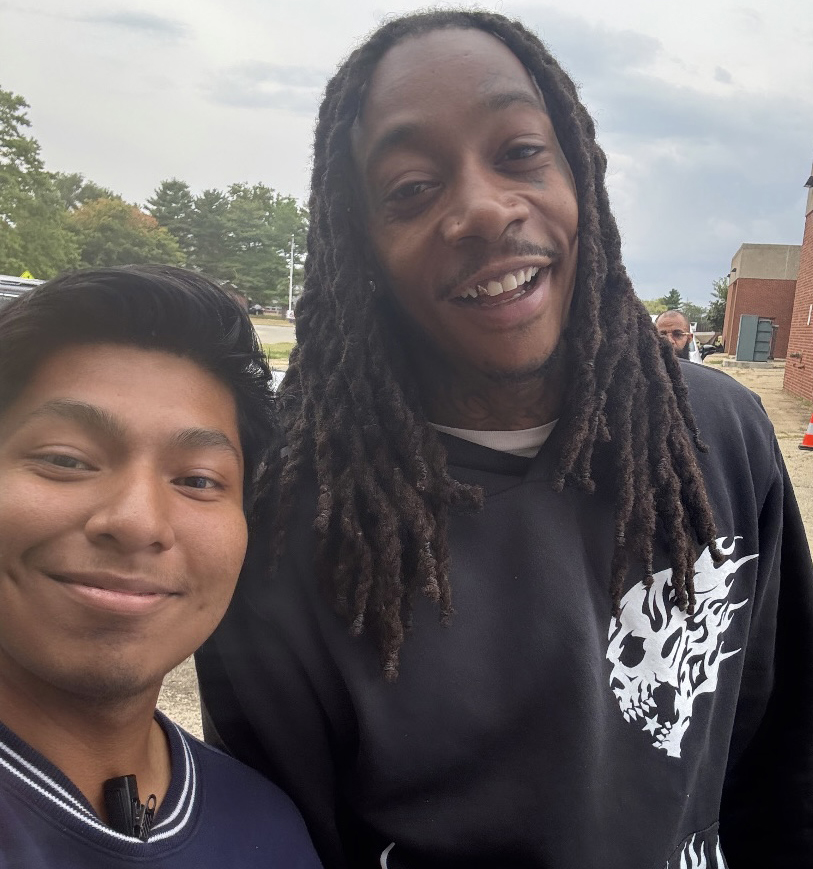
Francisco Albarran, a senior in media and cinema studies, met rapper Wiz Khalifa while working as an intern on the set of the upcoming crime drama Moses the Black.

Albarran was able to work on the production of a new drama Moses the Black, starring Omar Epps and rappers Wiz Khalifa and Quavo. Curtis “50 Cent” Jackson is an executive producer of the film, which is set to premiere in January 2026.

The semester-long internship, which grew out of conversations with Victor Font, senior lecturer of media and cinema studies, and Flyover Film Studios, offers students hands-on experience in a growing local film industry.

“Learning about Flyover’s [film] projects made me realize what a remarkable hands-on experience this could be for our MACS students,” Font said. “It took time and coordination to make it happen, and it’s incredibly rewarding to see this partnership become a reality.”

Film production in the region is expanding, thanks to new state tax incentives that are drawing more companies to shoot locally, said Derek Long, associate professor of media and cinema studies. For students, this surge translates into increased opportunities for on-set learning in a field where practical experience is essential.

“As MACS expands its media production-oriented curriculum, we are always seeking professionalization opportunities for our students, as media production is very much a learn-by-doing industry,” Long said.

The internship is designed for advanced production students willing to learn the different facets of the media production industry—from directing and cinematography to support and infrastructure roles.

I think the real benefit of this internship lies in opening students’ eyes to the wide variety of different types of labor that go into a professional media production in the 21st century, including those that aren’t necessarily ‘on set.’

“Our hope is that they get a broad sampling of the types of media industry work they might do after they finish their degree. In that sense, we want that broader experience to augment both the on-set focus of our classroom production curriculum and the critical thinking skills of our studies courses,” Long added.

Interns work both at Flyover Studios, which hosts sets, costumes, production offices, and other resources, and with visiting production companies shooting in Illinois.

“I think the real benefit of this internship lies in opening students’ eyes to the wide variety of different types of labor that go into a professional media production in the 21st century, including those that aren’t necessarily ‘on set,’” Long said.

Through his internship, Albarran was able to participate in many aspects of film production. He helped build bedroom and jail sets; shaped scenes filmed at Willard Airport in Savoy; and transported crew members.

Being involved in day-to-day operations also allowed Albarran to meet and interact with cast and crew, pictured below from left to right, the film’s director Yelena Popovic and actors Vonzell D. Scott (Fight Night: The Million Dollar Heist) and Corey Hendrix (The Bear).

Albarran said he was nervous at times about his role on the set, but encouragement from everyone around him helped boost his confidence.

“I was anxious, but everyone was telling me to relax, just enjoy the moment—that I deserved to be there just as much as anyone else,” he said. “I have all these people who just believe in me, and there’s no greater feeling than that.”

Share on social

2025-26 Ebert Fellows announced


Each fall, the Roger Ebert Fellowship program selects three College of Media undergraduate students to participate in the yearlong fellowship that aims to shape their skills in critical writing through immersion in the film industry.

Ebert theatre- orange

The Roger Ebert Fellows chosen for the 2025-26 academic year are Paige Gaines, Amir Rehab, and Jin Wang.

The program, named after the late Pulitzer Prize-winning film critic for the Chicago Sun-Times and University of Illinois journalism alum, allows students to work with former Chicago Tribune film critic Michael Phillips in engaging with notable figures within the film and media industry and strengthening their critical analysis and writing skills.

This year, the Ebert Fellows will participate in monthly workshops both on campus and in Chicago, curate screenings through the Roger Ebert Center for Film Studies at Spurlock Museum, and engage in radio exercises with Steve Morck, senior digital media producer at Illinois Public Media.

Phillips has been the advisor since the program began in 2015. When it comes to selecting the Ebert Fellows, he looks for something beyond the conventional: persuasive, compelling and “alive.”

“Ebert was a lot more than a ‘film critic,’ Phillips said. “He brought the world around him into the writing, which is not easy to do well, and he did it just about better than anybody.”

Another yearly highlight is the Fellows’ coverage of the True/False Film Fest in Missouri. This is a two-night excursion that entails covering the festival, where Phillips encourages the students to speak with people involved in the films that interest them the most.

“Whether it’s for radio podcasting, print, or introducing a film, anything we can do to get the students a little closer to the writer they want to become is the goal,” Phillips said.


Meet the 2025-26 Ebert Fellows

Paige Gaines is a senior earning a dual degree in media and cinema studies and in communication. She is looking forward to working with the other Fellows.

Paige Gaines

“Both of the other Fellows are in advertising, so it will bring different outlooks from what I have had,” Gaines said. “I’m really interested to see what I can learn from them and what they can learn from me.”

Gaines frequently attended Ebertfest as a child and is a distant relative of Roger Ebert. She wants to improve her review-writing skills and efficiency.

The True/False Film Fest is the event that Gaines is most excited for because of the screenings of documentaries revolving around social and political issues.

“I love telling stories about people who don’t have stories told about them as much,” Gaines said. “What better way to get exposure to that scene than going to where it’s hosted?”

One of Gaines’s favorite films is Therapy Dogs, a hybrid documentary-fiction comedy,because she saw it at an important part of her life, and it ignited her love for her career.


Amir Rehab, a senior in advertising, is looking forward to working with Phillips, meeting with directors, and evolving as a writer.

Amir Rehab

“Living in the USA and Algeria has given me so many different perspectives within our media that we consume,” he said. “Through design and editing, I learned how visuals can tell stories and evoke emotions.”

Rehab transferred to the University of Illinois last year and chose advertising as a major because it combines two things he has always loved—creativity and strategy.

He currently makes his own short-form documentaries and is interested in using this program to improve his storytelling capabilities and network.

“Putting yourself out there in uncomfortable situations in order to evolve is important,” Rehab said. ”If you’re just staying in the exact same spot, you’re not going to get anywhere.”

His favorite movie is Parasite, which won the 2020 Academy Award for Best Picture,because of the powerful message through the acting and visual storytelling.

“I was extremely impressed by the cinematography—the details in distinguishing class division and income inequality. It’s a very powerful message achieved not only through acting but also through visual storytelling and camera work!”


Jin Wang is a junior in advertising. She is most excited for the immersion trips to Chicago, where the students will work in the Ebert Fellow workshop and visit art exhibitions.

Wang is eager to learn more about film this year, as her criticism in the past has mostly revolved around paintings and sculpture.

“Criticism is essential because our experiences shape how we see the world,” Wang said. “It brings different viewpoints together and helps people express their own ideas.”

She is excited to collaborate with the other Fellows by contributing different ideas and opinions.

Wang’s favorite movie is the Korean film Wedding Dress because of the themes about family and love.

“It reminds me that love isn’t just about happy moments, but also about sacrifice,” Wang said. “It’s so emotional and it makes me feel deeply connected to the story and the characters.”

Share on social

Illini Watchers brings movie fans together for analytical discussion


Every Friday night, the sound of lively movie-take debates pours from Room 1090 and drifts down the halls of Lincoln Hall during The Illini Watchers’ weekly meeting.

The registered student organization began around 2018, originally named C-U Cinefile, to review various forms of media. The Illini Watchers pride themselves on being a welcoming space for everyone, regardless of how familiar they are with the film scene.

“The club represents the legacy that the University of Illinois has been a place where criticism is formed,” said Jonathan Knipp, senior lecturer of media and cinema studies and faculty sponsor of the club.

The Illini Watchers meeting

Like a book club for movies, each meeting includes discussion mostly surrounding a film that was chosen the week before, also allowing time for members to talk about other random movies, theater screenings, books, music, and games.

“My exec team and I will make the slides with the parts we thought were interesting,” said Nicolas Roacho, junior in media and cinema studies and Illini Watchers president. “But it’s a really laid-back discussion about the film we assigned everyone to watch.”

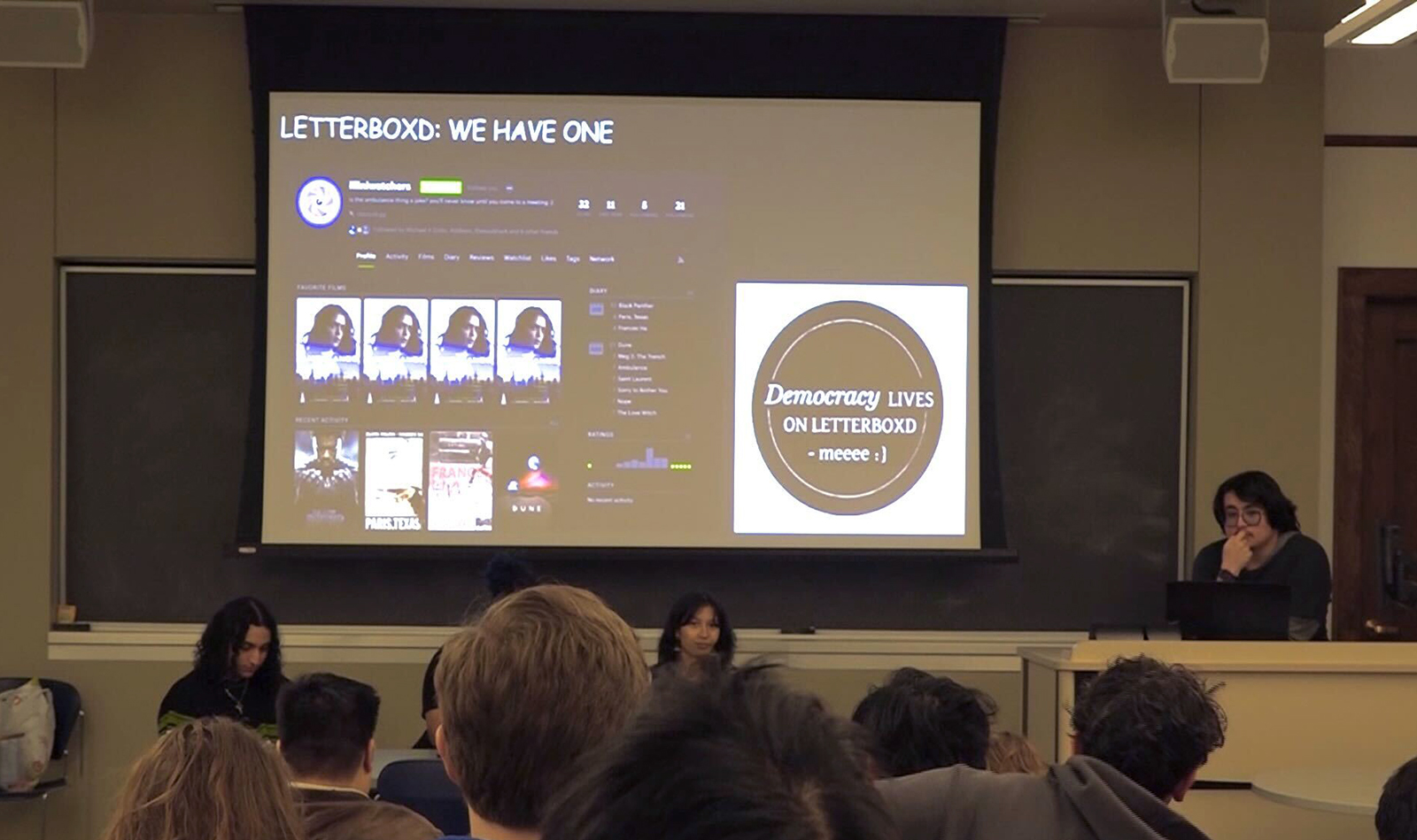
The Illini Watchers' Letterboxd page
The Illini Watchers share their film ratings on their Letterboxd page.

During the meeting, they take an average of everyone’s rating of the movie and post it on the club’s Letterboxd page, a social network for film fans.

At the end of each meeting, Roacho and other executive members announce a theme for next week, taking movie nominations from members to spin on a wheel. Whichever movie the wheel lands on is the one up for discussion the following week.

A recent theme was Hispanic Heritage Month, where all the suggested movies had a Hispanic writer, director, or lead. These themes are made to introduce members to films they might not have watched before, like international cinema, Roacho said.

Other events the club organizes are group bus rides to a movie theater, movie-themed trivia games, picnics on the Quad, and a yearly Halloween costume contest. They also sometimes collaborate with their sister club, Illini Film and Video, a film and video production organization, of which Roacho is also the president.

As the faculty advisor, Knipp looks for resources to help the club grow, with his most recent project trying to connect the club to the Roger Ebert Center for Film Studies.

His favorite part of being the advisor for the club is the same as being an instructor.

“It’s always about trying to start the conversation but not presiding over it or trying to influence it,” Knipp said. “Getting it kick-started so I can sit back and just let the students let their thoughts go wild.”

Knipp and Roacho emphasized the importance of appreciating media through their club.

“I like knowing that we are providing that community because it’s important to keep this sort of culture alive,” Roacho said.

With a membership count of just over 100, the group is diverse in majors, something both Knipp and Roacho say makes the Illini Watchers unique.

“The club is everything I wished for,” Roacho said. “There wasn’t a pool of people to talk about movies with at my high school; the people in Watchers are understanding of what I’m saying, even if they’re not too familiar with film.”

Share on social

I on the Media: Jonathan Knipp explores the psychology of horror films


Jon Knipp

From Psycho to Hereditary, horror films have long mirrored our collective fears. But today’s fascination with true-crime dramas and serial-killer stories—like Netflix’s Monster: The Ed Gein Story—may suggest something deeper at play. As audiences crave both terror and understanding, the line between entertainment and ethics grows thin.

Jonathan Knipp, senior lecturer of media and cinema studies who teaches a class on horror movies, shares his perspective on the psychology of horror films—why people like them, how and when the industry has changed, and where the genre might be headed in the future.

Why do people want to watch horror films? From a psychological perspective, why do so many of us enjoy the feeling of being scared?

I think all moviegoing (to the theater) is a ritual. But horror movies have an interesting distinction. People leave their houses to get scared so they can share the experience of not just encountering common anxieties, but working through them, too. You reach the climax…and you survived! Horror movies can be traumatizing (hello, Hereditary) but they also end. Is it too much to say that it’s kind of an exorcism?

Are there certain cinematic techniques or storytelling devices that consistently provoke fear or fascination in audiences?

Some of my students say that they only get scared if what they’re seeing “could really happen,” whatever that means (probably slasher movies and pursuit narratives). Others get freaked out by occult themes and devilry. There’s a tendency to dismiss “jump scares” as cheap and cliche, but audiences still jump.

How has the horror genre evolved over the years? What’s changed the most in how these films are made?

CGI replaced the reliance on practical effects, which many audiences dislike. Now there is a bit of a pushback, with filmmakers going back to the arcane use of makeup applications and puppetry but with digital gloss. Sometimes it works really well, like in The Substance. I think one of the biggest developments (in my lifetime) is the PG-13 horror movie, which is great because younger people are drawn to them. But it can also leave you wondering where all the blood and guts have gone.

Many point to Alfred Hitchcock’s 1960 Psycho as a turning point for horror. What makes this film stand out in the genre?

Hitchcock famously used the crew of his TV show to make it. That means they worked fast and cheap. Psycho shows a master filmmaker going down and dirty while still creating images that are composed and sequences that are still shocking in their effectiveness. Also, this film signaled a movement away from monster movies towards antagonists that were…human.

The new Netflix series about Ed Gein has stirred a lot of discussion. Is it ethical to portray real-life killers in ways that might make them seem sympathetic or even humanize them?

I think this is a case-by-case thing. It’s important to remember that these crimes are committed by people and not monsters. The more we understand, the more we can efficiently profile these criminals. That’s the theory at least. It’s like the topics of gun violence and suicide. They need to be understood, but there’s always a risk of glorifying the crime and/or triggering the spectator.

Why do you think horror tends to thrive during certain cultural or political moments? What do our fears on-screen say about us as a society?

Horror movies go in cycles. They can reflect the times or simply current trends. A surprise hit can result in a lot of imitations, like when Scream inspired a lot of self-referential horror movies. When audiences gravitate towards social media, you get a bunch of horror movies about the Web. In the ’50s, it was radioactive monsters. In the ’70s, you have counterculture horror movies inspired by Manson and many that match the political disillusionment of the era. Sometimes it’s hard to determine what cycle you’re in until you leave it.

What do you see as the future of horror?

More long-form series, like the ones Mike Flanagan makes for Netflix (The Fall of the House of Usher is great). More short-form, social media-inspired content. Can TikTok be scary? Some enterprising content creator will probably find out.

Share on social

Media literacy research and engagement initiatives address societal challenges


Faculty and graduate students across the College of Media are pursuing a range of activities aimed at understanding challenges to media literacy and developing interventions to improve it.

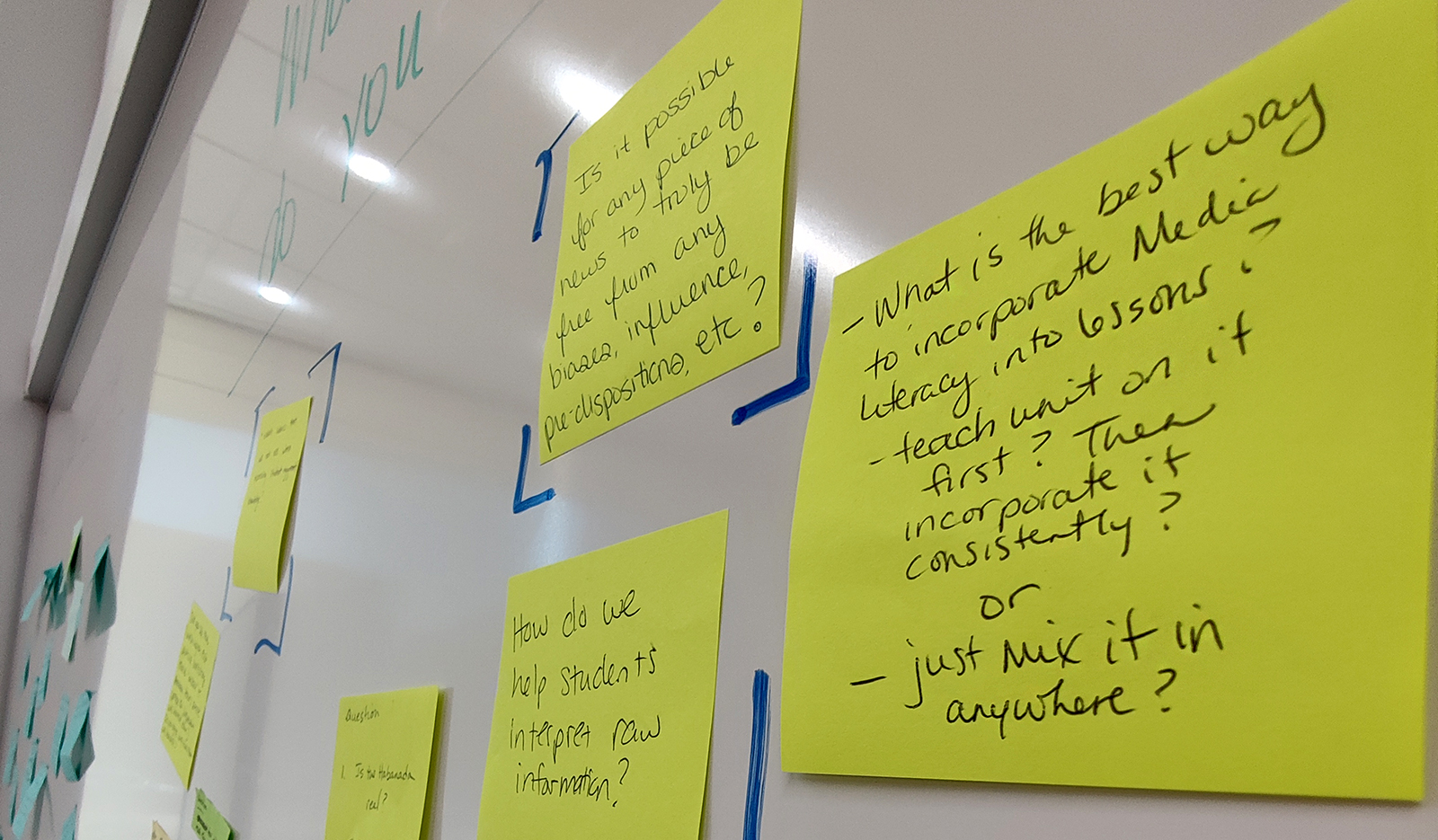
Post-Its from IMEDIA workshop

Recent activities include:

A team including Michelle Nelson, professor of advertising, Amanda Ciafone, associate professor of media and cinema studies, Stephanie Craft, professor of journalism, ICR doctoral student Gillian Paxton, and undergraduate student Maaike Niekerk, is investigating older adults’ media use, media literacy, and the role of media in fostering social connection. The research seeks to understand how older adults use media across a broad range of platforms and tools, including generative AI, and the challenges they face in doing so. The aim is to explore how improving media literacy may help them better navigate the media environment to meet their social and information needs. The study involves interviews with those who offer help and instruction regarding media and technology use through senior centers, public libraries, park districts and the like, and focus groups with older adults. This project is funded by a College of Media seed grant.

Professor Amanda Ciafone presenting at IMEDIA workshop
Amanda Ciafone, associate professor of media and cinema studies, presents at a workshop hosted by IMEDIA.

Related to this project, Ciafone was awarded funding to organize media and digital literacy workshops with European scholars and advocates to advance research, education, and transatlantic dialogue on older age and media literacy under the Jean Monnet Center of Excellence grant awarded to the European Union Center at the University of Illinois Urbana-Champaign. Ciafone said Europe has more rapid “demographic aging,” where a population’s average age increases, than the United States and robust models for media literacy policy and education.

As part of its mission to bolster research in media literacy, the College of Media hosts a regular gathering of faculty across campus to discuss research in media literacy across disciplines and to identify potential opportunities for collaboration. These conversations have so far included faculty in the College of Fine & Applied Arts, University Library, School of Information Sciences, College of Education, and College of Liberal Arts & Sciences.

The Initiative for Media Education Inquiry and Action, a collaboration between the College of Media and College of Education, is developing a media literacy micro-credential for teachers. IMEDIA was created in 2021 to help teachers in Illinois fulfill the mandate of a state law requiring media literacy instruction in public high schools. IMEDIA has offered in-person workshops for teachers to help them incorporate media literacy into their current teaching. The aim of the micro-credential is to broaden the reach of workshops by making the instruction and resources available online in a way that also offers teachers the opportunity to add a media literacy credential to their licenses.

A research study conducted by Nelson, ICR doctoral student Sakshi Bhalla, and Michael Spikes, co-founder of the Illinois Media Literacy Coalition, emerged from IMEDIA’s teacher workshops. The study, which included interviews with 20 educators from across the state of Illinois about the nature and challenges of media literacy education in their schools, found several digital divides that undermine the efficacy of state-mandated media literacy instruction in Illinois high schools. Their findings were published in the Journal of Media Literacy Education.

IMEDIA also is updating its eText, MEdia Matters, which is currently used in a variety of introductory undergraduate courses. The text will be a key resource for teachers pursuing the micro-credential and will be freely available for use in their classrooms.

Craft is part of a team comprising faculty from five universities engaged in a long-term research initiative to build a model of news literacy behavior that will inform efforts to increase people’s resistance to misinformation. The team has developed a widely used measure of news literacy knowledge and most recently has been investigating how greater news literacy knowledge translates into better news consumption behaviors reflecting that greater knowledge. The most recent study was presented in August at the annual meeting of the Association for Education in Journalism and Mass Communication.   

Share on social

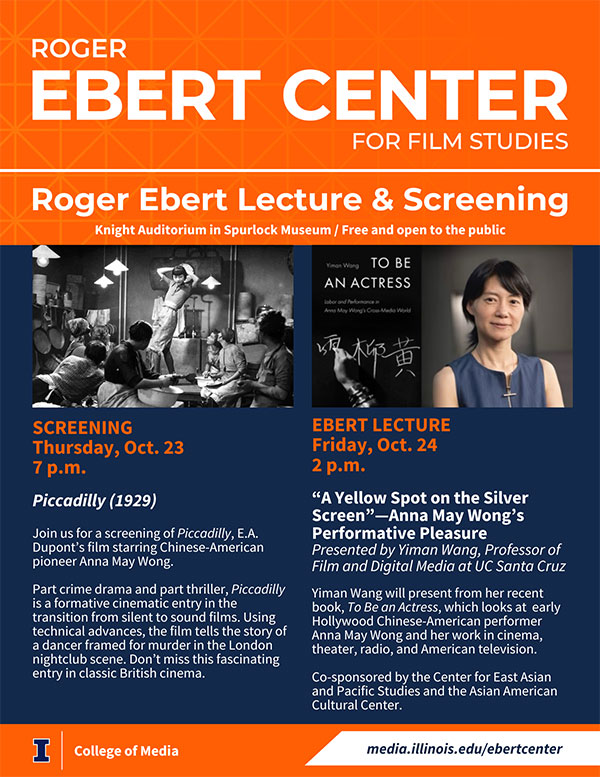
Roger Ebert Lecture: “A Yellow Spot on the Silver Screen”—Anna May Wong’s Performative Pleasure


Ebert Lecture 2025

The 2025 Roger Ebert Lecture and Screening will be held October 23-24 in the Knight Auditorium of Spurlock Museum.

Join us in person or via Zoom on Friday, Oct. 24, at 2 p.m. for the 2025 Roger Ebert Lecture, “A Yellow Spot on the Silver Screen”—Anna May Wong’s Performative Pleasure, given by Yiman Wang, professor of film and digital media at UC Santa Cruz.  Wang’s lecture will present from her recent book To Be an Actress, on early Hollywood Chinese-American performer Anna May Wong and her work in cinema, theater, radio, and American television. Anna May Wong forged a four-decade media-crossing, border-crossing career largely during the U.S. segregation era. Her recent return to public attention testifies to her indelible legacy. Yet, how we might reanimate her legacy remains a question. 

Viewing Wong as a performer and worker, not just a star, Wang invites a reconsideration of racialized, gendered, and migratory labor as the bedrock of the entertainment industries.  

Presented by the Roger Ebert Center for Film Studies and co-sponsored by the Center for East Asian and Pacific Studies and the Asian American Cultural Center.

As part of the annual Roger Ebert Lecture and Screening, join us for the screening of Piccadilly (1929) on Thursday, Oct. 23 at 7 p.m. at the Knight Auditorium, Spurlock Museum. E.A. Dupont’s film starring Chinese-American pioneer Anna May Wong is a formative cinematic entry in the transition from silent to sound films. Part crime drama and part thriller, Piccadilly uses its technical advances to tell the story of a dancer framed for murder in the London nightclub scene. Don’t miss this fascinating entry in classic British cinema. 

About the Presenter

Yiman Wang is Professor of Film & Digital Media at University of California, Santa Cruz. She is author of Remaking Chinese Cinema: Through the Prism of Shanghai, Hong Kong and Hollywood (University of Hawaii Press 2013), and To Be an Actress: Labor and Performance in Anna May Wong’s Cross-Media World (University of California Press 2024). 

She has published numerous articles in journals and edited volumes on topics of feminist media histories, ethnic border-crossing stardom, eco-cinema and environmental media, Chinese cinema, independent documentary, film remakes and adaptation. She is editor of a special issue of Feminist Media Histories on Asian Feminist Media (2019), co-editor of an InFocus Dossier on Queering Asian Media in Journal of Cinema and Media Studies (2023), co-editor of Chinese AnimationMultiplicities in Motion (2025), and co-editor of the Global East Asian Screen Cultures book series published by Bloomsbury. Presented by the Roger Ebert Center for Film Studies.

Share on social

Take 5 with Media Alumni: Jason Kim


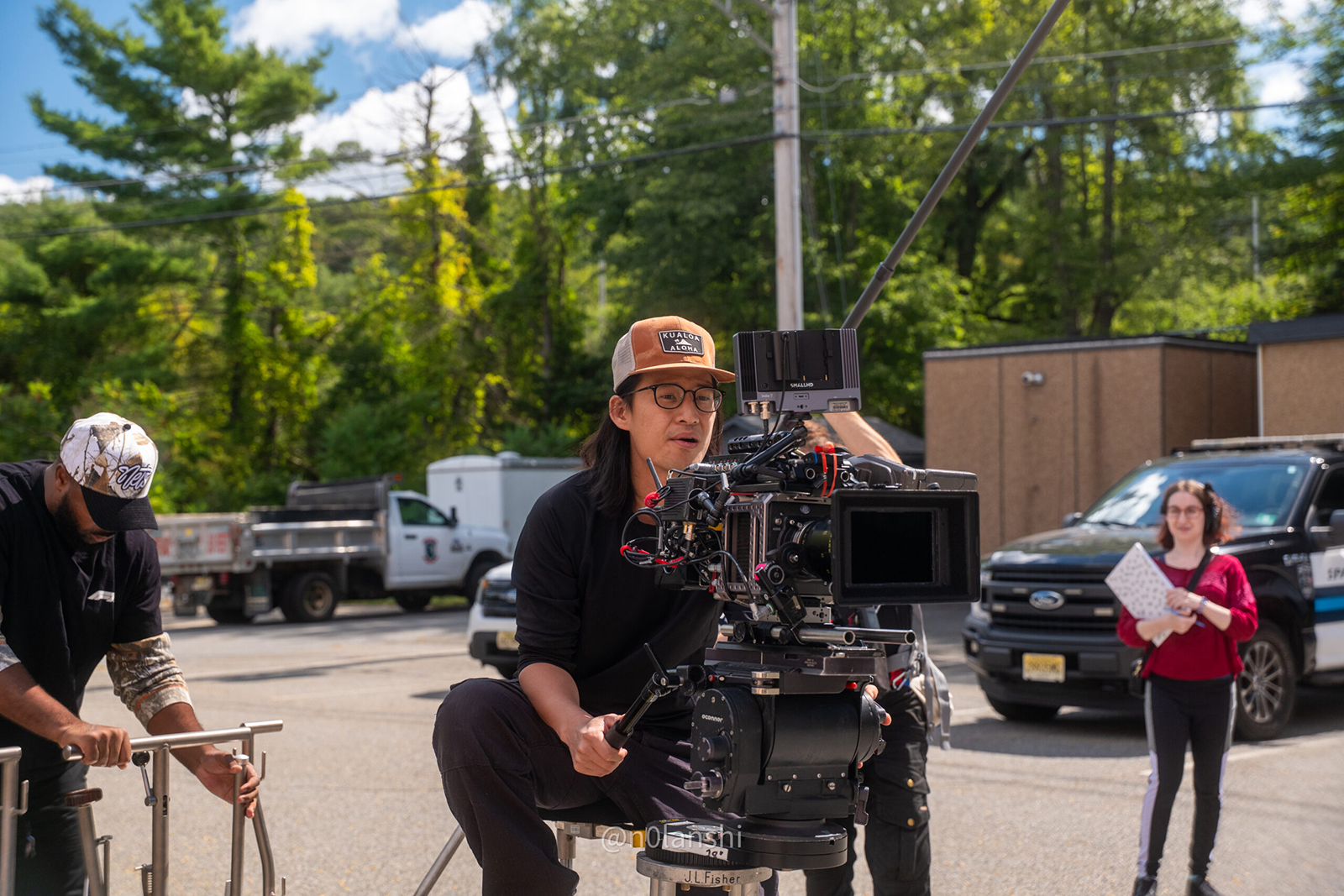
Jason Kim (BS ’13, media and cinema studies) is a director of photography and editor at Omnicom Studios in New York as well as director and executive producer of his own production company, House Productions LLC. Kim has earned numerous awards for his film work including a 2018 Telly Award for “General Branding” and a 2022 Webby Award for Advertising, Media & PR, “Best Use of Animation or Motion Graphics.” Learn more about this College of Media alum whose work is shaping the future of storytelling across film, advertising, and digital media.

Jason Kim

1. What first drew you to filmmaking and production, and how did that evolve into starting your own company, House Productions?

It’s difficult to pinpoint any one moment in time that drew me into filmmaking except for when I saw Taxi Driver, directed by Martin Scorsese and written by Paul Schrader. The inverse relationship between hero and circumstance—its anti-hero arc—showed me anything was possible in storytelling. I pursued being an artist through the medium of film ever since. House Productions allows me to hone my storytelling practice, learning, experimenting, and growing as a filmmaker. Today, House Productions produces high quality corporate videos and films I write and direct, including my latest project, Selfless.

2. Winning awards like the Telly and Webby, among others, is a huge accomplishment. Is there one project that felt especially meaningful to you?

The one project that has special meaning to me is working with the government to produce, write, direct, and edit a documentary series on the Stonewall National Monument, which helped pave the way for the gay rights movement. It’s not the most entertaining documentary but I learned a lot, and producing a document that recollects a period of time in Greenwich Village, Manhattan, is special to me.

Watch the 15-part series:

3. What advice would you give to students who want to break into directing or production but don’t know where to start?

Directing and producing are two separate paths. The best way to break into producing and production is to gain experience on set wherever you are and move to a bigger production market as soon as possible. Working with more experienced and nuanced crews, getting hands-on experience with the minutiae of filmmaking, and administrating complex paperwork is the name of the game.

As the adage goes, there is no one way to directing. Everyone has their own unique story and journey to how they come to directing. The best way to start is just to start. Get your hands on a script or write one. Find friends who will act and crew for you. Every project I’ve directed has included a learning curve, creative risk-taking, and a financial commitment. Not every project will feel true or significant. Moving past doubt, problem-solving limitations, and exercising curiosity are the first steps to directing.

Jason Kim at table

4. The media landscape is constantly changing—how do you keep your work both current and true to your vision?

The media landscape is more turbulent than ever, especially with the consolidation of traditional media companies with data-driven companies. Media production is under disruption from AI generation, with film projection being made especially vulnerable.

Disruption will have matured when AI artists can tell equally visually compelling stories—replicating the work of filmmakers, artists, craftspeople, and designers, as well as the human emotion and camaraderie in front of and behind the camera. Even still, if the art, intent, and motivations are pure, then I believe that work will have currency and truth.

5. What’s one dream project you’d love to direct or produce in the future?

My dream project is an indie sci-fi retro-noir that investigates the existence of hope in an Orwellian society. The goal is to receive a small working production budget to create something beautiful, meaningful, and artistic to satisfy the tastes of arthouse cinephiles as well as mainstream audiences. As film is a business, I have no delusion that a director must be profitable in their artistry to continue to practice directing. I believe a sci-fi genre within a low budget independent film context has the potential to break the ceiling and achieve commercial and artistic appeal. Complex VFX will be eschewed, instead of relying on ornate set design, practical effects, costumes, and locations for world-building. Then, the story itself will be the determinant of its success.

Another dream project of mine is to create a documentary on the early phases of the Internet developed at ILLINOIS through the ILLIAC computer and PLATO network. Researching the history of these emerging communication systems as a media and cinema studies major was the highlight of my time on campus. I would love to dive deeper into these early networks’ role in shaping society as we know it today, from the maturation of social networks to the advent of artificial intelligence. To premiere this document that encompasses the past, present, and future of digital communication would be a dream.

Share on social

Media students gain unique, real-world experience through summer internships


From working on film production crews and meeting famous actors to interviewing congressmen on Capitol Hill, several College of Media students ended their summers on a high note after wrapping up internships that offered memorable learning opportunities.

Francisco Albarran

Francisco Albarran (MACS), Film Production Intern, Chili Finger

When media and cinema studies senior Francisco Albarran heard Chili Finger—a new film starring John Goodman, Judy Greer, Sean Astin, and Bryan Cranston—was filming nearby this summer, he took a chance and emailed Rantoul-based Flyover Film Studios, asking if he could help out.

To his surprise, the words “perfect timing” quickly appeared in his inbox and the very next day, Albarran was on set, helping build scenes and soaking in hands-on production experience at locations across central Illinois.

In his second week of the internship, Albarran got a surreal assignment: pick up Bryan Cranston (Breaking Bad) from his rental house in Champaign. The next day, Albarran was in his driveway, watching with awe as the garage door slowly opened revealing one of his all-time favorite actors.

“It looked so amazing. It looked like Walter White [the character Cranston played in Breaking Bad] was actually right there in front of my eyes, which basically he was,” Albarran said.

During the 20-minute drive, the two shared a conversation about the Chili Finger production, life in general, and Albarran’s own film aspirations. Albarran asked Cranston to sign a plank of wood he had saved from the film set as a souvenir. The message read: “Francisco, thanks for the ride, my friend, Bryan Cranston.

“One week you have dirty laundry in the back of your car, and then the next you have an Emmy Award-winning [actor],” Albarran mused.

Albarran said meeting Cranston and working alongside the film crew, as well as working with his MACS 480 classmates, helped reinvigorate his passion for storytelling and filmmaking. He hopes to write, direct, and act in a short film this year.

Nathan Gonzalez (Journalism), Assignment Desk Intern, FOX News Channel at the Washington, D.C., Bureau

Nathan Gonzalez

As an assignment desk intern for FOX News at the Washington, D.C. Bureau, Nathan Gonzalez, a junior in journalism, produced coverage of protests, U.S. District Court cases, Senate and House committee hearings, live shots, interviews, and press conferences with members of Congress.

Some of the content he produced even aired on shows like Fox News Live, The Big Weekend Show, The Story, America Reports, America’s Newsroom, Special Report with Bret Baier, and The Will Cain Show.

“That was a huge moment,” Gonzalez said. “It reassured me that even as a rising junior, I’m capable of producing content that meets national standards.”

Gonzalez learned how national political reporting is structured, the importance of fostering relationships with fellow reporters, and that national and local reporting aren’t as different as they seem.

“While national outlets have far more resources, the core skills—approaching officials and asking questions—apply at every level. If you can interview municipal officials, you can press congressmen on Capitol Hill, without a doubt,” Gonzalez said.

Jonathan Mathew (Journalism), Entertainment Promotions Intern, Chicago Dogs

Jonathan Mathew

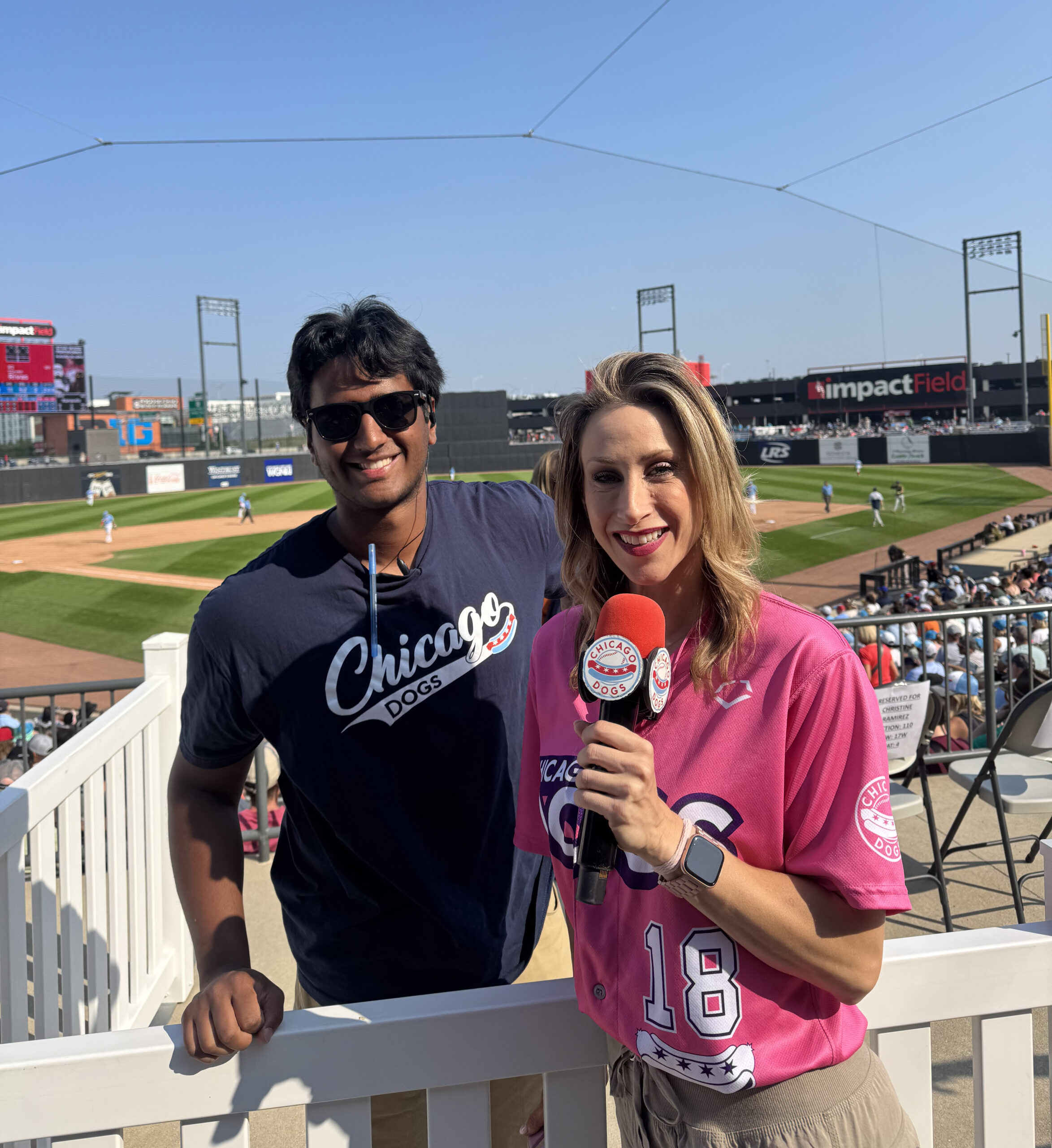
Whether he was working in the team store, ushering VIPs, overseeing the team’s Kid Zone, or dressed up as “Squeeze” the mustard mascot, Jonathan Mathew, a junior in journalism, had a great experience as an entertainment promotions intern with the Chicago Dogs baseball team this summer.   

Mathew said the opportunity to intern with the independent professional baseball team taught him a lot about sports business and entertainment, including different marketing techniques, as well as how to interact and engage with the public.

“I learned a lot of life lessons that will be valuable to me in the long run, and I am confident the return on investment I have with this internship will be more than I can imagine,” he said.

Mathew recalls one day working behind the mic as a gameday co-host tasked with entertaining the crowd between innings.

“That [is] an experience I will hold closely to my heart and have as a reminder to keep me motivated in achieving my career dream,” Mathew said.

Sarah Juan (Advertising), Social Media Content and Video Intern, Glow Recipe

Sarah Juan

Sarah Juan, a junior in advertising, went above and beyond to secure an internship at the global skin care company Glow Recipe, crafting a mock-campaign proposal highlighting a celebrity partnership. Her hard work paid off as Juan was awarded the internship as a social media content and video intern.

In her role, Juan assisted with content development, conducted market research, tracked metrics, and helped the social media team with new product launches, which was the highlight of the experience for her.

“Supporting the content team on set in NYC, I was able to work directly with models for new product launches and help direct filming for social content! Being on set was the most rewarding experience,” Juan said.

Juan recalls an important lesson her supervisor shared that will stick with her: “We’re all storytellers, no matter the industry you market in.”

“The beauty industry is tough and requires thick skin, but if you are passionate about supporting a mission through storytelling, that is what will get you far,” Juan said.

Cherie Chick (MS Advertising), Account Specialist Intern, Rakuten Advertising

Cherie Chick

Cherie Chick, an MS advertising student, applied to more than 80 positions and interviewed with eight different companies before securing an internship with her top choice, Rakuten Advertising. Rakuten provides advertising technology and consumer insights to global brands and retailers with a core focus on affiliate marketing, acting as the bridge between advertisers and publishers, including content creators, media outlets, and loyalty platforms.

Chick spent her summer in Chicago as an account specialist intern responsible for managing high-impact affiliate marketing campaigns by strategizing and negotiating publisher partnerships, optimizing creative placements to drive conversions, delivering performance insights to clients, and advising on quarterly spend strategies.

For Chick, the highlight of the internship was working with a diverse portfolio of client accounts spanning multiple countries and industries, from travel and finance to education and technology.

“This cross-regional exposure taught me how consumer behaviors, promotional calendars, and publisher relationships vary across markets,” Chick said. “For example, the way travelers research trips and the sites they interact with is entirely different from how consumers search for credit card offers or financial advisors.”

Share on social

Media faculty and TAs make list of teachers ranked as excellent


Updated 9/22/2025 to include Summer 2025 results.

Congratulations to all the College of Media faculty and teaching assistants who were ranked as excellent by their students!

Congrats image

This list is based on Instructor and Course Evaluation System questionnaire forms completed by students during the Spring 2025 and Summer 2025 semesters. Only those instructors who distributed ICES forms at least once during this time period and who released their data for publication are included in the list. View the complete list.

Note: * denotes that the instructor ratings were outstanding.

ADVERTISING

KENT BROWN – ADV 314

*TERRY KASDAN – ADV 409

EWA MASLOWSKA – ADV 494

*SHACHAR MERON – ADV 222, ADV 333

*MICHELLE NELSON – ADV 582, ADV 590

*MARISA PEACOCK – ADV 290, ADV 498

CHARLOTTE PELOQUIN – ADV 290

LEONA YI-FAN SU – ADV 492

KEVIN WISE – ADV 483

MEDIA

CL COLE – MDIA 590

JOURNALISM

*CHRISTOPHER BALL – JOUR 430, JOUR 451

ALISON DAVIS – JOUR 215, JOUR 340, JOUR 440

MELITA GARZA – JOUR 310

ALEXANDRE GONÇALVES – JOUR 102

CAROL LOMBARDI – JOUR 220

MEDIA & CINEMA STUDIES

*VICTOR FONT – MACS 371, MACS 480, MACS 481

JONATHAN KNIPP – MACS 282

JENNY OYALLON-KOLOSKI – MACS 262

STRATEGIC BRAND COMMUNICATION

EWA MASLOWSKA – SBC 505

RICH PIECZYNSKI – SBC 504

TEACHING ASSISTANTS

J. CHANG – ADV 250

C. CHICK – ADV 150

*K. COOK – ADV 250, ADV 490

A. GOODREAU – ADV 150

H. JI – ADV 250

M. KHOWAJA – ADV 250

N. OSHODI – ADV 150

S. PARK – ADV 360

R. SUN – ADV 284

T. CHEN – MACS 260

J. CINTRON – MACS 100

G. DUTRA GUEDES – MACS 100

S. GOMEZ- PEREZ – MACS 101

W. HELMKE – MACS 101

Y. HONG – MACS 100

Y. KANG – MACS 100

*G. PAXTON – MACS 100

J. ZHANG – MACS 260

N. ZHOU – MACS 101

Share on social

College of Media
119 Gregory Hall
810 S. Wright St.
Urbana, IL 61801
217-333-2350