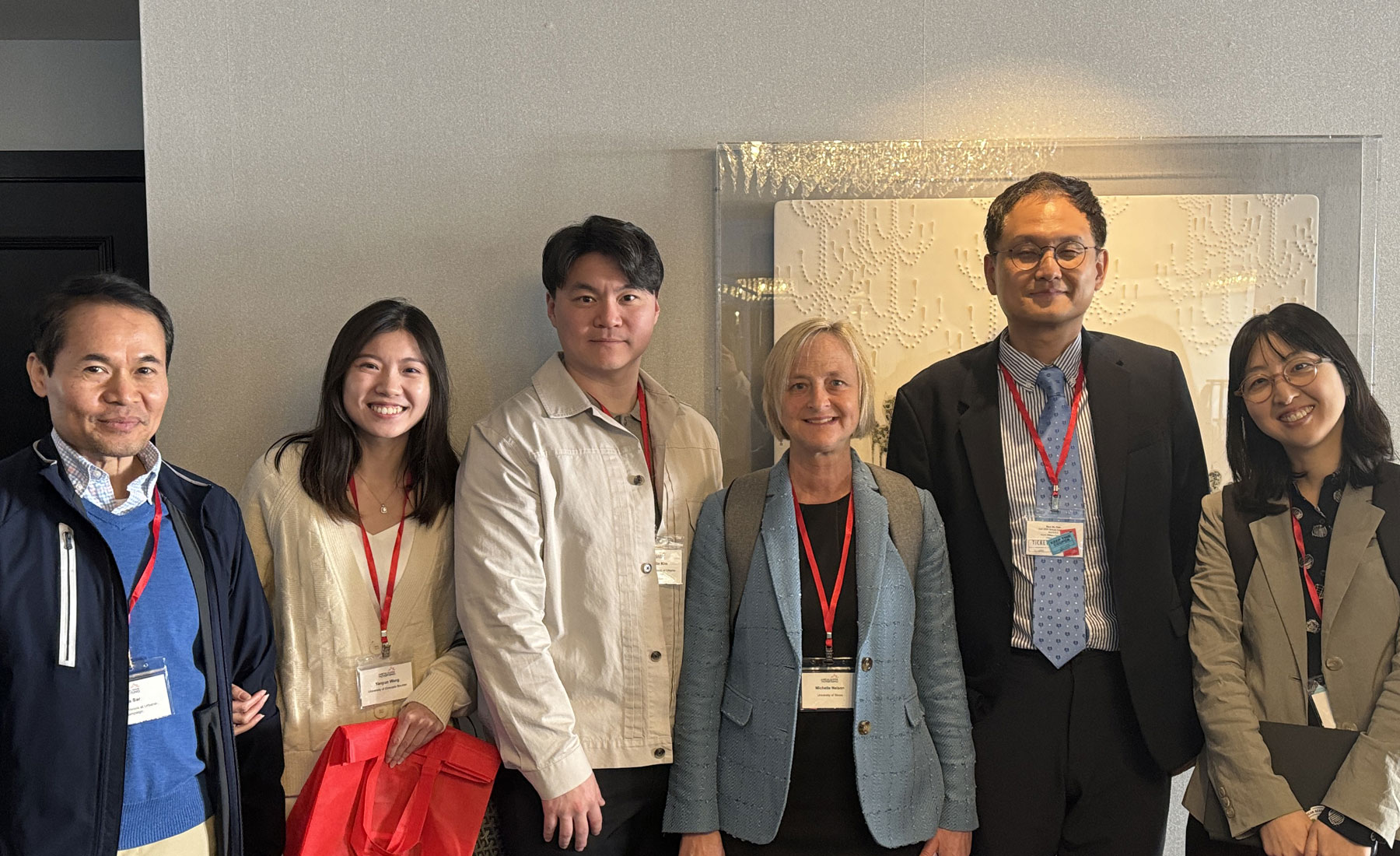
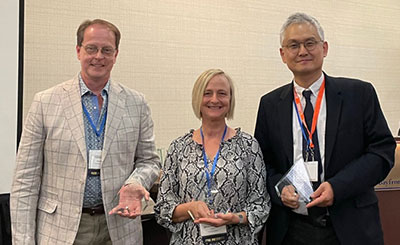
Faculty and graduate students in the Charles H. Sandage Department of Advertising and Institute of Communications Research were honored with awards and presented research at the annual conference of the American Academy of Advertising, held March 14-17, 2024, in Portland, Oregon.
Professor Michelle Nelson, head of the Charles H. Sandage Department of Advertising, won AAA’s Career Award, the Ivan L. Preston Outstanding Contribution to Research on Advertising Award. As AAA’s top research award, this is designed to honor an individual who has made an outstanding contribution to the discipline of advertising through a systematic and sustained program of published research. The award carries a $1,000 prize. This award is given only to active AAA members for exemplary research on advertising across 20 years or more.
Chang-Dae Ham, associate professor of advertising and associate head of graduate studies, was elected vice president of AAA and began his term on the executive committee.
Kevin Wise, professor of advertising, was appointed head of AAA’s graduate student committee.
ICR student WooJin Kim (Advisor: Chang-Dae Ham) won a doctoral dissertation competition award for “When Humans Anthropomorphize Nonhumans: Examining the Role of AI Interactivity and Human Motivations.” Floria Yujin Lee, a graduate student in advertising, won a travel fellowship award.
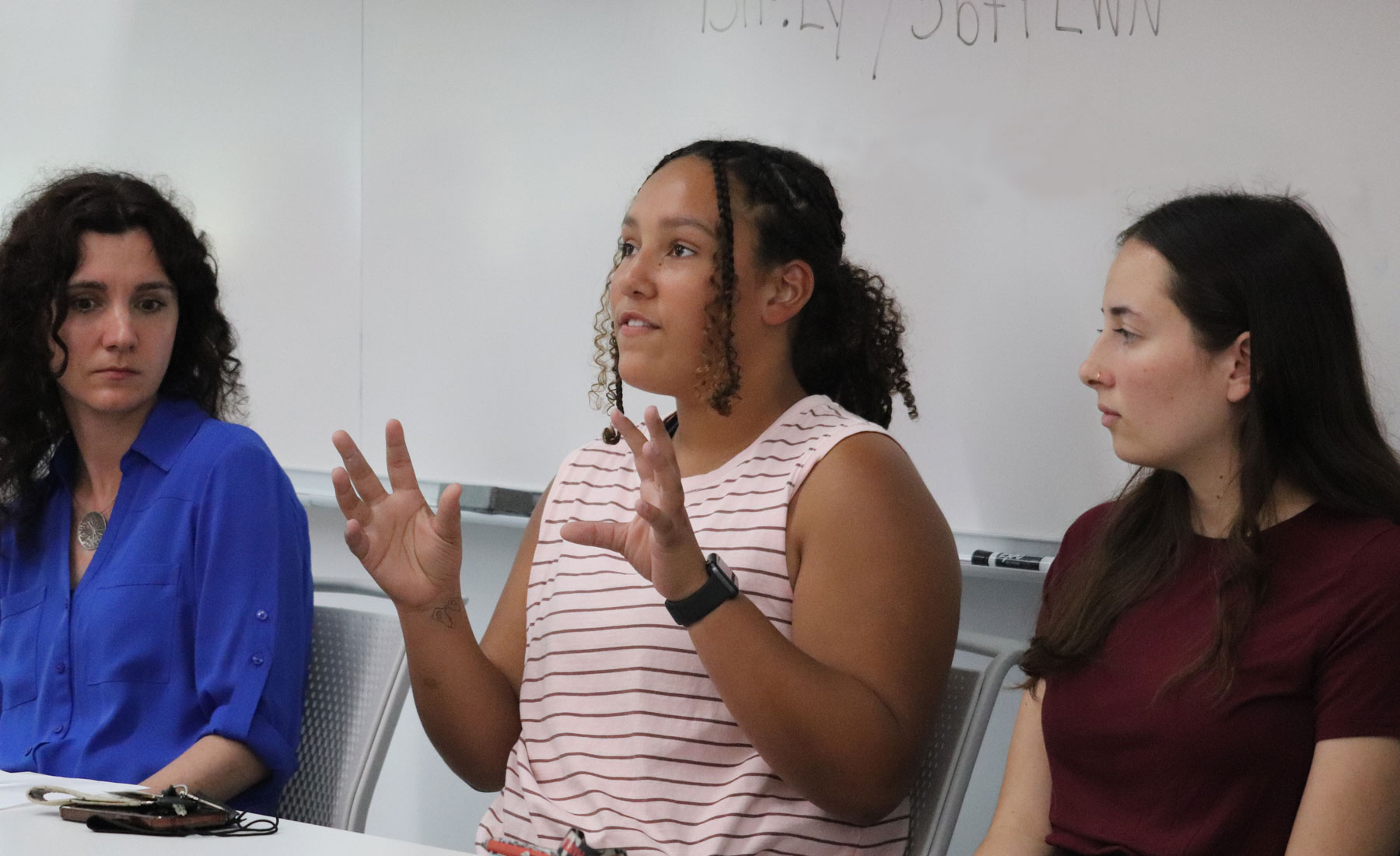
(Pictured at top: Professors Sela Sar at left, Michelle Nelson in center, and Chang-Dae Ham at right at the conference with graduate students.)
Presentations
Pre-Conference Panel Session: “How to Develop a Successful Journal Submission: Advice from Editors and Leading Experts” – with presentation “Best practices for experimental studies” by Sela Sar, professor of advertising
Special Session: “Stepping out of the Ivory Tower: Engaged Research & Teaching in Advertising” led by Professor Michelle Nelson
Research paper presentations:
“Hey, You Put Ads in My Netflix: How Audiences Negotiate the Changing Streaming Video Landscape” Floria Yujin Lee (MS Advertising), Masashi Fukada (MS Advertising), Paris Baptiste (MS Advertising), Xinle Du (MS Advertising); Professor Michelle Nelson
“Exploring Motivation to Follow Virtual Influencers (VIs): The Role of Emotional Attachment as a Mechanism for Generating Positive Effects in VI-Endorsed Advertising” Professor Chang-Dae Ham and Seo Jeong Heo (ICR)
“When Lonely Hearts Meet Talkative Artificial Intelligence (AI) Chatbot: Exploring the Role of AI Interactivity in Sociality Motivation in the Context of AI-Powered Advertising” WooJin Kim (ICR), Professor Chang-Dae Ham, Dongchan Lee (Northwestern University), Se Il Park (ICR), Seo Jeong Heo (ICR), Floria Yujin Lee (MS Advertising)
(Pictured above: Alumna Regina Ahn (MS ’14, advertising; PhD ’19, ICR) and Professor Michelle Nelson met a llama and alpaca during the AAA conference.)
March 7, 2024 | University of Illinois News Bureau
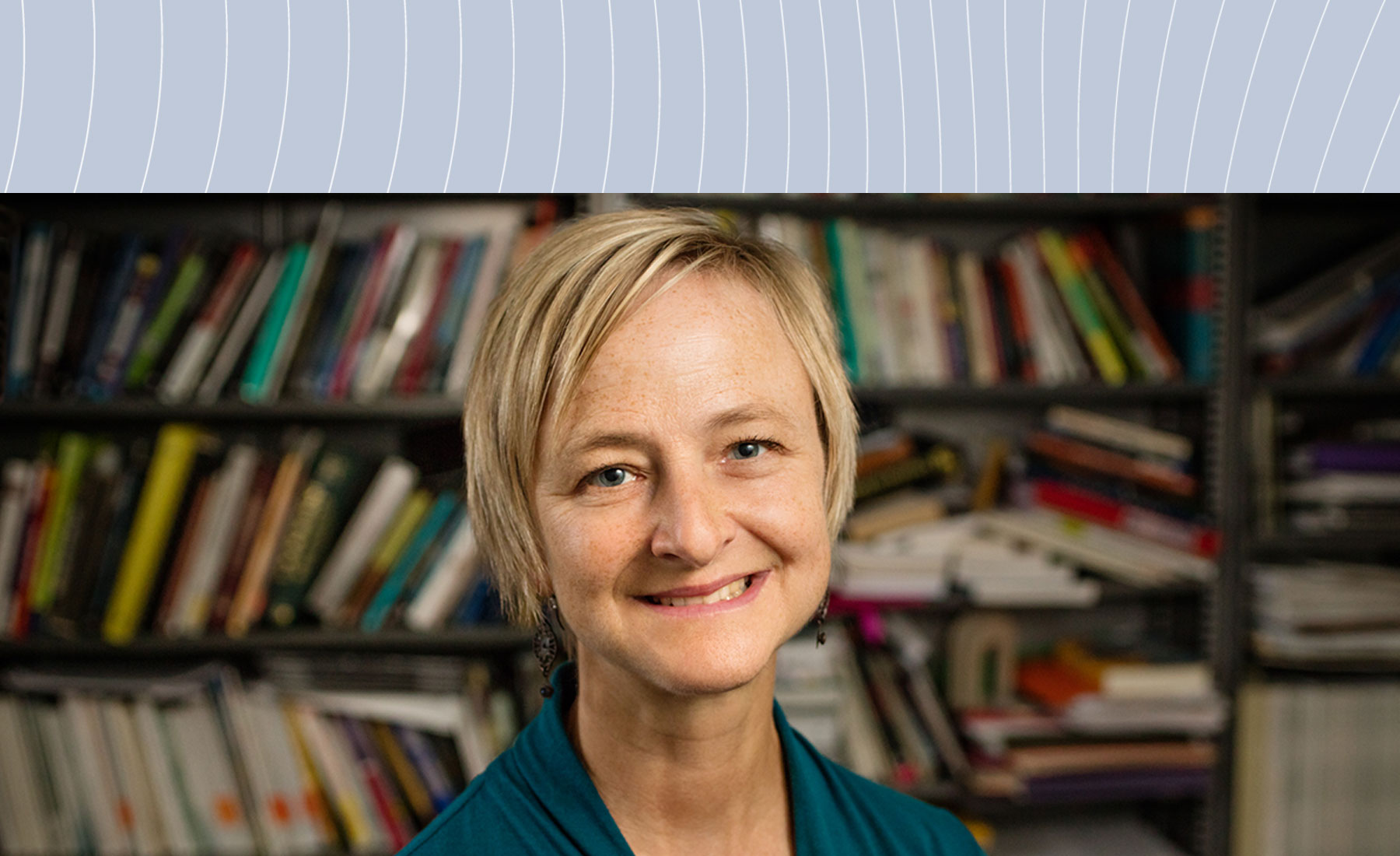
Michelle Nelson, professor and head of the Charles H. Sandage Department of Advertising, says voters should expect to see a lot more generative AI in political ads during the 2024 election cycle, warning that it might be difficult-to-impossible to tell what’s real and what’s fake. (Photo by L. Brian Stauffer.)
It’s estimated that $12 billion will be spent on political ads this election cycle—30% more than in 2020. The sheer volume of ads is remarkable, and there is vast potential to use this political information to contribute to democracy: to reach more potential voters and provide accurate information. There’s also more potential than ever for generative artificial intelligence to misrepresent candidates and policies, leading to confusion in the voting booth. News Bureau editor Lois Yoksoulian spoke with advertising professor and department head Michelle Nelson about the topic.
How is AI used in political ads, and what are some recent examples of AI-generated political ads?
After President Joe Biden announced his re-election bid, the Republican National Committee released an AI-generated political advertisement that depicted a dystopian world should Biden be re-elected. The video ad features a number of “what if” questions (e.g., What if crime worsens?) with AI-generated images. This is a classic fear appeal-negative attack ad. Emotional ads reach us, and we remember them—like the famous Daisy political ad used during the 1964 election cycle or the Willie Horton ad used in 1988. But they may also get some backlash for being too negative, too manipulative, especially because they are using AI.
Some say the Joe Biden RNC ad is the first AI-generated ad, but it’s hard to prove. However, in the top left corner of the ad, you see a disclosure in a small font: “Built entirely with AI imagery.” The video description on the GOP’s YouTube page says, “An AI-generated look into the country’s possible future if Joe Biden is re-elected in 2024.” So they are not hiding the use of AI. There’s also a spoof ad that ran on The Daily Show, which uses an AI-generated voiceover for Biden. It’s pretty easy these days to use AI tools to create content and make it look pretty real.
Are the entities behind these types of ads required to disclose that AI has been used?
The Federal Election Commission, the governmental body that regulates political communication, including advertising in the U.S., sought public comments on amending a regulation related to the use of deliberately deceptive AI in campaign ads at their meeting titled 2023: REG 2023-02 Artificial Intelligence in Campaign Ads. They have not yet made a ruling here. However, states such as California, Texas, Michigan, Washington, and Minnesota have enacted new state laws where any deepfake AI images, video, or audio need to be labeled in. A similar law is being discussed here in Illinois. It’s not clear how these state laws relate to the Constitution.
Some tech companies have started requiring disclosures. For example, Google indicated that all AI-generated political ads shown on YouTube or other Google platforms “that alter people or events” must have a prominent disclosure. There is also a verification process for political ads in some regions.
Microsoft has started their “Content Credentials as a Service” which is like a watermarking tool—it lets users digitally sign and authenticate the media—whether it’s an image or video through their Coalition for Content Provenance and Authenticity. The idea is that the watermark serves as metadata so users can see the history of the content. For example, “how, when, and by whom the content was created or edited,” whether by a person or AI. This information stays with the content so anyone can see the origin.
To what extent AI-generated political content is now being watermarked or disclosed I have no idea. It seems difficult to police all of these images at this moment in time.
What is the potential harm of using AI in political ads?
The concerns for harm relate to possibilities for deepfakes and disinformation. Others can re-create something using AI voice or images without authorization to create stories and content that are absolutely untrue.
We’ve had tools and technology in the past, like Photoshop to manipulate existing images. Do you remember the 2004 ads featuring altered photos depicting John Kerry, the Democratic nominee for president, and Jane Fonda at an anti-Vietnam War rally? Ads are regularly embellished or altered: The colors or lighting are changed to make people look ominous or more youthful. But this is different. This is a whole new level. Anyone can make AI messages using free tools such as Open AI’s ChatGPT or Google’s Bard. This may be good when used responsibly, or it may be harmful.
Our research shows that many people don’t know that the First Amendment protects political advertising in the U.S. Political advertising is not held up to the same standards as commercial advertising, say for a cheeseburger. The Truth-in-Advertising laws by the Federal Trade Commission do not apply to political ads. That means political ads can legally be deceptive or lie. Of course, there are libel laws, but they are rarely used in this arena.
Beyond this regulatory difference in commercial and political advertising, the idea is that we want free-flowing political information to contribute to a dialogue that can enhance our democracy. Too much regulation can have a chilling effect on political speech. Yet the potential today with AI to lie and deceive and to deploy these messages in a personalized manner and at a grand scale offers a challenge perhaps to our thinking about regulation and political advertising.
Do you have any advice on how consumers can spot the use of generative AI in political ads?
They can’t. You can look for irregularities like the number of legs on the cat. But it is getting harder and harder to tell if AI makes an image or video. Whether it’s Taylor Swift, an image of Trump in jail, or a funny meme, we can’t always tell, especially as we scroll through our social media feeds. The best we can do is hope that the tech industry develops systems able to trace the origin of the content so we can see who made the image and when and how. If this tech is built in, it’s harder to fool people. We could also encourage disclosure mandates among tech companies.
But in the age of this kind of media and in an election year, we need to focus on the basics of media literacy—looking for reliable sources of information, watching the political debates and trying to form our own informed opinions.
Editor’s note: To reach Michelle Nelson, call 217-344-5068; email nelsonmr@illinois.edu
This fall welcomes two new heads of academic units, a new center director, a new associate head of advertising graduate studies, three faculty promotions, and two new faculty in the College of Media.
Professor Michelle Nelson will serve as the head of the Charles H. Sandage Department of Advertising for a three-year appointment. Nelson is a past president of the American Academy of Advertising. Her research interest focuses on advertising literacy and political advertising.
Professor Mike Yao has been appointed as the director of the Institute of Communications Research. He previously served as head of the Department of Advertising. Yao’s research delves into the interplay between media technology, society, and human communication. He studies how people engage with emerging technologies like AI, immersive multimedia, and extended reality across diverse social settings, and how these interactions influence our social behaviors and human communication within technology-mediated digital spaces.
Angela Aguayo, associate professor of media and cinema studies, will serve this year as acting director of the Roger Ebert Center for Film Studies. She has previously served as Dean’s Fellow for Strategic Initiatives. Her research is centered around documentary production and media studies, connecting production, theory, and history.
Chang-Dae Ham, associate professor of advertising, has been appointed as associate head of graduate studies for the Charles H. Sandage Department of Advertising for a three-year appointment. Ham studies persuasion knowledge and digital advertising.
Three faculty in the College of Media have been promoted:
Jason P. Chambers has been promoted to professor of advertising. He also serves as Associate Dean for Diversity, Equity, and Inclusion. He is a scholar of advertising history, particularly the contributions of African Americans to the industry, and has a new book titled Advertising Revolutionary: The Life and Work of Tom Burrell that will be published in early 2024.
Ewa Maslowska has been promoted to associate professor of advertising with indefinite tenure. Her research centers around marketing communication and consumer behavior, specifically consumer-brand interactions in the context of new technologies.
Julie Turnock has been promoted to professor of media and cinema studies. She served as the inaugural director of the Ebert Center and is on sabbatical this year. Turnock’s research focuses on film, with an emphasis on special/visual effects. She is working on her third book, a technical, industrial, and aesthetic history of the special effects industry in the Hollywood studio era, circa 1915-1960. Informed by extensive archival research, it centers around the labor and artistry performed by unsung “below-the-line” studio effects workers whose skills make much of “movie magic” possible.
The Department of Journalism welcomes two new faculty members: Nancy Averett, lecturer, who specializes in science and environmental journalism, and Alex Gonçalves, assistant professor, who is a scholar of social media and data journalism.
The American Academy of Advertising held its annual conference March 23-26 in Denver, Colorado, where five faculty from the Charles H. Sandage Department of Advertising and graduate students in advertising and from the Institute of Communications Research presented papers, led panel discussions, and won awards.
Sela Sar, professor of advertising and director of the Institute of Communications Research, completed his term as president of the AAA and will remain on the executive committee until March 2024.
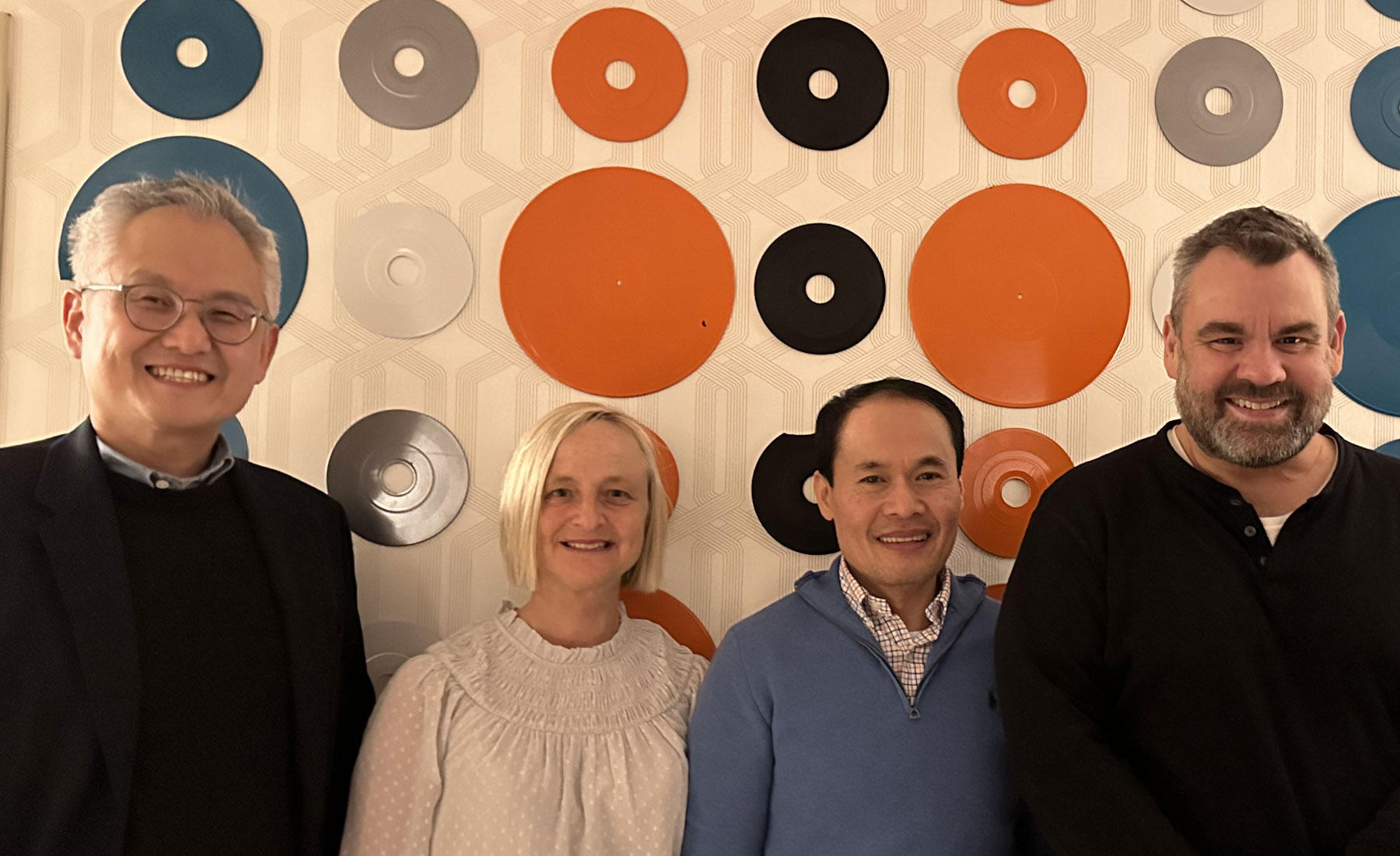
(Pictured at top: Professor Sela Sar, ICR doctoral student Dongchan Lee, advertising graduate student Prativa Subedi, and Associate Professor Chang-Dae Ham.)
AWARDS & HONORS
Journal of Interactive Advertising Best Article of the Year Associate Professor Chang-Dae Ham (pictured above, at right) and Ayoung Seok (advertising graduate student), along with Joonghwa Lee (University of North Dakota) and Soojung Kim (University of North Dakota), were part of a collaboration that won a “Best Article” award at the conference for “Avoidance and Acceptance of Native Advertising on Social Media: Applications of Consumer Social Intelligence, Persuasion Knowledge, and the Typology of Consumer Responses.”
Chen (Crystal) Chen (ICR doctoral student, pictured above) and ICR alumni Xiaohan (Catherine) Hu (PhD ’22), Xiaoyu (Zoe) Xu (PhD ’22), and Regina Jihea Ahn (PhD ’18) were part of collaborations that won research grants at the conference:
Chen, Hu, Xu, “Investigating the Effects of Social Presence and Perceived Autonomy in Chatbot Advertising”
Ahn and Joonghwa Lee (University of North Dakota), “Social Influence and Its Impact on Influencers’ Content Strategies on Instagram: From a Nano-Influencers”
In addition, Chen (Crystal) Chen and Olga Shabalina (ICR doctoral student) were awarded special travel grants from AAA.
PRESENTATIONS
Presentations by faculty and students included:
“Bridging Research and Practice: Advertising’s Role in Promoting Sustainability,” co-presented by Professor Sela Sar, among others
“How Neutralization Affects Subsequent Prosocial Behaviors: The Roles of Materialism and Moral Identity,” presented by WooJin Kim (ICR doctoral student) and Seo Jeong Heo (ICR doctoral student)
“Self-construal and Green Online Behavioral Advertising: The Moderating Role of Algorithmic Awareness and the Mediating Role of Self-esteem,” presented by Dongchan Lee (ICR doctoral student) and Professor Sela Sar
“Disentangling Control and Personalization: Exploring the Effects of Ad Choice and Ad Personalization in Digital Advertising Effectiveness,” co-presented by Professor Kevin Wise
“The Effects of Personalized Social Media Political Advertising on Attitude Formation: The Role of Personality and Political Orientation,” co-presented by Assistant Professor Ewa Maslowska, among others
“Constructing a ‘Metaverse’ Typology based on Affordances and Psychological Processes: A Systematic Literature Review,” presented by Professor Michelle Nelson, and ICR doctoral students Chen (Crystal) Chen, Yan (Anna) Liu, Jingyu Liu, Veranika Paltaratskaya, and Prativa Subedi (advertising graduate student)
“Computational Approaches to Advertising Research: Ongoing and Emerging Challenges and Lessons,” co-presented by Assistant Professor Ewa Maslowska, among others
“Understanding and Increasing Everyday Persuasion Knowledge about Political Advertising,” co-presented by Professor Michelle Nelson, Kirby Cook (ICR doctoral student), Associate Professor Change-Dae Ham, and Veranika Paltaratskaya (ICR doctoral student)
“The Future of Dataveillance in Advertising Theory and Practice,” moderated by Associate Professor Chang-Dae Ham and co-presented by Hari Sundaram (ICR doctoral student), among others
“Exploring Screen-Ad Congruence Effects on Visual Aesthetics and Ad Likeability in Social Media,” co-presented by Olga Shabalina (ICR doctoral student) and Professor Michelle Nelson
“Is Artificial Intelligence (AI) Superior to Human?: Rethinking the Role of Agent Knowledge in Perceived Autonomy, Superordinate Intentions, and Coping Mechanism with Influencer Marketing,” presented by Dongchan Lee (ICR doctoral student) and Associate Professor Chang-Dae Ham
The Charles H. Sandage Department of Advertising and the Hub for Brand Innovation and Advertising Technology have created a new professional workshop series for students through the Emerging Leaders Program, which aims to immerse students in the advertising industry.
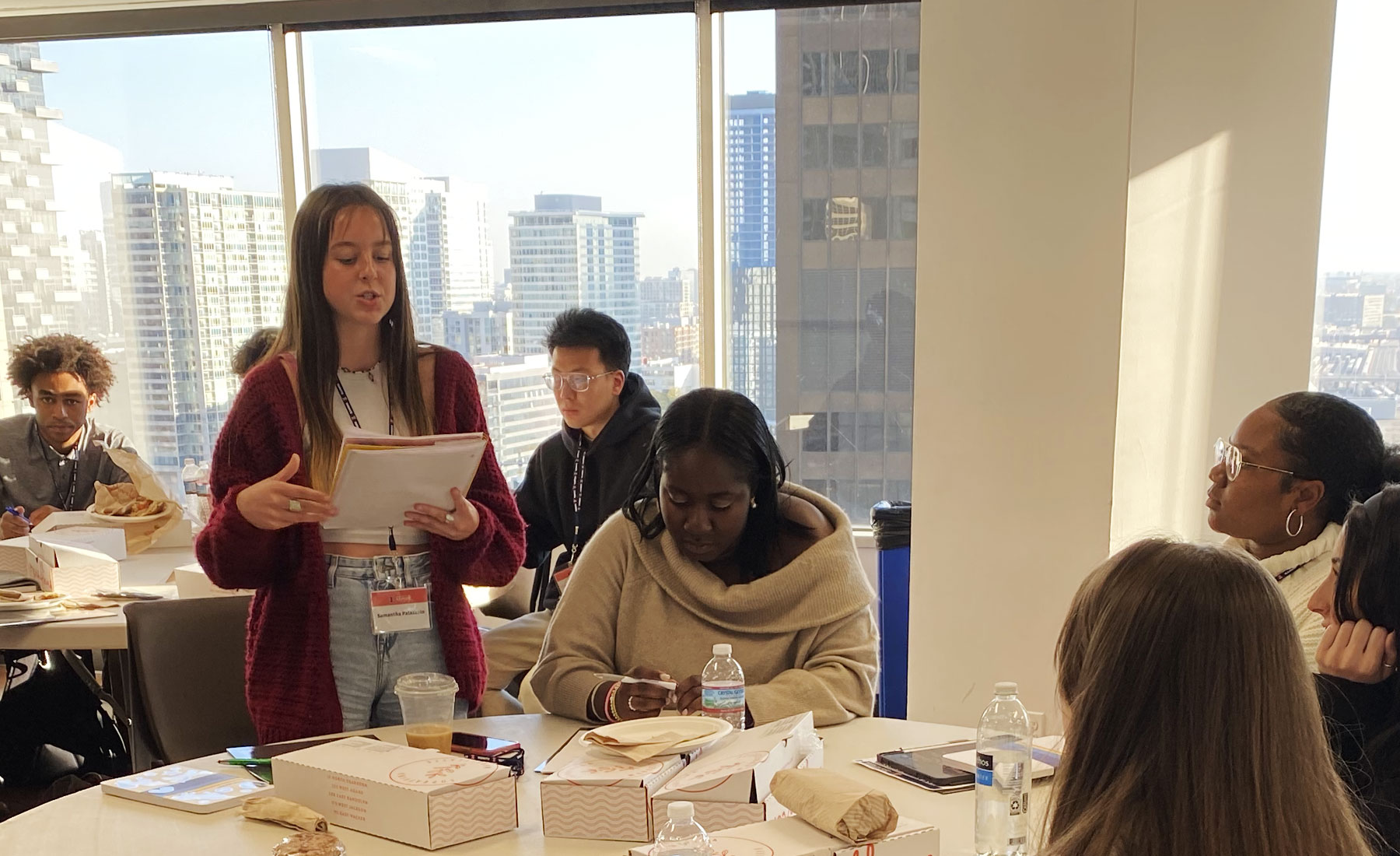
Thirty advertising students were selected for the 2022-23 academic year to gain experience in innovative areas of advertising, and network with University of Illinois alumni and industry guests in three workshops at the Illini Center in downtown Chicago.
“These immersive events allow students in the Emerging Leaders Program to interact with and learn from industry leaders in an experiential learning format,” said Michelle Nelson, professor of advertising and acting head of the department. “These experiences will also give students a unique advantage when they enter the job market.”
The program has focused on three themes in their workshops: programmatic advertising, brand strategy, and product marketing.
Susan Muirhead, associate director of the Brand Hub, was glad to develop an opportunity for students to apply their advertising skills outside of the classroom and gain a closer look at the advertising industry.
“I hope [students] learn about what the industry is doing so they’ll get a pulse on what’s happening and what the emerging trends are,” Muirhead said.
The sessions consist of a three-hour workshop where students work on a group project or exercise, followed by a two-hour networking event where students engage with peers and attending professionals and alumni.
Muirhead said the events have been a fun opportunity for both students and professionals to meet each other.
“I think [the industry professionals] are really impressed with the energy, the passion, and the talent, and how bright our students are.”
In October, the first workshop on the future of advertising technology was presented by The Trade Desk, which offers an independent media-buying platform.
“I learned about measuring audiences and media planning and the digital aspect of advertisements,” said Asia Griffin, a senior in advertising. “Just being able to network and talk to people at The Trade Desk was a great experience.”
In February, global advertising agency Leo Burnett presented on brand strategy and the students completed a Cultural Insights exercise, a tool actively used by the brand strategy team at Leo Burnett.
“I want to be more involved with Chicago-based companies,” said Joshua Watson, junior in advertising. “It’s also a good opportunity to learn more about what Leo Burnett is, what a job looks like there, and even just seeing all the people [who work] there.”
TikTok will host the last workshop in April, focusing on TikTok search engine optimization and product marketing.
Danielle Rowaiye, a junior in advertising, has enjoyed the program so far.
“I’m just excited to get to meet up with the same people again and have that same opportunity to network and to learn,” Rowaiye said.
Students and companies interested in participating in future Emerging Leaders Program events can contact Susan Muirhead at muirhea@illinois.edu.
It can be challenging to distinguish between a paid political ad and one that is not in today’s media environment, especially on social media. News Bureau editor Lois Yoksoulian spoke with advertising professor Michelle Nelson about the topic. New research from Nelson and her colleagues found that most adults—even those who are politically engaged and educated—do not fully understand online targeting, sources and funding for political ads, or the unique regulatory environment for political speech that is different from commercial speech.
Professor Michelle Nelson (Photo by L. Brian Stauffer)
Are political ads regulated, and how do they differ from commercial ads?
Political ads are a form of political speech, which is given more protection than commercial speech under the First Amendment, with the idea that the free flow of political information is essential for the functioning of a democracy. Commercial speech, which includes advertising for products and services, has been defined as speech that merely proposes a commercial transaction.
Only commercial speech is regulated by the Federal Trade Commission, motivated by the governmental interest of providing true and nonmisleading information to consumers. Not all commercial speech is advertising, and not all advertising is commercial speech. An ad for a McDonald’s burger is commercial speech, subject to the FTC rules regarding false and misleading information. An ad for a candidate is political speech, not subject to the FTC rules or any content-based guidelines.
However, the Supreme Court has said that time, place and manner restrictions can apply to political ads. For example, laws that require funding disclosure don’t compromise the content of the speech because they provide citizens with information regarding the message’s source. So, there is some regulation for political ads regarding source disclosure.
Is this level of regulation adequate?
No, especially on social media. For example, the “Stand By Your Ad” provision of the 2002 Bipartisan Campaign Reform Act, which requires anyone running for federal office to include the “I approve this message” as part of their ads, only applies to TV and radio, not to social media.
What this means for U.S. voters is that they may not be able to know the true source of the political message. It’s like the Federal Election Commission hasn’t caught up to what’s happening in the media environment. Increasingly, people are getting their political ads and information online. I believe that people have the right to know the source of messages so they can best evaluate the message.
False ads can be challenged through defamation and libel, but those processes take time. The challenge must be filed by the parties who feel wronged, and they probably will not be resolved before that campaign period is long over. So, these measures probably are not strong deterrents.
Any regulations about the message content may be seen as ”chilling” political speech. I’m not sure we want the government to censor ads’ content.
How can citizens determine who is behind a political ad if it is unclear?
As political speech, political advertising is regulated by the FEC. There are clear rules for source disclaimers such as who paid for it, whether it was endorsed by the candidate—on radio, newspaper, TV, outdoor and “communications placed for a fee on another person’s website”—but none exist for social media.
Ironically, some of the big tech companies are offering transparency. You can find out some information. For example, Meta offers an ad library, so you can see which organizations are spending money on the platform and how many ads were run, etc., and from there, you could click on the organization’s website. Google now has a verification process and offers transparency on who’s running ads online, and the FEC offers information about super PACS. People could visit OpenSecrets.org to find out more information about super PACS, as well.
However, that’s a lot of work. Most people probably do not have the time for this intensive search. It would be better, in my opinion, if there were clear, consistent and conspicuous guidelines for source disclosure in digital media, where people could see the organization and link to the organization’s website and donors.
What are some of the differences between political ads that we might see on television versus those we might encounter on social media?
First, it’s pretty easy to recognize a TV or radio ad. However, it’s not always so easy in social media. The FTC requires that paid advertisements or influencers include a “clear and conspicuous” disclosure—but not all ads have that disclosure, or it’s not so clear and conspicuous.
Second, you may not encounter political ads on all of your social media. In October 2019, Twitter announced it would stop accepting paid political advertising. This change was a significant move for a technology company whose revenue relied partly on political advertising. The action set off a series of decisions from other social media companies to regulate paid political advertising. While some companies also banned paid political advertising or instilled fact-checking, some platforms remained open for paid political advertising. YouTube announced it would do some limited fact-checking but would not allow microtargeting of ads.
I doubt there will be any governmental restrictions on political advertising on social media, but, interestingly, more than half of American surveyed in a Pew Research Center poll believed that social media shouldn’t allow political ads.
Third, some research suggests that a more diverse set of candidates advertise on Facebook, and the content of the messages may be less negative, less issue-focused and more partisan than TV commercials. This probably means that social media advertising is more targeted—probably to those who already agree with the messages. So we aren’t seeing a broad array of messages in our social media feed—we see those that we already know or with which we agree. The messages may be more like reminder messages or nudges to vote than informational content.
What steps can citizens take to increase their political advertising literacy in preparation for the current midterm and upcoming 2024 presidential election cycles?
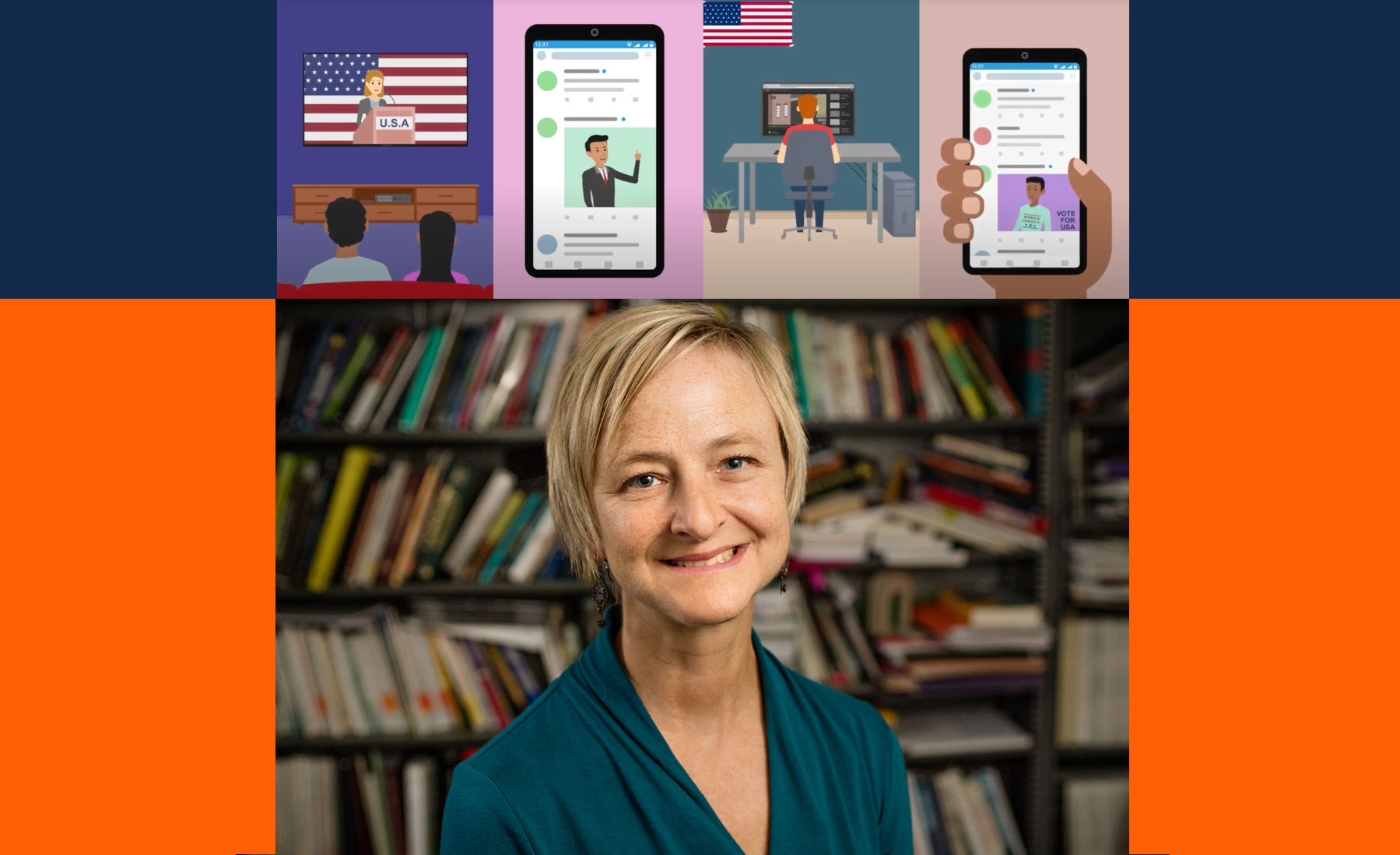
Everyone could learn more about political advertising regulations and sources. Our research group made the brief video (see below) to help all voters understand some of the key issues. We also have a website with more information, tips and even a quiz where you can check out your knowledge.
Also, the Annenberg Public Policy Center runs a fact check website where you can get all kinds of information on ads and check out if an ad is false or misleading from across the political spectrum.
And know that even though most political ads are probably providing some good information, we should all carefully scrutinize the information and check a variety of sources before entering the voting booth.
Editor’s note: To reach Michelle Nelson, call 217-344-5068; email nelsonmr@illinois.edu.
Eight projects led by College of Media faculty and staff have been selected to receive funding as part of the Mark L. Brandt Public Engagement Fellows program, established this year to provide undergraduate Media students with professional experience in public engagement activities. It also provides opportunities for students to participate in programs that support first-generation college students, students from underrepresented groups, and/or students with significant financial need.
“We are delighted to be honoring Mark Brandt’s legacy through opportunities for our students to work with College of Media faculty and staff on projects that make a difference in our community, our state, and the nation,” said Dean Tracy Sulkin.
Brandt was a 1986 alumnus of Illinois who retired early from a career in finance at General Electric. After his death in 2021, the College of Media received an estate gift of just over $1 million to create the Brandt Public Engagement Fellows program. The trustee of his estate, Mary Leyendecker, chose to ensure that his legacy makes a positive impact on students and society. The funds will provide internships for up to 40 Media students annually, with opportunities announced in both fall and spring semesters.
Below is a list of the projects, activities, and programs that received funding for Brandt Public Engagement Fellows for Fall 2022. College of Media undergraduate students who wish to apply for these opportunities should check their email inbox for the October 3 Advising Newsletter for more details.
Mis/Disinformation in Asian and Asian American Communities Research Project Led by Rachel Kuo, Assistant Professor of Media & Cinema Studies The Brandt Fellow will support research on a project that studies the historical and political contexts of mis/disinformation in Asian and Asian American communities through the use of community education workshops, oral histories, and focus groups. Working closely with the PI, the Brandt Fellow will support data collection and analysis; facilitate community research workshops and skills-trainings; and co-write and produce resource guides on Asian and Asian American history and ethnic media; and meet different community partners.
Roger Ebert Center for Film Studies Led by Julie Turnock, Associate Professor of Media & Cinema Studies This academic year (2022-2023) is the inaugural year of the Roger Ebert Center for Film Studies. The Brandt Fellow will primarily use their skills in web design, graphic design, and public relations, to build and update a public-facing website for the Ebert Center, and work with the College of Media’s Director of Communications to publicize Ebert Center events via social media. They will also play a key role to help make the activities of the Ebert Center available to the local community.
SHIELD Illinois Research Project Led by: Ewa Maslowska, Assistant Professor of Advertising Margaret Ng, Assistant Professor of Journalism Harsh Taneja, Associate Professor of Advertising The Brandt Fellows will help with a project with SHIELD Illinois—the community COVID-19 saliva-based testing program of the State of Illinois. Our project aims to understand public attitudes, news framing, and diffusion networks related to SHIELD COVID-19 testing through social media discourse and news coverage. The Brandt Fellows will take part in the process of data gathering and analysis and develop visualizations.
IMEDIA Led by: Amanda Ciafone, Associate Professor of Media & Cinema Studies, Director of Graduate Studies for the Institute of Communications Research CL Cole, Department Head, Professor of Media & Cinema Studies Stephanie Craft, Associate Dean for Academic Affairs, Professor of Journalism Michelle Nelson, Professor of Advertising The Brandt Fellow will help develop the digital communications strategy of the Initiative for Media Education Inquiry and Action. IMEDIA is a collaboration between the College of Media and the College of Education to help fill high school teachers’ needs for media literacy training and curriculum development in light of new Illinois State mandates requiring a unit of “media literacy” in all public Illinois high schools.
New Voices Internship Program Led by Daniel Almanza, Assistant Director of Media Career Services The New Voices Internship Program provides first-generation college students with support and opportunities to grow their resume as soon as they join the College of Media. Students in the program are given opportunities for professional development through workshop-style meetings with the Assistant Director of Career Services, as well as other members of the campus community. In addition to interviews, students will participate in projects based on their interests, as they align with the content needs of the College of Media.
Brand Hub Led by Susan Muirhead, Visiting Associate Director, Hub for Brand Innovation and Advertising Technology The Brandt Fellow will work with the Brand Hub on further development of their community and outreach efforts primarily through the development of Fall and Spring Brand Hub Marketing Fairs, in partnership with the Champaign Public Library. This includes support with program development, event marketing materials, and with the recruitment of student volunteers at these events. They will also be instrumental in the implementation of a pipeline system for nonprofits to work with the Brand Hub and courses in the Charles H. Sandage Department of Advertising. The Brandt Fellow will also assist, where possible, with the development of the second year of the Impact Marketing and Fundraising Fellowship program, which is set to launch in early June 2023.
Illinois Community Media Project Led by Angela Aguayo, Associate Professor of Media & Cinema Studies The Illinois Community Media Project is a grant-funded project to bring media production, curation, and documentation to underserved communities. We begin with building connections with local service organizations and through collaborative identification of social problems, design a media production outreach program. Our Illinois Community Media team works hands-on with students to connect classroom knowledge with the community. The Brandt Fellows will assist in planning public-facing speaker visits, organizing, and assisting with community-based projects, creating documentation content of events, and building website and social media presence for the organization.
News, Brews & Beatz Led by Moss Bresnahan, Executive Director of Illinois Public Media Illinois Public Media produces a quarterly series called News, Brews & Beatz—a space for diverse voices to engage in breakthrough conversations on community issues and realistic solutions. Each quarter, News, Brews & Beatz focuses on a different topic in a way that elevates Black voices and shares what individuals and nonprofit groups are doing to build community. The Brandt Fellow will assist with this multiplatform initiative, which includes content airing on TV, radio, and social media. They will also create short videos for TikTok and other social media as part of the News, Brews & Beatz initiative.
Pictured at top: Media alumna Dora Valkanova (PhD ’20, ICR), Urbana High School student Halie Thompson, and sophomore in journalism Ashley Gilbert discussed ways in which students were audiences and creators of social media content at an IMEDIA media literacy workshop this summer for public school educators. IMEDIA is one of the funding recipients in the Mark L. Brandt Public Engagement Fellows program.
August 5, 2022 | Tom Hanlon (College of Education) with Holly Rushakoff (College of Media)
Twenty-one Illinois public school educators learned how to incorporate media literacy into their curricula this summer through an IMEDIA media literacy workshop on campus, hosted by faculty from the College of Media and College of Education.
“Media literacy is especially important in light of the last presidential election and the amount of disinformation and misinformation that is pervasive in the U.S.,” said Professor Sarah McCarthey, head of the Department of Curriculum & Instruction in the College of Education. “It’s more and more critical that we equip students with the ability to discern what’s factual from what’s not.”
The workshop, attended by librarians and teachers from language arts, social studies, special education, and art, was developed by the College of Media and the College of Education. The two colleges recently jointly launched a program entitled “Initiative for Media Education Inquiry and Action (IMEDIA),” along with the cofounder of the Illinois Media Literacy Coalition, Michael Spikes of Northwestern University.
The workshop was designed to better equip teachers and students with media literacy skills to encourage mindful media consumption and production and to help teachers meet the needs of a state mandate requiring public high schools to teach media literacy beginning with the 2022-2023 school year.
“Many of us in the College of Media have been working on media literacy-related research and teaching in the last several years,” said Professor Stephanie Craft, head of the Department of Journalism. “When we heard about the new law, we wanted to be able to turn that work into action. Teaming up with curriculum and instruction experts in the College of Education seemed an ideal way to do that.”
The IMEDIA team introduced participants to key concepts in the framework for media literacy, with a focus on news media literacy. Educators were:
shown how to help students identify propaganda and see how the media have been used for social and political change throughout history,
instructed in how to use documentaries to increase media literacy, and
taught by a local Urbana High School student and undergraduate students from the College of Media how students are both creators and consumers of social media content.
The IMEDIA collaboration is working to build a robust critical media literacy curriculum in Illinois schools. Interested teachers will continue working with IMEDIA for follow up on media literacy implementation throughout the 2022-2023 school year.
“Preparing Illinois students to successfully navigate an increasingly complex media environment is vital to their well-being and ability to participate in democratic life,” Craft said.
“The end goal is quite simple,” McCarthey added. “We want all of our students to be prepared to be critical media consumers.”
IMEDIA team members include Professor Sarah McCarthey from the College of Education; Professor Amanda Ciafone from the College of Media; Michael Spikes from Northwestern University; doctoral student Sakshi Bhalla from the College of Media; Professor Michelle Nelson from the College of Media; Professor CL Cole from the College of Media; Professor Stephanie Craft from the College of Media; and Professor Jon Hale from the College of Education.Twenty-one public school educators attended the IMEDIA media literacy workshop held this summer at the Siebel Center for Design on campus.
University of Illinois Advertising Professors Michelle Nelson (center) and Chang-Dae Ham (right), along with Professor Eric Haley from the University of Tennessee (left) won two "Best Paper" awards at the AAA conference for their collaborative research.
At the American Academy of Advertising annual conference held March 24–27 in St. Petersburg, Florida, faculty from the Charles H. Sandage Department of Advertising and students from the Institute of Communications Research presented papers, served on panels, and won awards. Sela Sar, professor of advertising and director of the Institute of Communications Research, was elected president of AAA.
Associate Professor Chang-Dae Ham and Professor Michelle Nelson, along with Professor Eric Haley (University of Tennessee), received two “Best Paper” awards for their research in political advertising literacy:
Journal of Current lssues & Research in Advertising Best Article
Nelson, M. R., Ham, C. D., & Haley, E., “What do we know about political advertising? Not much! Political persuasion knowledge and advertising skepticism in the United States.”
Journal of lnteractive Advertising Best Article
Nelson, Michelle R., Chang Dae Ham, Eric Haley, and Un Chae Chung (ICR student) (2021), “How Political Interest and Gender Influence Persuasion Knowledge, Political Information Seeking, and Support for Regulation of Political Advertising in Social Media,” 21(3), 225-242.
Faculty and students also received honors for their reviewing:
Journal of Advertising Outstanding Reviewers
Michelle Nelson
Journal of Advertising Outstanding Student Reviewers
Xiaohan (Catherine) Hu(ICR student)
Presentations by faculty and students included:
“How Parental Mediation and Media Use Relate to Persuasion Knowledge. Knowledge of Influencer Tactics, and Ad Skepticism Among Adolescents in U.S. Black Immigrant Families,” co-presented by Michelle Nelson, among others
“Car Sharing Services: How Political Ideology Makes It Successful across Cultures,” co-presented by WooJin Kim(ICR student), among others
“Which Facts Matter: How Can We Build Advertising Literacy about Contemporary Political Advertising?”, co-presented by Michelle Nelson, Chang-Dae Ham, and Eric Haley (Tennessee)
“What is and How to Teach Computational Advertising: Gaining Insight from Computer Science and Marketing Communication Educators and Ad Practitioners,” co-presented by Ewa Maslowska, assistant professor, among others
“The Effects of Advertising on Consumer Well-Being,” co-presented by Michelle Nelson, among others
“Incidental Experience of Regulatory Fit, Nonfit, and Processing Style: Consumers’ Processing Mechanism of Online Behavioral Advertising (OBA), co-presented by Chang-Dae Ham and WooJin Kim
“The Spillover Effect of Robot Service Failure on Service Firms,” co-presented by WooJin Kim, among others
“Computational Research and Measurement Innovations: Affective Computing and Emotion AI in the Future Advertising Research,” co-presented by Ewa Maslowska, among others
February 3, 2022 | Tom Hanlon (College of Education) and Holly Rushakoff (College of Media)
A new state law is requiring Illinois public high schools to teach media literacy. Through IMEDIA, the College of Education and the College of Media arehelping teachers prepare to do just that.
When Governor J.B. Pritzker signed a bill into law on July 9, 2021, requiring that media literacy be taught in public high schools, Illinois became the first state in the nation to mandate such instruction.
The instruction, to begin with the 2022-2023 school year, will teach students how to analyze and communicate information from various mediums, including digital, interactive, audio, visual, and print.
Immediately after the bill was passed, the College of Education and the College of Media went into action, planning how to prepare Illinois teachers to be ready to instruct students in an area made critical by the massive amount of misinformation that circulates in cyberspace.
The two colleges collaborated to form the Initiative for Media Education Inquiry and Action (IMEDIA) to help fill educators’ needs for media literacy training and curriculum development. The goal of IMEDIA is to assist high school teachers with integrating media analysis and production into their classes and building a robust critical media literacy curriculum in Illinois schools.
“Many of us in the College of Media have been working on media literacy-related research and teaching in the last several years,” said Professor Stephanie Craft, head of the Department of Journalism. “When we heard about the new law, we wanted to be able to turn that work into action. Teaming up with curriculum and instruction experts in the College of Education seemed an ideal way to do that.”
IMEDIA will launch a pilot program on campus from June 27-29, to both find out what teachers are already doing in the area of media literacy and to help them integrate a media literacy component into their curriculum, said Professor Sarah McCarthey, head of the Department of Curriculum & Instruction. The three-day workshop is for local teachers and potentially for teachers across the state.
“Media literacy is especially important in light of the last presidential election and the amount of disinformation and misinformation that is pervasive in the U.S.,” McCarthey said. “It’s more and more critical that we equip students with the ability to discern what’s factual from what’s not.”
“Preparing Illinois students to successfully navigate an increasingly complex media environment is vital to their well-being and ability to participate in democratic life,” Craft added.
The state is putting together media resources for teachers to download, McCarthey said, “but it’s important to have a professional development component to that, and our workshop is going to provide teachers an opportunity to do some hands-on things as well.”
Early talks between the Colleges of Education and Media include the development of modules that high school teachers could download to use in their classrooms.
“We’ve also talked about in the future taking advantage of some of the credentialing programs that are in process at both the campus and state levels,” McCarthey said. “But the first step is to get this group of teachers ready for the fall.”
IMEDIA has recently received initial funding from the Office of the Chancellor. They are consulting with the Office of Foundation Relations to identify additional potential funding sources. The group also hopes to apply for Spencer Foundation funding to do a statewide survey of the media literacy landscape, to discover who is teaching what across the state.
“The end goal is quite simple,” McCarthey said. “We want all of our students to be prepared to be critical media consumers.”
In addition to Craft and McCarthey, members of IMEDIA include College of Education faculty member Jon Hale; College of Media faculty members Amanda Ciafone,CL Cole, and Michelle Nelson, and doctoral student Sakshi Bhalla; as well as Michael Spikes, a doctoral student at Northwestern University and founder of the Illinois Media Literacy Coalition, of which IMEDIA is a part.