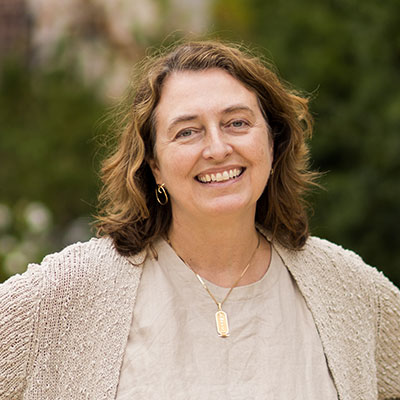
Q&A with Alison Davis

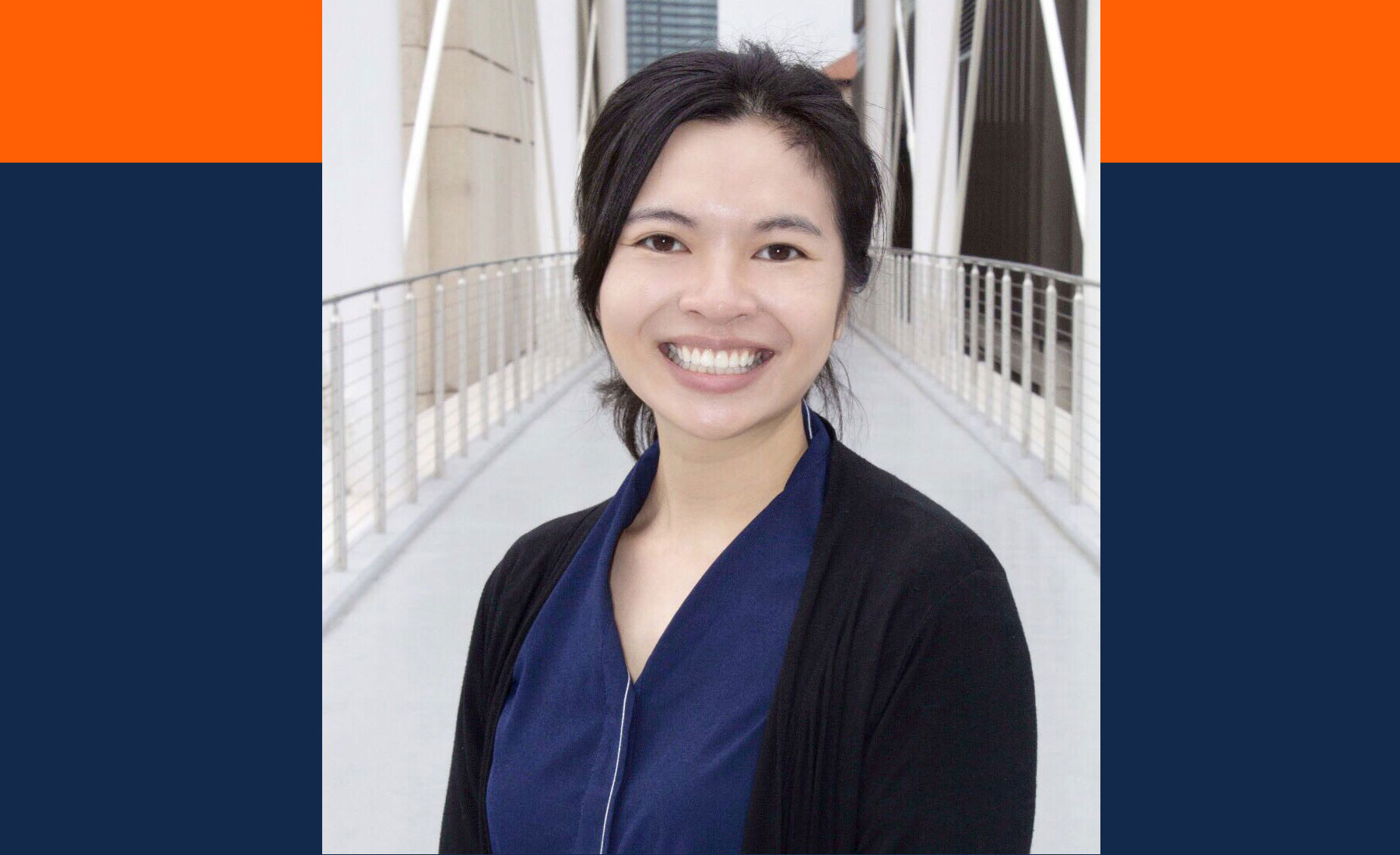
Get to know some of our College of Media faculty. Alison Davis is a lecturer in journalism and a seven-time regional Emmy Award winner.

Alison Davis

Why did you become a lecturer in the College of Media?
When I was working for the Big Ten Network, there were times that different professors would go on sabbatical, and I would fill in, teaching their classes, particularly the television production class. I loved it! I realized how fun it was teaching and working with students, seeing them learn new things, and watching their eyes light up when they understood something. Then, I saw a position opening and thought, “Well, maybe I would like to do this full-time; maybe I should consider teaching.” I ended up applying, and this is my fourth year of teaching in the Department of Journalism.

What courses do you currently teach?
I teach JOUR 215: Multimedia Reporting; JOUR 240: Introduction to Documentary Storytelling & Production; JOUR 340: Video Reporting & Storytelling; and JOUR 440: Advanced Documentary Storytelling & Production. For the first time this semester, Professor Stretch Ledford and I are teaching a globally focused documentary class, where we’re taking six students to Sierra Leone over spring break 2024 to produce documentaries about the issue of period poverty in Western Africa.

What did your career look like before returning to the University of Illinois Urbana-Champaign?
After I received my undergraduate and master’s degrees here, I worked for many years at the local PBS station, making shows and national documentaries. I worked for the Big 10 Network, creating documentaries about the University of Illinois—some sports stories and also stories that told the richness of the University, ranging from a biography on the man who invented the LED to our first African American captain of the basketball team; kind of the full gamut. My background is in filmmaking, and it’s great to teach that to students here.

For the past two decades, you’ve been producing national documentaries, receiving numerous regional Emmy Awards and over 20 Emmy nominations. What sparked your interest in doing such a thing?
I remember when I was an undergraduate, we were divided into tracks, and at that point, I was a broadcast journalism major. I loved doing videos and being able to tell stories—being a storyteller is something I have always loved doing since I was little. When I was in the news, I always felt there was more of a story, and I felt limited by doing a 30-second/minute-and-a-half package. I studied abroad in London, where I worked at a film company, and it was a blast, so when I came back, I did more work in video. After I was a freshly graduated person in my 20s, I had a chance to have my own television show and work in all of these different roles, learning what to do within those roles. It was an experience.

How did it feel to know your work was being noticed in a significant way that was shaping people’s opinions?
That was an incredible thing. We would enter the regional Emmys and feel like we didn’t have a shot at winning, but whenever I would, I just felt this unbelievable moment of shock and gratefulness. I remember the first time I won in Chicago. It was for a documentary I did about an architect who graduated from the University of Illinois and had built the capital of Australia, Canberra, but had died in obscurity. I recall sitting at this table—and they put you at a table with nominees in your category—and I was young, in my 30s, against older men. I talked to them about what projects they did, and they all sounded incredible compared to mine; then it was announced that I won. I took my mom and sister to that, and they couldn’t believe it; we were ecstatic.

What’s the biggest piece of advice you have for your students and others?
Don’t give up. If you’re making a video or any media project, you’re going to get frustrated. It could be technical problems when you’re trying to film. It could be your editing, and you’re sick of looking at this stuff that you don’t think you want to look at again. But don’t give up. Think about the goal of what you’re trying to create and keep working hard. Students, in general, should attend the whole University. Make use of the resources and all the great things here.

—Interview by Chloe Barbarise, New Voices Intern
Amanda Ciafone lends Coca-Cola expertise to new TV series ‘A History of the World in Six Glasses’


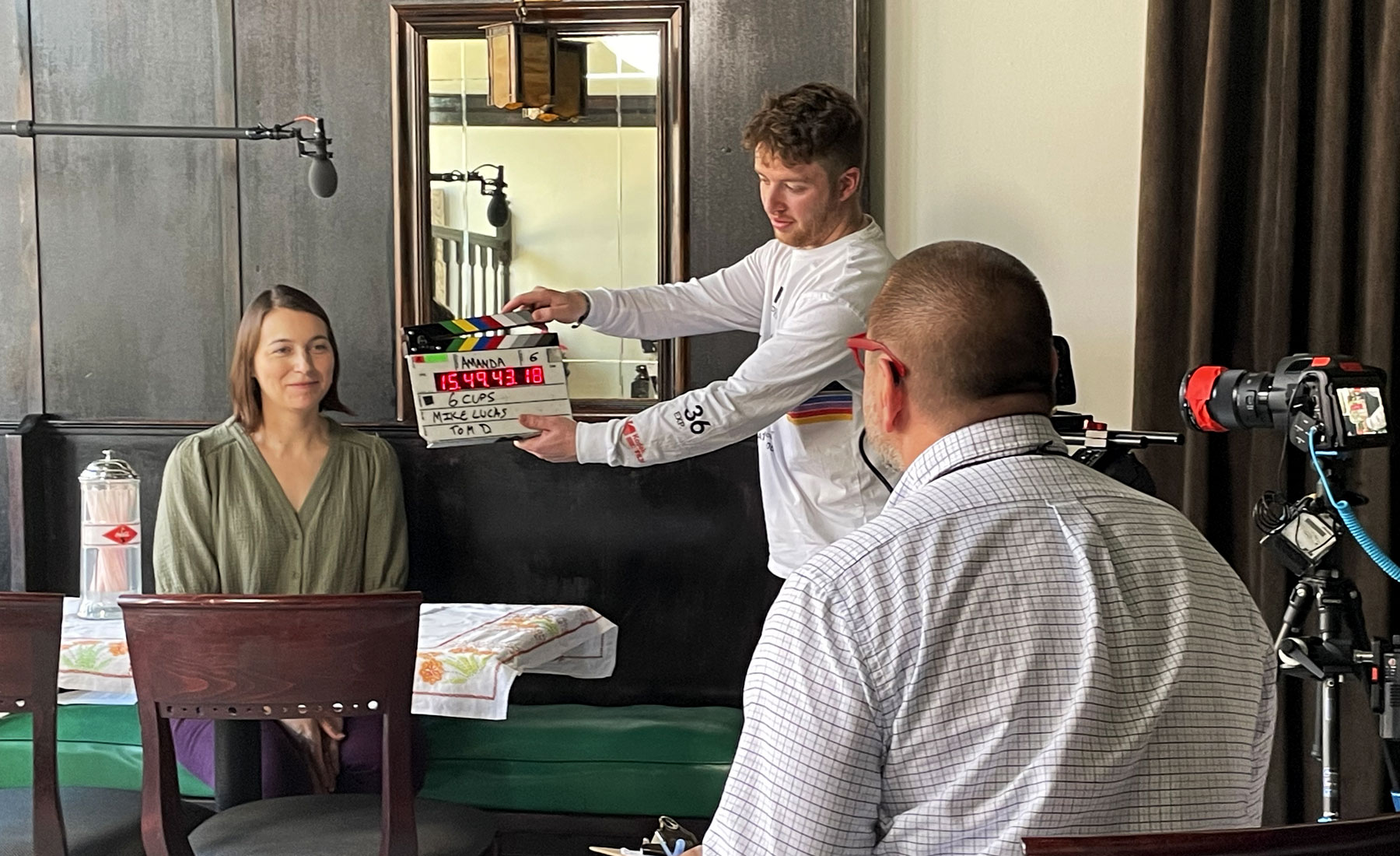
Amanda Ciafone filming
Amanda Ciafone, associate professor of media and cinema studies with an appointment in the Institute of Communications Research, was interviewed on August 19, 2022, at Flesor’s Candy Kitchen in Tuscola, Illinois, for the soda episode of the new TV series ‘A History of the World in Six Glasses.’ 

From a corner table in the Coca-Cola-branded brick building of Flesor’s Candy Kitchen (est. 1901) in Tuscola, Illinois—with a nostalgic Coca-Cola straw canister positioned nearby—Amanda Ciafone, associate professor of media and cinema studies, shared stories about Coca-Cola’s origins with producers of the new TV series A History of the World in Six Glasses.

Streaming on Fox Nation, the six-episode series stars comedians Dan Aykroyd, co-host Jim Belushi, and their friends Kevin Nealon, Jon Lovitz, and George Wendt. It’s based on a book of the same title by Tom Standage, who is interviewed in the broadcast among other authors and historians, where the history of beer, spirits, soda, wine, tea, and coffee are explored. The episodes are peppered with retro stock footage and ads, bubbly animations, as well as anecdotes, trivia, and taste tests around the bar from the chummy cast. 

Ciafone is featured in episode three—”Soda: American Fizz Goes Global”—drawing upon her research of Coke from her first book, Counter-Cola: A Multinational History of the Global Corporation (University of California, 2019). Ciafone’s book examines the Coca-Cola Company and the politics, cultural representations, and social movements around the multinational corporation’s impact on the environment, consumer health, workers’ rights and conditions, and international cultures and economies. She also has an appointment in the Institute of Communications Research and is ICR’s director of graduate studies.

“With the rising temperance movement in the late 19th century, [pharmacist and inventor] John Pemberton realized taking the red wine out will allow his drink to be marketable to a wider consumer base,” Ciafone explained in the episode. “So he’s seeking ingredients that will give you that kind of buzzy uplift without the alcohol, and he turns to coca and kola and puts them together to make this drink: Coca-Cola.”

Ciafone also described how social concerns, such as kids drinking caffeine, affected Coca-Cola.

“While the temperance movement, and eventually Prohibition, was a great boon to Coca-Cola because it didn’t have alcohol, those same forces of concern about people’s consumption of drinks that had ingredients that were potentially risky or unknown eventually brought Coca-Cola under the focus of both popular movements and government regulators.”

But of course, Coca-Cola survived court cases, brand wars, sugar substitutions, and other sticky situations.

Ciafone paraphrased a famous management guru, Peter Drucker, who said that “Coca-Cola is fundamentally an advertiser with access to a distribution system,” she said. “And it’s true. So much of their business is the production of the image around the drinks.”

To learn more about the popularity of soda (or pop), its place in American history, and its global impact, watch A History of the World in Six Glasses on Fox Nation.

Margaret Ng selected for 2023-24 James W. Carey Faculty Fellowship and AEJMC Emerging Scholar Award


Margaret Ng

Margaret Ng, assistant professor of journalism with an appointment in the Institute of Communications Research, has been selected for 2023-24 James W. Carey Faculty Fellowship. She was also recognized with the Association for Education in Journalism and Mass Communication Emerging Scholar Grant.

Ng will receive stipends to support her research on social media platform migration, within broader shifts in digital communication culture. The recognitions support her pioneering inquiry into this contemporary phenomenon in journalism.

The James W. Carey Fund for Faculty Excellence, established in 2021 through the generosity of the Carey family, is a prestigious recognition designed to bolster the research activities of faculty in ICR, the world’s oldest program for interdisciplinary research and doctoral education in communication and media studies. At ICR, Carey earned his doctoral degree, was a research professor, and served as director (1969-76); he also served as dean of the College of Media.

Ng said the Carey Faculty Fellowship’s research support will assist her to explore the social and cultural implications of the platform migration phenomenon. 

“It would detail, for instance, how circumstances like voluntary and forced platform discontinuance (a platform closing due to financial reasons or the de-platforming of notable figures) are influenced by a complex interplay of factors like culture, economics, and social identity,” she said. 

Ng was also recently awarded a $3,500 grant from the Association for Education in Journalism and Mass Communication. The AEJMC Emerging Scholar Award will enable Ng to study how journalists are grappling with platform migration in the wake of Elon Musk’s Twitter takeover in October 2022. 

She will hire a research assistant and administer a mixed-method approach that encompasses computational analysis of activities by 900 journalists on Twitter (now X) and Mastodon and qualitative interviews of 10 to 15 active journalists. The new knowledge helps journalists assess the risks and benefits of platform changes, facilitating smoother transitions and audience maintenance in the future.The results will appear in a journal publication and a chapter in her book, setting the scholarly discourse around the topic.  

“Both the James W. Carey Faculty Fellowship and AEJMC Emerging Scholar Award, along with the opportunity to bring on board the Mark L. Brandt Public Engagement Fellows, focus largely on the topic of my scholarly book project—platform migration,” Ng said. 

Ng will also team up with a student Brandt Fellow to engage with journalists and the public, potentially through a webinar, to provide a better understanding of the experiences, challenges, and strategies journalists employed following Musk’s Twitter takeover. The Mark L. Brandt Public Engagement Fellows program was established to support Media students assisting faculty and staff with public engagement projects.  

Advertising alum Ben Behrman promoted to CEO of major Chicago ad agency

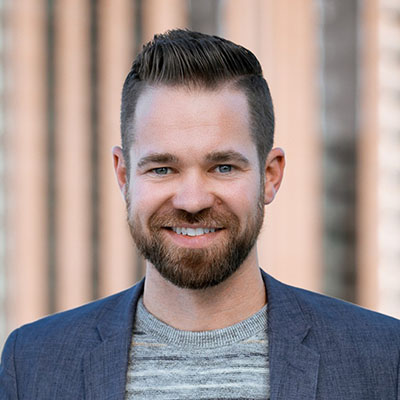
Ben Behrman (BS ’09, advertising) was recently promoted to chief executive officer of Schafer Condon Carter, a major ad agency based in Chicago. 

Behrman, a 14-year SCC veteran, joined the independent company as an intern in May 2009. He worked his way up from there, holding a variety of positions including account executive, director of digital strategy, and president and chief operating officer before being named CEO in January 2024. 

At SCC, Behrman has led campaigns for notable clients including Redbox, Kerrygold, and National Pork Board.

Behrman

Journalism students published in ‘The News-Gazette’


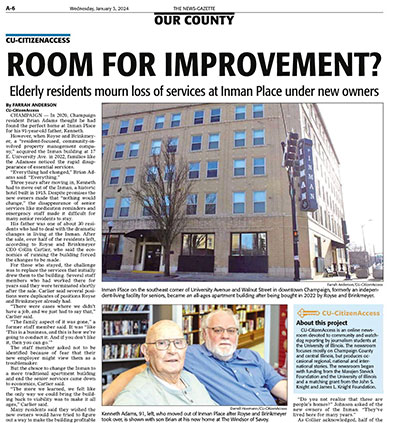
Several journalism students wrote investigative pieces that were recently featured in The News-Gazette.

Students in JOUR 315: Advanced Public Affairs Reporting and JOUR 483: Investigative Reporting classes, taught in Fall 2023 by Professor Brant Houston, Knight Chair Professor in Investigative and Enterprise Reporting, had work originally published in CU-CitizenAccess, an online newsroom devoted to community and watchdog reporting. Houston also teaches a Spring 2024 section of JOUR 400: Newsroom Experience that focuses on CU-CitizenAccess.

Articles by Farrah Anderson, Grace Brinkman, Ben Crane, Ethan Holesha, and Stephanie Wayda, all seniors in journalism, had stories picked up and re-published by The News-Gazette.

Read the students’ original articles here:


Anderson in paper

Journalism alum Angie Leventis Lourgos publishes ‘Life-Altering: Abortion Stories from the Midwest’

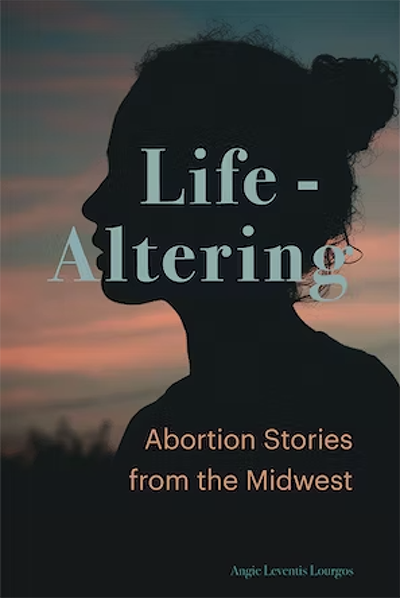
Angie Leventis Lourgos (BS ’03, journalism) has published a new book, Life-Altering: Abortion Stories from the Midwest, with the University of Missouri Press.

Based on pieces that originally appeared in the Chicago Tribune, each chapter imparts one person’s experience with abortion. By looking at myriad factors that influence the decision to abort a pregnancy—whether socio-economic, religious, legal, or medical—the accounts collected in this volume challenge the conventional labels of “pro-life” and “pro-choice.”

Leventis Lourgos has been a Chicago Tribune staff writer since 2009. Her work has won two Lisagor awards and one Sarah Brown Boyden award. She previously reported for the St. Louis Post-Dispatch and the News Tribune in Tacoma, Washington.

Life-Altering book cover

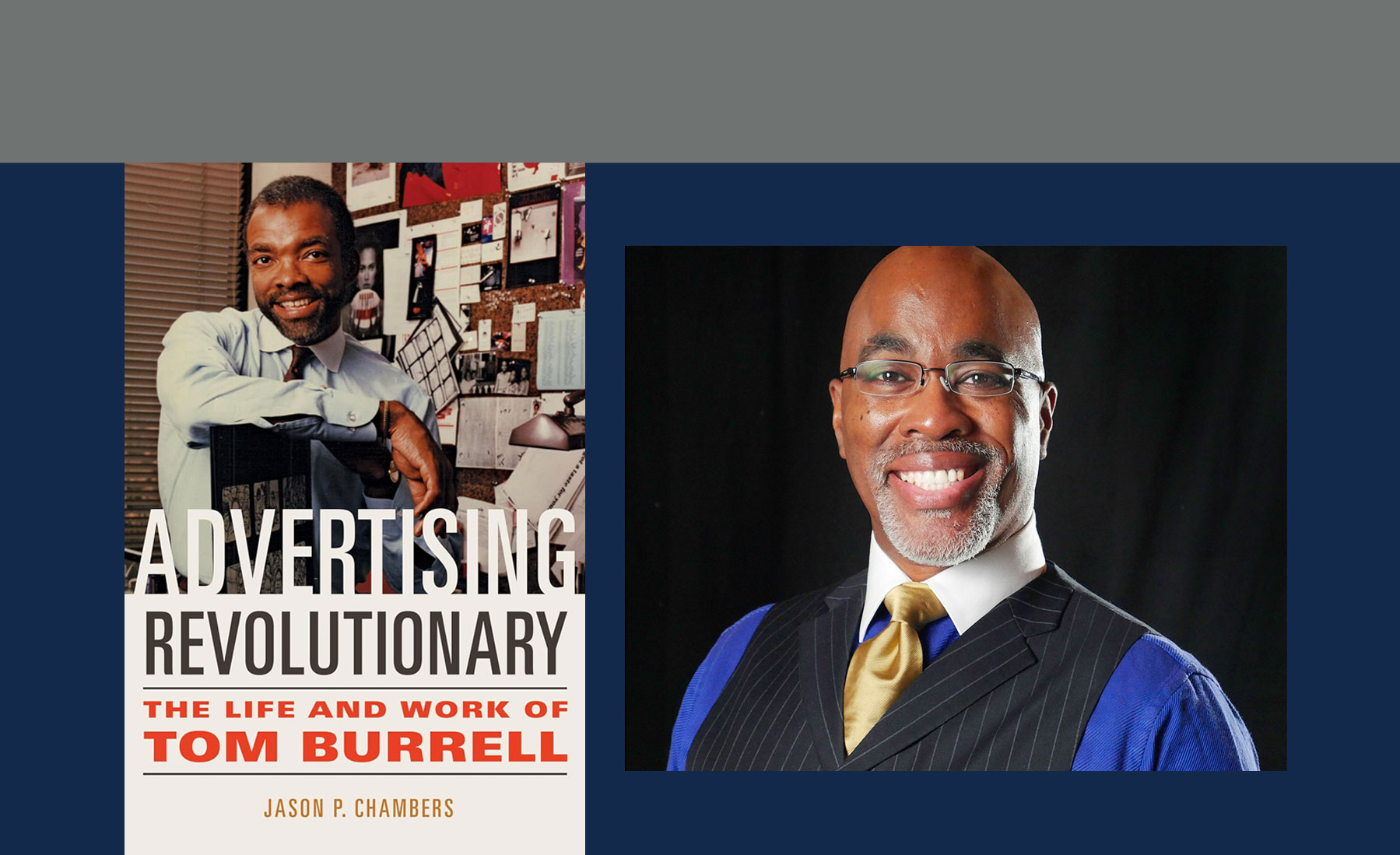
Jason P. Chambers’s new book ‘Advertising Revolutionary: The Life and Work of Tom Burrell’ details ad exec’s influence on industry’s approach to African Americans


Jason P. Chambers

Advertising Professor Jason P. Chambers’s new biography about Tom Burrell, a renowned Black visionary who changed the face of the ad industry for African Americans, will be published on February 6. 

While Advertising Revolutionary: The Life and Work of Tom Burrell (University of Illinois Press) will appeal to those interested in advertising and its history, Chambers said it’s written for a broad audience to enjoy.

“If you have an interest in biographies, Chicago, Chicago stories, Chicago entrepreneurs, African American entrepreneurs, what goes into the creation of an advertising campaign, and client relationships, I think you’d be interested in this story,” Chambers said. 

Chambers, who is also the associate dean for diversity, equity, and inclusion at the College of Media, describes Burrell as his “favorite person in the history of the [advertising] industry.”

“He started in advertising at a time in which the number of African Americans operating in a professional capacity could have been measured in the dozens,” Chambers said, adding that Burrell was the first Black copywriter at a mainstream agency in Chicago. “He is one of the people who is singularly responsible for helping to get African Americans on TV.”

Burrell not only created a place for African Americans within the advertising industry, but he also changed their representation in advertisements. His concept, known as “Positive Realism,” was relatively simple—present realistic and positive images of African Americans using products and brands—yet it was considered revolutionary at the time. 

"Advertising Revolutionary: The Life and Work of Tom Burrell"

Chambers said if you saw a television ad for McDonald’s or Coca-Cola in the 1980s or 1990s that depicted African Americans, Burrell’s agency probably created it.

Thanks to Burrell’s early pioneering efforts, there’s a greater breadth of representation in advertising today, Chambers said. More Hispanic Americans, Asian Americans, LGBTQ community members, and people with different physical abilities are included in current brand messaging than ever before. 

Despite a more inclusive environment, Chambers still questions how much of advertising today is culturally sensitive and how much is culturally representative.

“It’s one of those things that can have two steps forward and a step back,” he said. “It’s not linear progress, but it’s nonetheless, progress.”

Chambers, who also co-edited Building the Black Metropolis: African American Entrepreneurship in Chicago in 2017, said the catalyst for his second book occurred while doing research for his first book, Madison Avenue and the Color Line: African Americans in the Advertising Industry, published in 2009. 

Chambers had the opportunity to interview Burrell on several occasions during that time. He also spent two weeks at Burrell’s ad agency in Chicago through the Advertising Education Foundation Visiting Professor Program, which Chambers says, “deepened my admiration for him.”

The AEF Visiting Professor Program allows professors to visit advertising agencies to enhance their understanding of current developments and practices in advertising and marketing to inform their teaching and research. 

Spending one-on-one time with the industry legend before he retired, coupled with a desire to write a biography, is what led Chambers to call Burrell one day in 2011. Chambers recalls standing in his kitchen, calling Burrell’s office, and thinking “it was a long shot because I was fairly certain that he would try to write his own book.” 

After some consideration, Burrell opted not to write his autobiography, opening the door for Chambers to write the book. 

Chambers spent the next few years interviewing Burrell, mostly at his home in Chicago, along with several other sources who knew him well. 

Challenges did arise throughout the process as Chambers soon realized writing a biography, which relies heavily on oral interviews alongside extensive archival research, can prove difficult. There was even a point when Chambers stepped away from writing the book, having concerns about not being able to interview some key figures in Burrell’s life, such as his original business partner who had passed away before Chambers could interview him.

But Chambers found a renewed motivation after an encounter with two of his professional academic heroes at an event in Chicago. 

Christopher Robert Reed, professor emeritus at Roosevelt University, and Darlene Clark Hine, professor emerita at Michigan State University, both African American historians, gave him the push he needed to get back to writing the book.

“After I told them about the struggles that I was having in terms of deciding to move on from the book, they both said the same thing,” Chambers said. “They said write it anyway. Just tell the readers what happened and write it anyway.”

His experience has taught him a few lessons about courage and writing that he shares with his students. 

“I think the thing that students have to be reminded of is a lack of confidence in work that you’re going to publish is just part of it, and you have to give yourself a license to have those feelings,” he said. “But ultimately the difference between a writer and somebody who writes is that a writer has to make their work public. They have to try and publish.”

Julie Turnock awarded National Endowment for the Humanities Fellowship


Turnock

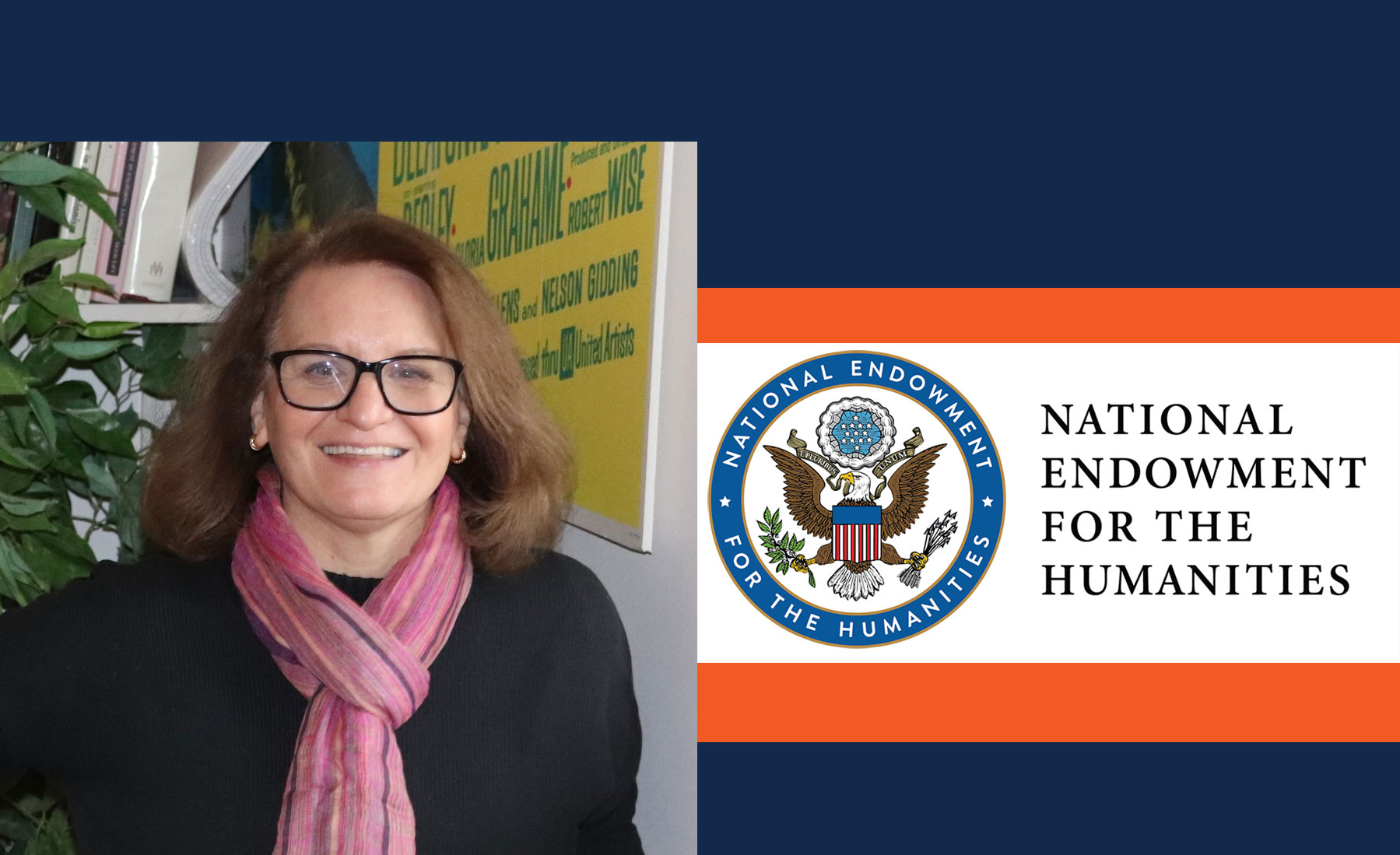
Julie Turnock, professor of media and cinema studies, was awarded a National Endowment for the Humanities Fellowship for a book project titled Beyond King Kong: Special Effects in the Hollywood Studio Era, 1915–1965. 

She will receive $60,000 in funding to research and write a book about the technical, labor, industrial, and aesthetic history of the special effects industry during the Hollywood studio era.

Turnock’s book project is a history of the labor performed by unsung “below-the-line” effects workers of the era. Through archival historical research, oral history accounts, interviews, theoretical discourse, and formal visual analyses, this project presents a polemic for considering the “specialness” of effects work not from the point of view of the film but from the position of the specially contracted labor. As a labor history, it centers the workers of the Hollywood studio era who are rarely considered in cinema histories, training attention onto those whose skills make much of “movie magic” possible.  

Turnock served as the inaugural director of the Roger Ebert Center for Film Studies and is on sabbatical this academic year. 

The NEH awarded $33.8 million in grants for 260 humanities projects across the country, including 82 fellowships. The fellowship program supports advanced research in the humanities, and recipients produce articles, books, digital materials or other scholarly resources. NEH Fellowships are competitive awards granted to individual scholars pursuing projects that embody exceptional research, rigorous analysis, and clear writing.

The NEH has received an average of 1,120 applications per year for fellowships in the last five rounds of competition, according to its website. During that time, it awarded an average of 79 fellowships per year for a funding rate of 7%, making the fellowships among the most competitive humanities awards in the country.

The NEH is an independent federal agency and one of the largest funders of humanities programs in the U.S. It supports research and learning in history, literature, philosophy and other areas of the humanities by funding selected peer-reviewed proposals from around the nation.

See University of Illinois News Bureau press release.

AAF selects four advertising students for diversity, equity, and inclusion program


AAF students

Updated 2/15/2024

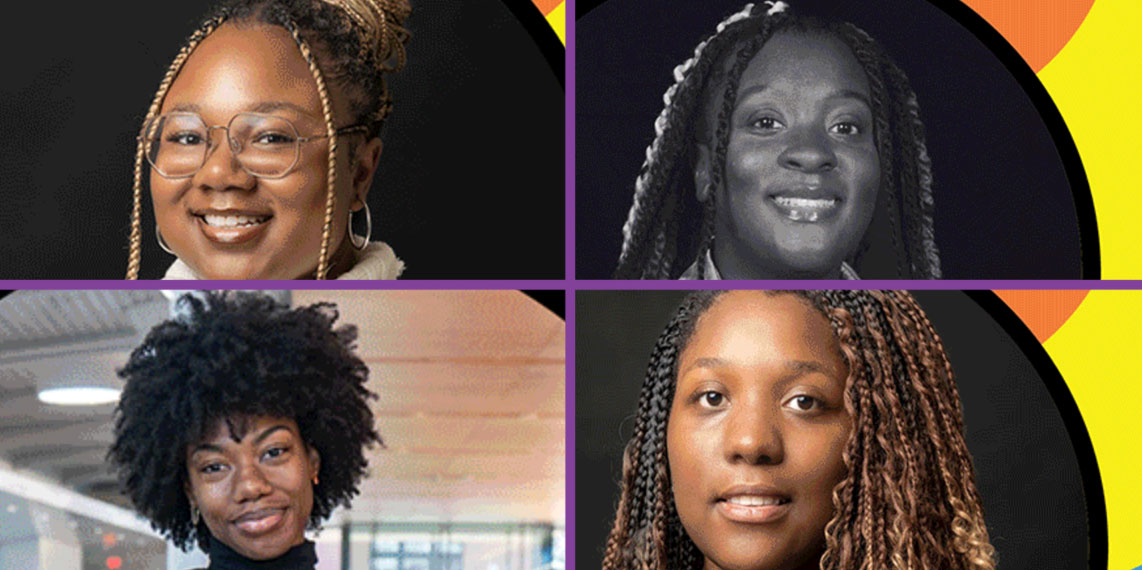
Four seniors in the University of Illinois chapter of the American Advertising Federation were named to the American Advertising Federation’s Most Promising Multicultural Students Class of 2024—an honor given to only 50 students each year throughout the United States. Honorees include advertising majors Aniya Davis, Lauren Jenkins, Naomi Muuzic, and Olivia Wallace (pictured above). 

The selected students participated in an industry immersion program with the highest-level industry executives and companies in New York on February 4-9, 2024. The program included professional development and personal branding workshops, the “Building Bridges for Our Future” Awards Ceremony and Luncheon, and Recruiter’s Expo.

Davis on Times Square

“A really big highlight was attending the different agencies and hearing about their work culture, and what they do, and how much they love what they do in the industry,” Davis said. “I think realizing that going into this industry, it’s going to be filled with passion, it’s going to be filled with excitement…really solidified my knowledge [that] this is what I want to do.” 

In 1997, the American Advertising Federation created the Most Promising Multicultural Students program to connect the advertising industry with the nation’s top multicultural college students. Since the program’s inception, the AAF Illinois chapter has had more winners than any other university or college. 

Recognizing the top 50 multicultural college seniors across the nation, the Most Promising program promotes diversity, equity, and inclusion within the advertising industry, giving advertising, media, communications, and tech companies the opportunity to tap into high-achieving talent of diverse college students from across the country.

Each year, students of racial or ethnic diversity from the AAF’s 140+ college chapters apply to the program. Advertising leaders select the highest-achieving diverse seniors to participate. This year’s judging panel included thought leaders with a range of backgrounds and experience and from companies such as Amazon Ads, Ogilvy, Snap, The Trade Desk, Vox Media, and Whirlpool.

The event serves as a recruiting opportunity for industry leaders to develop a diverse group, representing the best from the country to serve as the next generation of advertising leaders. It also offers students invaluable network, learning, and immersion experiences with professionals from top advertisers, media companies, and advertising agencies.

Maslowska selected as Center for Advanced Study Associate for 2024-25 academic year


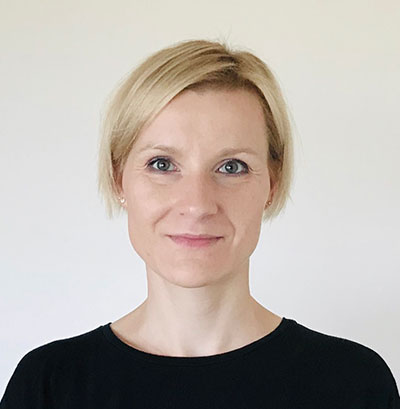
Ewa Maslowska

Ewa Maslowska, associate professor of advertising, was selected as a Center for Advanced Study Associate for the 2024-25 academic year, pending Board of Trustees approval. 

As a CAS Associate, Maslowska will take time off from teaching in Fall 2024 to focus on her research of fake online reviews.

Consumer reviews on many e-commerce and travel websites, social media platforms, and entertainment pages have been shown to play a crucial role in consumers’ purchase decisions. As a result, companies started motivating consumers to write reviews by providing various incentives. However, there’s been little research on the process of review generation or review perception, depending on the different levels of review incentives. 

Maslowska said her project “aims to investigate how incentives affect reviewers’ motivations and their reviews.” She also plans “to identify textual markers of incentivized and fake reviews and investigate whether it’s possible to train consumers to recognize such reviews, or at least make them more skeptical about them.” 

Maslowska, who also serves as faculty lead of the computer science + advertising degree program in the Charles H. Sandage Department of Advertising, was appointed a CAS Associate in the Spring 2024 semester upon the recommendation of CAS professors and with concurrence of campus and university administrations.

CAS Associates are tenured Illinois faculty members whose project proposals are selected in an annual competition. They are granted one semester of teaching release to pursue an individual scholarly or creative project. 

The Center for Advanced Study works with every department on campus to identify and support the most productive, high-achieving, and innovative faculty at Illinois, providing them with connections and funding to pursue their work. Members of this accomplished community are invited to participate in CAS activities throughout the year and given opportunities to present their work to the CAS community. See CAS’s upcoming events.

College of Media
119 Gregory Hall
810 S. Wright St.
Urbana, IL 61801
217-333-2350