Take 5 with Media Alumni: Jason Kim


Jason Kim (BS ’13, media and cinema studies) is a director of photography and editor at Omnicom Studios in New York as well as director and executive producer of his own production company, House Productions LLC. Kim has earned numerous awards for his film work including a 2018 Telly Award for “General Branding” and a 2022 Webby Award for Advertising, Media & PR, “Best Use of Animation or Motion Graphics.” Learn more about this College of Media alum whose work is shaping the future of storytelling across film, advertising, and digital media.

Jason Kim

1. What first drew you to filmmaking and production, and how did that evolve into starting your own company, House Productions?

It’s difficult to pinpoint any one moment in time that drew me into filmmaking except for when I saw Taxi Driver, directed by Martin Scorsese and written by Paul Schrader. The inverse relationship between hero and circumstance—its anti-hero arc—showed me anything was possible in storytelling. I pursued being an artist through the medium of film ever since. House Productions allows me to hone my storytelling practice, learning, experimenting, and growing as a filmmaker. Today, House Productions produces high quality corporate videos and films I write and direct, including my latest project, Selfless.

2. Winning awards like the Telly and Webby, among others, is a huge accomplishment. Is there one project that felt especially meaningful to you?

The one project that has special meaning to me is working with the government to produce, write, direct, and edit a documentary series on the Stonewall National Monument, which helped pave the way for the gay rights movement. It’s not the most entertaining documentary but I learned a lot, and producing a document that recollects a period of time in Greenwich Village, Manhattan, is special to me.

Watch the 15-part series:

3. What advice would you give to students who want to break into directing or production but don’t know where to start?

Directing and producing are two separate paths. The best way to break into producing and production is to gain experience on set wherever you are and move to a bigger production market as soon as possible. Working with more experienced and nuanced crews, getting hands-on experience with the minutiae of filmmaking, and administrating complex paperwork is the name of the game.

As the adage goes, there is no one way to directing. Everyone has their own unique story and journey to how they come to directing. The best way to start is just to start. Get your hands on a script or write one. Find friends who will act and crew for you. Every project I’ve directed has included a learning curve, creative risk-taking, and a financial commitment. Not every project will feel true or significant. Moving past doubt, problem-solving limitations, and exercising curiosity are the first steps to directing.

Jason Kim at table

4. The media landscape is constantly changing—how do you keep your work both current and true to your vision?

The media landscape is more turbulent than ever, especially with the consolidation of traditional media companies with data-driven companies. Media production is under disruption from AI generation, with film projection being made especially vulnerable.

Disruption will have matured when AI artists can tell equally visually compelling stories—replicating the work of filmmakers, artists, craftspeople, and designers, as well as the human emotion and camaraderie in front of and behind the camera. Even still, if the art, intent, and motivations are pure, then I believe that work will have currency and truth.

5. What’s one dream project you’d love to direct or produce in the future?

My dream project is an indie sci-fi retro-noir that investigates the existence of hope in an Orwellian society. The goal is to receive a small working production budget to create something beautiful, meaningful, and artistic to satisfy the tastes of arthouse cinephiles as well as mainstream audiences. As film is a business, I have no delusion that a director must be profitable in their artistry to continue to practice directing. I believe a sci-fi genre within a low budget independent film context has the potential to break the ceiling and achieve commercial and artistic appeal. Complex VFX will be eschewed, instead of relying on ornate set design, practical effects, costumes, and locations for world-building. Then, the story itself will be the determinant of its success.

Another dream project of mine is to create a documentary on the early phases of the Internet developed at ILLINOIS through the ILLIAC computer and PLATO network. Researching the history of these emerging communication systems as a media and cinema studies major was the highlight of my time on campus. I would love to dive deeper into these early networks’ role in shaping society as we know it today, from the maturation of social networks to the advent of artificial intelligence. To premiere this document that encompasses the past, present, and future of digital communication would be a dream.

Share on social

Professor Brant Houston to be honored at Investigative Reporters & Editors 50th anniversary gala


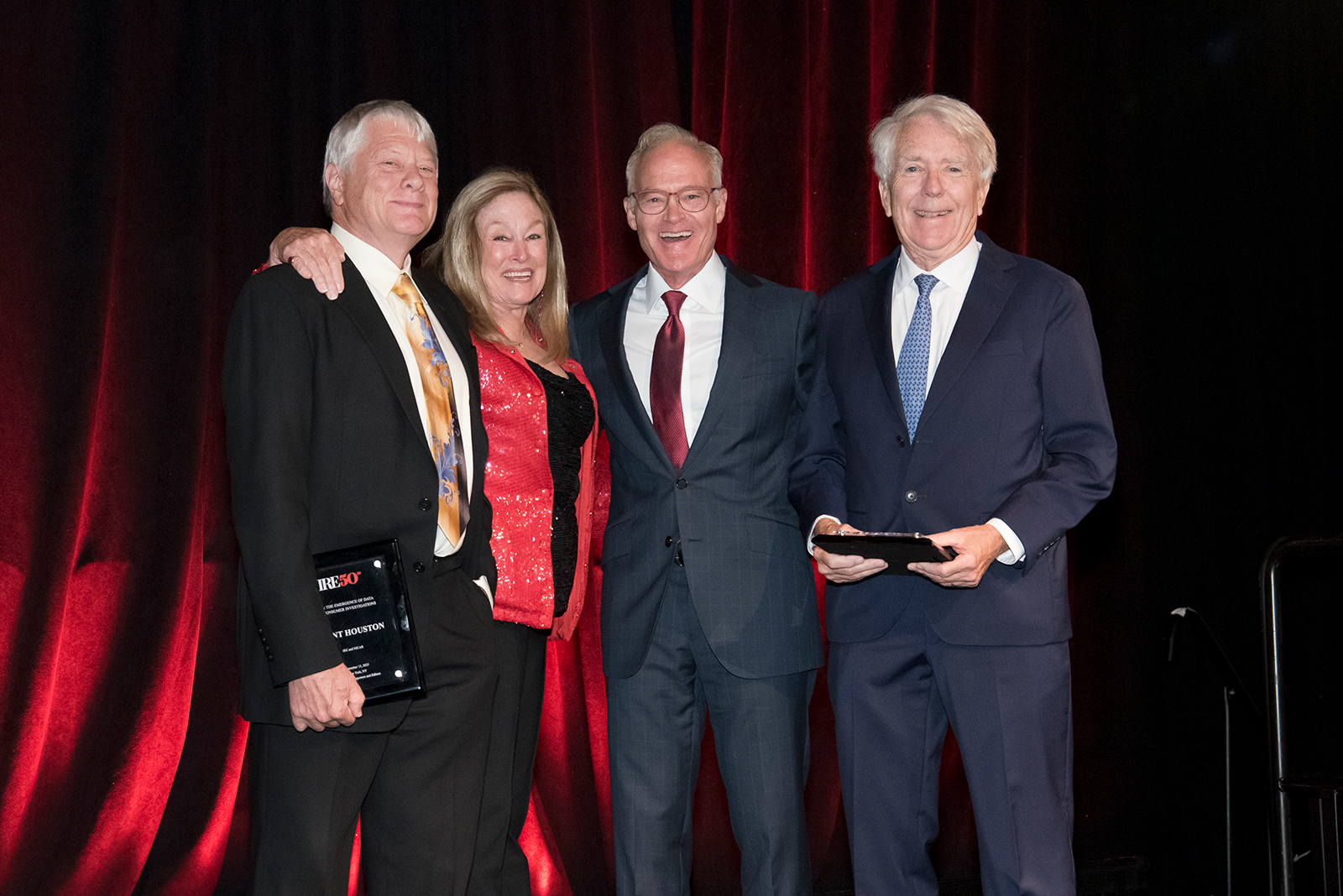
Brant Houston at the IRE gala

Update 9/19/2025:

Pictured above: Professor Brant Houston, left, is honored with awardees Lea Thompson and James B. Steele (far right), with host Scott Pelley, correspondent for 60 Minutes. (Photo by Nathalie Schueller.) The Investigative Reporters and Editors 50th Anniversary Gala raised $1.5 million for journalism training.

See more photos from the event.


Brant Houston, Knight Chair Professor in Investigative and Enterprise Reporting in the Department of Journalism, will be honored at the Investigative Reporters & Editors 50th Anniversary Gala on Monday, Sept. 15, in New York City.

Brant Houston

The event, which also serves as a fundraiser and live auction, recognizes journalists representing milestones from each decade since the organization’s founding in 1975. Co-chairs of the event are Paul Sagan, chair of ProPublica; AG Sulzberger, publisher of The New York Times; and Judy Woodruff, senior correspondent at PBS NewsHour. 

Houston will be honored for his impact on the industry during the 1980s, for his contributions to “The Emergence of Data and Consumer Investigations.” The other honorees in his category include James B. Steele of The Philadelphia Inquirer, Time, and Vanity Fair; and Lea Thompson of NBC News and WRC-TV in Washington, D.C.

Houston served as the executive director of Investigative Reporters and Editors from 1997 to 2007.

He co-founded the Global Investigative Journalism Network in 2003 and serves as chair of its board of directors; he also co-founded the Institute for Nonprofit News in 2009. 

Houston currently oversees the online newsroom at Illinois, CU-CitizenAccess.org, which serves as a lab for digital innovation and data journalism. 

“These stars of journalism, who all received training at IRE, exemplify the power and future of journalism, the very foundation of democracy,” said IRE executive director Diana Fuentes.

The gala will also feature Michael Keaton, acclaimed actor, director, and press freedom advocate, accepting IRE’s first Champion of Investigative Journalism Award, recognizing his spot-on portrayal of journalists and steadfast support for a free press.

IRE, a grassroots nonprofit organization dedicated to improving the quality of investigative reporting, was formed to create a forum in which journalists throughout the world could help each other by sharing story ideas, newsgathering techniques, and news sources.

Share on social

Journalism student Nathan Gonzalez chosen for New York Times Corps


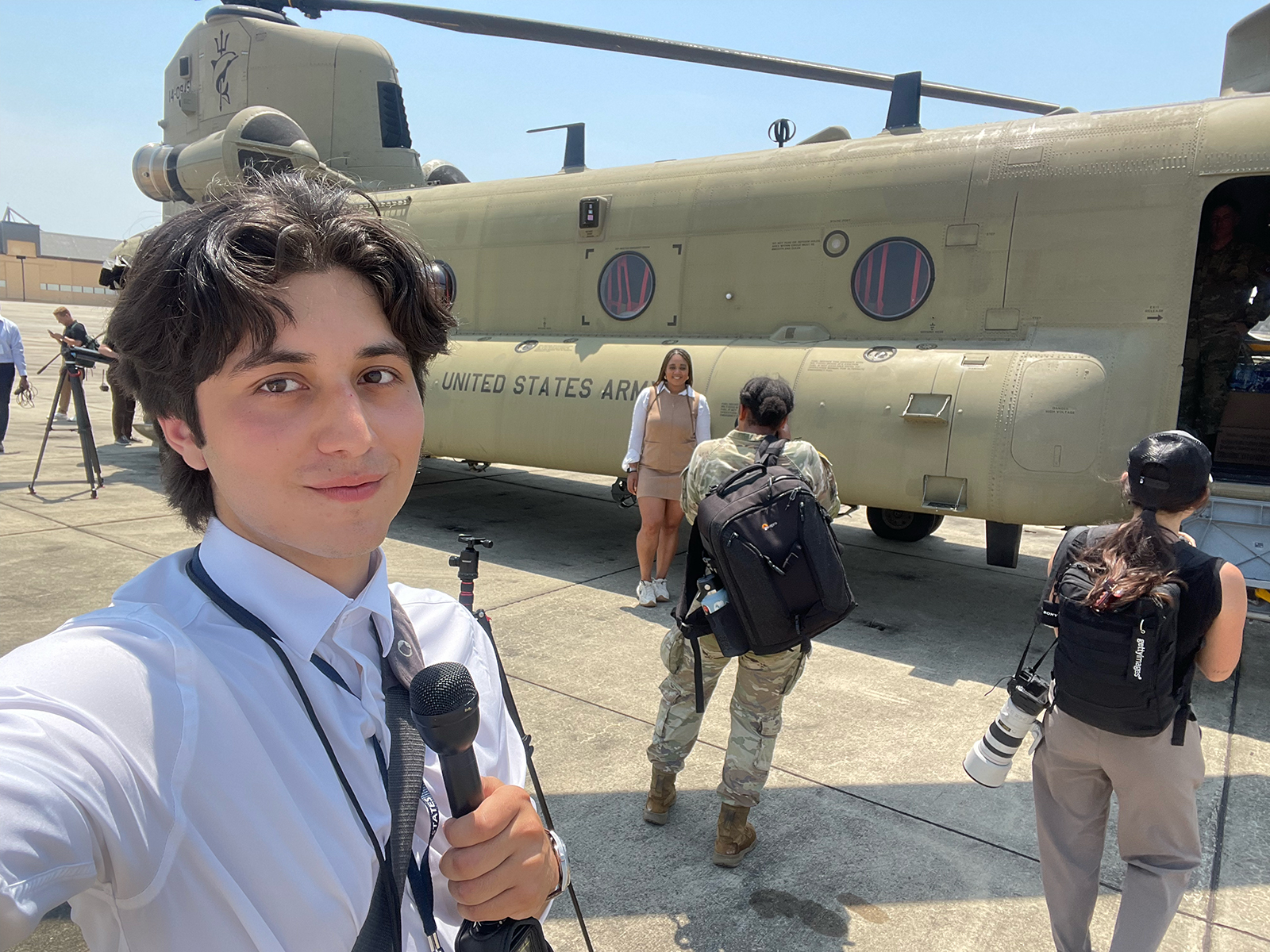
Nathan Army aircraft

Nathan Gonzalez, a junior in journalism, was one of 19 undergraduate students nationwide chosen to join The New York Times Corps, the newsroom’s talent-mentorship program for aspiring journalists.

Gonzalez will be paired with NYT Pentagaon reporter John Ismay, receiving career guidance and professional development sessions until he graduates. After completing the program, Gonzalez will have the opportunity to visit the New York Times newsroom to learn from other journalists in person. 

Gonzalez recently wrapped up a summer internship for FOX News at the Washington, D.C., Bureau, producing coverage of protests, U.S. District Court cases, Senate and House committee hearings, live shots, interviews, and press conferences with members of Congress.

Some of the content he produced aired on shows like Fox News LiveThe Big Weekend ShowThe StoryAmerica ReportsAmerica’s NewsroomSpecial Report with Bret Baier, and The Will Cain Show.

Since its launch in 2022, the Times Corps has offered mentors to 80 undergraduates who demonstrated a commitment to the field of journalism. The best-performing corps members are considered for The New York Times Fellowship, a yearlong work program, and other journalistic opportunities.

Share on social

Media students gain unique, real-world experience through summer internships


From working on film production crews and meeting famous actors to interviewing congressmen on Capitol Hill, several College of Media students ended their summers on a high note after wrapping up internships that offered memorable learning opportunities.

Francisco Albarran

Francisco Albarran (MACS), Film Production Intern, Chili Finger

When media and cinema studies senior Francisco Albarran heard Chili Finger—a new film starring John Goodman, Judy Greer, Sean Astin, and Bryan Cranston—was filming nearby this summer, he took a chance and emailed Rantoul-based Flyover Film Studios, asking if he could help out.

To his surprise, the words “perfect timing” quickly appeared in his inbox and the very next day, Albarran was on set, helping build scenes and soaking in hands-on production experience at locations across central Illinois.

In his second week of the internship, Albarran got a surreal assignment: pick up Bryan Cranston (Breaking Bad) from his rental house in Champaign. The next day, Albarran was in his driveway, watching with awe as the garage door slowly opened revealing one of his all-time favorite actors.

“It looked so amazing. It looked like Walter White [the character Cranston played in Breaking Bad] was actually right there in front of my eyes, which basically he was,” Albarran said.

During the 20-minute drive, the two shared a conversation about the Chili Finger production, life in general, and Albarran’s own film aspirations. Albarran asked Cranston to sign a plank of wood he had saved from the film set as a souvenir. The message read: “Francisco, thanks for the ride, my friend, Bryan Cranston.

“One week you have dirty laundry in the back of your car, and then the next you have an Emmy Award-winning [actor],” Albarran mused.

Albarran said meeting Cranston and working alongside the film crew, as well as working with his MACS 480 classmates, helped reinvigorate his passion for storytelling and filmmaking. He hopes to write, direct, and act in a short film this year.

Nathan Gonzalez (Journalism), Assignment Desk Intern, FOX News Channel at the Washington, D.C., Bureau

Nathan Gonzalez

As an assignment desk intern for FOX News at the Washington, D.C. Bureau, Nathan Gonzalez, a junior in journalism, produced coverage of protests, U.S. District Court cases, Senate and House committee hearings, live shots, interviews, and press conferences with members of Congress.

Some of the content he produced even aired on shows like Fox News Live, The Big Weekend Show, The Story, America Reports, America’s Newsroom, Special Report with Bret Baier, and The Will Cain Show.

“That was a huge moment,” Gonzalez said. “It reassured me that even as a rising junior, I’m capable of producing content that meets national standards.”

Gonzalez learned how national political reporting is structured, the importance of fostering relationships with fellow reporters, and that national and local reporting aren’t as different as they seem.

“While national outlets have far more resources, the core skills—approaching officials and asking questions—apply at every level. If you can interview municipal officials, you can press congressmen on Capitol Hill, without a doubt,” Gonzalez said.

Jonathan Mathew (Journalism), Entertainment Promotions Intern, Chicago Dogs

Jonathan Mathew

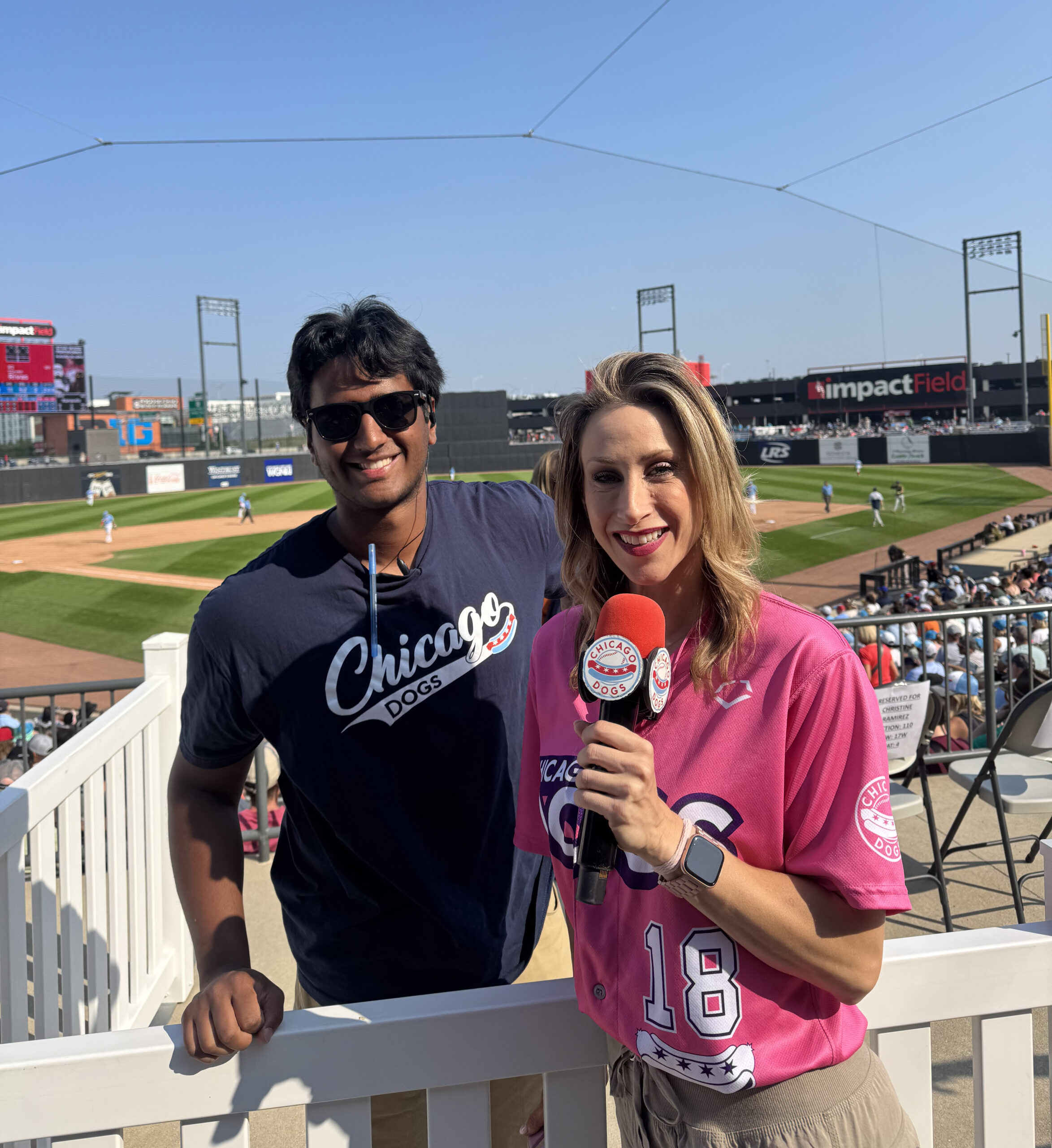
Whether he was working in the team store, ushering VIPs, overseeing the team’s Kid Zone, or dressed up as “Squeeze” the mustard mascot, Jonathan Mathew, a junior in journalism, had a great experience as an entertainment promotions intern with the Chicago Dogs baseball team this summer.   

Mathew said the opportunity to intern with the independent professional baseball team taught him a lot about sports business and entertainment, including different marketing techniques, as well as how to interact and engage with the public.

“I learned a lot of life lessons that will be valuable to me in the long run, and I am confident the return on investment I have with this internship will be more than I can imagine,” he said.

Mathew recalls one day working behind the mic as a gameday co-host tasked with entertaining the crowd between innings.

“That [is] an experience I will hold closely to my heart and have as a reminder to keep me motivated in achieving my career dream,” Mathew said.

Sarah Juan (Advertising), Social Media Content and Video Intern, Glow Recipe

Sarah Juan

Sarah Juan, a junior in advertising, went above and beyond to secure an internship at the global skin care company Glow Recipe, crafting a mock-campaign proposal highlighting a celebrity partnership. Her hard work paid off as Juan was awarded the internship as a social media content and video intern.

In her role, Juan assisted with content development, conducted market research, tracked metrics, and helped the social media team with new product launches, which was the highlight of the experience for her.

“Supporting the content team on set in NYC, I was able to work directly with models for new product launches and help direct filming for social content! Being on set was the most rewarding experience,” Juan said.

Juan recalls an important lesson her supervisor shared that will stick with her: “We’re all storytellers, no matter the industry you market in.”

“The beauty industry is tough and requires thick skin, but if you are passionate about supporting a mission through storytelling, that is what will get you far,” Juan said.

Cherie Chick (MS Advertising), Account Specialist Intern, Rakuten Advertising

Cherie Chick

Cherie Chick, an MS advertising student, applied to more than 80 positions and interviewed with eight different companies before securing an internship with her top choice, Rakuten Advertising. Rakuten provides advertising technology and consumer insights to global brands and retailers with a core focus on affiliate marketing, acting as the bridge between advertisers and publishers, including content creators, media outlets, and loyalty platforms.

Chick spent her summer in Chicago as an account specialist intern responsible for managing high-impact affiliate marketing campaigns by strategizing and negotiating publisher partnerships, optimizing creative placements to drive conversions, delivering performance insights to clients, and advising on quarterly spend strategies.

For Chick, the highlight of the internship was working with a diverse portfolio of client accounts spanning multiple countries and industries, from travel and finance to education and technology.

“This cross-regional exposure taught me how consumer behaviors, promotional calendars, and publisher relationships vary across markets,” Chick said. “For example, the way travelers research trips and the sites they interact with is entirely different from how consumers search for credit card offers or financial advisors.”

Share on social

New lecturer in advertising Penne Heede brings agency expertise to classroom


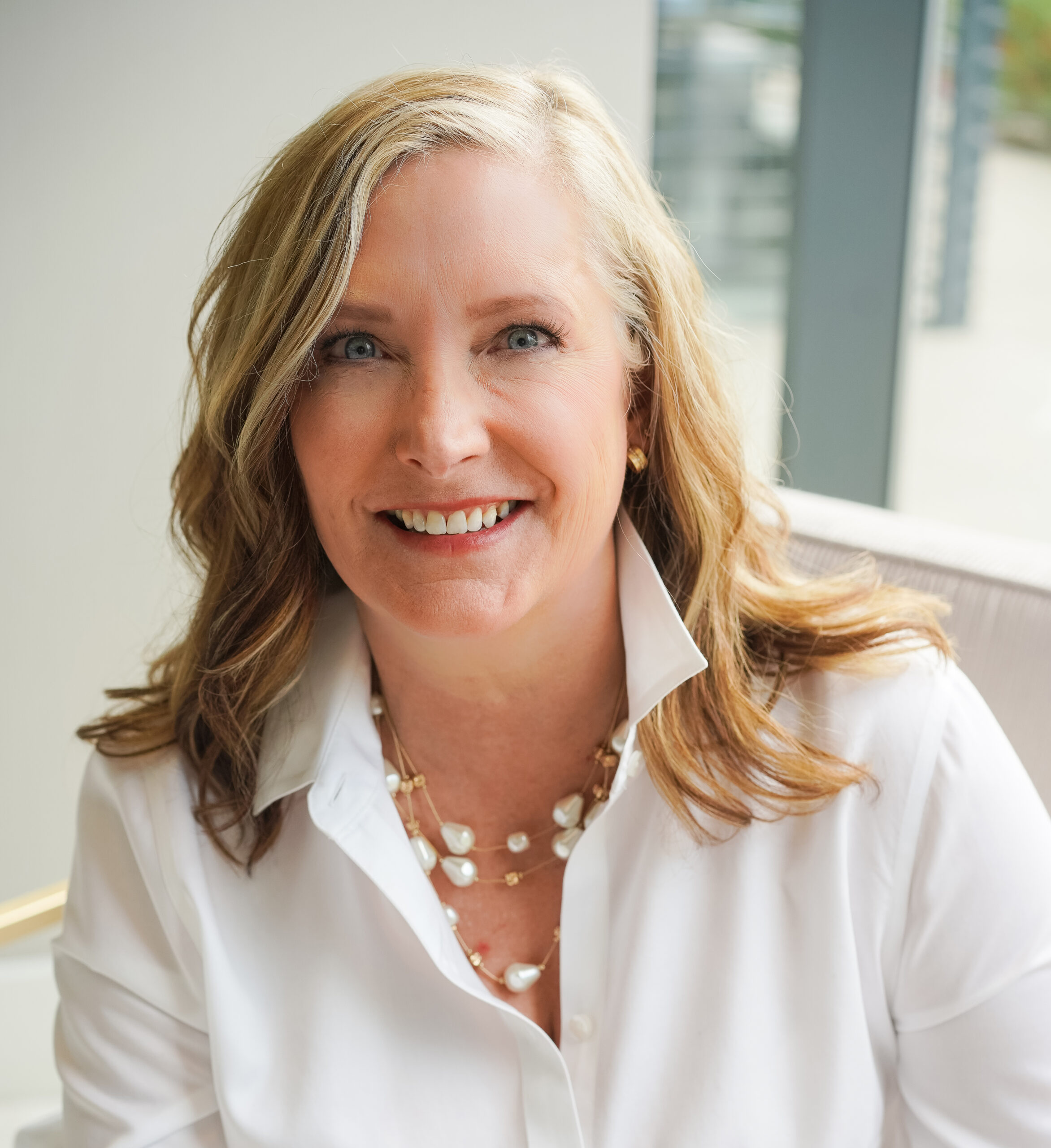
Penne Heede, a 30-year veteran in the ad industry, is looking forward to bringing her agency expertise to the classroom this fall as a new lecturer in the Charles H. Sandage Department of Advertising.

Penne Heede

Heede (MS ’23, strategic brand communication) will be teaching undergraduate and graduate classes including Advertising Design and Direction, Experiential Branding, and Creativity: Concept and Ideation.

More than three decades after Heede started her career with a technical degree in graphic design and worked her way up to creative and strategy director for an elite ad agency in Denver, Colorado, she went back to school to obtain a bachelor’s degree in interdisciplinary liberal arts.

Heede said she enjoyed the experience so much she was inspired to work towards a formal education in branding to open the door to a career in post-secondary teaching.

Heede was drawn to the strategic brand communication master’s degree Illinois offered due to its innovative focus on the science of branding.

“I loved Illinois’ program because it was a master of science [degree], not of art, and I was impressed with the mix of faculty” she said.

A few months after she graduated with a master’s degree, Heede saw the job posting for advertising lecturer at the College of Media and said, “it just read exactly what all my experiences have been.”

Heede’s teaching philosophy comes from a belief that everyone has their own personalities and way of doing things. She also tries to abide by 13th-century poet Rumi’s famous quote “to be a lamp, a lifeboat, or a ladder” for others.

“I added ‘lawnmower’ because sometimes you’re in the weeds and you just need somebody to go in front of you and make it a little bit easier,” Heede said.

Heede may align her educational approach with the beliefs of an ancient poet, but her views about the changing trends in the advertising industry are anything but archaic. 

“I’m psyched by [AI]. If you think about it, spell check was machine learning, and we all are just fine with it. Calculators were once taboo in high school math classes—now we’re okay with it,” she said. “It’s just the evolution of tools that help us.”

Heede also believes a human touch will always be needed in the industry to write, design, and uncover the motivation of consumers.

“[Asking] what inspires a person, what is their motivation towards doing things, what do they love, what do they hate—I really like that [kind of] thinking,” she said.

Heede considered similar questions for a three-year capital campaign she led, which raised $33 million for a 71-mile trail in the Denver region called the High Line Canal.

“I’m very proud of that campaign not only because it was so successful, but also because the trail is an amazing amenity for the region and it’s now protected in perpetuity,” she said.

For Heede, a good ad creates a behavior, whether it motivates someone to donate money, start recycling, or buy a chocolate bar. And sometimes, she said, a good ad will just elicit a strong emotion.

Heede, who is a huge fan of the late musician Prince, said she will never forget the full-page newspaper ad Chevrolet created after the star’s death.

Paying tribute to Prince, the ad featured a picture of a red Corvette with the epitaph: “Baby, that was much too fast. 1958-2016,” referencing lyrics from his 1982 hit, “Little Red Corvette.”

“I’m going to remember that my whole life; it was so good,” Heede said. “That’s what an ad should do. It should make you feel.”

Share on social

Media faculty and TAs make list of teachers ranked as excellent


Updated 9/22/2025 to include Summer 2025 results.

Congratulations to all the College of Media faculty and teaching assistants who were ranked as excellent by their students!

Congrats image

This list is based on Instructor and Course Evaluation System questionnaire forms completed by students during the Spring 2025 and Summer 2025 semesters. Only those instructors who distributed ICES forms at least once during this time period and who released their data for publication are included in the list. View the complete list.

Note: * denotes that the instructor ratings were outstanding.

ADVERTISING

KENT BROWN – ADV 314

*TERRY KASDAN – ADV 409

EWA MASLOWSKA – ADV 494

*SHACHAR MERON – ADV 222, ADV 333

*MICHELLE NELSON – ADV 582, ADV 590

*MARISA PEACOCK – ADV 290, ADV 498

CHARLOTTE PELOQUIN – ADV 290

LEONA YI-FAN SU – ADV 492

KEVIN WISE – ADV 483

MEDIA

CL COLE – MDIA 590

JOURNALISM

*CHRISTOPHER BALL – JOUR 430, JOUR 451

ALISON DAVIS – JOUR 215, JOUR 340, JOUR 440

MELITA GARZA – JOUR 310

ALEXANDRE GONÇALVES – JOUR 102

CAROL LOMBARDI – JOUR 220

MEDIA & CINEMA STUDIES

*VICTOR FONT – MACS 371, MACS 480, MACS 481

JONATHAN KNIPP – MACS 282

JENNY OYALLON-KOLOSKI – MACS 262

STRATEGIC BRAND COMMUNICATION

EWA MASLOWSKA – SBC 505

RICH PIECZYNSKI – SBC 504

TEACHING ASSISTANTS

J. CHANG – ADV 250

C. CHICK – ADV 150

*K. COOK – ADV 250, ADV 490

A. GOODREAU – ADV 150

H. JI – ADV 250

M. KHOWAJA – ADV 250

N. OSHODI – ADV 150

S. PARK – ADV 360

R. SUN – ADV 284

T. CHEN – MACS 260

J. CINTRON – MACS 100

G. DUTRA GUEDES – MACS 100

S. GOMEZ- PEREZ – MACS 101

W. HELMKE – MACS 101

Y. HONG – MACS 100

Y. KANG – MACS 100

*G. PAXTON – MACS 100

J. ZHANG – MACS 260

N. ZHOU – MACS 101

Share on social

I on the Media: Mike Yao discusses dependence on AI


Recently, there has been heightened media attention around the potential misuse of generative AI tools like ChatGPT—ranging from stories about individuals using it in harmful ways to concerns about people becoming overly dependent on it for companionship or therapy. While these accounts may represent extreme cases, they raise important questions about the role of AI in everyday life and how society should think about its limitations.

The College of Media spoke with artificial intelligence expert Mike Yao to learn more.

About the Media Expert

headshot of Mike Yao

Mike Yao is a professor of digital media in the Charles H. Sandage Department of Advertising and director of the Institute of Communications Research. He also oversees the Media, Technology, and Social Behavior Research Lab at Illinois and is a contributor to campus’s Generative AI Solutions Hub. Yao’s research delves into the interplay between media, technology, society, and human communication. He examines how people engage with emerging technologies like AI and immersive multimedia across diverse social settings and how these interactions influence social behavior and human communication in digitally mediated spaces.


What have you learned about artificial intelligence so far through your research?

At the Media Technology and Social Behavior Research Lab, we study not only what AI can do technically, but also how people actually communicate with it. Our research looks at the dynamics and social processes embedded in human–AI dialogue. Instead of treating AI as just a tool that performs specific functions, we focus on the communicative side, examining biases, stereotypes, expectations, linguistic patterns, and conversational styles that emerge when people interact with AI in social or interpersonal contexts.

What we are increasingly finding is that much of the challenge stems from the interface itself. Generative AI systems like ChatGPT are conversational by design. They allow people to use natural language to give instructions or ask for support. This seems simple, but it represents a profound departure from earlier technologies. In the past, users had to click with a mouse or write a line of code, actions that were purely instrumental and utilitarian, to “communicate” with technological systems. Once the interface begins to mimic human conversation, it introduces an entirely new layer of social, cultural, and psychological meaning into the interaction.

This conversational affordance makes AI feel more like a partner than a tool, opening the door to emotional connection, dependency, and even relationship-like dynamics. People begin to apply the same relational scripts they use with other humans—seeking empathy, validation, or intimacy. That is why the risks around reliance, especially in friendship or therapeutic contexts, are so pronounced.

At the same time, this is still a very new and rapidly growing area of research. We are only beginning to gather empirical evidence about how these relationships form, what they mean, and how they might shape human-to-human communication. What is clear, however, is that AI’s conversational design fundamentally changes how people use and think about technology, creating opportunities but also raising complex questions about boundaries, responsibility, and human well-being.

Where should we draw the line between what AI tools can do (brainstorming, tutoring) versus what should remain in the hands of trained professionals (mental health counseling, medical advice)?

AI illustration

The line between AI use and human expertise is not fixed; it has to be negotiated. Historically, the affordances of technology were clear: a hammer looks like it’s meant to hit nails, and it is intended to be used for performing that task. Generative AI is different. It’s a general-purpose system whose applications vary enormously depending on how a person first encounters it; one user sees a math tutor, another a coding partner, another a conversational companion. Because we don’t yet have stable “mental prototypes” of what AI is for, people project many different expectations onto it.

This makes it risky to rely solely on instinct or isolated stories when deciding what AI should or shouldn’t do. Instead, these boundaries should be informed by empirical evidence and social science research studying how people actually use AI, what benefits and harms emerge, and in what contexts.

My own view is that AI should be framed as a complementary tool rather than a replacement. Professionals, doctors, counselors, and teachers may use it to extend their capacity, but accountability for accuracy, safety, and judgment must remain with the human expert. The stakes are different for students or learners, who are still building the very skills AI might perform for them. Outsourcing too much to AI in those contexts risks undermining education and development.

And here’s where creativity offers an important example. Human creativity has multiple dimensions: idea generation, originality, and the craft of execution. AI can assist in implementation, but it cannot substitute the human act of judgment—deciding whether something is good, meaningful, or valuable. A piece of art, for instance, isn’t only about technical execution; it’s about interpretation in a social and cultural context. That value judgment is inherently human. If we let AI replace that instead of empowering it, we risk reducing creativity to production rather than meaning-making.

What responsibility should companies like OpenAI have in building safeguards against harmful usage, and what responsibility falls on society, parents, educators, or policymakers?

Responsibility here is shared. Companies like OpenAI clearly need to build technical safeguards, set limits, and be transparent about risks. But society as a whole also has a role: parents, educators, and policymakers must help set the norms and guardrails.

We’ve faced similar challenges before. Think about movie ratings, Internet protocols, or even electricity and railroad standards. These were not set by companies alone. They emerged through collective debate, negotiation, and regulation. AI is no different.

So, while developers must act responsibly, it is also vital that we, as a society, engage in open dialogue about values; what kind of transparency, respect, and agency we want to guarantee. Only through democratic processes and evidence-based policymaking can we create the appropriate boundaries for AI use.

What strategies can educators, media professionals, and advertisers use to encourage positive, productive uses of chatbots—while discouraging harmful or unhealthy reliance?

I think the guiding principle should be this: AI should empower humans and enrich human experience, not replace it. Technology should extend human capacity, not lead us away from it.

For educators, this means being clear about boundaries. Young people and students are especially vulnerable because they may not yet have the knowledge to judge AI’s output. They might outsource their learning without realizing what they’re losing. Educators need to frame AI as a support tool, for brainstorming, practice, or feedback, while keeping the responsibility for understanding and critical thinking with the learner.

For professionals such as journalists, marketers, or advertisers, the principle is similar. AI can make processes faster or more efficient, but the responsibility for quality, accuracy, and ethical judgment always lies with the human communicator. A writer might use AI to refine a draft, but the accountability for what’s published belongs to the writer, not the machine.

In terms of messaging, media and advertisers can help by highlighting these responsible uses and reinforcing that AI is a tool to support, not substitute, human creativity, empathy, and expertise.

What risks emerge when users turn to ChatGPT for friendship, therapy, or even romantic companionship? How might this affect human-to-human relationships in the long term?

The risks are real, but they’re also complicated. Humans are creative—we often use technologies in unintended ways. Some people are turning to AI chatbots for companionship, therapy, or even romantic connection. The conversational style of these systems makes them feel supportive, echoing patterns we know from parasocial relationships with media or even earlier technologies.

The danger is that overreliance on AI could weaken human-to-human relationships. If people begin substituting machine companionship for the effort and vulnerability required in real human connections, that could have long-term social costs.

But there’s also an opportunity here: AI functions as a mirror. Instead of only asking “what is AI doing wrong?”, we might ask “what is missing in people’s lives that makes AI companionship so appealing?” Loneliness, lack of empathy, strained family dynamics—these are human issues, and AI is simply revealing them in a new way.

So, the real risk is not just technological misuse, but a failure to reflect on ourselves. If we treat every problem as “AI’s fault,” we miss the deeper lesson: what human needs are being unmet, and how can we as a society address them?

If companies promote or integrate ChatGPT into their products, what ethical obligations do they have in framing its limits? How can advertising balance highlighting its benefits without overselling its role?

Ethics can be debated, but some principles are broadly shared: transparency, respect, and human agency. Companies have an obligation not to oversell AI as a replacement for human expertise or care. They should present it as a supportive tool while being clear about what it cannot do.

Advertising should highlight real benefits, efficiency, accessibility, assistance, while also being explicit about limits. The obligation is honesty: to frame AI as a powerful supplement, not a magical replacement.

“I on the Media” is a series from the University of Illinois College of Media in which faculty at the college address current issues and research.

Grad student Sekhar Padmanabhan champions public service journalism as manager, reporter at life-saving wildfire app Watch Duty


Smoke from the January 2025 wildfires light up the sunrise over downtown Los Angeles, CA.
Smoke from the wildfires light up the sunrise over downtown Los Angeles, California, on January 8, 2025. (Photo by GDMatthews, Adobe Stock.)

During the historically destructive wildfires in Los Angeles in January 2025, Sekhar Padmanabhan, a graduate student in the online science and technology journalism specialization program, found himself in need of the real-time alerts issued by Watch Duty, a free app where he works as a senior regional reporting manager and staff reporter.

Sekhar
Sekhar Padmanabhan

Although he was on the edge of the evacuation order zone, he stayed home with his cats while other reporters covered for him.

“I was watching on Watch Duty, just like everybody else,” Padmanabhan said. “I had the scanner and our Slack channels, but still, it was a very surreal experience.”

He was even interviewed by PBS Newshour to share his accounts as a Watch Duty employee who was also witnessing the fire grow.

Living through a wildfire firsthand and relying on Watch Duty to help him make decisions made him value the nonprofit service even more.

“What we want to do is give people enough information that’s correct, that they can do something with when things are happening, because you don’t always think clearly in an emergency,” he said.

While Padmanabhan’s home survived, he said, “everybody I knew, knew somebody who lost something”—his niece’s classmates lost homes in the Palisades, his sister’s friend’s restaurant burned down in Malibu, and his girlfriend’s doctor’s office burned down in Altadena.   

His job carries immense responsibility because not only does Watch Duty serve the general public, it also serves the first responders who use it when risking their lives. In just one night during the January wildfires, 600,000 new users signed up.

It’s been very rewarding to know that we have definitely helped people, given people extra time to get out, grab their pets, grab things they need, and be able to make informed decisions.

Watch Duty, which launched in August 2021, currently provides service to the Western half of the U.S., covering 22 states, and is staffed by 20 full-time employees, including reporters and engineers, and 300 volunteers, including firefighters, dispatchers, and first responders.  

Watch Duty app
The Watch Duty app interface, which alerts users of nearby wildfires and firefighting efforts in real-time.

For its role as a lifesaver, Watch Duty was recently named one of TIME’s Most Influential Companies of 2025 in the Pioneer category and received a 2025 Apple Design Award in the Social Impact category.

Padmanabhan said it’s gratifying to be recognized by these organizations for “doing this kind of, what I call, public service journalism.” More importantly, he’s grateful for the increased awareness and downloads of the app.

“It’s been very rewarding to know that we have definitely helped people, given people extra time to get out, grab their pets, grab things they need, and be able to make informed decisions,” Padmanabhan said.

Padmanabhan, who is nine credits away from graduating and becoming one of the first alumni of the Department of Journalism’s online science and technology journalism program, focused his master’s project on fire science and fire ecology. Specifically, he spoke with scientists who have studied pyrocumulonimbus clouds, which are commonly associated with wildfires.

“Basically, they’re thunderstorms that are generated by the fire,” he explained. “You may have heard something like fires can generate their own weather. Well, that’s what these are, and they can produce their own lightning, and rain, and all sorts of [phenomena].

“They produce these giant columns; some are up to 50,000 feet [and] can be seen from space,” he continued. “Even some of the smaller ones, when they collapse, when they go back down, they can throw a lot of wind out in all directions, which is dangerous for the firefighters on the ground and residents because you can’t predict it.”

Last semester, Padmanabhan wrote a 3,000-word article after interviewing scientists at the U.S. Naval Research Laboratory in Washington, D.C., and the Bureau of Meteorology in Melbourne, Australia. These scientists are working on predicting and modeling pyrocumulonimbus events so that fire managers will have a better idea of what’s coming.

“It really brought me back to what I love doing, which is getting this information out to the public,” he said.

Share on social

2025-2026 student award and scholarship recipients


Alma Mater

Updated May 19, 2026

Congratulations to these College of Media students who received campus and college awards and honors, and scholarships and fellowships that were made possible thanks to our donors.

HONORS

Bronze Tablet
Inscription on the Bronze Tablets in the Main Library recognizes students ranking in the top three percent of their graduating class.

  • Amanda Barry
  • Christina Kivarkis
  • Hailey Kotowski
  • Mallory Miller
  • Adelyn Mui
  • Layli Nazarova
  • Sydney Populorum
  • Konrad Przeczek
  • Lauren Redenius
  • Benjamin Shlau
  • Kara Yoo
  • Jiaying Zhou

Highest Honors
Highest Honors status in the College of Media is awarded to graduating seniors in the top five percent of their graduating class.

  • Audrie Ballard
  • Amanda Barry
  • Emily Chen
  • Christina Kivarkis
  • Hailey Kotowski
  • Jenny Lin
  • Mallory Miller
  • Adelyn Mui
  • Layli Nazarova
  • Sydney Populorum
  • Konrad Przeczek
  • Lauren Redenius
  • Yingying Ren
  • Benjamin Shlau
  • Kara Yoo
  • Jiaying Zhou

High Honors
High Honors status in the College of Media is awarded to graduating seniors in the top 10 percent of their graduating class.

  • Nicole Amrhein
  • Samantha Barajas
  • Sam Brody-Goldberg
  • Ruoxuan Chen
  • Reis Glover
  • Lauren Keith
  • Mattie Kennel
  • Ava Kolodziej
  • Caitlyn Land
  • Christopher LaPorte
  • Rory McFadden
  • Justin Meyers
  • Charles Michaels
  • Kendall O’Keefe
  • Caroline Pulford
  • Katherine Ratke
  • Heejae Shin
  • Lillian Paige Walk
  • Zhuoyi Wu

Honors
Honors status in the College of Media is awarded to graduating seniors in the top 20 percent of their graduating class.

  • Thanistha Bisalputra
  • Natalie Circolone
  • Li Deng
  • Elie Dixon
  • Kyle Ehrenhaft
  • Rawan El-Bawab
  • Siyi Gao
  • Lillian Garski
  • Raegan Gooding
  • Jillian Grabowski
  • Megan Harding
  • Macy Hull
  • Eunsung Koh
  • Kate Lamb
  • Shirley Ma
  • Maria Mancero
  • Haley Maser
  • Ryan McGee
  • Connor Micklos
  • Drew Mutchnik
  • Kaitlyn Nichols
  • Kyu Ha Nick Park
  • Piper Pascarella
  • Mary Piacente
  • Humza Qazi
  • Mariana Quezada Marquez
  • Eduardo Quintana
  • Chen Tu
  • Sofia Walters

James Scholars
This university-wide honors program encourages James Scholars to develop skills in leadership and service, research or honors coursework, service learning and global studies, and professional development.

  • Samantha Barajas
  • Amanda Barry
  • Diyosa Funk
  • Reis Glover
  • Raegan Gooding
  • Sofia Kanda
  • Eunsung Koh
  • Hailey Kotowski
  • Megan Krok
  • Christopher LaPorte
  • Peirong Li
  • Jenny Lin
  • Haley Maser
  • Mallory Miller
  • Nathan Murphy
  • Layli Nazarova
  • Kaitlyn Nichols
  • Kendall O’Keefe
  • Humza Qazi
  • Katherine Ratke
  • Madeline Santori
  • Sydney Spotts
  • Megan Ashley Wood

Kappa Tau Alpha
This college honor society recognizes academic excellence and promotes scholarship in journalism and mass communication.

  • Jenny Lin
  • Mallory Miller
  • Layli Nazarova
  • Lauren Redenius
  • Jiaying Zhou

Senior 100 Honorary
This campus honor recognizes academics, leadership, service, and engagement at the University of Illinois.

  • Emma Biallas
  • Sofia Kanda
  • Shivam Patel
  • Katerina Souleles
  • Sydney Spotts

AWARDS, SCHOLARSHIPS, & FELLOWSHIPS

A-Mark Journalism Master’s Scholarship

  • Kaniz Fatema

American Advertising Federation Most Promising Students

  • Odinakachukwu (Odi) Ogbuefi
  • Claire-Michelle Sweet
  • Kara Yoo

Anthony J. Petullo Endowment in Design and Advertising Fund

  • Alexandra Ehrhart
  • Zixuan (Zia) Lu

Barton A. Cummings Graduate Assistantship / Richard and Audrey Christian Graduate Assistantship

  • Tunga Jois
  • Michelle Martinez

Betty Hinckle Dunn Memorial Fund in Journalism

  • Annisyn Krebs-Carr

Bill Geist Broadcast Journalism Writing Prize

  • Mary Piacente

Brett Lerner Memorial Scholarship in Journalism

  • Sijie (Jenny) Lin

C&U Poster Advertising Company Scholarship

  • Tomi Dugbo

C. Arthur and Eleanor Hemminger Scholarship

  • Karys Boeriu
  • Yueming Gong
  • Yash Jagtap
  • Sofia Kanda
  • Tiffany Liu
  • Rory McFadden
  • Diego Miranda
  • Konrad Przeczek
  • Claire-Michelle Sweet

 C.O. “Doc” Erickson Scholarship in Journalism

  • Eunsung (Anna) Koh

Calvin Hugy Scholarship

  • Gabriella Blangiardo
  • Nevin McVicar
  • Kris Modi

Cardiss Collins Scholarship for Advertising Studies Fund

  • Kayla Robinson

Carl and Ruth S. Stephens Scholarship

  • Brendan Gallian
  • Isabella Lazansky
  • Maraya Petrova
  • Liliana Rodriguez
  • Madison (Maddie) Shaw

Charles G. Sotir Journalism Scholarship

  • Michael Sweeney

Clifford G. Christians Institute of Communications Research Career Advancement Fund

  • Tingyu Chen

College of Media Alumni Scholarship

  • Eduardo Quintana

College of Media Annual Fund Scholarship

  • Brianna Alvarado
  • Eli Kennel
  • Danielle Mitchell
  • Sophia Negrete
  • Livia Nigro
  • Josslyn Ostrom
  • Isabella (Izzy) Phillips
  • Rein Phone
  • Mary (Molly) Sloan
  • Elianna Williams

College of Media Dean’s Honors Scholarship

  • Thea Abang
  • Denise Aguilar
  • Maya Brito
  • Samantha (Sammy) Hernandez
  • Laila Hinton
  • Allison Ibarrientos
  • Jaelynn Isbendy
  • Quinn Isberg
  • Calli Kraft
  • Aria Manfroi
  • Jocelyn Melchor
  • Gabriel Montano
  • Noor Najjar
  • Isaiah Rohn
  • Yoselin Sanchez-Miran
  • Jenna Sissom
  • Joseph Tempel
  • Megan Weiss

College of Media Endowed Scholarship

  • Yufan Du
  • Elena Janeva
  • Ella Yoder

Cynthia Browne Placek Endowed Scholarship

  • Kennedy Caldwell

Daily Illini Journalism Scholarship Fund

  • Sofia Boddy
  • Qyler Bowie
  • Adam Edwards
  • Mariana Quezada Marquez
  • Alexandra Murphy
  • Emily Nnodi
  • Mary Piacente
  • Lillien Salas
  • Zachary Shapero
  • Evelyn (Evy) York

Daniel and Nancy Balz Endowed Fund in Journalism

  • Edgar Nava Garcia
  • Josephine (Richelle) Gunawan
  • Evelyn (Evy) York

David Shaul Endowed Scholarship in Journalism

  • Mariana Quezada Marquez

Dawn M. Turner and Kim D. Turner Endowed Scholarship in Media

  • Taya Brown

Deanna Frautschi and Alan Bedell Scholarship

  • Ben Shlau

Department of Journalism Scholarship

  • Faith Routley

Donald E. Chamberlain Journalism Scholarship

  • Prayse Odomes

Donald P. Mullally Internship at Illinois Public Media

  • Grace Merki

Ed Wilks Memorial Scholarship in Journalism

  • Giuliana Means

Florence Hood Miner Scholarship in Journalism

  • Jahzara Norris

Florence J. Johnson Scholarship

  • Yidan (Lisa) Hu
  • Peirong (Zoe) Li
  • Yuechen (Bonnie) Li
  • Nathaniel Murphy
  • Odi Ogbuefi
  • Atharva Sindwani
  • Zakk Wolovich
  • Megan Wood

Forsyth Family Endowed Scholarship

  • Karys Boeriu

George Will Endowed Scholarship

  • Emily Chen

Gerald P. Johnson Scholarship

  • Gabriel Alpher
  • Andrew Burkey
  • Eli Mitzenmacher

Gerald Robert Bland Scholarship

  • Amelia Benson

Glenn Hanson Scholarship in Visual Communication

  • Knox Mynatt

Glenn Holman Roberts Journalism Scholarship

  • Piotr Fedczuk

Goldie Maxine Cord and Marcus Franklin Cord Scholarship

  • Anthony Geritano

H. Maxine Gladding Greenwood Scholarship

  • Temitola (Temi) Akinyemi

Harold E. and Dorothy Johnson Sortor Journalism Scholarship

  • David Lyle

Harold Gustave Roettger Memorial Award

  • Amanda Barry
  • Mallory Miller
  • Adelyn Mui
  • Layli Nazarova
  • Sydney Populorum
  • Konrad Przeczek
  • Jiaying Zhou

Helen C. and Theodore B. Peterson Scholarship

  • Sarah Slattery

Hugh M. Hefner First Amendment Scholars Graduate Fellowship

  • Dwayne Banks
  • Rocio de la Rosa Vasquez
  • Kaniz Fatema
  • Reed Lofstedt

Ian Fleming Foundation Undergraduate Research Scholarship

  • Yufan Du
  • Yidan (Lisa) Hu
  • Yuhan Zhou

Illinois Broadcasters Association Scholarship in Broadcast Journalism

  • Liliana Rodriguez

Iris Chang Journalism Award

  • Katie Dalton

J. Christopher and Robin N. Kaler Scholarship

  • Jonathan Mathew

James Webb Young Travel Fund

  • Jiyeon Chang
  • Kirby Cook
  • Yujin Lee
  • Jiayi (Joy) Wang

Jay Lin Scholarship

  • Valerie Oviedo

Jenny Lenzini Memorial Scholarship

  • Adelyn Mui

Joe Sutton Honorary Scholarship

  • Evelyn (Evy) York

Joel D. and Analee Weisman Scholarship

  • Nathan Gonzalez
  • Megan Krok

John R. Foreman Scholarship

  • Emily Burciaga
  • Ashley Howerter
  • Layli Nazarova
  • Cooper O’Kelly
  • Ella Peterson
  • Fernanda Romero
  • Alyssa Thomas

John H. and Sylvia N. Schacht Memorial Scholarship

  • Paige Walk

John Russell Heitman Fellowship

  • Farah Bassyouni

Jonathan Laxamana Award in Student Filmmaking

  • Aidan Allenfort, molecular and cellular biology major, for his film Health. Hope. Peru.

Jonathan Laxamana Endowment Fund

  • Kris Modi

Judy Blasdell Bligh Journalism Endowed Scholarship

  • Jonathan Mathew

Jules and Jody Anne Becker Scholarship

  • Eunsung (Anna) Koh

Karen Lucas Petitte Endowed Scholarship in Journalism

  • Brendan Gallian
  • Megan Krok
  • Mallory Miller

Klues Scholars

  • Mia Avila
  • Andrea De La Torre
  • Kamron King
  • Larimar Rivera
  • Alanna Ross
  • Evita Zimmerman

Lulu Kelly Nardine Awards

  • Elissa Eaton
  • Mallory Miller
  • Mary Piacente

Lynne Blanton Student Travel Fund

  • Jiyon Chang
  • Jennifer Cintron
  • Haochen Ji
  • Youngin Kang
  • Ji Won Oh
  • Se Il Park
  • Wei Xiao

Marian and Barney Brody Creative Feature Article Writing Awards in Journalism

  • Adelyn Mui – 1st place – “More than a holiday tradition: Reindeer are a way of life at the Hardy Ranch in Rantoul”
  • Mackenzie (Mack) Jones – 2nd place – “Horses Nap on their Farm”
  • Sijie (Jenny) Lin – 3rd place – “Urbana will explore alternatives to mental health crisis intervention without police involvement”

Marilyn Miller Kaytor Fellowship

  • Colae Eason
  • Claire McDaniel

Marilyn Miller Kaytor Scholarships

  • Felicity Abbott
  • Sonja Aghakhan
  • Chloe Barbarise
  • Amelia Benson
  • Taylor Casey
  • Jean-Luc Charles
  • Kathryn Dalton
  • Edgar Nava Garcia
  • Mackenzie Jones
  • Haley Maser
  • Giuliana Means
  • Kyle Murry
  • Amanda Muscia
  • Layli Nazarova
  • Cooper O’Kelly
  • Jude Panlilio
  • Addison Petrinos
  • Humza Qazi
  • Ford Quaintance
  • Samuel Rink
  • Liliana Rodriguez
  • Penelope Roewe
  • Fernanda Romero
  • Riley Shankman
  • Tristan Starzec
  • Cora Steele
  • Alexandria Tatman
  • Paige Whiteside

Mark L. Brandt Public Engagement Fellows Program Fund

  • Andrei Badulescu
  • Mariah Brooks
  • Ruoxuan (Christina) Chen
  • Kaitlyn Devitt
  • Oluwatomi Dugbo
  • Paige Gaines
  • Megan Harding
  • Kris Modi
  • Adelyn Mui
  • Ektarit (Gus) Nophaket
  • Joy Wu

Mary Fulton Rothermel Fellowship

  • Yi (Sarah) Lin

Maureen Moore Memorial Fellowship in Advertising

  • Seo Jeong Heo
  • Tianxuan (Nikki) Wu

Murray Kalis Awards for Creativity in Advertising

  • Paige Walk – Best Single Ad
  • Christina Kivarkis – Best Portfolio
  • Jacklynn Cartwright – Best Campaign

Nancy Ronald and Ronald L. Hartshorn Internship Fund

  • Felicity Abbott
  • Nathan Gonzalez

Neil and Lynn Gissler Experiential Learning Fund

  • Brooke Babbington
  • Vanessa Benavides
  • Taya Brown
  • Ange Chang
  • Madelyn (Maddy) Collier
  • Yosef Fissahye
  • Gracieanna (Gracie) Gordon
  • Cooper Haynes
  • Alayna Irby
  • Eli Kennel
  • Hailey Kotowski
  • Madeline (Maddie) Kraus
  • Sara Kulesza
  • Mora Lozar
  • Alessandra Lugo
  • Valery Mayorga
  • Odinakachukwu (Odi) Ogbuefi
  • Sarah Page
  • Emma Roedder
  • Kathryn San Roman
  • Sydney Spotts
  • Kambyl Stipes
  • Georgia Sussenbach
  • Claire-Michelle Sweet

Nelio A. Florio and Patricia M. Florio Scholarship in Journalism

  • Sarah Slattery

Paul C. Fulton Scholarship

  • Hailey Kotowski
  • Christopher LaPorte

Paul Schrage-McDonald’s Fellowship in Advertising

  • Seo Jeong Heo

Raymond O. Torr Memorial Scholarship in Journalism

  • Cooper O’Kelly

Richard Hildwein Memorial Photojournalism Award

  • Samuel Yohnka

Richard Tuttle and Lois Marie Orr Endowment Scholarship

  • Grace Bernstein
  • Jaedynn Clark
  • Chloe Plyler
  • Katherine Ratke
  • Samuel Rink
  • Abby Timm
  • Samuel Yohnka

Robert N. and Lorraine M. Wilt Scholarship

  • Mariah Brooks

Robert O. Endres Endowed Internship at Illinois Public Media

  • Stephanie Orellana

Roger Ebert Fellows in Media Criticism

  • Paige Gaines
  • Amir Rehab
  • Jin Wang

S. Watson and Elizabeth S. Dunn Fellowship

  • Kirby Cook

Schlueter Family Endowed Fund for Internships in Journalism

  • Mariana Quezada Marquez

Veronica Pontarelli Toussaint and Dr. Paul Toussaint Scholarship

  • Justin Meyers

Wilkey Scholarship for Print Journalism
  • Olivia Dvorak

Institute of Communications Research welcomes 2025 cohort of doctoral students


The Institute of Communications Research is excited to announce their newest cohort! Please learn more about the students’ research interests below and join us in welcoming them to the University of Illinois College of Media community this fall. For more information, see full student profiles.

Thomas Farrenkopf

Thomas Farrenkopf earned his master’s degree in cinema and media studies at the University of Southern California. His research interests include new media and digital generosity; film theory, with a focus on Third and Fourth Cinema; Indigenous representation in film;  media and sociology: representation, exploitation, and labor; intersectional approaches to media studies (race, class, gender, sexuality); and critical theory and media’s impact on empathy and social responsibility.

Azam Hasanpour

Azam Hasanpour is a multidisciplinary film and theatre artist with an MA in cinema from the University of Tehran and an MFA in film and media arts from Temple University. With over eight years of focused experience in filmmaking, she brings a rich background in both artistic practice and academic research. Her research interests include digital humanities, visual arts, mixed media, documentary studies, and critical visual and media studies.

Xiaohua (Anthea) He

Xiaohua (Anthea) He earned her MSc in communication science from the University of Amsterdam, where she focused on persuasive communication. Her research interests include persuasion and information behaviors, with a particular focus on how consumers process and respond to health-related advertising crafted with persuasive strategies. 

Aiman Kazybayev

Aiman Kazybayeva previously served as dean of the School of Management at Almaty Management University (AlmaU). Before that, she was program leader for the marketing educational program and chair of the Department of Management, Marketing, and Logistics. She also founded and continues to head the Neuromarketing Laboratory at AlmaU, combining research and practice in consumer behavior studies. Her research focuses on advertising, consumer behavior, neuromarketing, and biometrics. She applies methods such as eye-tracking, facial recognition, and GSR to study how consumers process advertising messages and make decisions.

Seoyoung (Selene) Kim

Seoyoung (Selene) Kim earned her MA in media and communication from Korea University. Her research interests lie at the intersection of consumer behavior and human–AI interaction. She examines how people interact with AI and how it shapes their decision-making, particularly in the music entertainment industry and other media contexts.

Luciana Salviano Marques da Silva

Luciana Salviano Marques da Silva earned her master’s in media studies at the Federal University of Rio Grande do Norte in Brazil. Her research interests include digital journalism, artificial intelligence, television studies, media literacy, quality television, and public journalism.

Share on social

College of Media
119 Gregory Hall
810 S. Wright St.
Urbana, IL 61801
217-333-2350