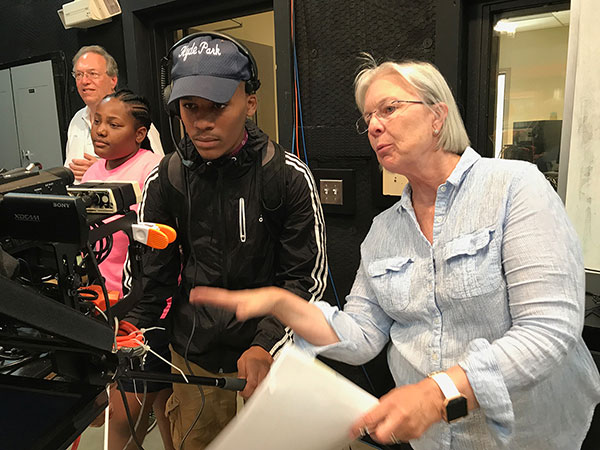
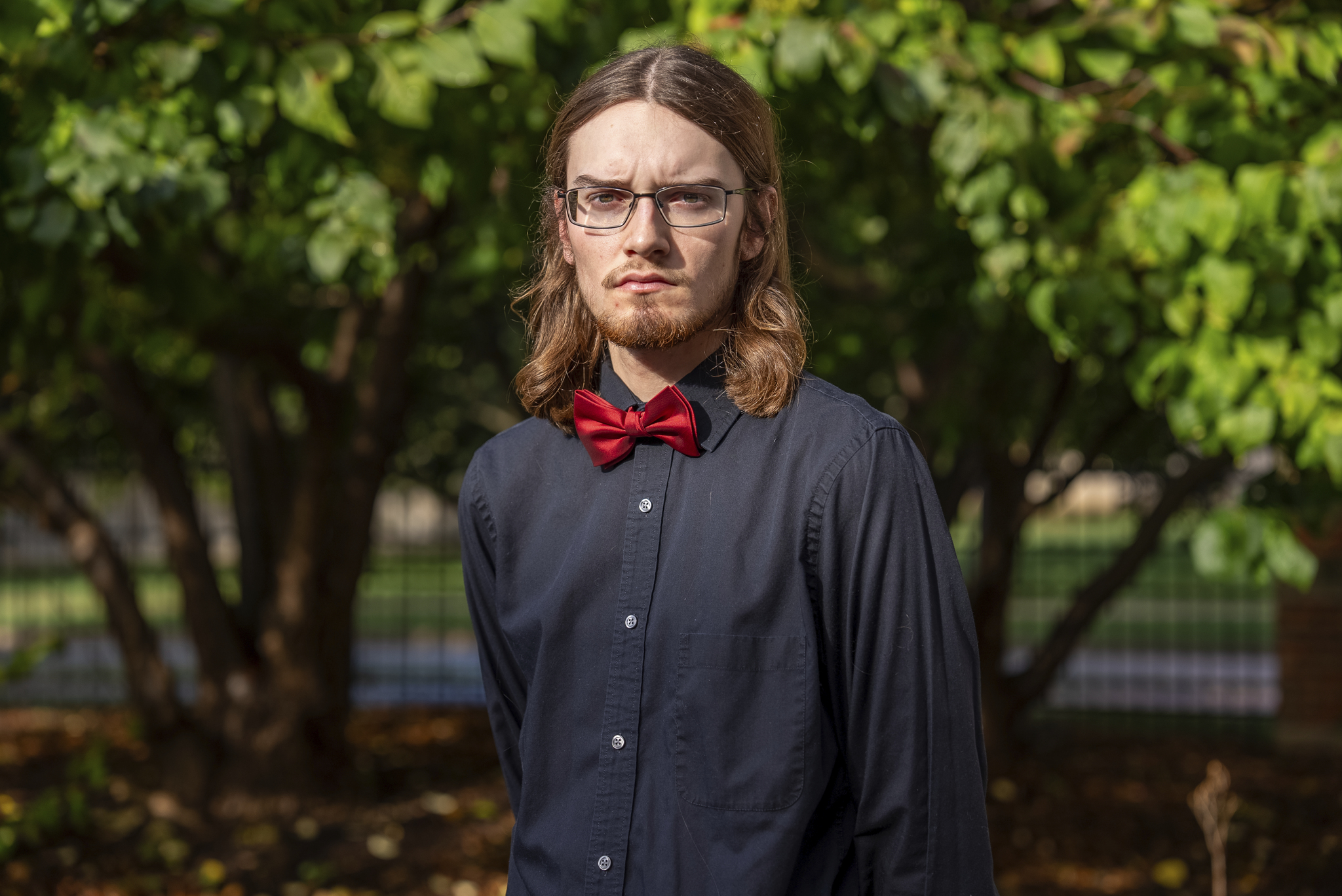
“Both awards are contested greatly by surrounding schools and programs. Their accomplishments with wins, even nominations, are truly resume builders,” said Kenneth Erdey, journalism instructor and technical coordinator for Richmond Studio, where UI7 broadcasts take place.
NATAS Mid-America EmmyAwards
Best Non-Fiction Longform – A.I. Uncovered: Produced by Piper Pascarella and journalism students from JOUR 445: Advanced Television Reporting last fall—including Hannah Lonergan, Kaitlyn Devitt, Maggie Knutte, Layli Nazarova, Daniel Branand, Ashley Gilbert, Rylee Jones, Jessie Cleverly, and Anna Koh—this UI7 special report looked at how artificial intelligence is reshaping our world.
Watch the segment:
Best Sports Program – Power Play: Produced by journalism students John Shay and Andrew Burkey, this pre-game sports show delivered insightful and engaging coverage of Illinois Hockey. Mazie Gierat (journalism), Peter Hanson (English major, journalism minor), and Caleb Noble (BS ’24, journalism) also played key roles in the show’s production.
Watch the segment:
Honorable Mention, Photography – Illini Boxing Club: Nathan Gonzalez (journalism) earned well-deserved recognition in the photography category for his work covering the Illini Boxing Club for Good Morning Illini.
SINBA Awards
The Illinois News Broadcasters Association announced the winners in the 2025 Student Awards, including several students from the UI7 Newsroom. These student broadcasters were honored Saturday, April 26, during the INBA Spring Convention in Bloomington.
The journalism student winners and their programs include:
First Place in Outstanding Hard Television Program – UI7 Presents Decision 2024: Piper Pascarella, Maggie Knutte, and Hannah Lonergan
First Place in Outstanding Sports Television Program – Illini Sports Night: Emily Richie and John Shay
Second Place in Outstanding Soft Television Program – Good Morning Illini: Hannah Lonergan, Mallory Miller, and Caroline Tadla
Nancy Benson, professor emerita of journalism, died on April 21, 2025. She was 72 years old.
In 1996, she was hired as a visiting professor in the Department of Journalism and became an assistant professor in 1997. She was promoted to associate professor in 2003 and to full professor in 2014. Before retiring in 2019, she served as interim head of the Department of Journalism.
During her 40-year career in broadcast journalism at various television and radio stations across the Midwest, including morning drive anchor and reporter at WMAQ radio in Chicago, Benson won numerous awards for reporting.
The highlight of her teaching career was developing an international reporting course. After a term of teaching about a particular country, she traveled with her students to that country. There, they would research and produce stories about issues that otherwise had been ignored. Nancy took students to Peru, China, Romania, Italy, and Turkey.
Get to know some of our College of Media students! Brendan Gallian is a Class of 2027 journalism major.
Why did you choose journalism at Illinois? After visiting other schools and learning more about the College of Media, I realized Illinois offered opportunities and experiences I wouldn’t find elsewhere, and I became more excited about what Illinois had to offer. I’m grateful I decided to attend, as it opened doors I didn’t expect when I first started my college search.
What drew you to journalism as a major? I’ve always loved sports. I played baseball growing up, collected sports cards, and I’m a huge White Sox fan. Journalism has given me a way to stay connected to the world of sports. Sports reporting allows me to combine my love of writing with the energy and excitement of the games. Once I got into feature writing, it became even more meaningful. Instead of focusing on scores and stats, I realized how much I enjoyed telling human stories, capturing the moments and people that don’t always get the spotlight.
How have your experiences outside the classroom shaped your journalism skills? Joining The Daily Illini has been one of the most essential parts of my experience at Illinois. I started as a sportswriter in Fall of 2023, covering cross country, track and field, and later, hockey. Writing two weekly stories and covering previews and recaps pushed me out of my comfort zone. I learned how to move beyond box scores and find the bigger story, like when I wrote about a soccer player scoring his first goal in front of his family. Telling stories like that showed me how much I enjoy feature writing and finding the human side of sports. Now, as the sports editor, I manage the entire sports section. I assign beats, edit articles, run weekly meetings, and make sure we maintain high-quality reporting. It’s a leadership role that taught me to be organized, work with different writers, and step up when needed.
Outside of The Daily Illini, I interned at Illinois Public Media (WILL), where I produced audio features, including a story about farmers installing wetlands to support local biodiversity. These hands-on experiences gave me a real-world understanding of journalism, helping me to become well-versed in conducting interviews and creating stories that matter.
What is one of your favorite stories you’ve written? One of my favorite stories was about a hockey player who scored his first goal in front of his family. Rather than writing a standard recap, I focused on the personal significance of the moment for the player. That experience reinforced how much I enjoy human-interest storytelling. I also appreciated covering smaller community events, like a local model train show. These stories allow me to highlight moments that may otherwise go unnoticed. They reminded me that journalism is not solely about significant headlines but about capturing meaningful human experiences.
What are your career goals after graduation? My long-term goal is to cover the Chicago White Sox for a professional publication. Although fewer journalists currently cover the team full-time, I want to help fill that gap and tell important stories about the organization. I plan to continue writing human-interest features and sports stories, focusing on the people behind the headlines. Whether I work for a traditional media outlet, a niche publication, or even a museum or historical organization, I want to keep telling meaningful stories.
What advice would you give to incoming journalism students? Believe in yourself and stay committed, even when it gets difficult. Journalism is competitive, and self-doubt is normal, but persistence is key. Try everything, join student media groups, pursue internships, and take different classes because you won’t know what you genuinely enjoy until you explore. Building relationships with professors and peers is also crucial, and the College of Media has many people dedicated to helping students succeed. Most importantly, remember that journalism is about passion. If you love storytelling, that will carry you through the challenges.
Update May 29, 2025: Congratulations to the students who presented “Uman Tok: Tailoring Hope, Renewing Futures in Sierra Leone” for receiving an award for Outstanding Oral Presentation at the Undergraduate Research Symposium from theOffice of Undergraduate Research! Some of these students previously won an award in 2024 for Outstanding Exhibit on this same research topic, which they continued work on in 2025.
Updated April 28, 2025
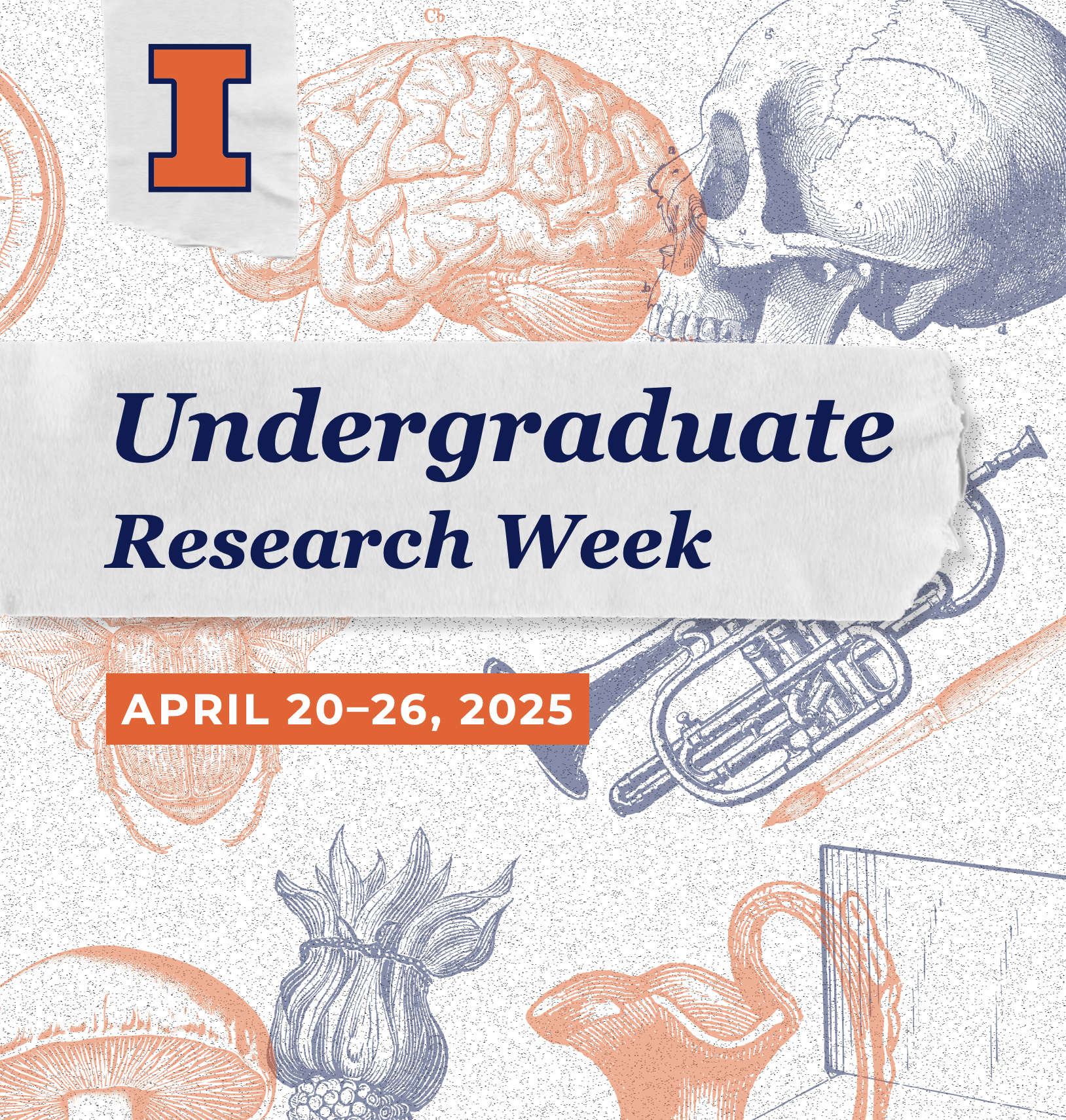
Students from all four majors in the College of Media participated in the annual University of Illinois Undergraduate Research Week, held April 20-26.
The Undergraduate Research Symposium, the signature event held on Thursday, April 24, at the Illini Union, features presentations, posters, and performances from students across campus.
Below is a list of Media student presentations as well as acknowledgements of Media graduate students and faculty who have mentored students presenting at Undergraduate Research Week.
Oral Panel
Health Modalities
“Evaluating the Persuasiveness of LLM-based Chatbots in Health Communication”
Tuesday, April 22, 4-6 p.m., Illini Union Rooms A, B, C, and South Lounge
“Salesperson-Product Matching Recommender System”
Alexia Rendon, Junior, Computer Science + Advertising, COM
“Understanding High school Students’ Experiences in a Culturally Responsive Computing Program”
Skyla Jin, Freshman, Computer Science + Advertising, COM
“Virtual Reality Game for Interactive Motion Planning”
Grace He, Junior, Computer Science + Advertising, COM
Omosefe Edomwande, Freshman, Computer Science, ENG
Undergraduate Research Apprenticeship Program
The Undergraduate Research Apprenticeship Program offers undergraduate students with little or no research experience the opportunity to work with graduate students and postdoctoral scholars on their research projects, explore the culture and process of research, and build on their existing abilities within a community of scholars.
Nina Issel, Sophomore, Journalism (COM)
Media Research Mentors
Doctoral student Veranika Paltaratskaya (above right), Institute of Communications Research, was the research mentor for Alina Huang, sophomore in communication and psychology (LAS), who presented “Understanding Consumer Interactions with Product Transparency Apps (PTAs) Using the Persuasion Knowledge Model” as part of the Social Science & Human Behavior poster presentations.
Doctoral student Alice Ji (above right), Institute of Communications Research, was the research mentor for Ayushi Maskey, junior in statistics + computer science (LAS), who presented “The Effect of Message Fatigue on Attention to Mental Health Messages” as part of the Heath & Wellness poster presentations.
Kevin Wise, professor of advertising, was the research mentor for Pushti Vora, junior in brain and cognitive sciences (LAS) who presented “The Impact of Mindless Scrolling on Dopamine Regulation and its Parallels to Gambling Addiction” as part of the Social Science & Human Behavior poster presentations.
Get to know some of our College of Media students! Chloe Barbaise is a Class of 2027 journalism major.
Why did you choose journalism as your major? I’ve always loved to write since I was in elementary school and my interest in journalism came about in middle school. We took a trip to our high school’s journalism program and when I saw the media room, I started to think about journalism as a career interest. Fast forward, I knew that U of I had one of the top journalism programs, and I wanted to come here to study journalism.
What’s the most important thing you have learned as a journalism student? I would say the most important thing that I have learned is being comfortable using cameras. I did not like taking photos or videos; I enjoy the editing and writing aspects of journalism. However, last year, I took a class with Alison Davis, JOUR 215: Multimedia Reporting. Now, I’m taking another class with her, and I learned that it’s just a part of journalism.
How would you describe New Voices and working with the College of Media? I really enjoyed being a part of the New Voices program. Daniel Almanza, assistant director of Media Career Services, manages the program and helps us with professional development and gaining different media-related experiences. The program helped us get connected to the College of Media and gave us the opportunity to write for the college website, where I conducted interviews with many faculty members and alumni that I wouldn’t have the opportunity to do otherwise. As a first-generation student, this program made me feel seen by the college as soon as I was enrolled.
Describe your role at The Daily Illini In my first year at The Daily Illini, I became a copy editor because I love to edit. It consisted mostly of fact-checking, spelling, and grammar. In the spring, I applied to become a senior copy editor. It was a paid position that opened more doors than just continuing as a copy editor.
Get to know some of our College of Media students! Lauren Barjami is a Class of 2026 advertising major.
What interests led you to choose advertising at the University of Illinois? Prior to coming to Illinois, I knew I wanted to pursue something in business that would also allow me to incorporate creativity. In high school, I started my own business, selling the art I made. When it came time to apply for college, I ended up getting accepted into advertising, which turned out to be the perfect fit for me. I immediately fell in love with the advertising program and the College of Media as a whole. Advertising sort of fell into my lap, and I am so grateful for that because it is a major that allows me to incorporate my personal interests of art and business into what I learn and, eventually, turn that into my career.
In what ways have your aspirations evolved since you began your college journey? Throughout my time on campus, I have been able to hone in on what I want to pursue through my involvement in different registered student organizations and classes. I have seen such a broad perspective of different opportunities, which has allowed me to find the specific path in advertising that is best for me. Fall semester freshman year, I took Statistics 107 and fell in love with the course so much that I became a course assistant. This class allowed me to discover my interest in the relationship between statistics and advertising, which goes to show how many routes in advertising you can take when you are given a wide array of opportunities. After exploring the science of advertising, I knew I wanted to go the technological route, so I declared a minor in Computer Science and Informatics. I want to work in some variation of an advertising data analyst role or to get into consulting because those are perfect fusions of technology and advertising. I have a summer internship consulting at Baker Tilly, where I hope to further immerse myself in the technical side of the advertising world and navigate what I want my future to look like.
Are there any professors or mentors within the College of Media that have helped guide this journey? There are so many people I look up to within the college and the list will continue to grow. The first College of Media mentor I had was Daniel Almanza, assistant director of Media Career Services. I was a member of the New Voices Internship program that Daniel coordinated, and that experience gave me a chance to develop my skills in media and familiarized me with multiple resources within the college, which was so helpful as a first-generation student. He also encouraged me to join different RSOs like the American Advertising Federation, which is now a primary aspect of my college career. Having that mentor relationship comforted me and acclimated me into the college environment early on. Daniel is always happy to give back to the students he works with, and he is a great person to have around.
I also want to mention Steve Hall, senior lecturer of advertising—everyone in advertising loves him. He is always running around, doing something, but no matter what, he always gets back to his students and has their best interests in mind. He is such a caring faculty member who is always willing to help students find opportunities and wants them to succeed far beyond graduation.
Which courses within the College of Media have you enjoyed the most? One class I really enjoyed was ADV 392: Industry Immersion Experiential Learning, with Amazon Ads and Global Overview, taught by Steve Hall. I loved taking a high-level course that taught me about advertising technology. We worked with a real client, managing actual products, campaigns, and budgets, which gave me insights on how advertising careers operate in the real world. The class taught me how to utilize tools for analytics and allowed me to develop presentation skills by creating and presenting pitches to clients. The class is a great balance between technical and personal skills within the field.
Another class I really enjoyed is ADV 480: Social Media Analytics with Professor Leona Yi-Fan Su. This course focused on advertising informatics and taught me how to use different programming languages to run social media campaigns. The content of the course was based on the technological parts of advertising that I find most interesting, which made it a perfect class for me.
The last class I want to mention is ADV 409: Media Entrepreneurship with Terry Kasdan, an adjunct lecturer. This class is essentially like Shark Tank. We split into groups to come up with product ideas and present them, teaching us how to advertise and sell properly. The instructor works in the industry, so we are learning from someone with first-hand experience. This class is a good escape from the technical classes I take because it is solely based on creativity and working with a team, which I find to be very enjoyable.
Do you have any advice for current or incoming freshmen as they start their journey? Do not put any pressure on yourself at all. Join anything and everything you can. Even for only two weeks, make your schedule back-to-back with trying new things, and then find out what you like most from there. Do not put too much pressure on yourselves over internships, and remember it is okay to get rejected. In college, everyone is on their own path, so don’t be too hard on yourself as you navigate your own. Make it a priority to make friends, join clubs, find hobbies, and have fun. Find a support system that cares for you whether that’s College of Media or anyone else on campus. Don’t focus too much on the past or future, just live in the present and appreciate everything because it all goes by so fast.
—Interview by Brooklynn Hubbard, New Voices Intern
Get to know some of our College of Media students! Emily Campos is a Class of 2026 advertising major.
What inspired you to choose advertising as your major, and how did you decide that College of Media was the right fit for you? When I was about 12, I started exploring entrepreneurship by launching my own slime business, managing everything myself from marketing and running my website to shipping products worldwide. Looking back, this experience greatly inspired my passion for both business and writing. When I first entered college, I pursued journalism because it seemed to align closely with these interests. However, after exploring further and discovering advertising, I realized that it perfectly combined the creative and strategic aspects I’d been searching for all along. Advertising is a constantly evolving field, full of opportunities to learn, meet new people, and stay connected with what’s happening around us. That’s why I’m so passionate about advertising.
What is your future goal as an advertising student? I have two main goals. Professionally, I’d like to start my career working at an advertising agency, ideally in copywriting. My ultimate career goal is to become a creative director, as I’d love to have the opportunity to lead campaigns and collaborate with diverse brands. I’m also interested in exploring other creative fields like film and animation because I enjoy different forms of storytelling and want to expand my experience beyond advertising. On a personal level, my long-term goal is to keep learning, stay curious, and approach every situation with an open mind and an open heart.
What specific opportunities or resources at the College of Media have helped you grow and learn in advertising? The most valuable resource at the College of Media to me is the people here. Create your own opportunities because you never know who you’ll meet or where those connections can take you. During my freshman year I had three internships—one with New Voices involving student media and another in global science communication, but my third internship started simply because I paid attention to the College of Media’s newsletter. At the time I felt uncertain about my college path and I saw a Zoom session featuring Professor Kevin Wise and his research on eye-tracking in advertising, so I joined. I was intrigued and asked how I could get involved. I wasn’t sure what might come of it, but I was curious enough to follow up. After we talked, he decided to create an internship for me. As a freshman, I ended up working with him, a PhD student, and a grad student on a research team. That experience really showed me how important it is to connect with people and be open to new opportunities. The people here are always willing to help if you show genuine interest, and that’s made all the difference for me.
What course within the College of Media do you enjoy or would like to recommend to other students? I would recommend any class with Shachar Meron, senior lecturer of advertising. I enjoy the way he teaches, making everyone curious and genuinely interested with the content. One of my favorite classes has been ADV 390: Content Creation. It’s a creative and engaging course that offers a clear view of what advertising involves. Many people underestimate how competitive the advertising industry is, and you need to stand out in order to succeed. This course helps you explore your perspective and figure out how you can contribute to the field.
What advice would you give to incoming students who are considering a career in advertising and are interested in joining our College of Media? My best advice is to absorb as much as you can from the world around you. Whether it’s learning about different people, noticing details in everyday life, or paying attention to things you’d usually overlook, there’s so much value in staying curious. You not only learn more about the world but also about yourself and what you’re capable of doing with that knowledge.
Also, many incoming students might feel like they are not doing enough or that they need to constantly prove themselves. But I believe that things happen the way they are meant to. What I hope more people realize is how valuable it is to stay open, curious, and engaged with the world around them. When you take the time to observe and appreciate what is in front of you, it can lead to meaningful growth in ways you might not expect. Sometimes, simply being present is enough to move forward.
April 14, 2025 | Ruth Kwak, Office of the Chief Information Officer, Technology Services
When the Website Management Center of Expertise collaborated with the College of Media, the College of Law and the School of Social Work to solve the challenges on each unit’s websites, the result was three new websites and a roadmap for building more.
Launched just one year ago from the grassroots efforts of the Website Implementation Guidelines Group, the Web CoE was established as part of the universitywide Operational Excellence initiative. With a mission to streamline dedicated resources and centralize expertise, the Web CoE now serves as a vital resource for helping units campuswide create and manage secure, accessible, and Illinois-branded websites.
How does it work?
At the heart of the Web CoE is its Website Management Consulting Service, designed to serve any group on campus—regardless of their levels of web experience. Groups can submit a ticket to start the consultation process, whether they’ve inherited an outdated website or are building one from scratch. The consulting team meets with the group to understand their specific goals, audience, technical capacity and needs. Based on this consultation, the team provides expert recommendations and, when appropriate, full-service migration support. Visit the Website Management Consulting Service webpage to learn more about the details of the process.
One of the biggest draws of working with the Web CoE is that it guarantees the final product will meet the university’s standards for accessibility, privacy, security and branding.
Previous Website Implementation Guidelines Group co-leader and current program director for the Website Management Center of Expertise, Cordelia Geiken shared more about why the Web CoE was identified as a part of the Operational Excellence initiative.
“People have been making websites at U of I since Mosaic in 1993, but it’s been all over the place. Our goal is to make things more streamlined, and to enable people to get the help they need in order to be accessible, secure and also branded…. Illinois branding is still pretty new. People are really excited about it and want to improve the user experience on their sites. If you’re on a University of Illinois site, you should know you’re on one.”
People have been making websites at U of I since Mosaic in 1993, but it’s been all over the place. Our goal is to make things more streamlined, and to enable people to get the help they need to be accessible, secure and branded.
Cordelia Geiken
Program Director for the Website Management Center of Expertise
Early adopters
This spring, the Web CoE completed full website implementation engagements with its first three early adopters: the College of Law, the College of Media and the School of Social Work. These projects were not only impactful for the individual units, but also valuable learning experiences for the Web CoE itself. The Web CoE engaged in a full website migration for each early adopter.
Geiken said that the early adopters each had a unique situation that the Web CoE had to work through. “All of campus will benefit from the unique situations those units faced,” Geiken said.
The College of Media
Without a web developer on staff, Holly Rushakoff, director of communications for the College of Media, was seeking assistance to update the college’s site when she was connected with Cordelia Geiken.
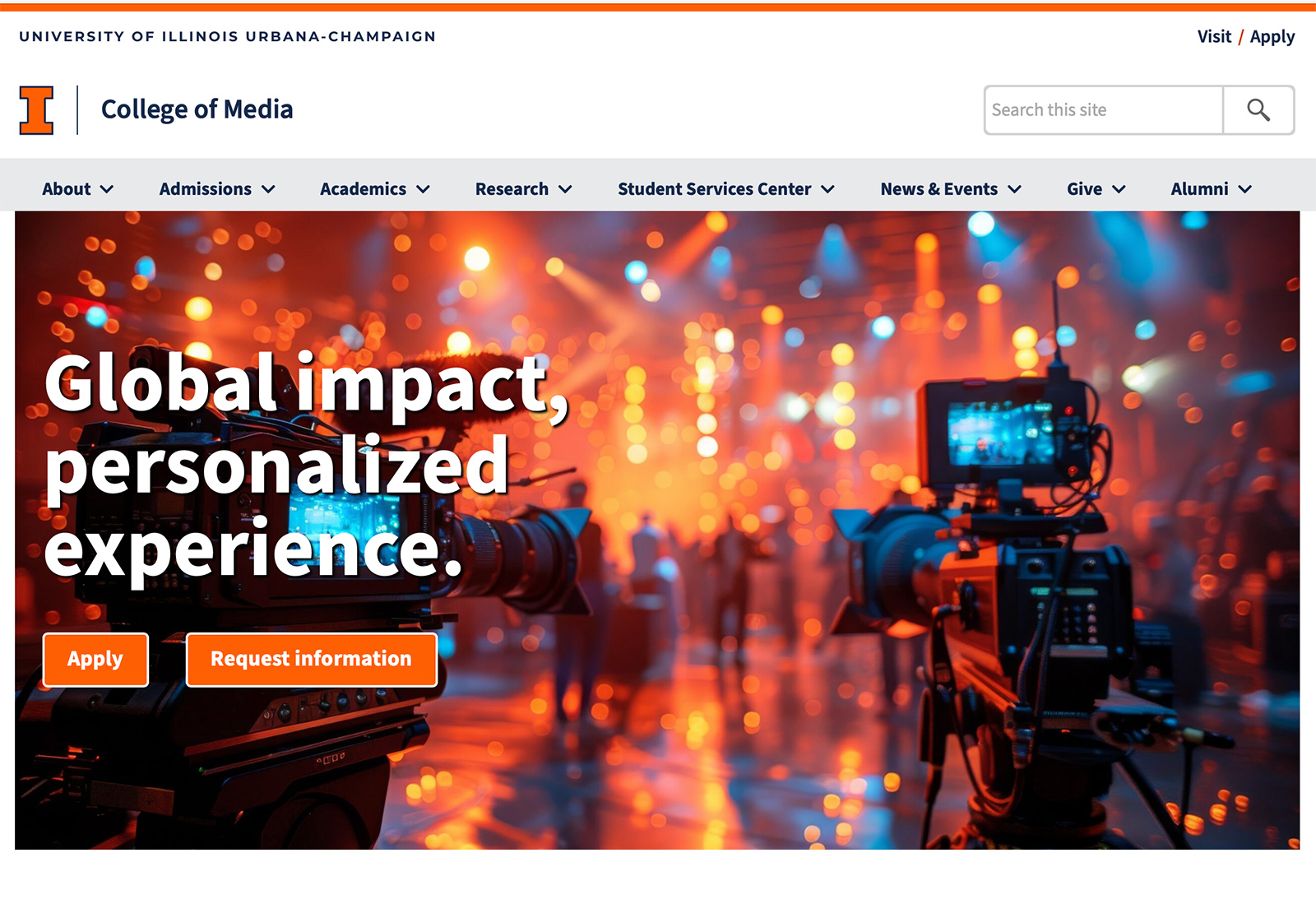
The College of Media’s previous homepage.
Media’s previous website was on Drupal and was a redesign that had been completed in 2019. According to Rushakoff, the web design of their page had impactful landing pages, but the other pages were simple with limited design and functionality options. Rushakoff also explained that the photos had to be a certain width or else it would break the flow of the page. These limitations were addressed with the Web CoE.
“The new website has accessibility enhancements and an incredible selection of design and layout options, from buttons to call-to-action blocks to clickable cards, plus photo slideshows, pull-quotes, and many header styles—and of course Illinois orange and blue templates to choose from. These design features enable us to make our stories much more visually dynamic and pull readers through the story or a landing page in a more engaging way, with multiple entry points,” Rushakoff said.
Working on the site was a year-long process, with many working meetings between Rushakoff and her Web CoE liaison, Liz Shallenberger, user experience design specialist at Technology Services.
The College of Media’s new website adheres to campus brand guidelines.
“The Web CoE team offered a wide range of expertise in web, graphic and user experience design, information architecture, accessibility and more. There were no questions they couldn’t answer! It was incredibly helpful and reassuring to have guidance from the Website Management Center of Expertise team throughout the entire process,” Rushakoff said.
Throughout the engagement, the College of Media was responsible for tasks such as auditing and organizing their content, tracking accessibility reviews, redesigning past stories with the new story template, updating short URLs and testing the development site for any issues before launch.
“I had an excellent experience working with the team from the Website Management Center of Expertise! Although it was a lot of extra work, it was primarily a joyful process because we could see the exciting transformation as we worked on the development site and chipped away at our milestones,” Rushakoff said.
The final product is a new Illinois-branded, accessible and secure website hosted on the Tech Services server, with people from the College of Media ready to perform site maintenance.
Krista Gaedtke, senior director of strategic marketing and communications for the College of Law was always looking for ways to stay connected with what was happening with website design at a campus level. The College of Law had been needing a refresh for a while, and so when talks about the Website Management Center of Expertise reached Gaedtke, she immediately submitted a ticket requesting available resources.
“Our previous site was not in terrible shape – it was nicely designed, well-structured, responsive and accessible, but it was decidedly not ‘on brand.’ There were also a few features that we were using on our previous site that didn’t provide the level of customization or flexibility that we needed, so finding viable alternative solutions was also a priority for the migration,” said Gaedtke.
According to Gaedtke, WordPress had been meeting their needs sufficiently, and so they opted to migrate their old WordPress site onto another WordPress site, focusing on minor re-structuring instead of changing the host.
“The end result is a website that is now fully compliant with Illinois brand guidelines and accessibility standards and takes advantage of many of the design features and components available within the Illinois web theme,” Gaedtke said.
In addition, Gaedtke noted that they were able to complete the website migration at no cost to the College of Law.
“Having gone through the process for a full-service website redesign project within the past ten years, I am well aware of the significant cost savings we were able to achieve with this partnership,” Gaedtke said. “I think we can easily say that we saved the College of Law at least $50,000 on this project, if not more.”
Gaedtke also mentioned several other benefits to partnering with the Web CoE, including regular access to the developers who were building the tools, the ability to offer feedback at will, see adjustments being made in real-time and suggest future developments.
Geiken said that the Web CoE worked with the College of Law for a full migration, and the College of Law then opted to perform their own future regular maintenance. However, as an official user of the Illinois Web theme, the College of Law will now have first access to all new product releases on the Illinois Web theme and tech support whenever needed.
“There was a point person for the project on both the Web CoE team and on our team. Dena Strong was assigned as our Web CoE liaison for the project; her background is user experience design, but she had to wear many different hats throughout our project, and she was an absolute rockstar. We met on a bi-weekly basis,” Gaedtke said.
Dena Strong, the Web CoE liaison for the project, is a senior information design specialist at Technology Services.
Gaedtke explained that the Web CoE drove the overall management of the project, prioritized action items, migrated all the content over to a development site, worked with them to make it look how they wanted; they performed troubleshooting and also advised on how to utilize certain tools.
On the other hand, Gaedtke’s team worked on making sure all the content was accurate and up-to-date, structured as they wanted it to be, and designed consistently across pages. As the site was on the College of Law’s server, they were also responsible for ensuring that they were aligned to the College of Law’s privacy and security best practices.
“There were certainly some growing pains along the way… simply because this was the first time that either of our teams were engaged in this type of project,” said Gaedtke. “We are really pleased with the end result.”
Over the years, the School of Social Work has had many conversations with units on campus about their lack of internal web support. Without internal staff dedicated to web support, they had been working with an external vendor.
“We started with well-designed, accessible, highly customized site that was expensive to maintain. Through migration [with the Web CoE], we transitioned to a clean, fresh design with significantly improved content organization. The new site aligns with our brand, enhances user experience and will hopefully be much easier to maintain in the long run,” said Becky Ponder, director of communications for the School of Social Work.
The previous site was a vended site hosted on WordPress with extensive customization.
“We had to do custom scripting in order to export their site out from their old environment to their current one. They don’t have staff to maintain their site, so we came up with a solution to address that, working with field consultants at Tech Services. We were able to hire a part-time field consultant to do maintenance for them,” Geiken said.
According to Ponder, the Website CoE managed more of the technical aspects of the site, while the School of Social work’s team focused on content, design preferences and identifying functional needs.
Social Work partnered up with Web CoE liaison and lead consultant for the project Huaqi Zhang, user experience design specialist at Technology Services.
“It was a true partnership, with both teams working diligently to ensure the site met our goals,” Ponder said.
The result was a full migration to a fresh site with dedicated web maintenance support from Tech Services. Receiving overall website support from campus has resulted in significant cost savings for the School of Social Work.
“One of the biggest takeaways from this migration is how complex website transitions can be, even with a great support team. Every website has unique needs, and ensuring all integrations function properly takes time and patience. It was a learning experience for everyone involved! While it was a complex transition, we’re grateful to have the new site launched and are very happy with it,” Ponder said.
The Web CoE has created a list of campus web resources for anyone at the university. This list of resources will be ever-evolving, updated with resources to support groups with all web-related concerns.
“Not everybody needs someone else to set up or maintain their sites. So we wanted to provide some resources for those who do have staff who can do all this for them. This is where collaboration comes in, and this is what this resources page and what our group is all about. We are trying to create a place for people to collaborate, to use whatever resources they have to join in the efforts to unify and protect our websites. So far, it has produced a much better product across the board,” Geiken said. Following the work on the three early adopter’s websites, the Web CoE will be reflecting and refining the program processes while engaging with the College of Applied Health Sciences on a website migration. The Web CoE will be ready to work with more units in the later summer of 2025. If you’re interested in learning more or working with the Web CoE, submit a ticket to start a conversation or to get on the list.
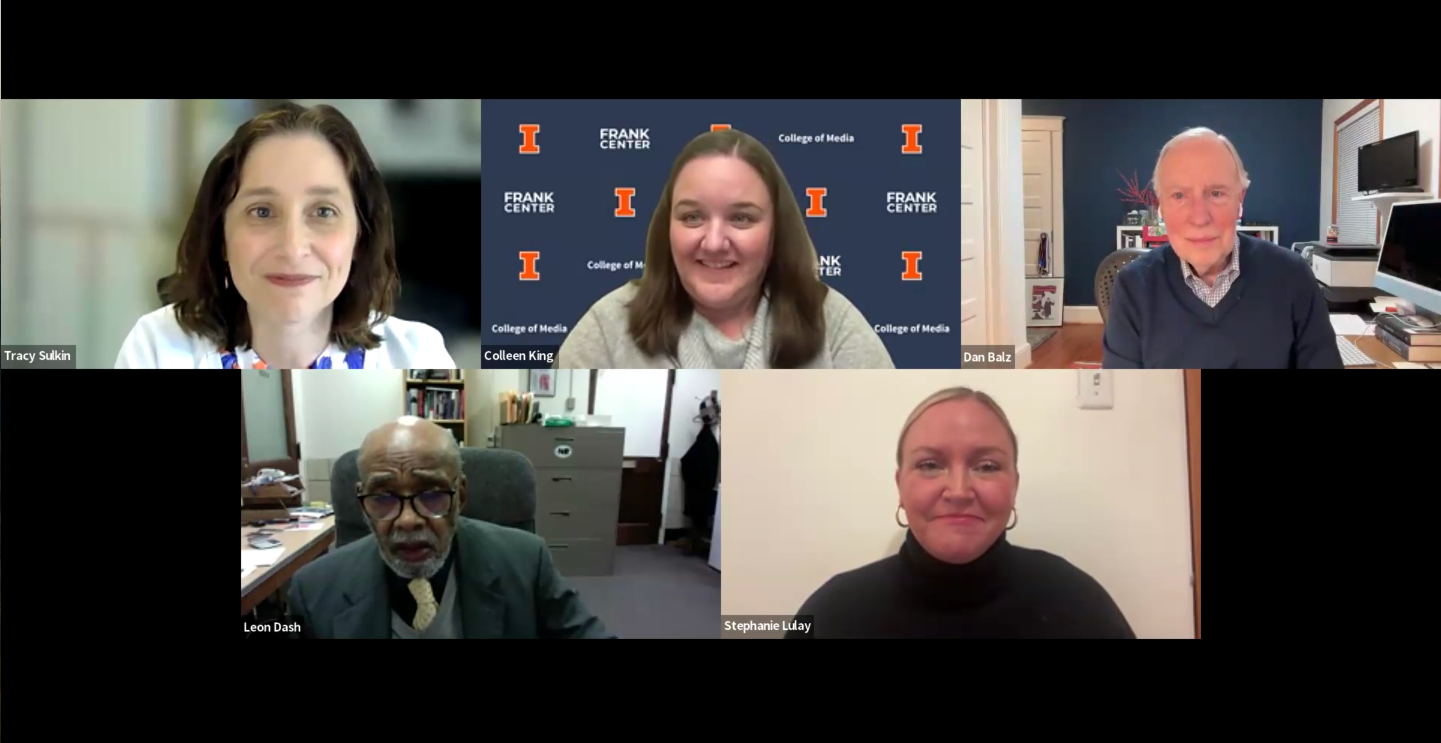
On February 25, 2025, the Suburban Illini Club hosted the College of Media for “Engaging in a Divided Society: Lessons from Journalism,” a panel discussion on how to engage with others in an age of polarization.
Leon Dash,Professor and Swanlund Chair, Department of Journalism; 1995 Pulitzer Prize Winner for Explanatory Reporting while at The Washington Post
Colleen King,Clinical Assistant Professor, Department of Journalism; Director of the Richard and Leslie Frank Center for Leadership and Innovation in Media; former Executive Producer for MSNBC’s The 11th Hour with Brian Williams
Dan Balz(BS ’68, MS ’72, journalism), Chief Correspondent at The Washington Postcovering national politics, the presidency and Congress
Stephanie Lulay(BS ’08, journalism), Executive Editor and Co-Founder, Block Club Chicago, an award-winning, reader-funded nonprofit newsroom focused on Chicago’s neighborhoods
Read excerpts from “Engaging in a Divided Society” below. Note: Answers have been condensed for length and clarity.
Sulkin: It strikes me that a threshold that we discuss a lot is the lines between news versus commentary. And many see the lines between those two as becoming increasingly blurred. I wonder what your thoughts are about the extent to which that seems a useful theoretical divide, and then what the consequences are of the blurring of those lines.
Dash: News columns are very clear that they are news columns, and I try to point that out to the students, in terms of understanding what a news column is. An opinion column is very, very different from a news column, in which you have a lot of leeway to express your opinion. I think social media has blurred the lines between what is considered news and what is considered an opinion. But I think the conventional publications have continued to distinguish between the two and keep them separated.
Lulay: I think Twitter/X and TikTok are full of opinions. We’re in a period where newsrooms are rapidly disappearing and we’re in an era that the world really needs more truth tellers. Something I’ve seen, engaging with readers for a long time, is that readers on the whole really aren’t able to distinguish between news-driven reporting and opinions on the Op-Ed page, and I think that that damages trust.
Balz: One of the things we’ve noticed is that commentary and opinion writing draws a huge audience. And we know that because of the siloed nature of how people get their news, that people seek out opinion journalism that conforms with their points of view. And in the in the digital age, particularly when you’re looking at a homepage for—whether it’s the Washington Post or the New York Times or the Wall Street Journal—the commentary pieces are right there smack next to the news pieces. In a printed paper, the opinion pages are in a separate place. They’re clearly marked. But in a sense the, the presentation has helped to blur the lines.
Sulkin: We’ve been talking about the public’s trust in the news and looking at polling about what people think about the media. There’s been a slow decline in trust in all sorts of institutions over the past several decades, with the news media being part of that. Pew reports that over three-quarters of Americans and majorities from both political parties think that news organizations tend to favor one side or the other. Yet large majorities also say that news coverage keeps politicians from doing things that they shouldn’t. So that scrutiny, that watchdog role, still holds. What are your views about what would help the public to regain trust, if we think it’s been lost, or where could we build on some of those pockets of trust?
Lulay: I’m really happy to be in a local newsroom these days. I think we can make a real impact in terms of trust. Trust is built from the ground up and there’s no better place to build relationships with readers than in a local newsroom. Rebuilding trust in our city is key to why Block Club was founded.
When we started this newsroom, there was a study that trust, particularly on the South and West sides of our city—these are under-resourced areas of our city—trust was at an all-time low with the media. And that was because of generations of the media either only reporting on crime or chaos that happened in those neighborhoods, if they ever showed up at all. At Block Club, instead of covering a traditional beat like courts and education in such a big city where there’s too much going on, our reporters are assigned to two to three contiguous neighborhoods. And when they’re covering a smaller area like that, they really are able to build close relationships with readers, which we believe ensures the news that we’re reporting not only reflects what they most care about, but also leads to a more accurate portrayal of their neighborhood.
King: I would say it’s very tricky because the skills that we teach our students to cover Chicago and maybe go work for Stephanie [Lulay] are not different than skills I would teach up-and-coming reporters to go work with Dan [Balz]. I think people are turning off the news in large part because it always seems like bad news right now. So perhaps we can be more creative in our angles, but I also think transparency is a big part of reporting. And being honest in what we know and what we don’t is a big part of it, too. You know, it is our job to hold people accountable; that’s why we do what we do. Hopefully over the course of time, people can see that our reporting holds up and is fact-based and we’re just trying to report the truth as best we know it.
Balz: Repairing the decline in trust is a very difficult job that we can’t do in and of ourselves as news organizations. What’s happened in terms of the decline of trust is a societal-wide problem. Just as the polarization of the country is a societal-wide problem. And it will take time to begin to overcome that. We have a role to play in that. There are things we can do about that. Colleen [King] is exactly right. Transparency is important. The idea of being open about what we know and what we don’t know is important. But we also have to do what we’ve always done, which is to be aggressive in our reporting and follow that wherever it leads us and live with the consequences of that. Our first obligation is to find the truth to the best that we can find it on any day or week.
Sulkin: We had Chuck Todd visit the College of Media in December right before he announced that he would be departing NBC News after a long career there. I think a narrative thread he was pulling was that local news is the cure to what ails the news ecosystem. I think part of the argument was that maybe if folks have the opportunity to engage with local news, that helps with some spillover to how they think about national news. But the growing news deserts mean a lot of folks don’t have local news.As we are preparing students and launching them out into their careers, Colleen and Leon, what are we doing to correct some of these news desert issues?
Dash: My emphasis with my students is fact-based reporting. It’s a no-no in my classes when they say, ‘I assume’ or ‘I think.’ I say you shouldn’t be ‘assuming’ and you shouldn’t be ‘thinking’ anything. You should know. If you don’t know, you should say you don’t know. And transparency is a big part of that. Being honest and upfront. I don’t even know how you overcome this divide in this society today. But in terms of conventional journalism, fact-based reporting is very, very important and transparency is also very important.
King: And I would say we’re training our student journalists to learn all kinds of skills. Our students are leaving our universityknowing how to podcast and write, do audio and video journalism, and write online or for print news outlets. So they could really drop in anywhere and cover any community they want to. While we’ve got many who want to return home to the Chicagoland area, or make it big in New York or LA or Washington, we do encourage them to think about covering smaller communities— at least getting a start there—and understanding what it’s like to cover a community where you do get to know your audience and the people you’re covering and in government as well.
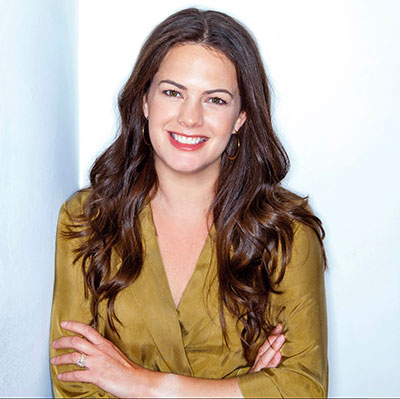
Netflix director Emma Miller (BS ’08, media studies) says returning to campus to speak at the 2025 College of Media Convocation ceremony feels like a full-circle moment for her.
As a Media student at Illinois, she remembers renting DVDs through Netflix’s mail subscription service for her film classes.
“I could watch films on my own time, which was really exciting because there was one video shop in town and all the film students would race to check out the film,” she said.
While Netflix was a lifesaver for her as a student, her current role at the global streaming service has proven to be an even more incredible opportunity.
“It’s amazing and I’m having the best time. I really love it, and I have to say [my job] has exceeded my expectations in a lot of ways,” she said.
Miller, who was named one of The Hollywood Reporter’s“35 Rising Executives 35 and Under” in 2018, joined Netflix in 2023 as director of overall deals in the series division.
I appreciate everything Illinois did to get me here and hopefully I can give something back and inspire at least one student.
Emma Miller(BS ’08, media studies)
Netflix Director of Studio Scripted Series
Since then, her title has changed to director of the studio scripted series division, but her role has essentially stayed the same.
Part of her job is to oversee deals with certain creative entities. For example, she covers Aggregate Films, founded by Jason Bateman (Ozark), and 21 Laps Entertainment, founded by Shawn Levy (Stranger Things).
Miller also works on ground-up development, doing first-reviews of projects and pitches from writers and producers.
“I’m basically one of the people at Netflix who buys projects and then supervises the creative development of those projects from the pitch to all the way out when it’s on the air,” she said.
Most of her work is reading first-episode scripts and giving notes to guide the writers, “almost like an editor would do in publishing.”
If Netflix picks up the series, Miller will do the same for all the episodes at the script level. While most of her work is in the creative domain, Miller also handles some business responsibilities as well. She oversees the production of projects, including budget management, hiring of actors and directors, and traveling to shoots on location to get shows up and running. She also covers technical aspects like editing sound mixes, visual effects, and film cuts.
As Miller approaches her two-year anniversary at Netflix, she’s looking forward to the release of a few exciting projects she’s managed.
Forever, a reimagination of the 1975 novel by Judy Blume, premieres on Netflix on May 8. Black Rabbit, starring Jason Bateman and Jude Law, is awaiting an air date. Miller is also working on post-production of Man on Fire, a television remake of the 2004 film starring Denzel Washington.
“I love Netflix and I’m really enthusiastic about what we’re doing,” Miller said. “I will say it’s just really fun to know that a lot of people are going to watch your work and the kind of impact you can have on culture is thrilling.”
Miller says she first learned about the power of media and how it can shape the way you experience the world as a student at Illinois. She credits a Women in Film class for changing the course of her academic career from English to media studies (now called media and cinema studies).
Miller, who serves on the College of Media Alumni Leadership Council and won the 2023 Emerging Leader Award, continues to engage with the college as a panelist for Media Career Nights and soon, to address the College of Media’s Class of 2025.
“I appreciate everything Illinois did to get me here and hopefully I can give something back and inspire at least one student,” she said.