Students create first all-Spanish news broadcast ‘UI7 En Vivo Contigo,’ present at NAHJ conference


As the son of first-generation immigrant parents from Mexico, Emilio Reyes sometimes found it difficult fitting in while growing up in rural Indiana.

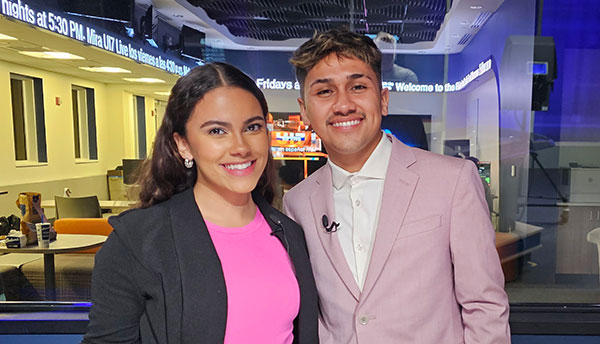
Emilio Reyes and Anneliese Cornejo Garcia of En Vivo Contigo

It wasn’t until he came to the University of Illinois to study journalism that he says he began to really embrace his Hispanic heritage. 

“I [was able] to find my community and really flourish so much here. I really think the U of I has definitely helped me develop and accept and love my identity so much that I am at my utmost [best],” Reyes said. 

Reyes, a senior and president of the Latino fraternity Sigma Lambda Beta International Fraternity Inc., says his time at Illinois has not only allowed him to gain a new sense of self-confidence, but also empowered him to help others on campus and beyond connect with their Latina/Latino roots. 

Last fall, Reyes and two other journalism students created, anchored, and produced En Vivo Contigo (“Live with You”), an all-Spanish-speaking television newscast on UI7, the University of Illinois cable channel. 

“I’ve always believed that media representation is so important,” Reyes said. “If I would have seen someone that looks like me on TV, I would have definitely learned about what a journalist is way before I was 18 years old and applying to colleges.”

It’s an endeavor that earned him and recent graduate Anneliese Cornejo Garcia (BS ’24, journalism; BA ’24, Spanish) an opportunity to speak at the National Association of Hispanic Journalists convention held July 9-13, 2024, in Los Angeles.

Reyes, who studied abroad in Spain last semester and interned at Cuatro Gotes Producciones, a multimedia ad agency, said he was grateful for the networking opportunities the NAHJ convention provided.

Creating a show that highlights my communities’ stories, which often go untold, while promoting other Latinx journalists in the field has been a dream, and I’m excited to keep growing and improving our work!

“It was the best of the best—the most amazing panels and connections, especially for Latino journalists,” Reyes said. 

Ken Erdey, journalism instructor and technical coordinator for Richmond Studio, also attended the convention and watched as the two talked to a large audience of media industry professionals as well as college students about the origins of the show. 

“Anneliese and Emilio excelled in telling their story to make En Vivo Contigo happen,” Erdey said. “It was a great day and made me proud to be a part of Illinois Journalism.”

Garcia and Reyes presenting at NAHJ convention
Emilio Reyes and Anneliese Cornejo Garcia presenting at the 2024 National Association of Hispanic Journalists convention. (Photo by Ken Erdey.)

Erdey began talks with Reyes, Cornejo Garcia, and Jackie Barba, a senior in journalism, in Spring 2023 about the possibility of starting a Spanish-speaking newscast. 

Thanks to a major gift from Richard and Leslie Frank that provided state-of-the-art renovations to Richmond Studio and established the Frank Newsroom, Erdey knew he could expand opportunities and open new doors for students at UI7. 

The students were elated about the idea of starting an all-Spanish-speaking news platform, which first aired in Fall 2023 and ran through Spring 2024.

“There was no Spanish-language news in central Illinois before UI7 En Vivo Contigo, and we’re not on a mainstream network, but to have this come [about] with college students making that first step and carving the path is huge,” Cornejo Garcia said. 

Barba, executive producer of the show, feels fortunate to be a part of En Vivo Contigo. 

“My identity as a Latina informs so much of my work as a journalist, and I value spaces where that is celebrated,” Barba said. “Creating a show that highlights my communities’ stories, which often go untold, while promoting other Latinx journalists in the field has been a dream, and I’m excited to keep growing and improving our work!”

Reyes’s experience at the 2024 NAHJ convention inspired him to revitalize the local Illinois NAHJ chapter, which hasn’t been as active in recent years. After seeing firsthand the number of opportunities and resources NAHJ provides, Reyes and Barba want more students to get involved.

Jackie Barba and Emilio Reyes at UI7 Open House
Jackie Barba and Emilio Reyes (center) talk with other students in the Frank Newsroom during a UI7 Open House in September. (Photo by Nathan Gonzalez, photography intern.)
 

“These jobs [and connections] that you would never believe are just right there. People see us, they hear us, and they want to help us as students take advantage of that,” he said.

Barba is also working with Reyes to help strengthen the local NAHJ chapter. As vice president of the Society for Professional Journalists at Illinois, Barba recognizes the importance of providing resources and opportunities for other Hispanic journalists.

Any student interested in joining the Illinois chapter of NAHJ can contact Emilio Reyes at emilio3@illinois.edu.

For more information about En Vivo Contigo, which is open to all majors and Spanish-proficiency levels, email Ken Erdey at kerdey@illinois.edu. 

The second season of En Vivo Contigo kicked off on September 27 and airs every other Friday at 4:30 p.m. live, on-demand, or on UI7 Newsroom’s Roku channel.

Share on social
New book by Matthew Ehrlich explores the history of the phony cancer drug Krebiozen


In March 1951, Andrew Ivy—at the time, one of the most renowned scientists and medical ethicists in the U.S.—held a press conference in Chicago to announce Krebiozen, a recently discovered wonder drug that Ivy said could dramatically help cancer patients. The announcement created a frenzy among cancer patients, who deluged the University of Illinois’ Chicago campus, where Ivy was vice president in charge of the professional schools at the time, with telephone calls trying to obtain it.

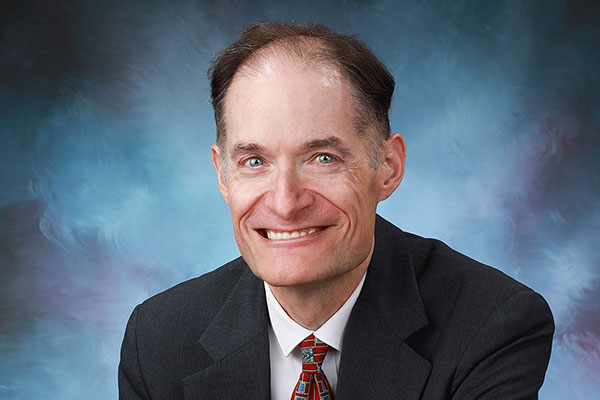
Matthew Ehrlich

But within a few months, Krebiozen was denounced by the American Medical Association and, a few years later, Ivy, the drug’s creator Stevan Durovic and some of their supporters were prosecuted for fraud.

The dramatic Krebiozen saga culminated in Durovic fleeing the U.S., Ivy’s reputation in ruins and two of his U of I colleagues—President George Stoddard and Provost Coleman Griffith—ousted from their positions, in part because of their association with the scandal.

The Krebiozen Hoax: How a Mysterious Cancer Drug Shook Organized Medicine, a new book by Matthew C. Ehrlich, a professor emeritus of journalism at Illinois, examines the controversial drug’s dramatic rise and fall.

Although the sensational story of Krebiozen has since faded into obscurity, Ehrlich said that its lessons are relevant today, offering potent reminders about the dangers of medical misinformation, misplaced trust and the unquestioning adoption of unproven treatments. “The Krebiozen Hoax” is also a cautionary tale about the pitfalls of hubris and how the political climate can undermine public trust in established institutions and mainstream medicine.

According to the author, Krebiozen was “a quintessential example of medical quackery” that “foreshadowed today’s bitter debates over health misinformation, medical freedom and scientific and educational expertise.”

Krebiozen also marked a “key historical moment for the Food and Drug Administration,” which was then flexing new regulatory powers, and its stance on that drug triggered backlash from cancer patients and accusations of medical overreach when the agency reported the drug was worthless as a cancer treatment, refused to license it and blocked its interstate shipment. 

“It was a big episode, not just in the history of the U of I but also in the history of the whole state of Illinois, since the legislature and the governor got involved,” Ehrlich said. “And then, of course, it became a national deal with the involvement of the FDA and the National Cancer Institute. Illinois Senator Paul Douglas and even President Lyndon Johnson at one point got sucked into this whole thing.”

The story of Krebiozen is a poignant reminder that these travails are nothing new, but instead have ample historical precedent. It is also a reminder of the damage that can be inflicted when quackery and all the untruths that accompany it go unchecked for too long.

The book details how Durovic, an unknown doctor who had never published peer-reviewed research on the drug’s performance, duped a world-renowned clinician and scores of vulnerable patients who were desperate to find a cure for a frightening disease. 

Ever evasive about the medicine’s formula and origins, Durovic indicated that it was derived by stimulating horses’ immune systems and extracting their blood, a potential form of immunotherapy that piqued Ivy’s research interests in the body’s defenses against cancer and may have clouded his professional judgment.

The Krebiozen Hoax book

“Where I think Ivy went wrong is when he dug in his heels and refused to listen when first his close friends, then his scientific associates and prominent groups and organizations told him Krebiozen was worthless,” Ehrlich said. “He really seemed to have a natural stubbornness and a strong ambition to make a lasting contribution to science that may have gotten the best of him. And he never renounced Krebiozen, despite all the personal and professional travails that befell him.”

Ehrlich’s book examines how public excitement over the drug elevated Ivy’s Sisyphean pursuit of clinical trials and federal approval for the drug to a nationwide cause, attracting A-list supporters such as movie star Gloria Swanson and environmentalist Rachel Carson, a cancer patient who briefly and unsuccessfully treated herself with it.

The battle to obtain “fair trials” of Krebiozen that advocates believed would demonstrate its efficacy once and for all pitted them against federal regulators, mainstream medicine and the AMA. Ivy and Durovic accused the AMA of conspiring with powerful corporate interests to keep Krebiozen off the market after failing to seize control of it. 

When the FDA refused to license the drug, angry demonstrators besieged the White House, with cancer patients waving picket signs declaring, “I need Krebiozen to live!”

“Krebiozen is one episode in a long, sorry series of such episodes, and that’s one of the reasons I wanted to write about it,” Ehrlich said. “It just had colorful characters involved, including Ivy, Stoddard, and Douglas.”

Ivy was a distinguished physiologist and medical ethicist who testified as a representative of the AMA at the Nuremberg trials and was once dubbed “the conscience of U.S. science” by Time magazine. His friend Douglas was a firebrand Democrat legislator and decorated war hero who became one of Krebiozen’s biggest supporters and foremost legislative sponsors. 

“And, like Ivy, once Douglas committed to it, he dug in and would not be dissuaded from it,” Ehrlich said.

Were it not for Ivy’s star power, political connections, rapport with the press and federal agencies’ confusion over which of them was responsible for regulating it, the Krebiozen controversy likely would have fizzled more quickly, according to the author.

Dr. Andrew Ivy
Dr. Andrew Ivy

Ehrlich examines the historical conditions that existed when Krebiozen came to prominence and how they likely heightened the controversy surrounding the drug.

In Ehrlich’s exploration of Krebiozen’s tumultuous history, he notes that it was among nearly150 miracle cures for cancer that were touted at one time or another. The Krebiozen controversy copied the pattern of many such brouhahas that preceded it—and foreshadowed many of those that came after it, including controversial treatments for COVID-19 such as hydroxychloroquine, Ehrlich said. 

“People should be aware that these things happen from time to time,” Ehrlich said. “The story of Krebiozen is a poignant reminder that these travails are nothing new, but instead have ample historical precedent. It is also a reminder of the damage that can be inflicted when quackery and all the untruths that accompany it go unchecked for too long.”

The book was published by 3 Fields Books.


Editor’s note:    

To reach Matthew Ehrlich, call 217-333-1365 or email mehrlich@illinois.edu.

ISBN: 0252088115 

A press kit with photos of the author and the book’s cover is available from News Bureau.

View original press release.

Share on social
College of Media to hold three-part webinar series, ‘Bridging Divides: Conversations on Media and Disagreement’


How are we teaching students, and the broader community, to disagree? It’s a question the College of Media hopes to address in a new three-part series, “Bridging Divides: Conversations on Media and Disagreement.”

Update 11/13/24: Read excerpts from the Q&As:


Bridging Divides banner

Faculty from the Departments of Advertising, Journalism, and Media & Cinema Studies will host free webinars exploring how productive discussions occur across lines of disagreement and difference. All take place on Fridays at noon via Zoom, on October 18, October 25, and November 1.

“The College of Media’s ‘Bridging Divides’ series is an opportunity to foster civic preparedness through expert-led dialogues,” said Dean Tracy Sulkin. “We look forward to welcoming students, faculty, staff, alumni, and community members to these important conversations.” 

The talk topics and panelists include:

Reaching across the Aisle: Advertising and Messaging in an Age of Polarization

October 18, 12-12:45 p.m.
Register to join via Zoom.

Jason P. Chambers

Jason P. Chambers, Associate Dean for Diversity, Equity, and Inclusion; Professor, Charles H. Sandage Department of Advertising; author of Advertising Revolutionary: The Life and Work of Tom Burrell

Michael Strautmanis (BS ’91, advertising; JD ’94, law), Executive Vice President for External Affairs, Obama Foundation 


What Does It Mean to Be an Informed Critic? 

October 25, 12-12:45 p.m.
Register to join via Zoom.
Learn how to give criticism a good name. During this session, the panelists will share a how-to for every kind of writer.

Jenny Oyallon-Koloski, Assistant Professor, Department of Media & Cinema Studies; author of Storytelling in Motion: Cinematic Choreography and the Film Musical

Michael Phillips, Chicago Tribune Film Critic; College of Media Ebert Fellows Mentor


Engaging with People, Perspectives, and Policies When You Don’t Agree: Lessons from Journalism

November 1, 12-12:45 p.m.
Register to join via Zoom.

Leon Dash, Professor and Swanlund Chair, Department of Journalism; 1995 Pulitzer Prize Winner for Explanatory Reporting

Colleen King, Clinical Assistant Professor, Department of Journalism; Director of the Richard and Leslie Frank Center for Leadership and Innovation in Media; former Executive Producer for MSNBC’s The 11th Hour with Brian Williams  

Share on social

Journalism alum Thomas Winski receives IJEA Lifetime Achievement Award

Winski

Thomas Winski (MS ’75, journalism) was selected to receive the 2024 Illinois Journalism Education Association Lifetime Achievement Award. Winski accepted the award on September 20 at the annual IJEA conference at Illinois State University.  

Each year, the IJEA seeks to honor retired individuals for a lifetime of dedication to scholastic journalism. 

Winski was an assistant professor of journalism at Lindsey Wilson College in Kentucky for four years before joining the faculty at Emporia State University in Kansas. There, he served as assistant professor of journalism for 16 years and co-director of the journalism program until his retirement.

Alumna Cheryl W. Thompson to receive Washington Association of Black Journalists Legacy Award

Cheryl W. Thompson

Cheryl W. Thompson (BS ’82, LAS; MS ’84, journalism), investigative correspondent and senior editor at NPR, and associate professor at George Washington University, will receive the 2024 Washington Association of Black Journalists Legacy Award.

This award recognizes a current or retired journalist or journalism educator in the Washington, D.C., area who has broken barriers and/or provided distinguished leadership in increasing access and opportunities to people of color in journalism. 

Thompson will be honored at the third annual WABJ Special Honors & Scholarship Gala on Saturday, Dec. 7, at the Blackburn University Center, Howard University. 

“As the first elected Black president of the Investigative Reporters and Editors organization, and as an associate professor of investigative reporting at George Washington University, where she founded and also advises an NABJ student chapter, Cheryl has forged an exemplary pathmaking career rooted in strengthening the next generation qualifying her as a worthy recipient of WABJ’s Legacy Award,” the WABJ Awards Review Committee said. The Investigative Reporters and Editors is a 6,000-member organization dedicated to enhancing the quality of investigative journalism. 

Thompson has worked at Champaign-Urbana’s News-Gazette, Chicago Tribune, The Kansas City Star, Los Angeles Daily News, The Gainesville Sun, and The Washington Post, where she wrote extensively about law enforcement, political corruption and guns, and was a White House correspondent during President Barack Obama’s first term.

She has received numerous awards for her investigative reporting, including an Emmy, three sharedPulitzer Prizes, and five awards from the National Association of Black Journalists, one awarded in 2019 for a Washington Post Sunday Magazine story on the nearly 50-year-old unsolved murders of six little black girls in D.C

Thompson is a member of the Alpha Kappa Alpha Sorority, Inc. and received the NABJ Educator of the Year Award in 2017. She’s also a founding and current board member of the Center for Collaborative Investigative Journalism, which focuses on cross-border investigations.

Roger Ebert Lecture: “Documentaries on the Frontlines of Democracy: How Kartemquin’s Storytelling Works for Stronger Publics”

Event flier Ebert Lecture and Screening 2024

10/18/2024
2 p.m.
Knight Auditorium, Spurlock Museum, 600 S. Gregory, Urbana
Or join us via Zoom

The 2024 Roger Ebert Lecture and Screening will be held October 17-18 in the Knight Auditorium of Spurlock Museum.

Join us in person or via Zoom for the Roger Ebert Lecture “Documentaries on the Frontlines of Democracy: How Kartemquin’s Storytelling Works for Stronger Publics,” presented by Patricia Aufderheide, University Professor of Communication Studies at American University in Washington, D.C.

Kartemquin Films, a Chicago media arts legend founded in 1966, has evolved through generations with a consistent claim for its documentary work: honest, experiential stories of real life in America can strengthen the democratic process, by empowering people to see themselves as active members of the public. It’s been a feminist-forward collective, a production center for labor activism, and a home for engaged humanist stories. At a time when democracy itself is at risk, this talk takes a close look at how filmmakers with a passion for their craft, an artistic vision, and a commitment to an open and just society told Midwest-centric stories that won Emmys, duPont-Columbias, Peabodys, Oscar noms, and changed how viewers understood themselves in the world. 

Angela Aguayo, associate professor of media and cinema studies, will provide an introduction, and Raina Politva from the University of California Press will provide a brief statement before the Ebert Lecture by Patricia Aufderheide. Founding member of Kartemquin Films, Gordon Quinn, will also be in attendance. Quinn’s first film, Home for Life, was heralded as “an extraordinarily moving documentary” by Roger Ebert. A Q&A will follow. 

About the Presenter

Aufderheide

Patricia Aufderheide is University Professor of Communication Studies in the School of Communication at American University in Washington, D.C. She founded the School’s Center for Media & Social Impact, where she continues as Senior Research Fellow. Her books include Kartemquin Films: Documentaries on the Frontlines of Democracy (University of California Press), Documentary Film: A Very Short Introduction (Oxford), The Daily Planet (University of Minnesota Press), and Communications Policy in the Public Interest (Guilford Press), as well as co-authoring Reclaiming Fair Use: How to Put Balance Back in Copyright (University of Chicago), with Peter Jaszi.

She has been a Fulbright Research Fellow three times, in Brazil (1994-5), Australia (2017), and South Korea (2024). She is also a John Simon Guggenheim fellow (1994) and has served as a juror at the Sundance Film Festival among others. Aufderheide has received numerous journalism and scholarly awards, including the George Stoney award for service to documentary from the University Film and Video Association in 2015, the International Communication Association’s 2010 for Communication Research as an Agent of Change Award, Woman of Vision award from Women in Film and Video (DC) in 2010, a career achievement award in 2008 from the International Digital Media and Arts Association and the Scholarship and Preservation Award in 2006 from the International Documentary Association.

Presented by the Roger Ebert Center for Film Studies.

Historic gift from Richard and Leslie Frank totals $10.5M for College of Media


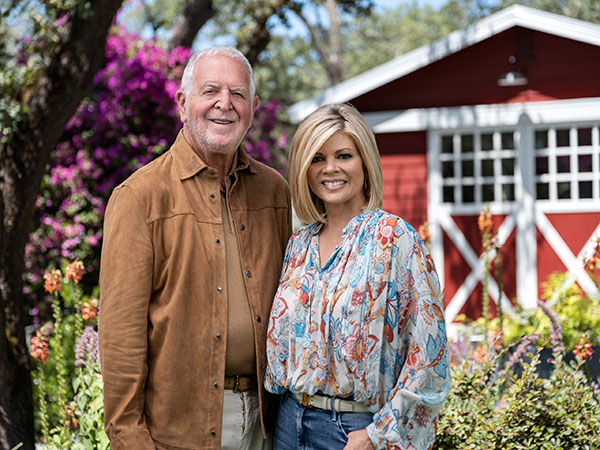
With their latest $2.5 million donation, Richard and Leslie Frank increased their historic gift to the College of Media to upgrade classrooms on the lower level of Gregory Hall.

Richard and Leslie Frank
The couple’s latest $2.5 million donation will fund the renovation of classrooms on the lower level of Gregory Hall, located on the University of Illinois Quad, and will create a new hybrid, flexible classroom as the centerpiece.

The new funding will enable a substantial renovation of the lower level of Gregory Hall, with the creation of a new hybrid, flexible, or hyflex, classroom as the centerpiece.

The new multipurpose classroom, which will be constructed in the space that currently houses two smaller classrooms and an office, will boast features that all three departments in the College of Media will be able to take advantage of—such as advertising brand consultations, journalism press conferences, and media and cinema studies production—and enable hybrid teaching and conferencing. 

“Because we believe in the fundamental impact that media has on our society, we want to continue to invest in our future media leaders at the University of Illinois,” said Rich Frank. “We’re excited to establish a new state-of-the-art space that will support the excellence of the College of Media, and we hope to inspire other donors to make gifts that leave a lasting impact on the college.”

The gift will also renovate the lower level, featuring a more modern design such as new flooring, painted walls throughout the entire hallway, including the east and west wings, and digital signage. Substantial work in that part of Gregory Hall has not occurred since the 1990s. The project details are underway; work will begin in summer 2025.

The College of Media is deeply thankful to Richard and Leslie Frank for their generous investments that not only have expanded opportunities for our current students and faculty but will continue to facilitate an enriched experience for those to come.

“This new gift will create a showpiece in Gregory Hall,” said Dean Tracy Sulkin. “The College of Media is deeply thankful to Richard and Leslie Frank for their generous investments that not only have expanded opportunities for our current students and faculty but will continue to facilitate an enriched experience for those to come.”

The Franks’ original gift of $7.5 million in 2020 is the largest gift ever made to the College of Media. That gift enabled the creation of the Frank Newsroom at Richmond Studio, the college’s broadcast teaching facility, and endowed the Richard and Leslie Frank Center for Leadership and Innovation in Media.

Having each experienced professional success in media and entertainment, the Franks are committed to creating a positive impact in media for generations.

Rich Frank, who received his bachelor’s degree in marketing from the University of Illinois, began his career at the advertising agency BBDO in New York City before moving to Los Angeles to work as a Sales Manager at KTLA. He then served as President of Chris-Craft Broadcasting. In 1977 he became President of Paramount Television Group, overseeing the creation and production of such shows as TaxiFamily Ties, and Cheers as well as the creation of the groundbreaking entertainment news show, Entertainment Tonight. In 1985 he became President of Disney Studios. Under his leadership, the studio created iconic sitcoms such as The Golden Girls and Home Improvement, and films including Good Morning VietnamDead Poets Society, and The Lion King. He also oversaw the launch of the Disney Channel. Rich served three terms as President of the Academy of Television Arts and Sciences. In 2007, the Academy of Television Arts and Sciences recognized him with the prestigious Syd Cassyd Founder’s Award. In 2011, Rich received an honorary doctorate from the American Film Institute where he is currently a Vice Chairman on the AFI’s Board of Directors. Rich previously served on the board of the Motion Picture Association of America. His archival interview with the Television Academy provides a fascinating historical perspective of the evolution of modern television: https://bit.ly/3iQvS7s

Born in Hamilton, Ontario, Leslie Frank began her career in Canada before crossing the border to work in some of the largest television markets in the United States. She spent more than 25 years covering many major stories including the 9/11 attacks, where she reported live from ground zero in New York City, as well as from the scene of the devastating aftermath of Hurricane Katrina, and inside the courtroom at the Michael Jackson trial. Leslie spent the last nine years of her TV news career reporting and anchoring at the number one rated station, KABC in Los Angeles, where she covered politics, crime, weather calamities, as well as interviewing some of the biggest stars in Hollywood on the red carpet. Prior to Los Angeles, Leslie was the main anchor at KCPQ in Seattle, where she took the 10 pm newscast to number one in its time slot and clinched an Emmy for outstanding news anchor. In 2024, she joined the board of directors of Treasury Wine Estates Ltd.

Leslie and Richard are former owners of Frank Family Vineyards, a highly acclaimed luxury wine business based in the Napa Valley, California, that was acquired by Treasury Wine Estates in 2021.

Under the leadership of its inaugural director, Colleen King, clinical assistant professor of journalism, the Frank Center has brought media industry leaders to campus for free and public events including Steve Kornacki, Brian Williams, and on December 3, NBC News chief political analyst Chuck Todd. The Frank Center has also held virtual Q&As with Kara Swisher, Michael Steele, and Dan Balz. See recordings of these conversations with the Frank Center.

Share on social

Blue tongues and an exposed brain: How ‘Beetlejuice Beetlejuice’ visual effects went back to basics


They were, to the industry, a kind of proof of concept that both aesthetically they can be successful, and also they could be marketed as an attraction, ‘Come see what the movies do now.’

Beetlejuice

Digital effects in films have existed for decades. Their true watershed moments came in 1991 with James Cameron’s Terminator 2: Judgment Day and 1993’s Steven Spielberg blockbuster Jurassic Park. Though the films had a limited number of CGI shots, the effects—a liquid morphing into a robot and dinosaurs roaming the planet—showed the industry that such technology could appeal to audiences, even though the execution was still expensive and difficult to pull off, says Illinois professor of media and cinema studies Julie Turnock.

Journalism alum Mike Carpenter writes book about Illinois basketball 

Carpenter book

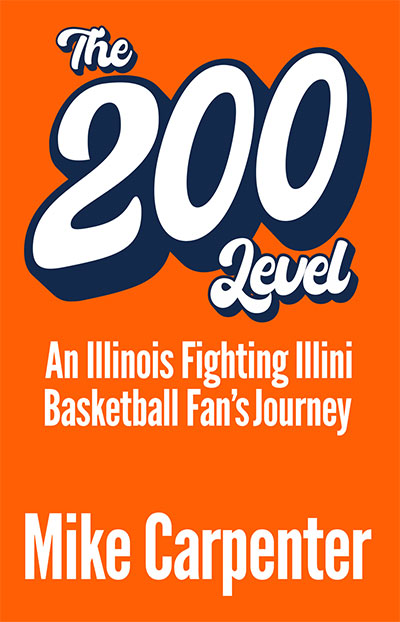
Mike Carpenter (BS ’09, journalism) has written a book about the last 30+ years of Illinois basketball, The 200 Level: An Illinois Fighting Illini Basketball Fan’s Journeywhich will be released on October 3.

The book is a mix of personal narrative and sports journalism, charting the ups and downs of the program while reflecting on Carpenter’s own personal experiences as a fan.

Carpenter was a sports talk broadcaster and podcaster for ESPN 93.5 from 2011 through 2019. He’s hosted his own podcast on Illini sports, The 200 Level, for the past five years. 

Learn more.

Media faculty and TAs make list of teachers ranked as excellent


Congratulations to all the College of Media faculty and teaching assistants who were ranked as excellent by their students!

Congrats image

This list is based on Instructor and Course Evaluation System questionnaire forms completed by students during the Spring 2024 semester. Only those instructors who distributed ICES forms at least once during this time period and who released their data for publication are included in the list. View the complete list.

Note: * denotes that the instructor ratings were outstanding.

ADVERTISING

ANDREW GLEASON – ADV 490

STEVE HALL – ADV 150

TERRY KASDAN – ADV 409

EWA MASLOWSKA – ADV 594

SHACHAR MERON – ADV 250

MICHELLE NELSON – ADV 582

*MARISA PEACOCK – ADV 290, ADV 498

*ALLISON VANCE – ADV 350

CARRIE WILSON-BROWN – ADV 393

KEVIN WISE – ADV 588

*MIKE YAO – ADV 461 


JOURNALISM

*CHRISTOPHER BALL – JOUR 430, JOUR 451

STEPHANIE CRAFT – JOUR 205

*ALISON DAVIS – JOUR 215, JOUR 340

COLLEEN KING – JOUR 313

VINCE LARA-CINISOMO – JOUR 220

CHARLES “STRETCH” LEDFORD – JOUR 335

*CAROL LOMBARDI – JOUR 220

MARGARET NG – JOUR 425


MEDIA & CINEMA STUDIES

ANGELA AGUAYO – MACS 391

VICTOR FONT – MACS 480

JONATHAN KNIPP – MACS 282

SUSAN MUIRHEAD – MACS 372

M. QUINONES-RIVERA – MACS 375


STRATEGIC BRAND COMMUNICATION

EWA MASLOWSKA – SBC 505

RICH PIECZYNSKI – SBC 504


TEACHING ASSISTANTS

K. COOK – ADV 284

X. DONG– ADV 250

W. DU – ADV 150

*N. FAISAL – ADV 250

M. FUKADA – ADV 284 

*Y. LEE – ADV 360

A. LIU – ADV 150

*M. LYERLA – ADV 150

*S. PARK – ADV 360

Z. RANDOLPH – ADV 284 

*J. CINTRON – MACS 100 

Y. GAO – MACS 101

*Y. KANG – MACS 101

J. OH – MACS 100

*J. ZHANG – MACS 260

Share on social

College of Media
119 Gregory Hall
810 S. Wright St.
Urbana, IL 61801
217-333-2350