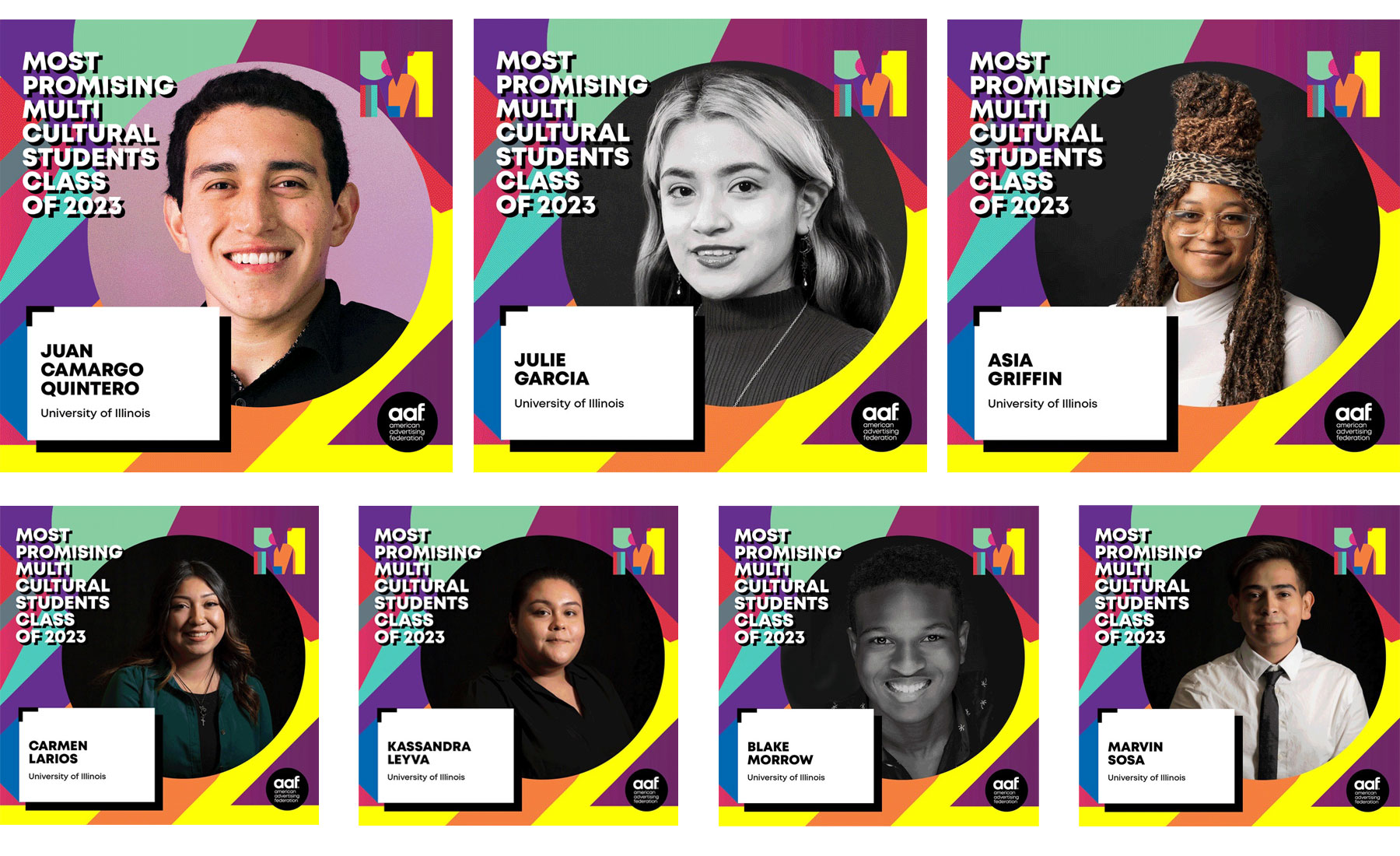
Seven seniors in the University of Illinois chapter of the American Advertising Federation were named to the American Advertising Federation’s Most Promising Multicultural Students Class of 2023—an honor given to only 50 students each year throughout the United States. Honorees include advertising majors Julie Garcia, Asia Griffin, Carmen Larios, Kassandra Leyva, Blake Morrow, and Marvin Sosa, and chemistry major Juan Camargo Quintero.
In 1997, the American Advertising Federation created the Most Promising Multicultural Students program to connect the advertising industry with the nation’s top multicultural college students. Since the program’s inception, the AAF Illinois chapter has had more winners than any other university or college.
Recognizing the top 50 multicultural college seniors across the nation, the Most Promising program promotes diversity, equity, and inclusion within the advertising industry, giving advertising, media, communications, and tech companies the opportunity to tap into high-achieving talent of diverse college students from across the country.
Each year, students of racial or ethnic diversity from the AAF’s 140+ college chapters apply to the program. Advertising leaders select the highest-achieving diverse seniors to participate.
In February, the winning students will participate in a four-day industry immersion program in New York City with the highest-level industry executives and companies that includes professional development and personal branding workshops. They will also be recognized at the annual Building Bridges for Our Future awards luncheon.
The event serves as a recruiting opportunity for industry leaders to develop a diverse group, representing the best from the country to serve as the next generation of advertising leaders. It also offers students invaluable network, learning, and immersion experiences with professionals from top advertisers, media companies, and advertising agencies.
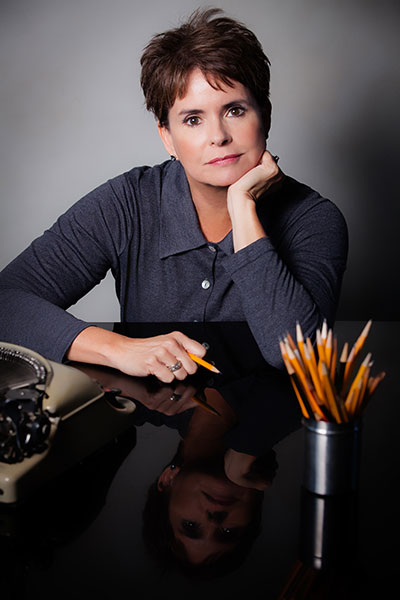
Award-winning alumna Demetria Kalodimos (MS ’83, journalism) has released a nine-part true crime podcast about a 1975 cold case murder.
Carol’s Last Christmas examines the murder of Carol Rofstad at Illinois State University in 1975. The podcast, which was produced by Kalodimos’ company, Genuine Human Productions, is the culmination of a two-year investigation with Alexandra Daskalopoulos, a journalist and legal researcher, and George Seibel, a retired Chicago police officer who founded the Institute for Cold Case Solutions at Morton College.
Kalodimos, who was named Tennessee Broadcaster of the Year in 1995 and inducted into the Tennessee Journalism Hall of Fame in 2016, was a television news anchor at WICD Channel 15 in Champaign before her 34-year career as principal anchor and investigative reporter at WSMV-TV Nashville.
In addition to podcast, documentary, and music video production, she is currently executive producer of the non-profit, web-based Nashville Banner, a locally owned, civic news organization.
Kalodimos has anchored and reported the news for more than 40 years and has won some of the top awards in broadcast journalism including 16 Emmys, three Investigative Reporters and Editors national awards, and three Edward R. Murrow Awards for investigative reporting. She was named 2021 Professional in Residence at Lipscomb University School of Communication.
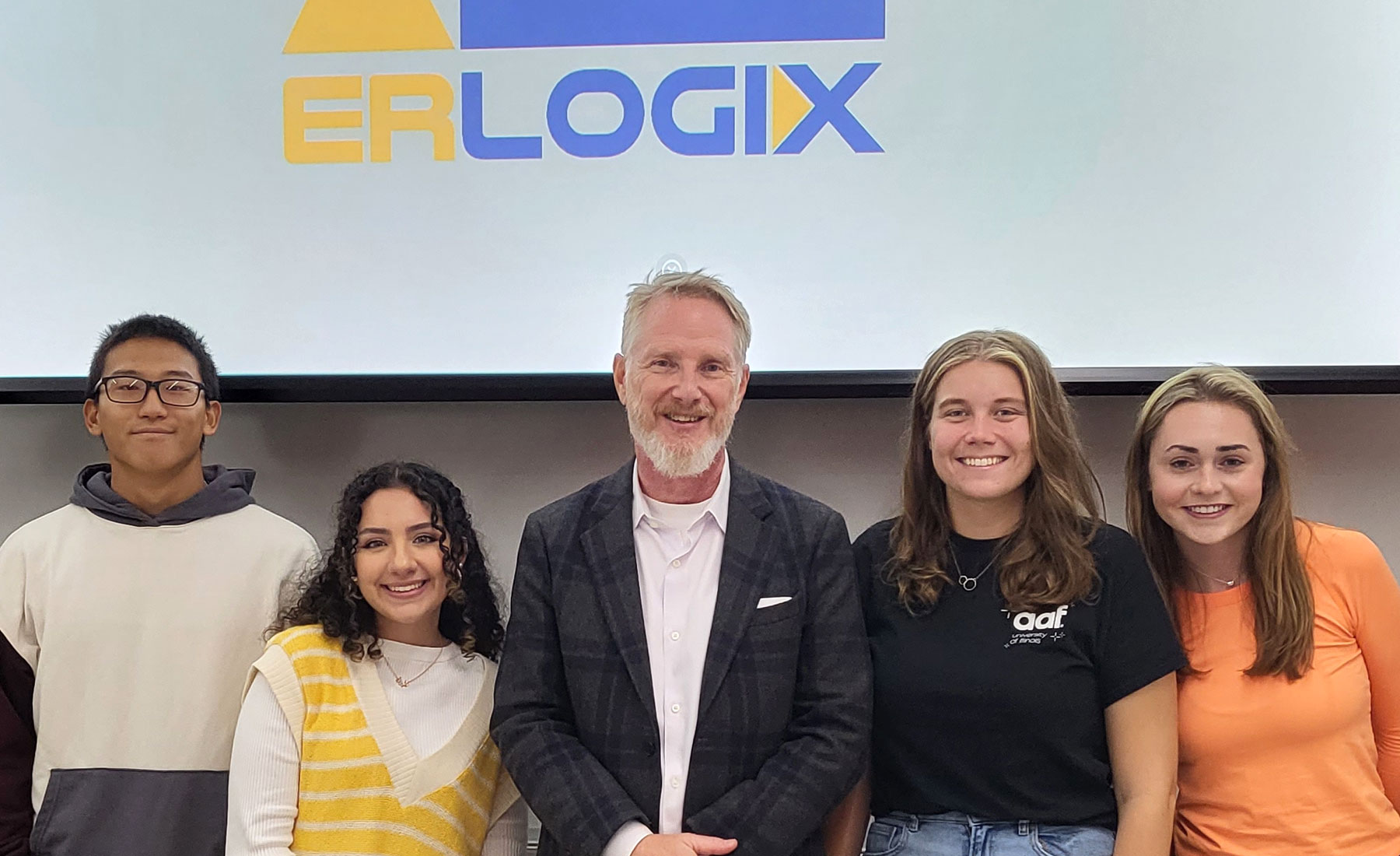
In Fall 2022, Mike Wychocki (center) was invited back to campus by the College of Media to explain to students in the American Advertising Federation RSO how he developed the new branding and marketing campaigns for EagleRail.
Since Mike Wychocki (BS ’83, advertising) graduated from the University of Illinois College of Media nearly 40 years ago, he has helped build and sell two advertising/marketing agencies, traveled around the world, and become Chief Marketing Officer of a global container-shipping transportation company.
In all that time, Wychocki has never forgotten a certain College of Media associate dean and a professor, both of whom played a vital role in his education and professional success.
“One of the things that keeps me connected to the University of Illinois and the College of Media is, at the time, we had a Dean of Students named William Alfeld. He helped me get across the finish line,” Wychocki said. “I think if it weren’t for Dean Alfeld, I probably wouldn’t have graduated.
“Dean Alfeld was one of those kind gentlemen who had a big heart. He would always help me figure something out,” Wychocki said of the late Alfeld, who served as associate dean at the college from 1962 to 1992.
Wychocki, a first-generation college student from the south side of Chicago, was unfamiliar with the collegiate lifestyle and overwhelmed upon his arrival.
He initially struggled with academics and didn’t care for the large lecture-type classes held in huge auditoriums. Thankfully, Alfeld helped him navigate the challenge of introductory courses, and helped identify the strengths and talents that enabled him to thrive in the major.
Wychocki also recalls an advertising professor who had a profound impact on his career—the late Gordon White, who Wychocki describes as “the second most influential person” he encountered as a student on campus. White, who taught classes in advertising creative strategy, also earned his MS and PhD degrees in the college.
“[Professor White] taught me a lot and was very supportive of me. He gave me the confidence to know that I was a good storyteller. And I believe that all advertising starts with a good story,” he said.
“Taking several journalism classes also helped and Professor White explaining how to craft and express a strong message definitely kept me inspired in my career over the years,” Wychocki added. “Plus, Professor White was an actual Mad Men Creative Director at BBDO on Madison Avenue in NYC in the 1960s and he taught us how the U.S. ad market transited from long-format ads in the 1950s to short, clever, and pithy ads just like Don Draper reminded us 30 years later.”
Wychocki also has fond memories of his time working at WILL-TV as a production assistant, production manager, and assistant producer. He said engaging in hands-on learning at WILL was a pivotal decision that helped guide him to choose a path in marketing and advertising.
The advertising education he received at Illinois has enabled him to create numerous career opportunities, including his current role as CMO of EagleRail. About seven years ago, Wychocki started out as a freelance marketing consultant for EagleRail, a global transportation solution that automates short-haul container shuttling between ports and intermodal facilities.
Wychocki describes the company concept as “doing with a 60,000-pound box what Amazon warehouses do with a 60-pound box. Robotically lift it, shuttle it, and set it back down in the right spot.” He developed that elevator pitch seven years ago, and still uses it today.
After just a few months of joining the company, Wychocki purchased majority interest of EagleRail from the company’s inventor and took the lead as Chairman and Chief Executive Officer. More recently, he decided to focus on the marketing and sales side of the business and hired his own replacement.
“I always knew my job here was to sell this concept—create this story from the whole cloth. I recently hired my own replacement with international operational and global finance experience and gave myself the title of Chief Marketing Officer,” he said.
No matter how far his career has taken him away from the University of Illinois campus, he will always recall the unique places and traditions that students still enjoy today, such has hanging out on the Quad and “geeking out” to the Marching Illini band perform at sporting events.
If he had any career advice to give current advertising students, Wychocki says it would be to work hard to create, cultivate, and value professional relationships. While a good strategy and creative execution are important, nothing helps you succeed long-term like creating a personal connection with the people you’re working with, whether it’s a client or a colleague.
“I’m a huge believer in positive relationships as currency. I think it is one of the keys to success,” he said. “You have three elements in life that will determine the level you achieve professionally: how smart you are, how hard you work, and how well you work with other people. If you’ve got two out of three, you’ll be a success…and working well with others is the lowest investment and highest return of the three.”
Wychocki also recommends being yourself and understanding your own strengths first.
“If you know what your brand is and know what your strengths are, then you’ll know how to position yourself either for jobs or accounts or freelance opportunities that are right for you,” he said. “Be yourself and find out what your internal brand is. If you want to figure out how to create someone else’s brand, first you’ve got to figure out your brand, and then you’ll be in the best position to succeed.”
January 9, 2023 | Kelly Youngblood and Vivian La, Communications Intern
(Photos by Isabella Pennebaker, photography intern.)
The first cohort of students in the Brand Ambassador Program are halfway through their yearlong experience, which pairs a student interested in social media and brand management with Fighting Illini student-athletes and local organizations.
Since its inception just four months ago, the program is already making a positive impact for student ambassadors, student-athletes, and the community at large.
“I think it’s been incredibly successful on both ends,” said Carrie Wilson-Brown, lecturer in media and cinema studies and advertising, and a faculty lead for the program (pictured at right). “I know the athletes are really excited to have our student ambassadors give as much input as possible into their feeds and I know the ambassadors are really thrilled with that kind of hands-on experience.”
The purpose of the program is to offer students experiential learning to enhance their social media management skills and to help student-athletes develop their brand. It also focuses on aiding local organizations with digital promotion.
“It really is a great partnership between community members, and also gives our students a range of experiences in real-world circumstances,” said Wilson-Brown.
With a mission to educate students about the most current advertising trends and to provide them with leading-edge experiences that go beyond classroom theory, both the Sandage Department of Advertising and the Brand Hub are shaping the field of strategic brand communication.
“The Brand Ambassador Program is another novel professional development opportunity for advertising students that the Brand Hub has coordinated,” said Professor Mike Yao, head of the Sandage Department of Advertising. “We are proud to foster this collaboration. Students are applying the advertising, branding, and social media strategy skills that they’ve acquired through our curriculum, and through their own experiences, to support the success of their peers and the local community.”
Nearly all of the 20 student ambassadors are advertising majors. Some ambassadors have paired up with local organizations such as Visit Champaign County to help highlight local events and businesses with their own robust social media following. Most are working with Fighting Illini student-athletes to strategize and create content for their social media.
The Brand Ambassador Program helps student-athletes address last year’s changes to the NCAA Name, Image, and Likeness (NIL) policy, which now allows all NCAA D1, D2, and D3 student-athletes to be compensated for their name, image, and likeness, regardless of whether their state has NIL laws in place.
Wilson-Brown said the updated NIL policy has created an incentive for student-athletes to enhance their brand and increase their social media presence. As a result, student-athletes recognize the importance of a digital persona and a professionally curated social media feed.
“The ambassador program is an opportunity to use the talents of students and faculty to help athletes sculpt a brand for themselves online and hopefully to monetize themselves with local and national sponsorships as well,” she added.
Wilson-Brown noted the students are ambassadors, not agents, and do not directly facilitate any sponsorship deals or monetary contracts.
The Brand Ambassador Program operates in conjunction with the INFLUENCE program, which was launched by the University of Illinois Division of Intercollegiate Athletics last year. INFLUENCE is an educational approach to the monetization of an athlete’s name, image and likeness that emphasizes brand and strategy development along with business and financial concepts. INFLUENCE is powered by NIL sports technology company Opendorse, which features all Fighting Illini athletes within its athlete endorsement website.
Kaylee Patthana, a junior majoring in advertising, is working with Illini women’s volleyball player Kennedy Collins to help promote her personal brand. Patthana said she and Collins have discussed ways she can expand her brand to include not only her college athletic persona but also her personal interests such as fashion and lifestyle aesthetics.
Patthana says that the close-knit nature of the ambassador group is her favorite aspect of the program: “I love that in this program I have a network of people around me that I can talk to and work with who also love to do what I do,” she said.
Jack Struthers (pictured at top), a senior in advertising working with an Illini soccer player, said the ambassador program is mutually beneficial for Media students who want real-world experience and athletes looking to expand their brands.
Struthers said managing a social media presence as a student-athlete can be overwhelming and this partnership can help address some of those challenges.
“Getting paired with an ambassador from the College of Media who kind of understands how the [sports endorsement] ecosystem works and understands how [social media] works and can inject content—I think it’s extremely powerful,” he said.
Emily Gonzalez is a senior in advertising working with an Illini women’s basketball player. Through this partnership, Gonzalez gets to share her expertise on social media trends to help create relevant content, such as a “day in the life” video.
“It’s all about the analytical side of things and just trying to communicate possible trends that are taking off,” said Gonzalez, who is now considering a career path in social media management.
Brand Ambassadors meet monthly with Wilson-Brown to update their progress, reporting about post content and analytics. After a semester of guiding brand ambassadors, Wilson-Brown said she’s excited to expand the program, whether that’s adding more students, more athletes, or more partnering organizations.
“I find students have a much more nuanced understanding of how to use these digital tools every day and so we’re able to collaborate really beautifully on that and I think that’s really humbling,” she said. “It’s a really great learning opportunity that we have in the Advertising department.”
With a significant need for professionals to communicate science, discoveries, and innovations to the general public, a flexible hybrid/online program—with a focus on science and technology—will be offered through the journalism master’s degree beginning Fall 2023.
Students can earn the Master of Science in Journalism degree with a focus on science and technology journalism entirely online in as few as two semesters full-time or can tailor a part-time schedule over additional semesters. Students also may opt to take courses that “stack” to a professional credential, and those courses can later be applied to a degree.
“The Department of Journalism is proud to expand our curricula to train current and future journalists how to communicate important scientific and technical information to the general public,” said Mira Sotirovic, head of the Department of Journalism and associate professor and Karin and Folke Dovring Scholar in Propaganda. “We have seen a growing interest in, and a growing need for, science communication and are thrilled to receive Investment for Growth funding to begin meeting the demand.”
The new curricula will also offer a science and technology communication certificate for undergraduates, and the online 400-level courses in this track will expand paths to degree completion for undergraduates.
“Scientific research and innovation are present in our daily lives, in seen and unseen ways,” said Claudia Lutz, outreach manager at the Institute for Genomic Biology. “As the last few years have reminded us, this is particularly true of the field of genomics, which intersects with almost every aspect of both life sciences and society. We are excited to help give future science journalists an inside look at how science is done and a broader awareness of its impact.”
The online master’s program and individual course modules are ideal for journalists and prospective journalists who want to improve and specialize in science writing or to gain a competitive advantage in the field; scientists and their academic colleagues who wish to be more effective in communicating to lay audiences; and communications professionals who work for nonprofits, government agencies, or science- or technology-focused corporations who are interested in boosting their skills and understanding.
Courses will cover writing science stories in plain English; the basics of data journalism, including building databases and analyzing data; visualization in newsrooms; humanizing data through video storytelling and humanizing science communication by harnessing virtual reality; and more. Students will also examine the science of genomics and its applications to environment, health, and technology through course modules. See a sample course sequence for the master’s degree and sample course modules.
As part of the preparation for enrolling students next fall, the Department of Journalism is hiring a new professor in science, technology, data, or digital journalism to supplement the course offerings.
“They will have an important role in the new concentration,” Sotirovic said. “The new faculty member will teach courses in science journalism, as well as some combination of courses in data journalism, social media analytics, and other courses based on their own expertise and interests.”
Additionally, the Institute for Genomic Biology is hiring a postdoctoral fellow in science communications curriculum coordination. This position will help develop course materials and oversee experiential learning for students in the program.
When Angela Aguayo, associate professor of media and cinema studies, was considering a project for her MACS 199: Documentary and Social Change honors course that would help her students connect the community through media, the idea for a student-generated podcast came to mind.
She knew podcasts were a familiar forum for university students and would offer an opportunity for them to talk about meaningful topics, helping them to make sense of what they’ve endured in the last couple of years.
“These are kids who missed rituals around their formative years because of what happened [with the COVID-19 pandemic] and they’re trying to pick up the pieces and understand what education means to them. So, I thought this [podcast] would be a really great way to integrate the practices of storytelling with their own experience,” Aguayo said.
What she didn’t anticipate is how much she would learn by listening to each of her student’s stories, which spotlight the highs and lows of the college experience in a post-isolation world.
“This is a wonderful moment—they delivered more than I expected. Many of these students are science and engineering majors and I was delighted at their embrace of media arts practice, and I learned so much about them through the stories they filed,” Aguayo said.
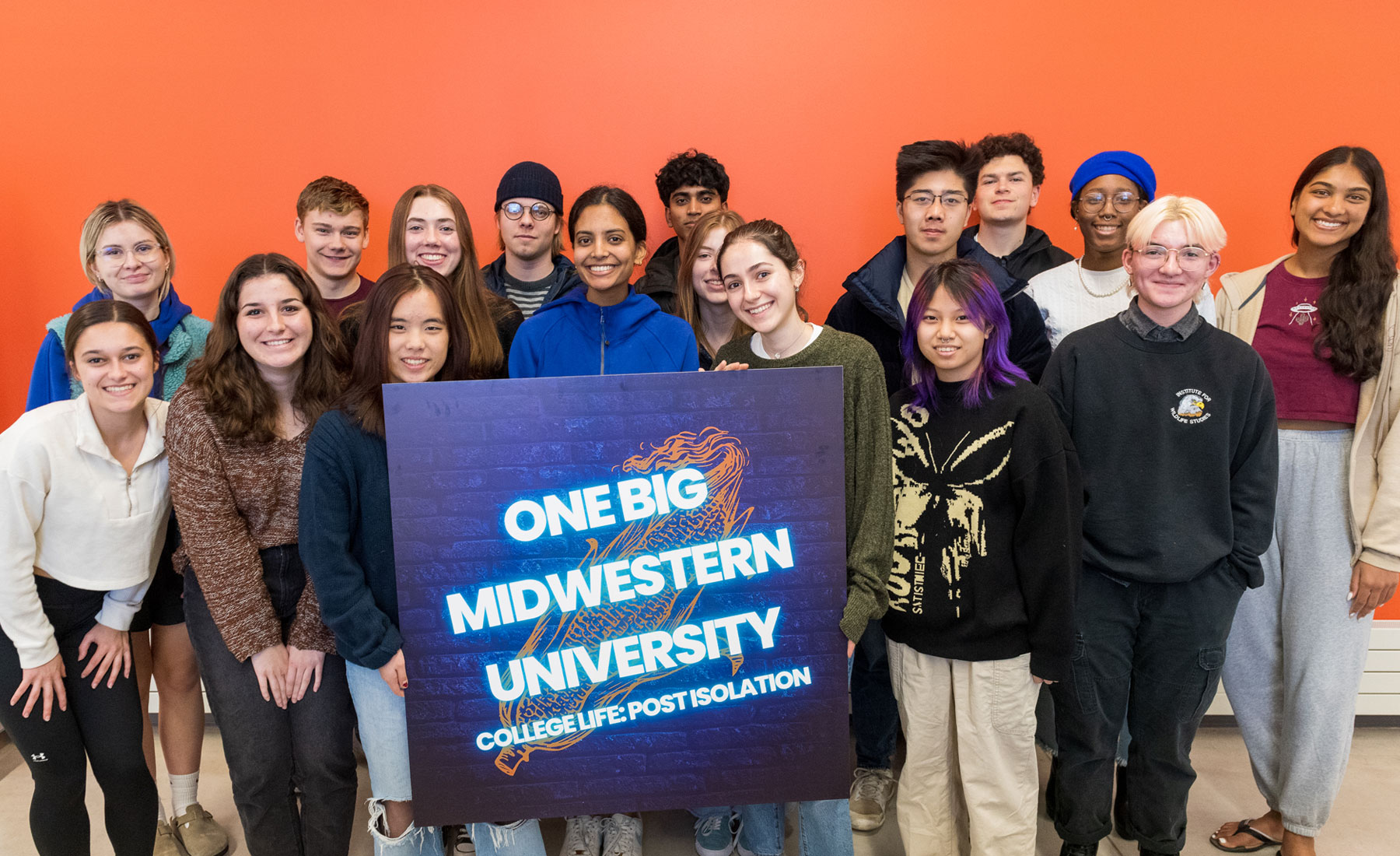
Aguayo’s course, which was restricted to Chancellor’s Scholars in the Campus Honors Program, drew students from the Grainger College of Engineering to the College of Education to the College of Fine and Applied Arts. Their 19-episode podcast, which is aptly named “One Big Midwestern University,” features students talking about how to make friends as college freshmen, finding simple joys, isolation, the pressure to find jobs, anti-transgender culture, and more.
Each episode, averaging 10 minutes long, addresses something different. Aguayo promises that listeners will “hear from people you’ve never met” and “learn about spaces you probably wouldn’t normally enter.”
“I was moved by the students’ willingness to share and be vulnerable. They saw that in the most effective documentary films that created change, that’s what was there, getting to something real and honest,” Aguayo said. “Your audio can be messed up a little bit and your images can’t all be great but if you’re delivering real and honest [material], it’s compelling.”
Freshman Elias Newton, majoring in architecture, chose to talk about dealing with feelings of loneliness and substance use on campus. Newton said the project helped him to realize that “most people are going through something.”
Newton also appreciated the class’s emphasis on learning the art of storytelling.
“With storytelling versus other forms of portraying issues, storytelling is what’s the most memorable and the most impactful and the most moving,” he said.
Emma Schmahl, a freshman studying elementary education, filed a story on making friends as a freshman. Schmahl said she wanted to hear people’s personal experiences, and to get advice on what works and what doesn’t.
“The assignment taught me how to talk to people in an interview setting and then [how to take] these pieces of audio and [make] something out of it,” Schmahl said.
The “One Big Midwestern University” podcast is also made possible thanks to Aguayo’s Illinois Community Media Project, funded by Chancellor Jones’s Call to Action to Address Racism & Social Injustice Research Program. One pillar of her project, which began nearly two years ago, is finding ways to get students to engage with communities around media production.
Last semester, one of Aguayo’s media and cinema studies classes worked with the Champaign-Urbana Public Health District and Immigrant Services of Champaign-Urbana to organize a family photo booth, creating 60 framed photos for local immigrant families.
Aguayo is grateful to be at the University of Illinois, where she feels encouraged to offer her students hands-on learning experiences with community media.
“I came to this campus because I wanted to be with people who innovate and think about the university’s connection to the world. It’s exciting to be in an environment where innovation in public engagement is supported, and to be at an institution that brings the smartest and the brightest and the accomplished students to campus,” Aguayo said.
While most of the students in the class are new media-makers, Aguayo said when she first suggested the idea of a podcast to her students, they were excited and eager to tell stories that connect people.
“Many of them had ever done anything like this, but it turned out amazing,” she said. “They understood what it meant to bring voices to the table that we don’t hear all the time, they understood what it meant to tell stories that mattered to people, they understood what it meant to be vulnerable in that process and that thrilled me. [Their] stories are captivating.”
Matthew Schmitt, a freshman double-majoring in computer engineering and physics, focused on using exercise to maintain mental health on college campuses.
Schmitt said the class offers an invaluable experience, using sound to convey a message and even perhaps spark a social change.
“I think we need more people with the skills that this class is teaching us,” he said. “The class teaches us we can use these forms of media to try to cause some sort of social change. And that’s important because a lot of people don’t think that they can cause change just by creating something and putting it out there, but you can. I think it’s important to know that you can cause the change that you want to see in the world.”
“One Big Midwestern University” debuts on Spotify on December 15. The podcast will soon be listed on Apple Podcasts and Google Podcasts. The united hope of the class is that it might bring people together to discuss topics that are important to students and that it provides value to the community.
“I think it would be nice if [people] listened to it and they hear real stories that are a little bit different from what they’ve heard before,” Schmahl said. “I just want people to hear it and feel like they can relate to other people’s experiences and know that what they’re experiencing—if it’s happy or not so happy or stressful—other people are experiencing the same things and they’re not alone.”
“Do you think it’s possible to build a computer that simulates real life? … If you were living in a simulation, would you be able to tell?” So begins The Goji Project, a short science fiction film produced by students in MACS 480: Advanced Filmmaking last spring. The film has received recognition from three film festivals this fall.
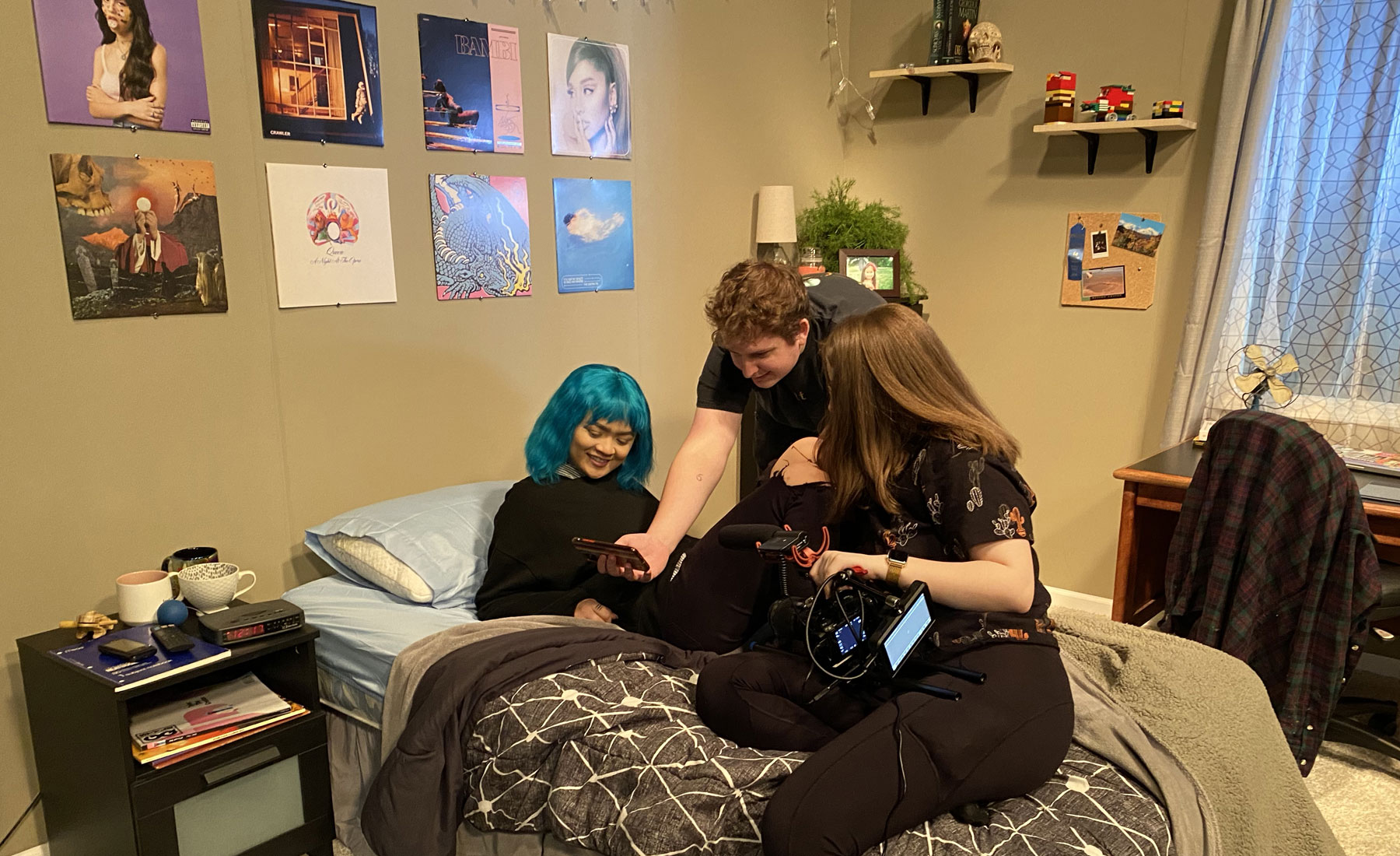
Students in media and cinema studies, advertising, and theatre collaborated on a short film for Advanced Filmmaking in Spring 2022, which received honors from three film fests this fall. Pictured are Raiya Wen (BFA ’22, FAA); Lincoln Rogers (BS ’22, advertising); and Robyn Pease (senior in media and cinema studies).
The Goji Project won Best Sci-Fi from Crown Point International Film Festival in October, which awards films in a monthly competition for filmmakers around the world. It also received an honorable mention for a student film at Art Film Awards, and a certificate of achievement in the Sci-Fi Short category at LA International Film Festival’s Indie Short Fest.
Students produced The Goji Project in the course taught by Victor Font, lecturer in the Department of Media & Cinema Studies, and premiered it at the UIUC Student Film Festival in April. The nearly 23-minute film was written and directed by Lincoln Rogers, then a senior in advertising who graduated in May 2022.
“The best part of the whole process for me was the connections I made with the other people in the class,” said Rogers, who is now a creative maker at SOCIALDEVIANT, an advertising service in Chicago. “When you’re in go-mode, on the clock, filming, those connections happen really quickly…. And what started as a script that I read to the class over a Zoom meeting became this story that was really meaningful to everybody, that we all got to have a hand in bringing to life.”
Rogers was inspired by a philosophical piece called “The Simulation Argument” by Nick Bostrom: “How likely is it that we are the first real humans, rather than digital copies made by humans far more advanced than us?” Rogers explained. He contemplated how people derive value from their lives and make sense of patterns and coincidences.
What started as a script that I read to the class over a Zoom meeting became this story that was really meaningful to everybody, that we all got to have a hand in bringing to life.
Lincoln Rogers
Writer and Director of The Goji Project
“My favorite scene is the conversation between the two Gojis, when orange-hair Goji says [to blue-hair Goji] that, ‘No matter what the simulation means, it is beautiful.’ The unknowns of the universe can be terrifying, but they came together in this crazy way to create a beautiful world for us.”
As a Media student, Rogers knew he wanted to make movies and said Font “is an amazing professor” and took his Advanced Filmmaking course twice “because it was such a valuable experience.” Rogers is already working on his next film—another sci-fi—”about a man who works at an insurance agency who has an advanced AI assistant implanted in his brain.”
Font created the Advanced Filmmaking course in 2019 but it wasn’t offered in 2020 due to the pandemic. The Department of Media & Cinema Studies has been collaborating with the Department of Theatre in the College of Fine and Applied Arts to recruit student actors for their Advanced Filmmaking course. This fall, Theatre’s Advanced Scriptwriting course will generate the script to be used this spring. The class will also collaborate again with Krannert Center for the Performing Arts, as they did in 2019 with the Department of Theatre to create the short film Red Ball. The MACS course plans to film before spring break and to edit a first draft to present at the 2023 UIUC Student Film Festival.
“More resources lead to more talent, better productions, and more achievements,” Font said about the cross-campus collaboration. He also hopes their recognition by film festivals will attract more students interested in pursuing media and cinema studies as a major and a career.
“I’m sure this is our first award of a lot and better ones to come,” Font added.
See behind-the-scenes photos from various stages of filming The Goji Project, which used the new production studio in Gregory Hall to hold auditions and the television studio set at Illinois Public Media to construct a dorm room.
Watch The Goji Project:
Film credits:
Written and Directed by: Lincoln Rogers (BS ’22, advertising)
Executive Producer: Victor Font, lecturer of media and cinema studies
Original Score: Tony Rogers (Lincoln’s father)
Director of Photography: Robyn Pease (Class of 2023, media and cinema studies)
Chief Lighting Technician: Nathan Carlberg (BS ’22, media and cinema studies)
Starring: Raiya Wen and Ben Mathew (both BFA ’22, theatre/acting, College of Fine and Applied Arts)
November 7, 2022 | Faith Lee, Communications Intern
Through the annual Roger Ebert Fellows program, established in 2015 at the College of Media, three undergraduate students are selected each fall to gain in-depth learning experiences that focus on critical thinking, arts and entertainment criticism, and interpretative journalism.
The 2022-23 Roger Ebert Fellows are Levi (Lee) Beckett, Andrew Stover, and Tania Trejo, all media and cinema studies majors.
Named after the late Pulitzer Prize-winning film critic and University of Illinois journalism alumnus Roger Ebert, the Ebert Fellows will receive a stipend and work closely with Michael Phillips, film critic for the Chicago Tribune, to strengthen their writing, radio, video, and storytelling skills across a wide range of multimedia platforms. The experience, coordinated through the Roger Ebert Center for Film Studies, will prepare them for an increasingly competitive arts and entertainment media job market.
Over the past two years, the COVID-19 pandemic caused the program to adopt a hybrid model, but this year will offer more in-person interactions. The students will connect monthly with Phillips for workshops. They will also attend film festivals, including the True/False Film Fest in Columbia, Missouri, in March.
“It’s been very difficult to work around the limitations of what we had to do when it was almost entirely online,” Phillips said. “I sense that people are eager and grateful for a return to as much in-person activity as they feel is possible.”
Phillips has been an advisor and mentor since the program began and has enjoyed working with the students. He hopes that they learn as much from him as he does from them.
“I want to make them more confident about doing something they’ve never done before,” Phillips said. “I try to get all of us to think hard about what it is we’re trying to say when we write something and how well we’ve argued our point.”
Meet the 2022-23 Ebert Fellows:
Lee Beckett is a junior in media and cinema studies, with a minor in political science. Beckett has always enjoyed the art of filmmaking and critiquing films. He appreciates Roger Ebert’s work and is excited to explore new opportunities and to network.
“I think by getting experience and hearing from people who have learned by trial and error is the best way to learn,” Beckett said. “We’re going to go to a couple film festivals and we’re going to meet with some people who are making content in the local area and also in Chicago, so I’m hoping to learn from professionals.”
On campus, Beckett is involved in the Young Democratic Socialists of America and Red Bison, an ecological restoration organization.
Beckett’s favorite film is Fantastic Mr. Fox because he “really likes the story and the characters and it’s simple and fun, but it also has a deeper theme underneath.”
Andrew Stover is a junior in media and cinema studies, with a minor in critical film production. He developed his interest in film in 2016 and created a blog dedicated to reviewing films. Stover is a longtime fan of Roger Ebert’s work and is honored to be chosen as a fellow.
“I have a genuine passion for film criticism, and I was excited to be selected. It’s a great honor,” Stover said. “I hope to gain more experience outside of film.”
Stover continues his passion for critiquing films by writing reviews for Film Threat, an independent film review site where he’s published more than 125 reviews. He looks forward to working with Phillips and the other fellows to expand his skills.
“Having a broad knowledge of film, podcasting, and other forms of media that I will learn about during this fellowship will help me be able to do more than just film-centric [work],” Stover said.
Stover said his favorite satirical comedy is The Truman Show because he “admires Jim Carrey’s dramatic turn as Truman Burbank” and thinks it is one of his best performances.
Tania Trejo is a senior in media and cinema studies. She loves to plan and create films. Trejo hopes to highlight the Latino community in her work in the future.
“This fellowship will help me achieve my goals by providing me with different skills such as interviewing, writing, and podcasting,” Trejo said. “I will also get more exposure and access. Since I will be working with people who are in the industry, I am excited to ask more questions about what they do.”
Trejo said she is also excited to attend film festivals and watch films that she would not normally watch on her own.
Currently, her favorite movie is Everything Everywhere All at Once because “the movie itself tackles issues that first-generation American families face in a funny and sentimental way.”
During the 2022-23 academic year, the College of Media will explore a theme of media literacy to build community and connections for students, faculty, and staff. The idea for an annual, opt-in theme emerged during the College of Media strategic planning process in 2020, and selection of a theme is voted on by faculty and staff each spring.
Josh Heuman, a teaching assistant professor in the Department of Media & Cinema Studies and the Department of Journalism, was appointed by College of Media Dean Tracy Sulkin as a Dean’s Fellow. He will work with department and college leadership teams to facilitate activities around media literacy this academic year. Learn more.
Media Literacy Initiatives in the College of Media
Initiative for Media Education Inquiry and Action (IMEDIA)
The Initiative for Media Education Inquiry and Action was formed by the College of Media and the College of Education, along with the cofounder of the Illinois Media Literacy Coalition, to help fill educators’ needs for media literacy training and curriculum development. In Summer 2022, IMEDIA held a media literacy workshop for public school educators. Learn more.
Political Advertising Literacy Research Group
The Political Advertising Literacy Research Group includes researchers in the University of Illinois College of Media and at the University of Tennessee. The researchers are investigating how much U.S. voters know about political advertising, called political advertising literacy, and improve their knowledge to effectively cope with misleading political advertising. Their research was featured in Forbes in September 2022.
View resources, including classroom slides and reference links
Media Matters eText
This eText aims to empower readers with increased media literacy, or the ability to access, analyze, evaluate, create, and communicate using a variety of media. Anyone with a University of Illinois netID can view this multimedia-rich, online textbook. The book is authored by College of Media faculty Amanda Ciafone, associate professor of media and cinema studies; Stephanie Craft, professor of journalism and associate dean for academic affairs; and Michelle Nelson, professor of advertising.
Defining and Measuring News Literacy
September 21, 2022
As part of the Center for Advanced Study’s Initiative on Conspiracy, Misinformation, and the Infodemic, Stephanie Craft, professor of journalism and associate dean for academic affairs, presented a talk on “Defining and Measuring News Literacy.”
About the presentation:
The rapid spread of misinformation during the COVID-19 pandemic has increased calls for news literacy to help reduce endorsement of misinformation, conspiracy theories, and other falsehoods. Recent research showing that individuals with higher levels of news literacy are more likely to reject COVID-19 misinformation and conspiratorial thinking suggests that improving news literacy could be part of a strategy to equip individuals to reject health misinformation. However, varied approaches will be necessary to engage with groups that differ in political orientation, race, age and news consumption habits.
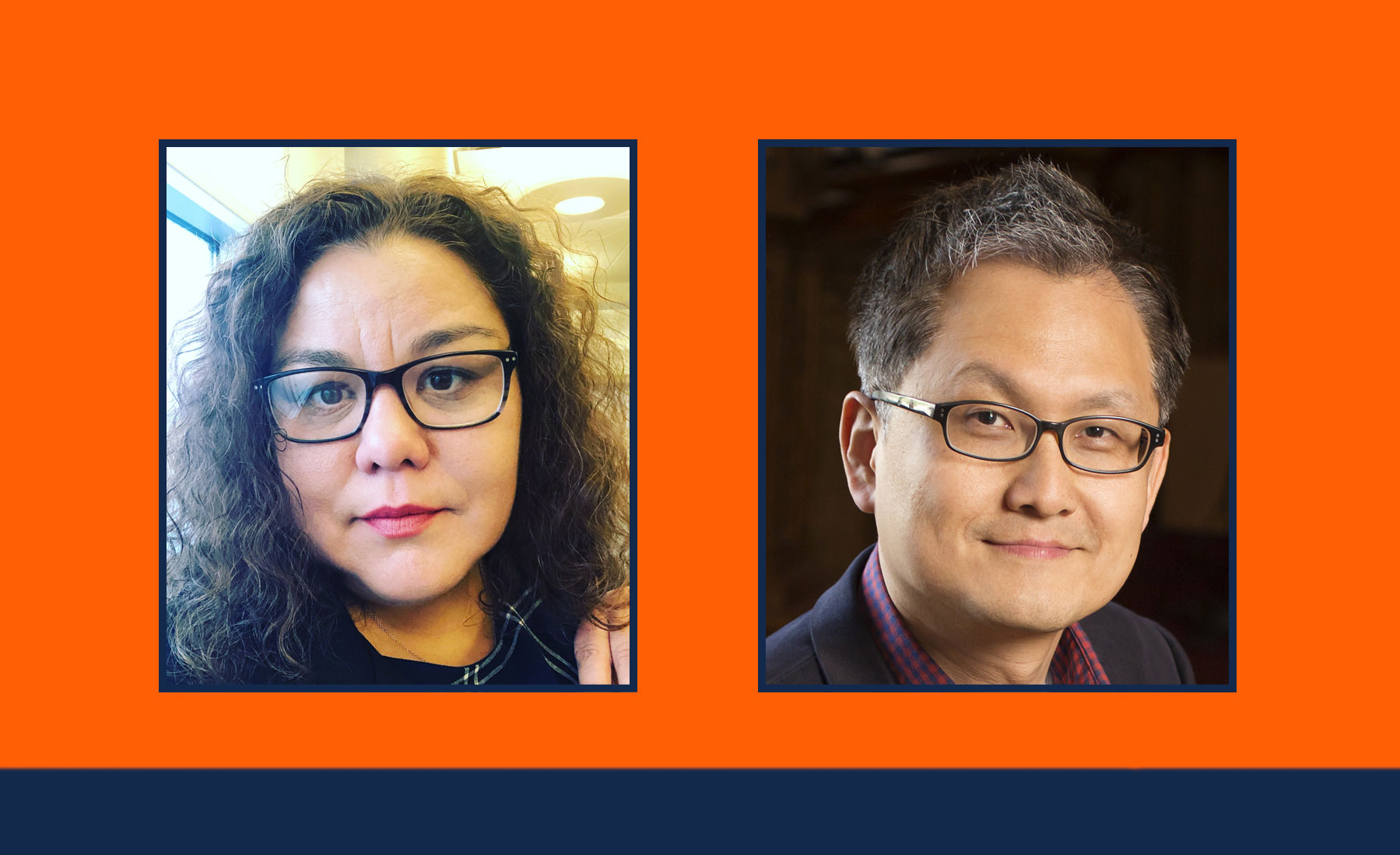
Two College of Media faculty members affiliated with the Institute of Communications Research have been selected as James W. Carey Faculty Fellows for academic years 2022-2024. Both Angela Aguayo, associate professor of media and cinema studies, and Chang-Dae Ham, associate professor of advertising and director of graduate studies in advertising, will receive the honor and a stipend to support their research activities.
As a Carey Faculty Fellow, Aguayo will work on a book project called Collective Matters, which examines how traditions in the humanities, health care, law, and education manifest through documentary in non-theatrical spaces, addressing the rituals of media producing, screening, and circulating that bind communities across time. During his Carey Faculty Fellow tenure, Ham will conduct research on digital data literacy and privacy issues.
Established in 2021, the James W. Carey Fund for Faculty Excellence was endowed by Carey’s four sons to honor their father’s legacy at the College of Media and within the field of media. At ICR, Carey earned his doctoral degree, was a research professor, and served as director (1969-1976); he also served as dean of the college. The Carey Fund supports research activities of the outstanding faculty in ICR, the world’s oldest program for interdisciplinary research and doctoral education in communication and media studies.
To join Carey’s family, former students, colleagues, and friends in growing the endowment, please visit the College of Media giving page, click on the orange “Give Online Now” button, and select the Carey Fund under “Nurture Excellence in Media Faculty.”