CU-CitizenAccess, a community online news and information project overseen by Professor Brant Houston, the Knight Chair in Investigative and Enterprise Reporting in the Department of Journalism, was part of a team that won two Lisagor Awards for exemplary journalism from the Chicago Headline Club on May 8.
The team received both “Best Reporting on Race and Diversity” and “Best Reporting on Crime and Justice” in the student category for their submission titled “At Illinois public universities, campus cops pull over Black drivers at higher rates.”
The student team included Maia McDonald, Nicole Jeanine Johnson, Khadija Ahmed, Isabelle Senechal, Amilia Estrada; Investigative Project on Race and Equity, Chicago Public Media, WBEZ, Chicago Sun-Times, CU-CitizenAccess, Saluki Local Reporting Lab, and The Daily Egyptian.
University of Illinois students who contributed to the project through CU-CitizenAccess included Molly Hughes (MS ’25, journalism), Jordan Butler (BS ’25, journalism), and Courtney Dillon (BS ’25, journalism; BA ’25, LAS).
“Managing editor Dylan Tiger (BS ’19, journalism; MS ’20, iSchool) did an excellent job wrangling difficult data and interviews with local officials and helping to coordinate our part,” said Houston. “It was a great experience for students to be involved in the collaboration.”
CU-CitizenAccess is devoted to investigative and enterprise coverage of social, justice, and economic issues in east central Illinois.
The Lisagor Award entries were judged by an impartial Society of Professional Journalists chapter outside Illinois.
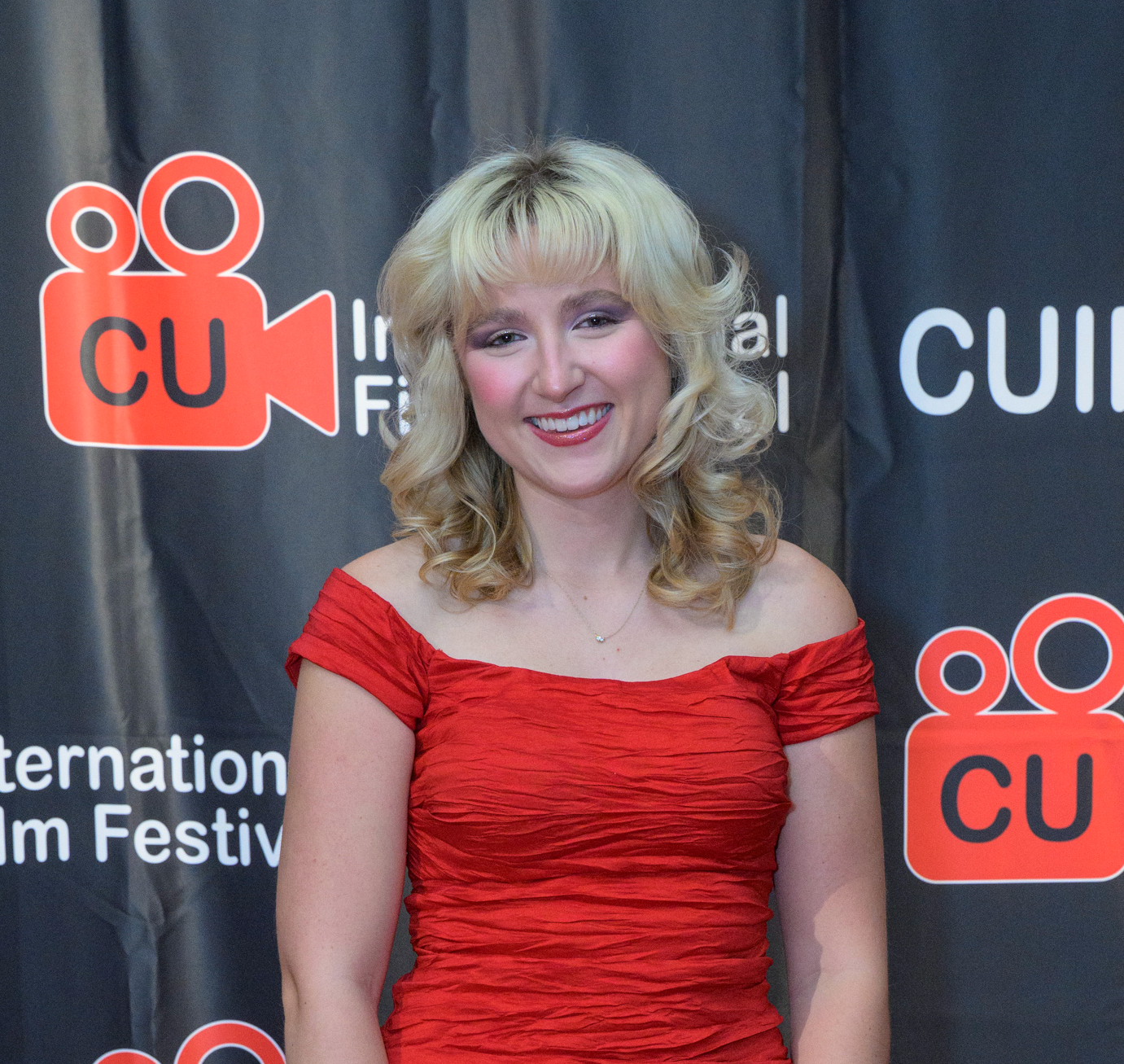
Get to know some of our College of Media students! Ella Yoder is a Class of 2027 media and cinema studies major.
What made you choose the media and cinema studies (MACS) major?
During my search for universities, the University of Illinois Urbana-Champaign stuck out quickly, specifically, the media and cinema studies (MACS) major. MACS allows its students to engage with film production as soon as freshman year, while other universities I was looking at set a limit for production courses to juniors and seniors. Personally, I knew I had a desire to learn about films and wanted a university that would give me hands-on learning opportunities that I could take advantage of the minute I got to campus. I am so happy that I found the College of Media because of the standards they set for their students with the required engagement that offers a holistic view of the film and cinema industry.
How did you first get interested in your major?
As a kid I always enjoyed making little movie projects. I was the type of person who spent their free time making up funny stories and filming them as a movie rather than going outside. This interest in producing movies only grew as I got older. Starting off as a child with a vision, to now, being a junior in college, I have begun working as a production assistant at a local production studio to continue my passion for filmmaking. While I am on set for these larger productions, I am reflecting on my younger self who had no idea the College of Media was waiting for me to pick up that camera.
What College of Media resources have you found helpful in navigating college?
A resource I will forever promote is the Media Technology Center. There are so many similar offices on campus. The College of Media has their own dedicated unit that is open to students in Media courses in the college to rent out different required items. The range of available equipment may vary per location, but typically there will always be microphones, tripods, lighting, and even green screens ready to be used! The rentable equipment has been particularly useful for me when trying to work on my class projects. With the easy-to-use check-in and check-out system, I truly recommend more students to utilize this resource.
Are there any professors who have been critical to your academics?
Even before the start of my first year, I knew that the professors of media and cinema studies in the College of Media were going to be beyond helpful to my future. This is because I reached out to a few instructors during the summer ahead of my first classes—and there were quite a few who responded with a desire to meet with me and explain the major and all that encompasses studying as a MACS major. This brief introduction into the friendly environment of the faculty stuck with me as I proceeded throughout my time at the University of Illinois.
April 29, 2026 | Giuliana Means, Communications Intern
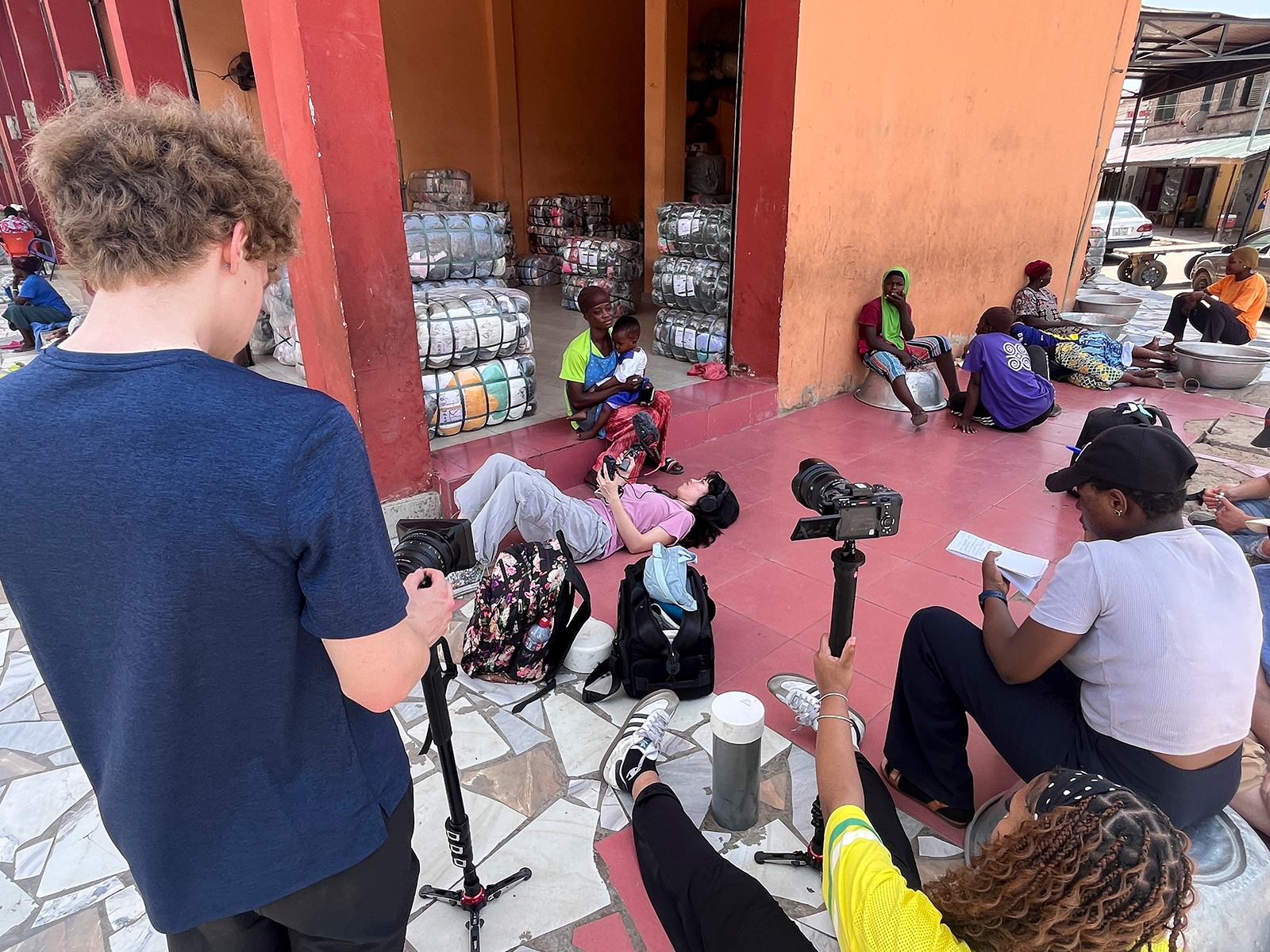
Through the course “Globally Focused Advanced Documentary Filmmaking,” five journalism students and three advertising students explored the lives of female head porters, called kayayei, in a faculty-led trip to Accra, Ghana, over spring break.
“I know from my experience that traveling and working abroad, especially in Africa, can be an inflection point in one’s life and globally contextualize values,” said Charles “Stretch” Ledford, associate professor of journalism, who has visited more than 55 countries throughout his career. “It was incredibly gratifying to be in a position to provide students this kind of opportunity.”
The course focuses on the labor of the kayayei, young women and girls—some barely in their teens—who migrate from Ghana’s rural north to the country’s urban centers, primarily Accra and Kumasi, in search of work. That work consists of carrying loads that can exceed their own body weight through the city’s sprawling markets, earning the equivalent of less than a dollar per load while exposing themselves to exploitation, musculoskeletal injury, chronic anxiety and depression, and other health and wellness risks.
Focusing on Accra’s Kantamanto used clothing market, the class is producing a documentary focusing on three narratives about kayayei who work there: a day in the life of Sahada Shehabu, a 22-year-old kayayoo; the risks of the work, described by Muhammad Salifu, founder and director of the Kayayei Youth Association; and the role the kayayei play within the market’s economy, explained by Edward Atobrah, deputy general secretary of the Ghana Used Clothing Dealers Association.
You’re dealing with something that has a real impact, and you’re seeing change happen and immersing yourself in a community that you may not have had an opportunity to [otherwise visit].
Tomi Dugbo
Senior in Advertising
The journalism students will also create a 360º-immersive video, photo essays, an audio segment, and social-media friendly short vertical videos. They are sharing their initial work at the campus Undergraduate Research Symposium on Thursday, April 30, in a poster presentation titled “They Want to Go Home: Ghana’s Kayayei.”
Kaitlyn Devitt, a senior in journalism who worked primarily on the documentary film and 360º-immersive video, says the team worked an average of six hours a day over seven shooting days in three locations.
Devitt wants to pursue international journalism after she graduates, especially after this project, because of how rewarding it was.
“This project was perfect to get my feet wet,” Devitt said. “The topic itself was interesting because these women are my age, and who’s to say this couldn’t be me if I hadn’t had the privilege of growing up in America?”
During the trip, the advertising students worked with the Kayayei Youth Association to amplify their mission. They also communicated the journalism students’ reporting processes on social media and documented their experience through a blog site.
“This experience taught me the importance of collaboration where you’re not only working with advertising students, but journalism students,” said Tomi Dugbo, a senior in advertising. “You’re dealing with something that has a real impact, and you’re seeing change happen and immersing yourself in a community that you may not have had an opportunity to [otherwise visit].”
Advertising students also spent time visiting global ad agencies, such as Innova DDB and Ogilvy Africa Ghana, to analyze cross-cultural campaign approaches. They also plan to develop strategic communications campaigns for partner NGOs.
For all the students, it was their first time producing journalism and strategic communications in a foreign country.
“Don’t let perfection be the enemy of good,” advised Marisa Peacock, senior lecturer of advertising. “There’s always time to refine, edit, and evolve it, but you can’t let the perfect shot stand in the way of getting the work done.”
With only a week to conduct interviews, collect footage, and produce the strategic communications deliverables, the team persevered in an environment that demanded that they adapt quickly.
Adelyn Mui, a senior in journalism, dove headfirst into the project to capture an authentic representation of the women’s stories and overcome the challenges of not having the connections she does when reporting on campus.
“Doing global journalism taught me a lot about journalism in general because those same skills I learned in Ghana, I can apply here locally on campus; they were just amplified since I was in a different country,” Mui said.
Students from Fourah Bay College in Sierra Leone and the University of Media, Arts and Communication in Ghana were partners in the project under the umbrella of the Illinois Partnership for African Women’s Health Narratives, spearheaded by Ledford. It is a continuation of his 2023 collaboration with Dr. Francis Sowa, Dean of Faculty of Communication, Media and Information Studies at Fourah Bay College, and new collaborator, Dr. Stephen Tindi, a lecturer at University of Media, Arts and Communication in Accra.
Alison Davis, senior lecturer of journalism, said the Illinois students naturally fell into the role of technological mentors for their West African peers.
“Students from the other countries were able to pick up our equipment and run with it; that’s the collaboration I like to see,” Davis said. “People are not that much different. You get a group of college students together, and they’re all similar. I love that.”
Next year, Ledford hopes to continue the story with reporting in Ghana’s Northern Region, examining how climate change may be accelerating the “push” of young women from Ghana’s rural and relatively poor north to work as kayayei in the country’s more developed south.
Major funding was provided by the University of Illinois through the BRIDGE Program, Vision 2030 Global Strategy Implementation Grant, Campus Research Board, Illinois Global Institute, Department of Journalism, the College of Media, and the Karin and Folke Dovring Endowment Fund, with additional support from Lisle International and Sony Electronics.
Photos by and courtesy of Charles “Stretch” Ledford and Marisa Peacock.
English professor Christopher Kempf also received the prestigious award. They are among 223 individuals working across 55 disciplines chosen through a rigorous peer-review process from nearly 5,000 applicants, according to the announcement of the fellows. The John Simon Guggenheim Memorial Foundation awards fellowships to exceptional individuals in pursuit of scholarship in any field of knowledge and creation in any art form, under the freest possible conditions.
Turnock’s project, “Beyond King Kong,” is a technical, industrial, and aesthetic history of the special-effects industry in the Hollywood studio era, circa 1915-1960, well before the digital era. It goes beyond 1933’s special effects landmark King Kong to examine the historical economic structures that organized personnel and production of this distinctive sector of studio-era filmmaking. Attending to the material conditions of special visual effects production and informed by extensive archival research, it centers on the labor performed by unsung “below-the-line” effects workers rarely considered in cinema histories but whose skills make much of “movie magic” possible.
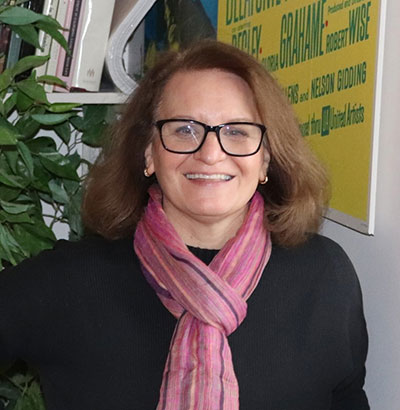
Turnock is the director of the Roger Ebert Center for Film Studies and the author of the books The Empire of Effects: Industrial Light and Magic and the Rendering of Realism and Plastic Reality: Special Effects, Technology, and the Emergence of 1970s Blockbuster Aesthetics. She is the recipient of a National Endowment for the Humanities Fellowship and is a 2020-2022 College of Media Scholar.
(Photo by Fred Zwicky / University of Illinois Urbana-Champaign)
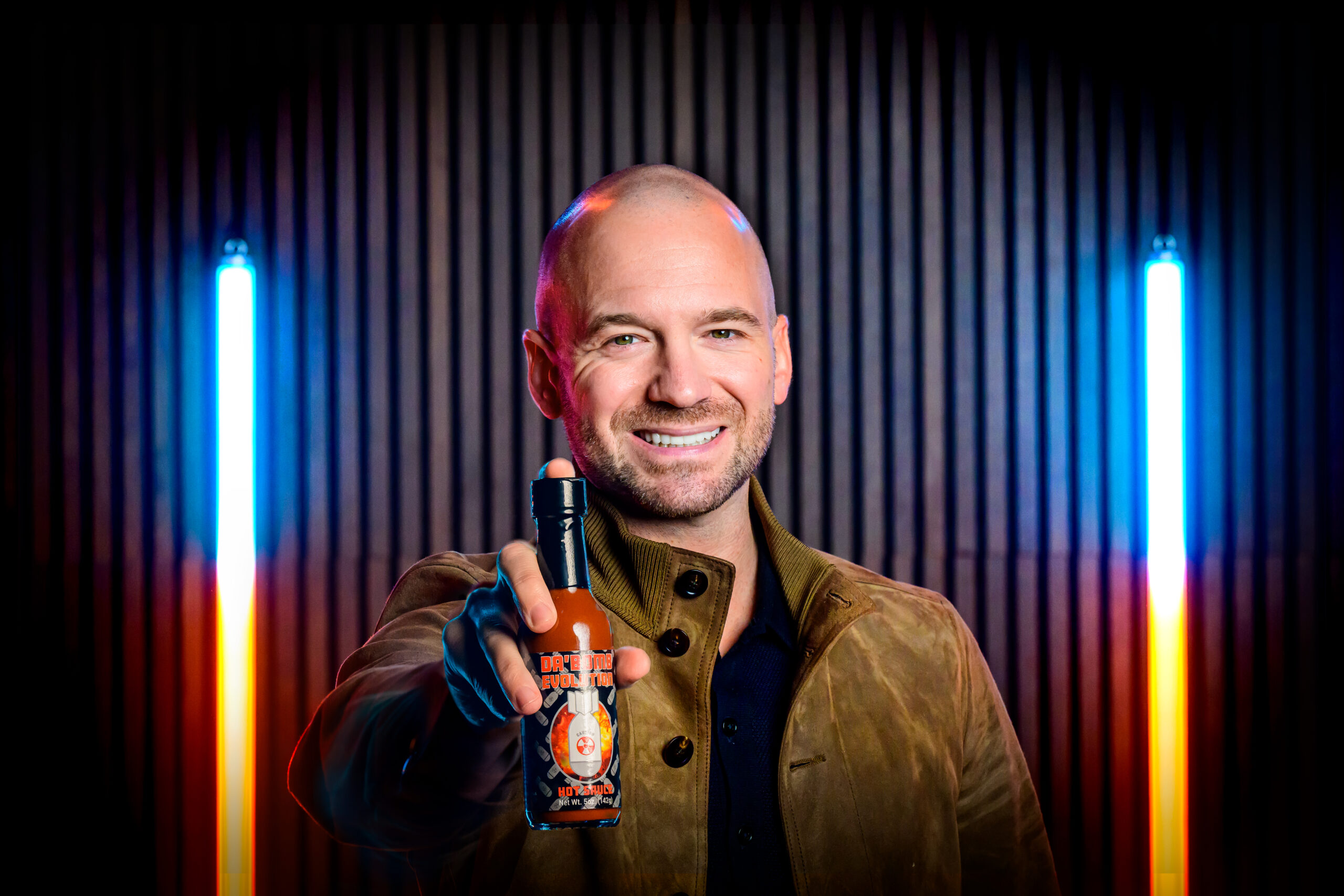
Evans is the co-creator and host of the popular YouTube show Hot Ones, where musicians, professional athletes, and television and movie stars join Evans in eating chicken wings doused in progressively spicier hot sauces within the format of a talk-show interview. He notched a Daytime Emmy® Award nomination in 2021 for Outstanding Entertainment Talk Show Host and has won multiple Internet entertainment awards. Evans also was named to TIME magazine’s inaugural “Time100 Creators” list last year, heralding the most influential digital voices of the modern media industry.
“Sean Evans defined his own path and reimagined the role of a journalist and a talk show host in the modern media landscape,” said Illinois Chancellor Charles L. Isbell, Jr. “We encourage Illinois students and alumni to be innovative, and Sean created something no one else had. His work inspires us to continue to push boundaries, to challenge convention, and to develop new ideas instead of just adopting old ones.”
Sean’s career is a wonderful illustration of where an Illinois education, one that nourishes creativity and confidence, can take you. We are so proud of his accomplishments and know that he will inspire students with his story.
Tracy Sulkin
College of Media Dean
Evans forged an affinity for the university long before he arrived at Illinois as an undergraduate student. His mother attended the U of I, and Evans’s favorite holiday haul to this day was the morning he found a Sega Genesis and an orange-and-blue Illinois Starter jacket underneath his Christmas tree as a boy.
Once he stepped on campus as a student, a lasting imprint was left almost immediately.
“You walk out on the Quad, and it looks so quintessentially college,” said Evans, a native of Crystal Lake. “It looks like a college out of a film. There’s a scale and a history to it that really smacks you in the face. Walking onto the Main Quad for the first time, I had this feeling of being in a totally different place in my life and feeling a lot of comfort in it.”
Evans said he “trusted the incubation period” of the journalism program in the College of Media to build up his skill set. He recalled the high standards the professors expected out of students, and the meaningful experience he gained cycling through each production role on WPGU-FM student news broadcasts.
Alum Sean Evans, Hot Ones host, visits with students in Journalism 340: Video Reporting and Storytelling, taught by College of Media senior lecturer Alison Davis. The class was one Sean remembered taking when he was in school. (Photo by Fred Zwicky / University of Illinois Urbana-Champaign)
“Sean’s career is a wonderful illustration of where an Illinois education, one that nourishes creativity and confidence, can take you. We are so proud of his accomplishments and know that he will inspire students with his story,” said Tracy Sulkin, dean of the College of Media.
But like many young people entering the workforce in 2008, he found a flagging job market upon graduation. Evans returned to his old summer gig: a Chicago architecture tour guide.
“I remember feeling so hopeless,” Evans said. “There was this existential feeling to it. But even at that time, I had a passion for what I wanted to do. I would take every freelance project I could get. I knew I had a passion for this work and needed an outlet for it.”
His meteoric rise began after successfully pitching and developing Hot Ones in 2015, when he was working at Complex magazine. He wasn’t even the biggest fan of chicken wings. At best, Evans thought it could be a fun idea he and his co-creators would program on a quarterly basis. But the format of humanizing celebrities—and making them forget their media training—by putting them through blistering hot wing sauces worked in capitalizing on the attention economy. Notable guests have included Will Smith, Stephen Curry, Billie Eilish, Justin Timberlake, Gordon Ramsay, Neil deGrasse Tyson, Dua Lipa, and many more across the show’s 400 episodes.
(Photo by Fred Zwicky / University of Illinois Urbana-Champaign)
“I certainly never thought it would be my own media company,” Evans said. “We were working in cubicles at Complex and ended up making something that became bigger than these giant, hulking media companies it was incubated in.”
Evans remains deeply involved in the preparation for each Hot Ones episode and works late into the night formulating precise questions and perfecting his delivery of those queries to his guests. These nocturnal work sessions always transport Evans back to his time at Illinois, where he would sign up for the latest availability in the basement of Gregory Hall to edit his broadcast journalism projects.
“I always really liked going down there, having my headphones on, being the only person in the building, and just lost in the basement of Gregory Hall cutting packages,” Evans said. “I still to this day work like that. I’ve written my best interview questions—and probably the most interview questions—after 10 p.m.”
As his own celebrity stature has grown, Evans has eagerly returned to his alma mater. He has attended sporting events, spoken to students, and even hosted a special edition of Hot Ones with Illinois men’s head basketball coach Brad Underwood as the guest. It’s all a part of giving back to a place that has been special to him for most of his life, and Evans can’t wait to add to that legacy with his role as Commencement speaker.
“As somebody who loves this school, went to this school, and now has this crazy pop culture platform, it’s fun to bring that energy back to Illinois,” Evans said.
Watch Chancellor Charles L. Isbell, Jr. interview Commencement speaker and Illinois Media alumnus Sean Evans:
For more information regarding the universitywide ceremony—including the stadium’s clear-bag policy, student regalia, and parking instructions—visit commencement.illinois.edu.
Editor’s note: To request a media interview with Sean Evans, contact Kovert Creative at fwfpr@kovertcreative.com. For media requests related to Commencement, contact Patrick Wade, director of executive communications and issues management, 217-333-5010, pwade@illinois.edu. For information about Commencement, contact commencement@illinois.edu.
After years of planning, a new bachelor’s in sports media is ready for prime time.
In response to a growing interest from students—and with a proven track record of successful alumni across the sports media industry—the College of Media is expanding its roster to offer a Bachelor of Arts in Sports Media.
The program will prepare students for a variety of careers in sports media, including as PR and strategic communication managers, content creators and digital storytellers, social media and data analysts, sportscasters and producers, and more.
The new undergraduate degree received official approval from the Illinois Board of Higher Education in Spring 2026.
This is an area of high interest from students and employers alike, and, together with our campus partners, we are prepared to offer students a first-rate experience marked by the innovation, rigor, and personalized attention that defines all of our degree programs in the College of Media.
Tracy Sulkin
College of Media Dean
Starting April 27, current University of Illinois Urbana-Champaign students may apply to transfer into the BA in sports media for Fall 2026. Transfer students from outside the University of Illinois can apply to the program for Spring 2027. First-year students can apply for Fall 2027 entry.
Courses from all three departments in the College of Media—Advertising, Journalism, and Media & Cinema Studies—will make up the core curriculum for the sports media degree.
“We’re excited to offer this interdisciplinary degree to prepare students for exciting career paths within sports media. This is an area of high interest from students and employers alike, and, together with our campus partners, we are prepared to offer students a first-rate experience marked by the innovation, rigor, and personalized attention that defines all of our degree programs in the College of Media,” said Dean Tracy Sulkin.
As streaming, podcasting, and multi-screen sports viewing continue to reshape how teams, fans, and brands interact, graduates who understand these evolving dynamics will have an advantage in the job market.
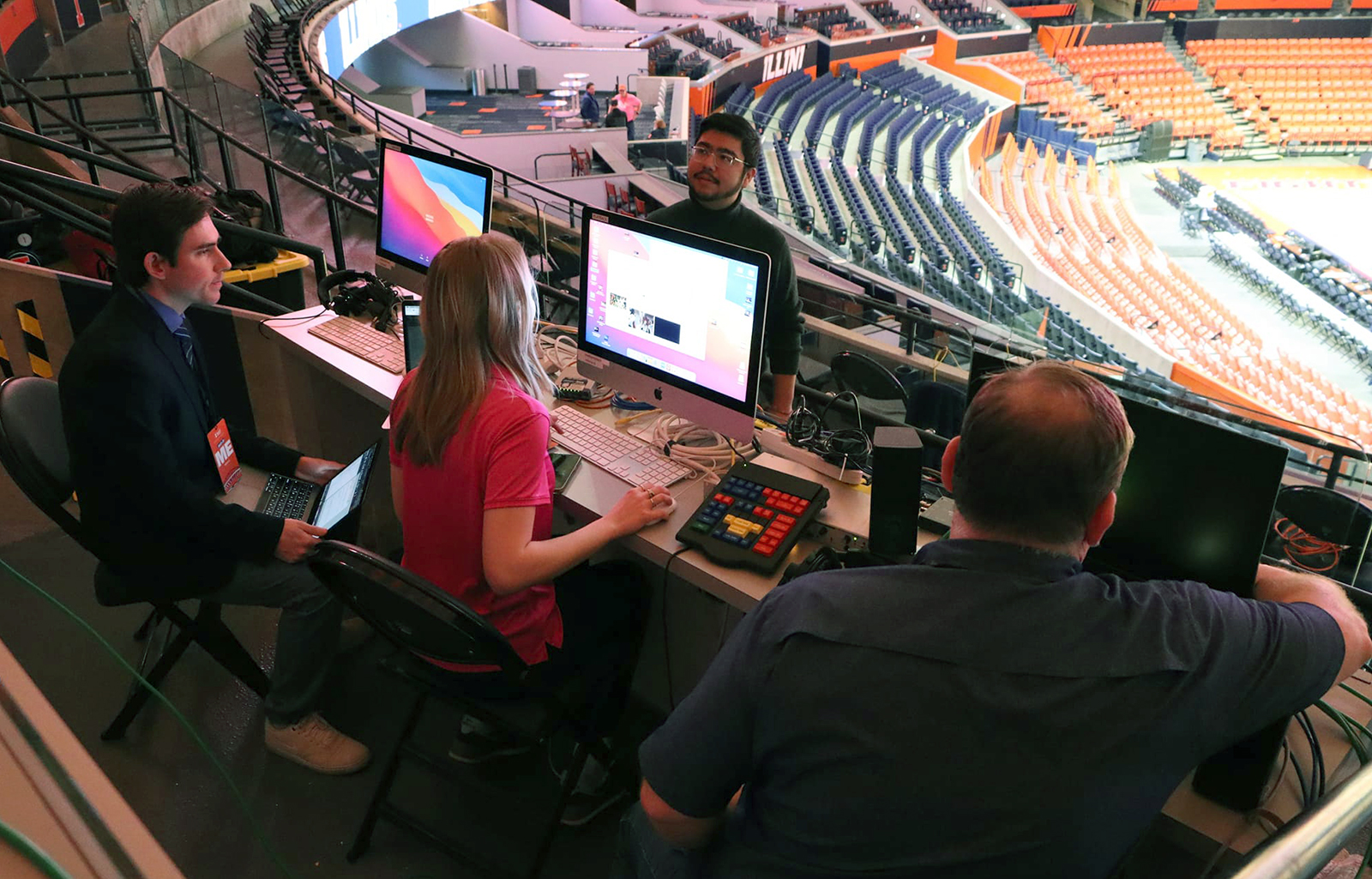
The College of Media already offers sports-focused courses, including “Sports Public Relations,” “Sports Journalism,” “SportMedia, Technology & Culture,” and just this spring, “Sports Advertising & Branding” debuted. Students can also gain firsthand production and reporting experience through Illini Sports Night, a program covering Illinois Athletics, through the course “Newsroom Experience.”
Sports media majors will be able to take elective courses within the Department of Recreation, Sport, and Tourism in the College of Applied Health Sciences, such as “Sport Analytics: Data-Driven Decision Making,” “The Foundations of Sport Management,” and “Issues in Intercollegiate Athletics: The Big Ten Conference.”
To expand experiential learning opportunities, the College of Media plans to collaborate with alumni working in the sports industry to create additional immersion and internship opportunities. These efforts will build upon past programs that included tours of athletic companies like Nike and Adidas. Alumni currently hold top positions across sports media such as producing, anchoring, and writing for national networks and publications; leading communications and videography for professional sports leagues; working with celebrity athletes, athletic brands, and sports teams; and some have even competed as Olympic athletes.
Students will also benefit from the extensive opportunities that come with the University of Illinois’ premier athletics program and its membership in the Big Ten Conference. For example, students have produced live pregame shows for Illini Sports Night in collaboration with the B1G+ network, and many intern at Fighting Illini Productions, the video team for the University’s Division of Intercollegiate Athletics. Additionally, DIA colleagues serve as adjunct instructors in the College of Media, and both local and national sports personalities frequently visit classes, including Brian Barnhart, the Illinois football and men’s basketball play-by-play announcer, and Gus Johnson, the lead college football and basketball play-by-play announcer for FOX Sports.
The BA in sports media is the sixth undergraduate degree offered by the College of Media, along with advertising, computer science + advertising, journalism, media and cinema studies, and an online degree in media for transfers. Learn more about Media’s academic programs.
The Super Bowl, the Milano Cortina Winter Olympics, and the FIFA World Cup this summer have set the stage for a sports season defined not just by competition but by community.
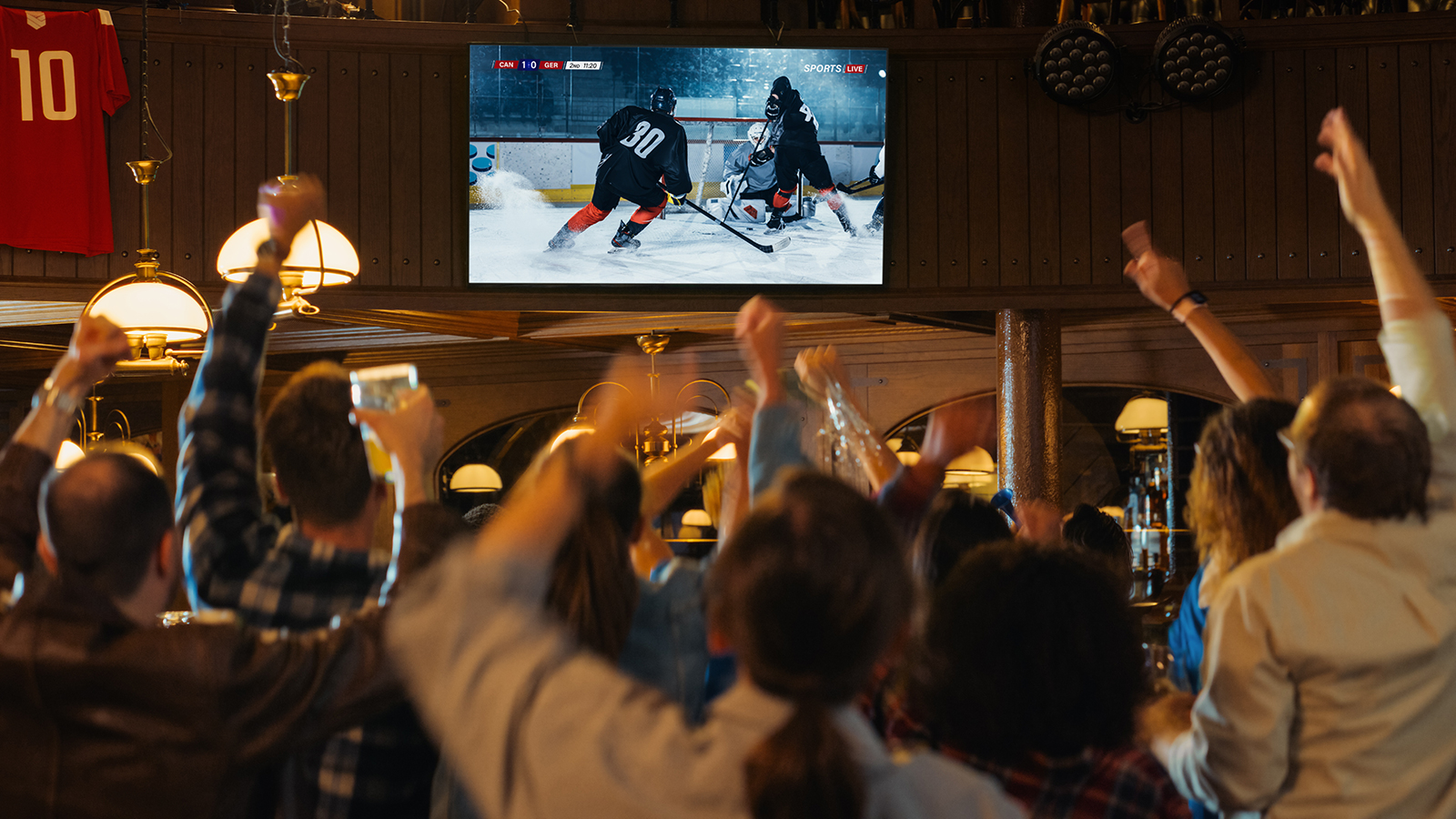
These sporting events create shared viewing rituals that bring millions of people together to experience the games in real time. And while audiences continue to reach historic highs, even as media habits fragment, it’s worth examining how these events shape identity, fandom, community, and the way people connect with one another.
To help understand why sports carry such cultural influence and how brands try to engage with fans in these moments of collective attention, we spoke with Steve Hall,senior lecturer of advertising, who is teaching a brand new course this semester on “Sports Advertising and Branding” and serves as chair of the University of Illinois Urbana-Champaign Athletic Board.
With the rise of “communal viewing”—from watch parties to bars to fan zones—how does the social nature of watching sports amplify the impact of an ad compared to watching alone?
Viewing sports together as a shared social experience can be extremely powerful and create incredible opportunities for advertisers. It can also pose serious challenges.
The impact of advertising in communal contexts is complicated and depends on a dizzying array of variables. There are a lot of questions that need to be asked. For starters, how does an advertiser define and measure impact? From a media perspective, there’s a ton of data analytics being generated to measure what and when people are watching when it comes to sports on linear and streaming platforms. But that’s just scratching the surface.
Questions remain: What kind of fan zone, bar, or watch party is it? Organized or spontaneous? Is the game, match, or race interesting or boring? What stake or emotional connection do each of the audience members have with the sport, teams, players, and the group of people or type of fans who are there watching? Favorite or rival team winning or losing? Are people intensely engaged, having side conversations, focused on eating a pastrami on rye, checking fantasy stats, or posting videos of themselves at the party on social media?
Then you have the ad itself. Is the storytelling mediocre or amazing? Does it connect with the audience on an emotional, human level from a creative perspective? Do people discuss, share, or comment on the ad with others in a positive or negative way? Is there a strategy to amplify the advertising message across omnichannel touchpoints?
Understanding the impact of advertising in communal viewing environments is complicated. Stay curious. Keep asking questions. Because you’ll never have all the answers.
With the United States co‑hosting the 2026 FIFA World Cup, how significant is this moment for American brands looking to reach a global audience—especially given soccer’s growing popularity in the U.S.?
Whether you call it soccer or football doesn’t matter—the 2026 FIFA World Cup is a huge moment for all brands looking to reach global audiences. As the most popular sport on the planet, fandom is massive and culturally diverse. That opens a very big door for advertisers to tell their stories, create experiences, and connect with people everywhere on the world stage. To be successful, culture should be at the epicenter of advertising, fan engagement activities, and marketing programs. Branding is about what people think, feel, and believe. It’s reputation.
The FIFA World Cup will present incredible opportunities for advertisers to leverage culture, meet new audiences, create trust, and build relationships with everything from in-stadium brand activations to prime-time TV commercials. This global event will allow brands to align fans, teams, and athletes with relevant, authentic storytelling, sponsorships, partnerships, and innovative experiences that will not only reach global audiences, but connect with them in entirely new ways. After all, the world will be watching. Game on.
What are students currently analyzing and discovering in your brand new “Sports Advertising and Branding” course?
Currently, we’re looking at the relationship between culture, trends, and sports. Overall, the class allows students to explore, discover, and examine sports advertising and branding in a broad array of contexts that connect advertising, marketing, media, sports, teams, athletes, fans, events, experiences, and partnerships at amateur, collegiate, and professional levels.
The course introduces industry practices and processes to help students understand and apply concepts related to research, data, consumer behavior, strategic planning, creative content, production, media, and branded integration into the incredibly immense and fascinating world of sports.
Specific topics include sports information, public relations, event management, fan engagement, merchandising, brand activation, technology, e-sports, NIL, gambling, ethics, personal branding, sports celebrities, and collaborations. The class also incorporates experiential learning opportunities with alumni, sports industry professionals, and coaches, as well as attending NCAA athletic events on campus.
Ph.D., S.I. Newhouse School of Public Communications, Syracuse University (Mass Communications)
M.S., University of Illinois at Urbana-Champaign (Advertising)
B.A., Hastings College, Hastings, Nebraska
Course Specialties
Advertising Strategy
Account Planning
Advertising Management
Advertising Campaigns
Background
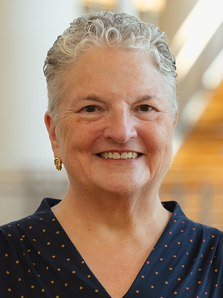
Dr. Jan Slater served as the Chief Marketing Officer for Gies College of Business and Professor of Advertising in the Charles H. Sandage Department of Advertising at the University of Illinois. She aslo served as Dean of the College of Media for six years, and head of the Department of Advertising for three years prior. Before her appointment at Illinois, Dr. Slater was an associate professor and the associate director of the E. W. Scripps School of Journalism at Ohio University for nine years. She joined the academy following a successful career as an advertising practitioner, working in private industry, as well as owning her own multi-million-dollar advertising agency, J. Slater & Associates.
Dr. Slater has served as president of the Association for Educators in Journalism and Mass Communication (AEJMC), an organization she’s been active with since 1995. Additionally, she has served on the AEJMC Advertising Division’s executive committee as research chair, teaching chair, vice head, and head. She served as vice chair and chair of the Council of Divisions for four years, and was a member of the AEJMC Strategic Planning Design Team. She has served as a member of the committee, as well as a member of the council of the Accrediting Council on Education in Journalism and Mass Communications’ Accrediting Committee and has been chair of the American Advertising Federation’s Academic Committee.
Research and Creative Endeavor
Brand relationships, brand strategy, and branded content are the main areas of Slater’s research. She has been published in the Journal of Marketing Communications, Advances in Consumer Research, Journalism and Mass Communication Educator, and the Journal of Advertising Education. She is a contributing author to a series of advertising books published by Sage and co-author of What’s in a Name? Advertising and the Concept of Brands.
The 2026 Chaz and Roger Ebert Symposium, presented by the Roger Ebert Center for Film Studies, will address “Onscreen Fantasies/IRL Illusions: Fandom, Parasocial Relationships, and the Media.” Join us for this free two-day event on March 30-31, featuring a film screening, a roundtable discussion, and keynote address.
Monday, March 30
Film Screening: The Wiz
7 p.m., Knight Auditorium, Spurlock Museum
Before Wicked, there was The Wiz.
Join the Ebert Center for a screening of Sidney Lumet’sThe Wiz (1978). See cultural icons such as Michael Jackson, Diana Ross, and Nipsey Russell follow the yellow brick road in this musical retelling of The Wizard of Oz.
While considered a failure upon its release, the film has since developed an enduring and charming legacy, as well as a dedicated cult fan base.
The film will be introduced by Dr. Alfred L. Martin, Jr., Chair of the Department of Cinematic Arts at University of Miami, and Ebert Symposium keynote speaker.
Tuesday, March 31
Roundtable Discussion
2-3:30 p.m., Knight Auditorium, Spurlock Museum
Join a roundtable discussion with doctoral students from the Institute of Communications Research on the Ebert Symposium theme of “Onscreen Fantasies/IRL Illusions: Fandom, Parasocial Relationships, and the Media.” Not only will it explore themes from The Wiz and the Ebert Symposium keynote speech, but it will also expand to all types of media. Moderated by Cait Coker, Curator of Rare Books and Manuscripts at the University of Illinois, this discussion will be held among ICR students Youngin Kang, Gustavo Nery, Stephanie Perez, Kendra Williams, and Nansong Zhou. Audience participation is encouraged.
“What The Wiz Was (and Is): Media Industries, Distribution, Reception and The Wiz”
The Ebert Symposium keynote will be delivered by Dr. Alfred L. Martin, Jr., Chair of the Department of Cinematic Arts at University of Miami.
As a part of the Ebert Symposium’s theme,“Onscreen Fantasies/IRL Illusions: Fandom, Parasocial Relationships, and the Media,” Martin draws attention to The Wiz as the first Black-cast blockbuster and re-assesses its significance to issues of Black media production, initial reception, distribution, and its enduring fandom. Concomitantly, this presentation is about the ways, particularly within a socio-political environment hostile to Blackness, The Wiz provides a prism through which to place the feminist “I” and joy into research. Engaging media industry studies, fandom/reception studies, and media studies, this presentation argues that the history and ongoing legacy of The Wiz is far more complicated than reducing it to a financial failure.
Martin is associate professor of media studies and chair of the Department of Cinematic Arts at the University of Miami. He is author of Fandom for Us, by Us: The Pleasures and Practices of Black Audiences (New York University Press, 2025) and The Generic Closet: Black Gayness and the Black-Cast Sitcom (Indiana University Press, 2021), editor of Rolling: Blackness and Mediated Comedy (Indiana University Press, 2024), and co-editor of The Golden Girls: Tales from the Lanai (Rutgers University Press, 2025). A former marketing communications executive and ballet dancer, in his spare time, Martin is a ballet teacher, coach, and choreographer.
Join a once-in-a-lifetime opportunity to shape the future of the College of Media at Illinois
January 14, 2026
A centennial is more than a milestone—it’s an invitation to define the future together.
As the College of Media approaches its 100th anniversary, we celebrate our proud legacy and commit to advancing the next era of media education and research. Illinois Media graduates have informed the public, shaped culture, advanced technology, and transformed the way the world connects. To ensure this momentum carries into the next century, the College of Media invites its most passionate supporters to help lead the way through the Centennial Circle.
The Centennial Circle will be launched to honor visionary donors who make transformational investments. Induction into the Centennial Circle recognizes gifts of $100,000 or more to any fund in the College of Media between January 1, 2026, and December 31, 2027. Donors can make an outright gift, a pledge, or a deferred gift such as a bequest in their will or a beneficiary designation of their IRA.
College of Media Dean Tracy Sulkin emphasized the historic significance of the Centennial Circle as the college celebrates its 100th anniversary in 2027.
“A centennial invites us to honor our past while envisioning a bold future. In this unique moment, philanthropy will play a central role in shaping the next 100 years of media,” said Dean Sulkin. “Joining the Centennial Circle is an opportunity to create a powerful, lasting legacy—one that uplifts generations of students and strengthens media education and research at Illinois for decades to come.”
Donors may choose to support any fund in the College of Media, including the Centennial Fund, which helps meet emerging priorities, from technology advancements and innovative pedagogy to faculty and student research. Recent examples of donor-funded impact include the founding of the Richard and Leslie Frank Center for Leadership and Innovation in Media and the Roger Ebert Center for Film Studies, student support such as scholarships and the Media Technology Center, and faculty support such as research initiatives and named professorships.
Preparing students for academic and professional success means ensuring they can navigate, analyze, and communicate effectively in an ever-changing media landscape. Support for the Centennial Fund positions the college to address complex societal challenges, including AI, media literacy, civic and public engagement, and the accessibility of news and information.
Joining the Centennial Circle is an opportunity to create a powerful, lasting legacy—one that uplifts generations of students and strengthens media education and research at Illinois for decades to come.
Tracy Sulkin
College of Media Dean
“The Centennial Circle reflects the power of partnership between the College of Media and our alumni and friends,” said Deanne Johnson, senior assistant dean for advancement. “By aligning philanthropic vision with emerging priorities, donors help ensure Illinois remains at the forefront of media education for generations.”
The historic cohort of Centennial Circle donors will be recognized during a College of Media centennial celebration and featured across the college’s communication channels. Recipients will also get a commemorative Centennial Circle lapel pin.
Join us in shaping the College of Media’s second century:
We welcome the opportunity to explore how your philanthropic vision can align with your passions and create lasting impact for the College of Media’s second century. To learn more, please contact Deanne Johnson, Senior Assistant Dean for Advancement, at 217-244-5466 or jhns@illinois.edu.