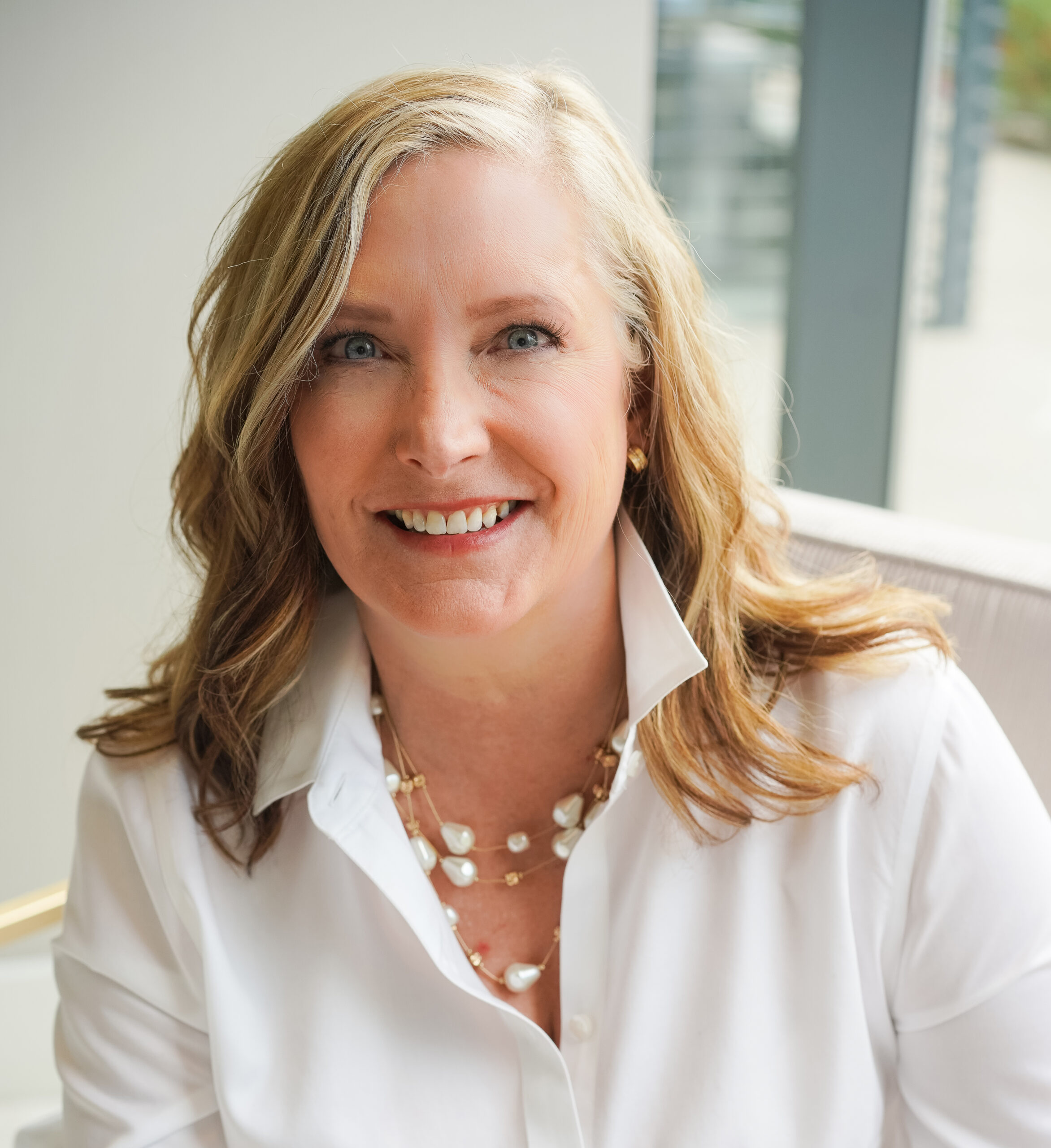
I on the Media: Ewa Maslowska discusses AI “friendships”


As AI chatbots become more sophisticated, people are increasingly turning to them not only for information, but also for companionship. Concerns are growing over increasing cognitive, emotional, and social reliance on AI tools.

The College of Media spoke with Ewa Maslowska, associate professor of advertising and expert in consumer-brand interactions in the context of new technologies, to learn how AI chatbots are able to simulate friendships, the benefits and risks of using chatbots as “friends,” and how to maintain healthy boundaries with chatbots.  

About the Media Expert

Ewa Maslowska

Ewa Maslowska is an associate professor of advertising in the Charles H. Sandage Department of Advertising. Her research centers around marketing communication and consumer behavior, specifically consumer-brand interactions in the context of new technologies.

Her current research and teaching interests include personalized advertising, brand engagement, social media advertising, eWOM, consumer decision making, digital analytics and computational advertising.


In your research, you describe AI chatbots as exhibiting human traits to assume roles as “friends.” What makes these simulated friendships feel so real?

Several factors contribute to the realism of these simulated relationships. First, chatbots communicate in natural, conversational language and can simulate diverse personality traits. They are hyper-personalized, adapting to individual users over time. Like social media platforms and other engagement-driven technologies, they are designed to exploit cognitive and emotional vulnerabilities to maximize user interaction.

Humans are predisposed to anthropomorphize. We often attribute human characteristics to non-human entities. I am sure we have all described an object in human-terms, maybe named our car or a laptop.

AI chatbots are designed to trigger perceptions of humanness, encouraging users to relate to them in personal and social ways. They address us by name, praise our ideas, agree with us, and offer encouragement. Many users say that chatbots do not judge or challenge them, but they simply listen. In this sense, they function as mirrors, reflecting back our thoughts and beliefs. I strongly recommend Shannon Vallor’s book The AI Mirror. Chatbots are also always available. As such, they are easier to form relationships with than our fellow humans, who do not always have the time, who may disagree with us, who may criticize us, or be in a bad mood.

What should be considered before using AI chatbots?

AI chatbots can have mental health benefits: Chatbots may stimulate cognitive engagement, provide positive emotional experiences, encourage behavioral change, and offer a space to practice social skills.

However, there are also risks. Overuse and emotional overdependence are growing concerns. Delegating cognitive tasks to AI may impair critical thinking, and outsourcing emotions and empathy may hinder the development of interpersonal skills. Interactions with a chatbot may reshape our expectations for human relationships, potentially leading to disappointment or even social withdrawal. Moreover, chatbots are designed to sound convincing, and despite known issues such as hallucinations and bias, we tend to trust them, sometimes more than other people.

AI image with fingers

Privacy is another major concern. We have to rely on the companies behind these tools to protect our data and not use the data to train their algorithms or try to manipulate us. This is especially important in the case of emotional dependence. Because chatbots reflect users’ beliefs and are trained on online content, they can reinforce biases and create echo chambers.

You argue that AI chatbots’ ability to form simulated relationships—and thereby influence users—constitutes a new dimension of social engineering. Can you explain what that means and how this form of persuasion is different from traditional advertising?

Unlike traditional advertising, which typically relies on one-way communication, AI chatbots engage users in two-way, dynamic, personalized, and emotionally resonant conversations. This interaction creates a sense of intimacy and trust, which can make users more susceptible to influence.

Furthermore, traditional advertising is often clearly marked and easily identifiable. AI persuasion is frequently embedded within seemingly neutral interactions, which makes it harder for users to distinguish between genuine advice and influence.

Whereas traditional dark patterns manipulate users through interface designs, such as misleading buttons or confusing opt-outs, AI chatbots use relational manipulation that leverages simulated empathy, attentiveness, emotions, and social cues.

What responsibilities do advertisers and designers have when creating chatbots that can persuade through simulated relationships? What should they keep in mind so that AI persuasion doesn’t cross ethical lines?

Designers who create these tools and advertisers who use them to embed their products or develop interactions with their customers should keep in mind that these chatbots are not just delivering messages, but they are engaging users in interactions that can shape beliefs, behaviors, and maybe even identities.

They need to realize that these tools are not neutral; they reflect certain values and beliefs. Transparency is very important, but it should be done in a non-manipulative manner (compare cookie disclosures that discourage from rejecting cookies and other dark patterns). There should be mechanisms to provide users with an option to consent or opt out. Chatbots should have safeguards to not exploit emotional vulnerabilities and to protect users, especially vulnerable populations. Chatbots should also be auditable. There is also an issue of accountability—that is, who is responsible for intended but also unintended consequences. We need new ethical guidelines for both designers and advertisers.

If you could give advice to everyday users about maintaining healthy boundaries with AI chatbots, what would it be?

It’s essential to maintain healthy boundaries with AI chatbots, especially as they become more integrated into our daily lives. With so much hype surrounding AI, it’s easy to fall into extremes: either becoming overly optimistic or deeply skeptical. We need to think critically and expose ourselves to a variety of perspectives. There are excellent books, newsletters, and podcasts that can help us better understand what these tools can do, and how to use them in ways that protect our well-being.

My first piece of advice is simple: prioritize your human relationships. These relationships can be challenging, but they offer emotional depth, shared vulnerability, and opportunities for empathy that AI cannot replicate.

On a more practical level, I’ve adopted strategies to dehumanize my interactions with AI chatbots. For example, I don’t thank the chatbot. I see it as analogous to thanking a spreadsheet for executing a formula. I’ve also customized my chatbot settings to depersonalize the interaction. For example, I’ve asked it not to address me by name, not to evaluate my questions or provide encouragement, and to provide a range of perspectives.

Finally, it’s important to remember that engagement is the business model. Like social media, these tools are designed to exploit our cognitive and emotional vulnerabilities. We need to practice self-awareness. Reflect on how your interactions with AI affect your mood, thinking, and behavior. Set usage goals. Sometimes, the best way to protect ourselves is through traditional methods: turning off notifications, scheduling tech-free time, and taking walks to take care of our minds and bodies.

Share on social
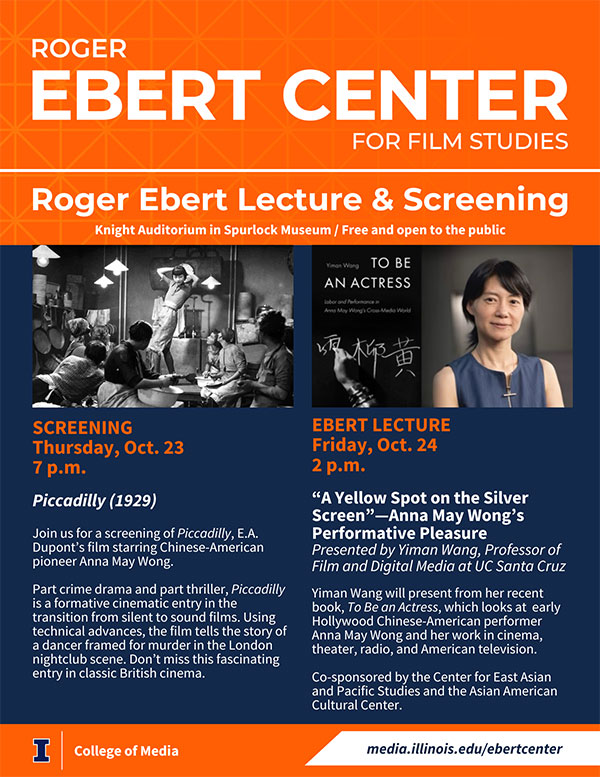
Roger Ebert Lecture: “A Yellow Spot on the Silver Screen”—Anna May Wong’s Performative Pleasure


Ebert Lecture 2025

The 2025 Roger Ebert Lecture and Screening will be held October 23-24 in the Knight Auditorium of Spurlock Museum.

Join us in person or via Zoom on Friday, Oct. 24, at 2 p.m. for the 2025 Roger Ebert Lecture, “A Yellow Spot on the Silver Screen”—Anna May Wong’s Performative Pleasure, given by Yiman Wang, professor of film and digital media at UC Santa Cruz.  Wang’s lecture will present from her recent book To Be an Actress, on early Hollywood Chinese-American performer Anna May Wong and her work in cinema, theater, radio, and American television. Anna May Wong forged a four-decade media-crossing, border-crossing career largely during the U.S. segregation era. Her recent return to public attention testifies to her indelible legacy. Yet, how we might reanimate her legacy remains a question. 

Viewing Wong as a performer and worker, not just a star, Wang invites a reconsideration of racialized, gendered, and migratory labor as the bedrock of the entertainment industries.  

Presented by the Roger Ebert Center for Film Studies and co-sponsored by the Center for East Asian and Pacific Studies and the Asian American Cultural Center.

As part of the annual Roger Ebert Lecture and Screening, join us for the screening of Piccadilly (1929) on Thursday, Oct. 23 at 7 p.m. at the Knight Auditorium, Spurlock Museum. E.A. Dupont’s film starring Chinese-American pioneer Anna May Wong is a formative cinematic entry in the transition from silent to sound films. Part crime drama and part thriller, Piccadilly uses its technical advances to tell the story of a dancer framed for murder in the London nightclub scene. Don’t miss this fascinating entry in classic British cinema. 

About the Presenter

Yiman Wang is Professor of Film & Digital Media at University of California, Santa Cruz. She is author of Remaking Chinese Cinema: Through the Prism of Shanghai, Hong Kong and Hollywood (University of Hawaii Press 2013), and To Be an Actress: Labor and Performance in Anna May Wong’s Cross-Media World (University of California Press 2024). 

She has published numerous articles in journals and edited volumes on topics of feminist media histories, ethnic border-crossing stardom, eco-cinema and environmental media, Chinese cinema, independent documentary, film remakes and adaptation. She is editor of a special issue of Feminist Media Histories on Asian Feminist Media (2019), co-editor of an InFocus Dossier on Queering Asian Media in Journal of Cinema and Media Studies (2023), co-editor of Chinese AnimationMultiplicities in Motion (2025), and co-editor of the Global East Asian Screen Cultures book series published by Bloomsbury. Presented by the Roger Ebert Center for Film Studies.

Share on social

Take 5 with Media Alumni: Jason Kim


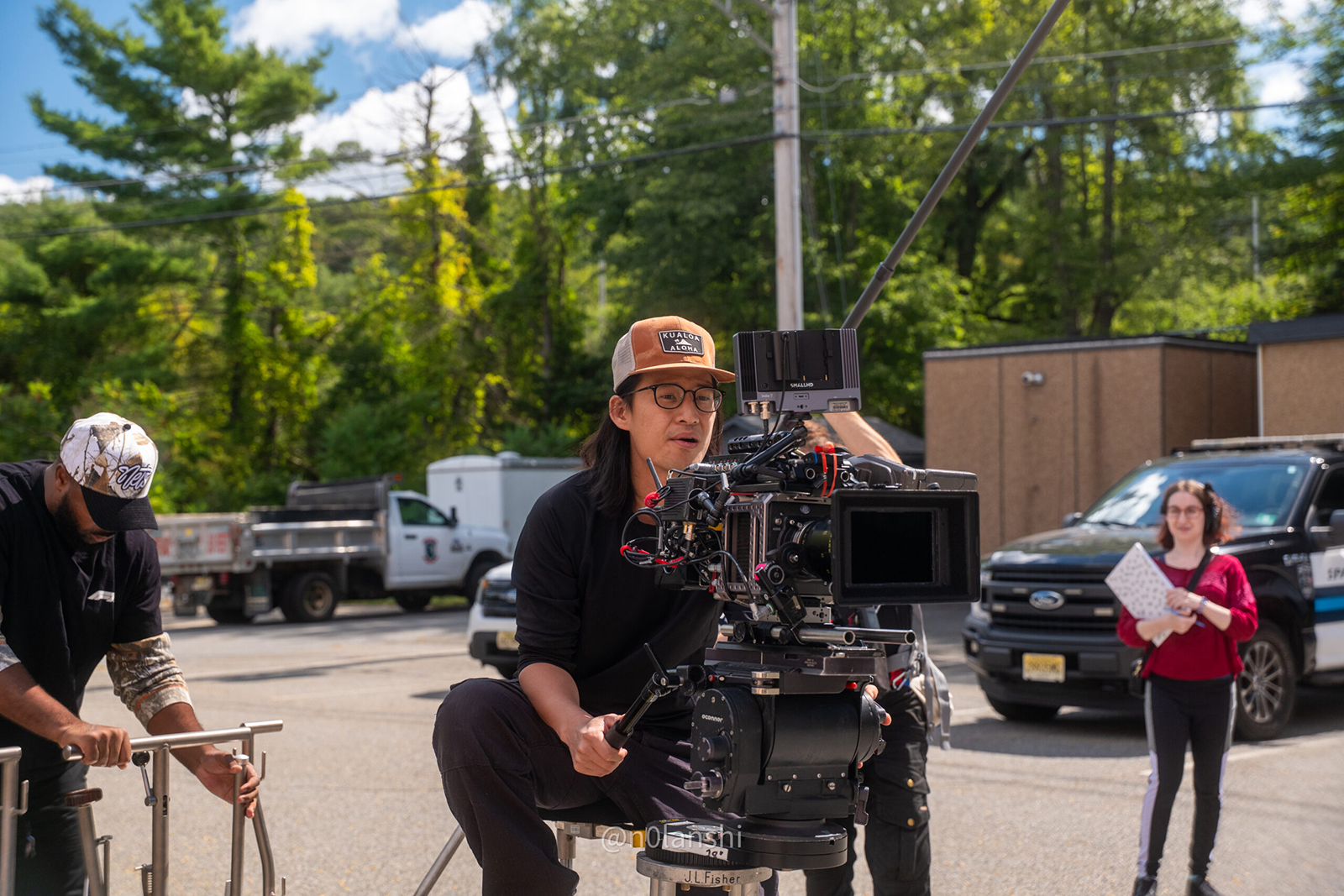
Jason Kim (BS ’13, media and cinema studies) is a director of photography and editor at Omnicom Studios in New York as well as director and executive producer of his own production company, House Productions LLC. Kim has earned numerous awards for his film work including a 2018 Telly Award for “General Branding” and a 2022 Webby Award for Advertising, Media & PR, “Best Use of Animation or Motion Graphics.” Learn more about this College of Media alum whose work is shaping the future of storytelling across film, advertising, and digital media.

Jason Kim

1. What first drew you to filmmaking and production, and how did that evolve into starting your own company, House Productions?

It’s difficult to pinpoint any one moment in time that drew me into filmmaking except for when I saw Taxi Driver, directed by Martin Scorsese and written by Paul Schrader. The inverse relationship between hero and circumstance—its anti-hero arc—showed me anything was possible in storytelling. I pursued being an artist through the medium of film ever since. House Productions allows me to hone my storytelling practice, learning, experimenting, and growing as a filmmaker. Today, House Productions produces high quality corporate videos and films I write and direct, including my latest project, Selfless.

2. Winning awards like the Telly and Webby, among others, is a huge accomplishment. Is there one project that felt especially meaningful to you?

The one project that has special meaning to me is working with the government to produce, write, direct, and edit a documentary series on the Stonewall National Monument, which helped pave the way for the gay rights movement. It’s not the most entertaining documentary but I learned a lot, and producing a document that recollects a period of time in Greenwich Village, Manhattan, is special to me.

Watch the 15-part series:

3. What advice would you give to students who want to break into directing or production but don’t know where to start?

Directing and producing are two separate paths. The best way to break into producing and production is to gain experience on set wherever you are and move to a bigger production market as soon as possible. Working with more experienced and nuanced crews, getting hands-on experience with the minutiae of filmmaking, and administrating complex paperwork is the name of the game.

As the adage goes, there is no one way to directing. Everyone has their own unique story and journey to how they come to directing. The best way to start is just to start. Get your hands on a script or write one. Find friends who will act and crew for you. Every project I’ve directed has included a learning curve, creative risk-taking, and a financial commitment. Not every project will feel true or significant. Moving past doubt, problem-solving limitations, and exercising curiosity are the first steps to directing.

Jason Kim at table

4. The media landscape is constantly changing—how do you keep your work both current and true to your vision?

The media landscape is more turbulent than ever, especially with the consolidation of traditional media companies with data-driven companies. Media production is under disruption from AI generation, with film projection being made especially vulnerable.

Disruption will have matured when AI artists can tell equally visually compelling stories—replicating the work of filmmakers, artists, craftspeople, and designers, as well as the human emotion and camaraderie in front of and behind the camera. Even still, if the art, intent, and motivations are pure, then I believe that work will have currency and truth.

5. What’s one dream project you’d love to direct or produce in the future?

My dream project is an indie sci-fi retro-noir that investigates the existence of hope in an Orwellian society. The goal is to receive a small working production budget to create something beautiful, meaningful, and artistic to satisfy the tastes of arthouse cinephiles as well as mainstream audiences. As film is a business, I have no delusion that a director must be profitable in their artistry to continue to practice directing. I believe a sci-fi genre within a low budget independent film context has the potential to break the ceiling and achieve commercial and artistic appeal. Complex VFX will be eschewed, instead of relying on ornate set design, practical effects, costumes, and locations for world-building. Then, the story itself will be the determinant of its success.

Another dream project of mine is to create a documentary on the early phases of the Internet developed at ILLINOIS through the ILLIAC computer and PLATO network. Researching the history of these emerging communication systems as a media and cinema studies major was the highlight of my time on campus. I would love to dive deeper into these early networks’ role in shaping society as we know it today, from the maturation of social networks to the advent of artificial intelligence. To premiere this document that encompasses the past, present, and future of digital communication would be a dream.

Share on social

Professor Brant Houston to be honored at Investigative Reporters & Editors 50th anniversary gala


Brant Houston at the IRE gala

Update 9/19/2025:

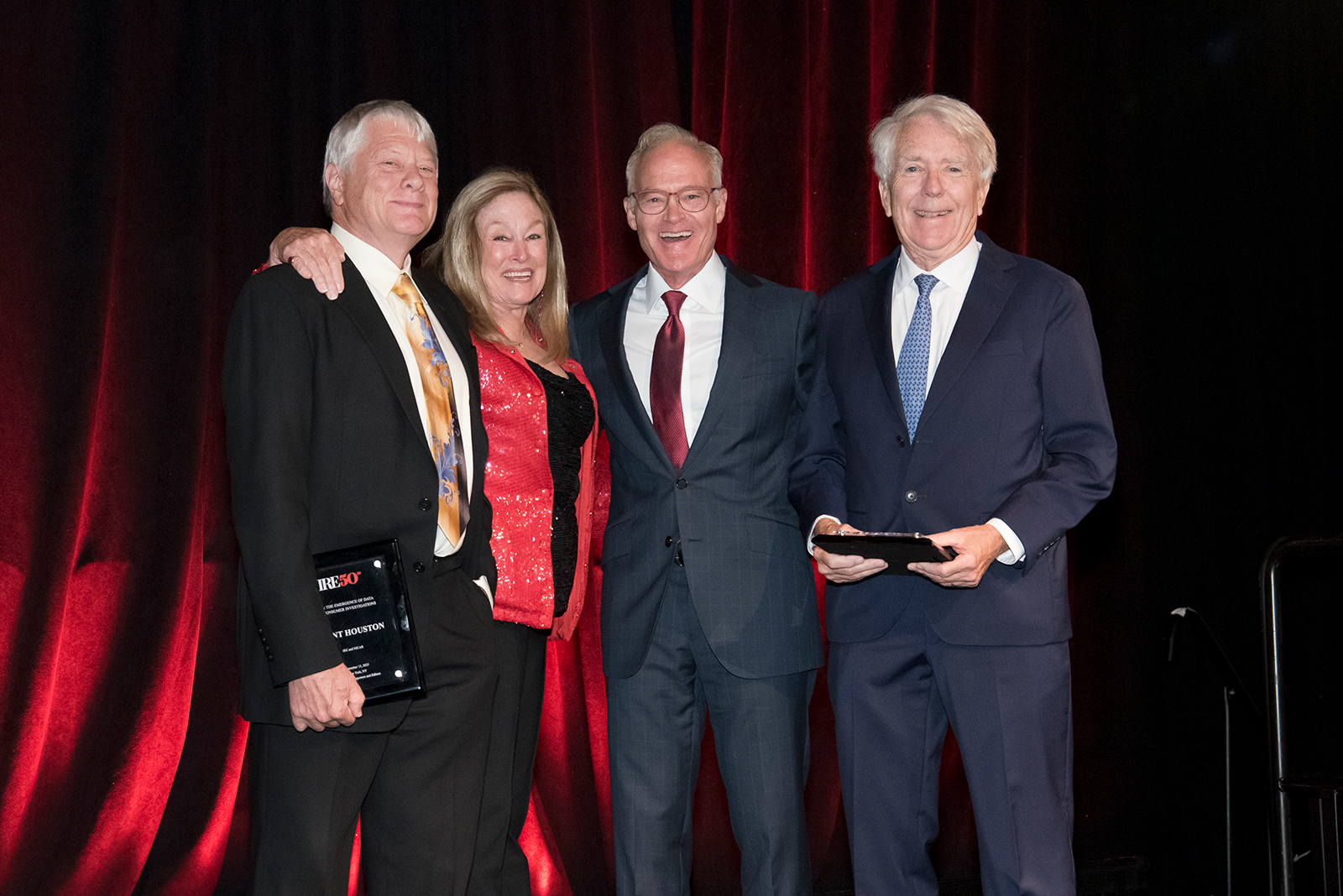
Pictured above: Professor Brant Houston, left, is honored with awardees Lea Thompson and James B. Steele (far right), with host Scott Pelley, correspondent for 60 Minutes. (Photo by Nathalie Schueller.) The Investigative Reporters and Editors 50th Anniversary Gala raised $1.5 million for journalism training.

See more photos from the event.


Brant Houston, Knight Chair Professor in Investigative and Enterprise Reporting in the Department of Journalism, will be honored at the Investigative Reporters & Editors 50th Anniversary Gala on Monday, Sept. 15, in New York City.

Brant Houston

The event, which also serves as a fundraiser and live auction, recognizes journalists representing milestones from each decade since the organization’s founding in 1975. Co-chairs of the event are Paul Sagan, chair of ProPublica; AG Sulzberger, publisher of The New York Times; and Judy Woodruff, senior correspondent at PBS NewsHour. 

Houston will be honored for his impact on the industry during the 1980s, for his contributions to “The Emergence of Data and Consumer Investigations.” The other honorees in his category include James B. Steele of The Philadelphia Inquirer, Time, and Vanity Fair; and Lea Thompson of NBC News and WRC-TV in Washington, D.C.

Houston served as the executive director of Investigative Reporters and Editors from 1997 to 2007.

He co-founded the Global Investigative Journalism Network in 2003 and serves as chair of its board of directors; he also co-founded the Institute for Nonprofit News in 2009. 

Houston currently oversees the online newsroom at Illinois, CU-CitizenAccess.org, which serves as a lab for digital innovation and data journalism. 

“These stars of journalism, who all received training at IRE, exemplify the power and future of journalism, the very foundation of democracy,” said IRE executive director Diana Fuentes.

The gala will also feature Michael Keaton, acclaimed actor, director, and press freedom advocate, accepting IRE’s first Champion of Investigative Journalism Award, recognizing his spot-on portrayal of journalists and steadfast support for a free press.

IRE, a grassroots nonprofit organization dedicated to improving the quality of investigative reporting, was formed to create a forum in which journalists throughout the world could help each other by sharing story ideas, newsgathering techniques, and news sources.

Share on social

Journalism student Nathan Gonzalez chosen for New York Times Corps


Nathan Army aircraft

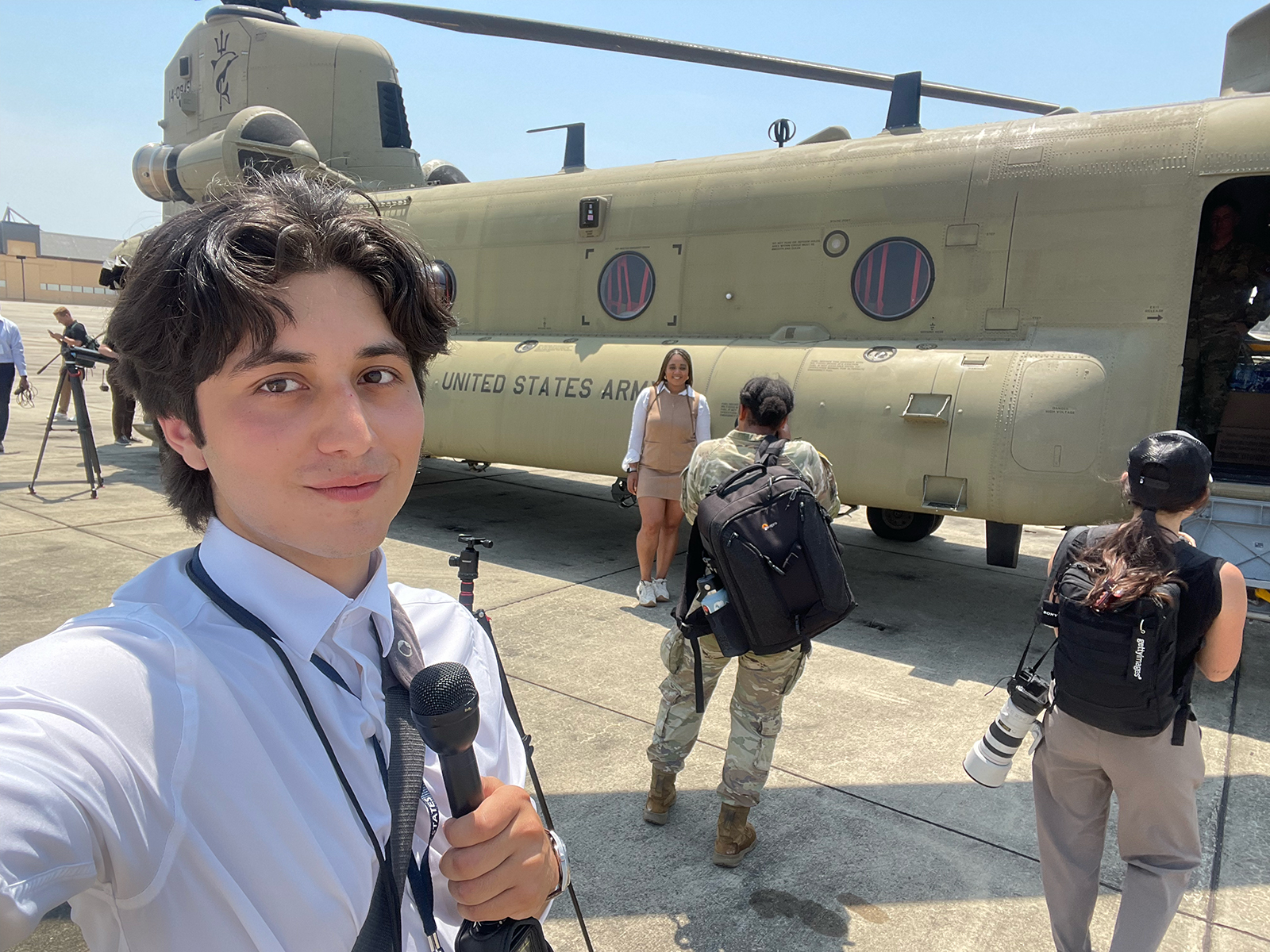
Nathan Gonzalez, a junior in journalism, was one of 19 undergraduate students nationwide chosen to join The New York Times Corps, the newsroom’s talent-mentorship program for aspiring journalists.

Gonzalez will be paired with NYT Pentagaon reporter John Ismay, receiving career guidance and professional development sessions until he graduates. After completing the program, Gonzalez will have the opportunity to visit the New York Times newsroom to learn from other journalists in person. 

Gonzalez recently wrapped up a summer internship for FOX News at the Washington, D.C., Bureau, producing coverage of protests, U.S. District Court cases, Senate and House committee hearings, live shots, interviews, and press conferences with members of Congress.

Some of the content he produced aired on shows like Fox News LiveThe Big Weekend ShowThe StoryAmerica ReportsAmerica’s NewsroomSpecial Report with Bret Baier, and The Will Cain Show.

Since its launch in 2022, the Times Corps has offered mentors to 80 undergraduates who demonstrated a commitment to the field of journalism. The best-performing corps members are considered for The New York Times Fellowship, a yearlong work program, and other journalistic opportunities.

Share on social

Media students gain unique, real-world experience through summer internships


From working on film production crews and meeting famous actors to interviewing congressmen on Capitol Hill, several College of Media students ended their summers on a high note after wrapping up internships that offered memorable learning opportunities.

Francisco Albarran

Francisco Albarran (MACS), Film Production Intern, Chili Finger

When media and cinema studies senior Francisco Albarran heard Chili Finger—a new film starring John Goodman, Judy Greer, Sean Astin, and Bryan Cranston—was filming nearby this summer, he took a chance and emailed Rantoul-based Flyover Film Studios, asking if he could help out.

To his surprise, the words “perfect timing” quickly appeared in his inbox and the very next day, Albarran was on set, helping build scenes and soaking in hands-on production experience at locations across central Illinois.

In his second week of the internship, Albarran got a surreal assignment: pick up Bryan Cranston (Breaking Bad) from his rental house in Champaign. The next day, Albarran was in his driveway, watching with awe as the garage door slowly opened revealing one of his all-time favorite actors.

“It looked so amazing. It looked like Walter White [the character Cranston played in Breaking Bad] was actually right there in front of my eyes, which basically he was,” Albarran said.

During the 20-minute drive, the two shared a conversation about the Chili Finger production, life in general, and Albarran’s own film aspirations. Albarran asked Cranston to sign a plank of wood he had saved from the film set as a souvenir. The message read: “Francisco, thanks for the ride, my friend, Bryan Cranston.

“One week you have dirty laundry in the back of your car, and then the next you have an Emmy Award-winning [actor],” Albarran mused.

Albarran said meeting Cranston and working alongside the film crew, as well as working with his MACS 480 classmates, helped reinvigorate his passion for storytelling and filmmaking. He hopes to write, direct, and act in a short film this year.

Nathan Gonzalez (Journalism), Assignment Desk Intern, FOX News Channel at the Washington, D.C., Bureau

Nathan Gonzalez

As an assignment desk intern for FOX News at the Washington, D.C. Bureau, Nathan Gonzalez, a junior in journalism, produced coverage of protests, U.S. District Court cases, Senate and House committee hearings, live shots, interviews, and press conferences with members of Congress.

Some of the content he produced even aired on shows like Fox News Live, The Big Weekend Show, The Story, America Reports, America’s Newsroom, Special Report with Bret Baier, and The Will Cain Show.

“That was a huge moment,” Gonzalez said. “It reassured me that even as a rising junior, I’m capable of producing content that meets national standards.”

Gonzalez learned how national political reporting is structured, the importance of fostering relationships with fellow reporters, and that national and local reporting aren’t as different as they seem.

“While national outlets have far more resources, the core skills—approaching officials and asking questions—apply at every level. If you can interview municipal officials, you can press congressmen on Capitol Hill, without a doubt,” Gonzalez said.

Jonathan Mathew (Journalism), Entertainment Promotions Intern, Chicago Dogs

Jonathan Mathew

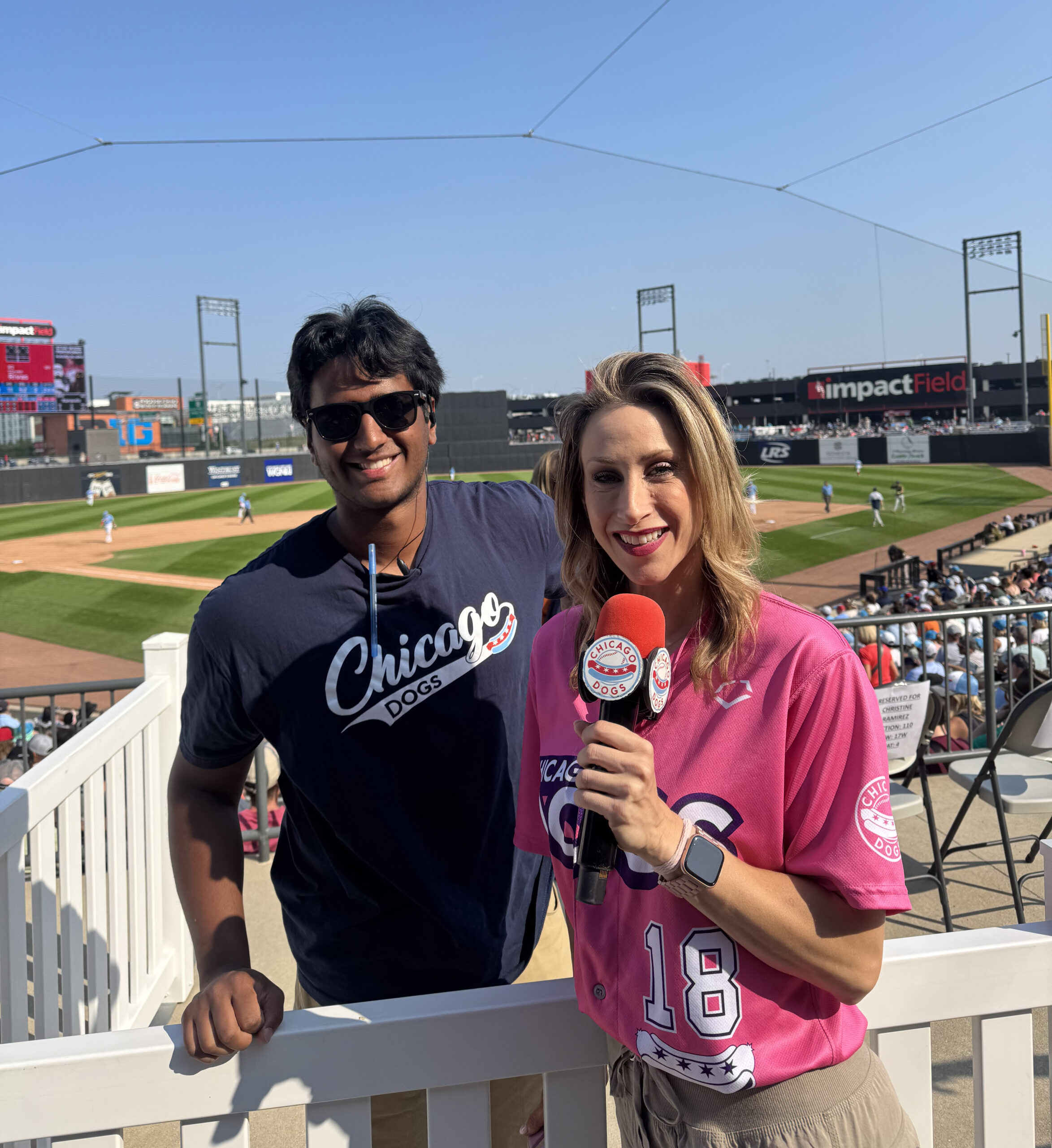
Whether he was working in the team store, ushering VIPs, overseeing the team’s Kid Zone, or dressed up as “Squeeze” the mustard mascot, Jonathan Mathew, a junior in journalism, had a great experience as an entertainment promotions intern with the Chicago Dogs baseball team this summer.   

Mathew said the opportunity to intern with the independent professional baseball team taught him a lot about sports business and entertainment, including different marketing techniques, as well as how to interact and engage with the public.

“I learned a lot of life lessons that will be valuable to me in the long run, and I am confident the return on investment I have with this internship will be more than I can imagine,” he said.

Mathew recalls one day working behind the mic as a gameday co-host tasked with entertaining the crowd between innings.

“That [is] an experience I will hold closely to my heart and have as a reminder to keep me motivated in achieving my career dream,” Mathew said.

Sarah Juan (Advertising), Social Media Content and Video Intern, Glow Recipe

Sarah Juan

Sarah Juan, a junior in advertising, went above and beyond to secure an internship at the global skin care company Glow Recipe, crafting a mock-campaign proposal highlighting a celebrity partnership. Her hard work paid off as Juan was awarded the internship as a social media content and video intern.

In her role, Juan assisted with content development, conducted market research, tracked metrics, and helped the social media team with new product launches, which was the highlight of the experience for her.

“Supporting the content team on set in NYC, I was able to work directly with models for new product launches and help direct filming for social content! Being on set was the most rewarding experience,” Juan said.

Juan recalls an important lesson her supervisor shared that will stick with her: “We’re all storytellers, no matter the industry you market in.”

“The beauty industry is tough and requires thick skin, but if you are passionate about supporting a mission through storytelling, that is what will get you far,” Juan said.

Cherie Chick (MS Advertising), Account Specialist Intern, Rakuten Advertising

Cherie Chick

Cherie Chick, an MS advertising student, applied to more than 80 positions and interviewed with eight different companies before securing an internship with her top choice, Rakuten Advertising. Rakuten provides advertising technology and consumer insights to global brands and retailers with a core focus on affiliate marketing, acting as the bridge between advertisers and publishers, including content creators, media outlets, and loyalty platforms.

Chick spent her summer in Chicago as an account specialist intern responsible for managing high-impact affiliate marketing campaigns by strategizing and negotiating publisher partnerships, optimizing creative placements to drive conversions, delivering performance insights to clients, and advising on quarterly spend strategies.

For Chick, the highlight of the internship was working with a diverse portfolio of client accounts spanning multiple countries and industries, from travel and finance to education and technology.

“This cross-regional exposure taught me how consumer behaviors, promotional calendars, and publisher relationships vary across markets,” Chick said. “For example, the way travelers research trips and the sites they interact with is entirely different from how consumers search for credit card offers or financial advisors.”

Share on social

New lecturer in advertising Penne Heede brings agency expertise to classroom


Penne Heede, a 30-year veteran in the ad industry, is looking forward to bringing her agency expertise to the classroom this fall as a new lecturer in the Charles H. Sandage Department of Advertising.

Penne Heede

Heede (MS ’23, strategic brand communication) will be teaching undergraduate and graduate classes including Advertising Design and Direction, Experiential Branding, and Creativity: Concept and Ideation.

More than three decades after Heede started her career with a technical degree in graphic design and worked her way up to creative and strategy director for an elite ad agency in Denver, Colorado, she went back to school to obtain a bachelor’s degree in interdisciplinary liberal arts.

Heede said she enjoyed the experience so much she was inspired to work towards a formal education in branding to open the door to a career in post-secondary teaching.

Heede was drawn to the strategic brand communication master’s degree Illinois offered due to its innovative focus on the science of branding.

“I loved Illinois’ program because it was a master of science [degree], not of art, and I was impressed with the mix of faculty” she said.

A few months after she graduated with a master’s degree, Heede saw the job posting for advertising lecturer at the College of Media and said, “it just read exactly what all my experiences have been.”

Heede’s teaching philosophy comes from a belief that everyone has their own personalities and way of doing things. She also tries to abide by 13th-century poet Rumi’s famous quote “to be a lamp, a lifeboat, or a ladder” for others.

“I added ‘lawnmower’ because sometimes you’re in the weeds and you just need somebody to go in front of you and make it a little bit easier,” Heede said.

Heede may align her educational approach with the beliefs of an ancient poet, but her views about the changing trends in the advertising industry are anything but archaic. 

“I’m psyched by [AI]. If you think about it, spell check was machine learning, and we all are just fine with it. Calculators were once taboo in high school math classes—now we’re okay with it,” she said. “It’s just the evolution of tools that help us.”

Heede also believes a human touch will always be needed in the industry to write, design, and uncover the motivation of consumers.

“[Asking] what inspires a person, what is their motivation towards doing things, what do they love, what do they hate—I really like that [kind of] thinking,” she said.

Heede considered similar questions for a three-year capital campaign she led, which raised $33 million for a 71-mile trail in the Denver region called the High Line Canal.

“I’m very proud of that campaign not only because it was so successful, but also because the trail is an amazing amenity for the region and it’s now protected in perpetuity,” she said.

For Heede, a good ad creates a behavior, whether it motivates someone to donate money, start recycling, or buy a chocolate bar. And sometimes, she said, a good ad will just elicit a strong emotion.

Heede, who is a huge fan of the late musician Prince, said she will never forget the full-page newspaper ad Chevrolet created after the star’s death.

Paying tribute to Prince, the ad featured a picture of a red Corvette with the epitaph: “Baby, that was much too fast. 1958-2016,” referencing lyrics from his 1982 hit, “Little Red Corvette.”

“I’m going to remember that my whole life; it was so good,” Heede said. “That’s what an ad should do. It should make you feel.”

Share on social

Media faculty and TAs make list of teachers ranked as excellent


Updated 9/22/2025 to include Summer 2025 results.

Congratulations to all the College of Media faculty and teaching assistants who were ranked as excellent by their students!

Congrats image

This list is based on Instructor and Course Evaluation System questionnaire forms completed by students during the Spring 2025 and Summer 2025 semesters. Only those instructors who distributed ICES forms at least once during this time period and who released their data for publication are included in the list. View the complete list.

Note: * denotes that the instructor ratings were outstanding.

ADVERTISING

KENT BROWN – ADV 314

*TERRY KASDAN – ADV 409

EWA MASLOWSKA – ADV 494

*SHACHAR MERON – ADV 222, ADV 333

*MICHELLE NELSON – ADV 582, ADV 590

*MARISA PEACOCK – ADV 290, ADV 498

CHARLOTTE PELOQUIN – ADV 290

LEONA YI-FAN SU – ADV 492

KEVIN WISE – ADV 483

MEDIA

CL COLE – MDIA 590

JOURNALISM

*CHRISTOPHER BALL – JOUR 430, JOUR 451

ALISON DAVIS – JOUR 215, JOUR 340, JOUR 440

MELITA GARZA – JOUR 310

ALEXANDRE GONÇALVES – JOUR 102

CAROL LOMBARDI – JOUR 220

MEDIA & CINEMA STUDIES

*VICTOR FONT – MACS 371, MACS 480, MACS 481

JONATHAN KNIPP – MACS 282

JENNY OYALLON-KOLOSKI – MACS 262

STRATEGIC BRAND COMMUNICATION

EWA MASLOWSKA – SBC 505

RICH PIECZYNSKI – SBC 504

TEACHING ASSISTANTS

J. CHANG – ADV 250

C. CHICK – ADV 150

*K. COOK – ADV 250, ADV 490

A. GOODREAU – ADV 150

H. JI – ADV 250

M. KHOWAJA – ADV 250

N. OSHODI – ADV 150

S. PARK – ADV 360

R. SUN – ADV 284

T. CHEN – MACS 260

J. CINTRON – MACS 100

G. DUTRA GUEDES – MACS 100

S. GOMEZ- PEREZ – MACS 101

W. HELMKE – MACS 101

Y. HONG – MACS 100

Y. KANG – MACS 100

*G. PAXTON – MACS 100

J. ZHANG – MACS 260

N. ZHOU – MACS 101

Share on social

Associate professor of advertising Leona Yi-Fan Su selected for 2025-26 Emerging Research Leaders Academy 


Leona-Yi-Fan-Su

Leona Yi-Fan Su, associate professor of advertising and a faculty affiliate at the Institute of Communications Research, was selected by the Interdisciplinary Health Sciences Institute for the 2025-2026 Emerging Research Leaders Academy.

The ERLA allows mid-career researchers to refine their goals, make connections, and develop skills to strategically lead collaborative, multi-investigator research teams, and pursue center-level or large-scale, collaborative research funding.

Su, who was one of 15 Illinois researchers chosen for this year’s cohort, engages in a range of interdisciplinary and collaborative research projects on science and health issues.

Her key research areas include studies on social norms, humor, incivility, social media, engagement metrics, virtual assistants, big data, machine learning, brand communication, science communication, health communication, and environmental communication.

ERLA candidates are nominated by a dean, department head, or director, and evaluated by a campuswide selection committee. Factors such as their commitment to the program, future leadership potential, and how their participation will benefit their career as well as that of the Illinois research enterprise, are all considered before the final selection is made.

Throughout the Fall 2025 and Spring 2026 semesters, ERLA members will engage in reflection and personal assessment, clarify their vision and goals, and develop five-year action plans that they will present at the ERLA graduation in April 2026.

Share on social

Journalism alum, ocean expert Annie Crawley wins 2025 Illini Comeback Award


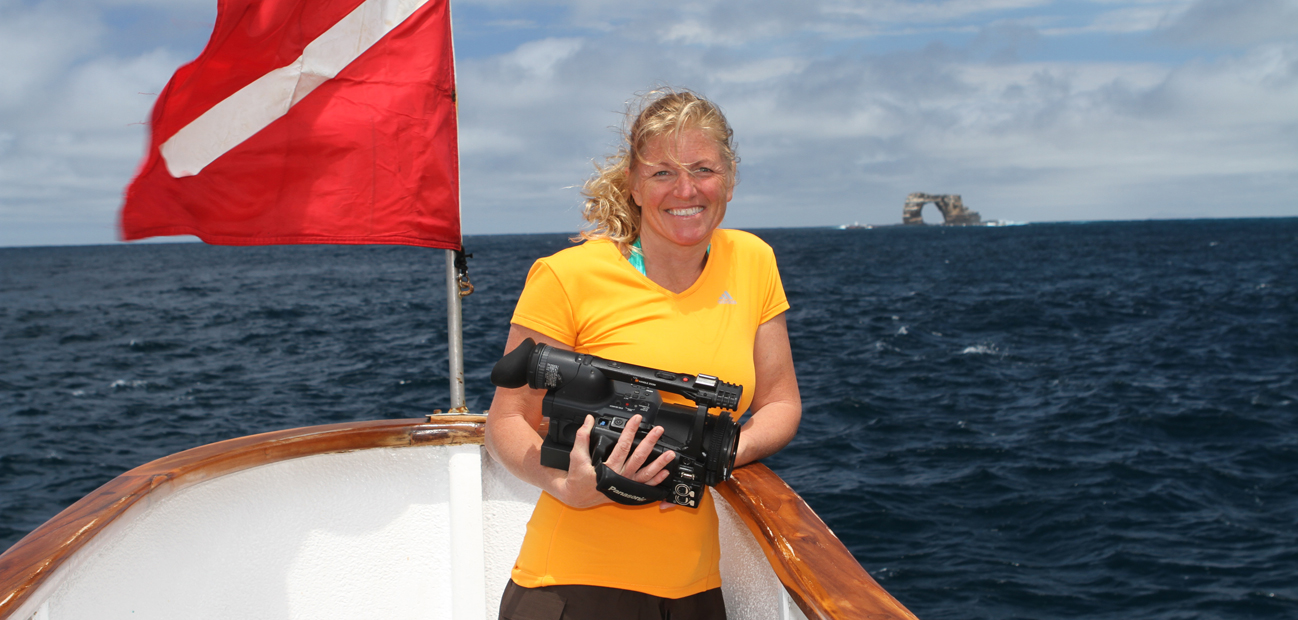
Annie Crawley (BS ’90, journalism) was one of two recipients to win the University of Illinois Alumni Association’s 2025 Illini Comeback Award.

Annie Crawley

Crawley, a.k.a. “Ocean Annie,” is a pioneering underwater filmmaker, environmental photojournalist, author, and ocean advocate whose career spans more than three decades.  

She has become a driving force for ocean literacy, exploration and conservation through immersive storytelling and education. She founded “Dive Into Your Imagination”—a series of award-winning illustrated books and award-winning DVDs that have reached global audiences, inspiring millions to care for and become a voice for oceans.

The College of Media is hosting a special screening of Crawley’s film The Island of the Shark, Guardians of Malpelo, followed by a Q&A with Crawley on Wednesday, Sept. 24, at 4:30 p.m. at Spurlock Musem. The event is free and open to the public. Participants may also join by registering for the Zoom link.

Crawley’s recent work includes ocean-themed visual compositions for symphonies with renowned composer Stella Sung—merging science, music, and art to spotlight noise, chemical, and sound pollution. Her latest documentary, The Island of the Shark: Guardians of Malpelo, highlights shark conservation and the fight against illegal fishing in Colombia.

As a columnist for Scuba Diving Magazine and an in-demand speaker, Crawley challenges us to dive deeper—to hear the ocean’s story and recognize the role we all play in the ocean’s future.

Since 1980, when the Illini Comeback Award was established, the UIAA has invited prominent and accomplished alumni back to the campus to participate in various activities during Homecoming Weekend.

Honorees are provided opportunities to interact with current students and share information about their professional experiences and the value of their University of Illinois education.

UIAA Alumni Awards will be presented in conjunction with Homecoming Week, September 21-27.

Read more about Annie Crawley.

Read more about UIAA’s 2025 Alumni Awards.

Share on social
College of Media
119 Gregory Hall
810 S. Wright St.
Urbana, IL 61801
217-333-2350